Successful Blog

  • Home
  • Community
  • About
  • Author Guidelines
  • Liz’s Book
  • Stay Tuned

Hierarchy of Influence: Matching Your Actions to Expected Reactions

January 10, 2012 by Liz

Redux: I wrote this post in Feb. 2011. Based on recent conversation, it seems even more relevant now and so I choose to pick it up, add some clarity and publish a newer version this week.

Not Every Attempt Gets the Expected Outcome

cooltext443794242_influence

When our son was barely five years old, he was a shy child who lived by his own timetable. He had his own ways of doing things. If you wanted his attention, your best bet was to make eye contact and simply explain what you what you had to say.

It was during that year, that his grandparents came to visit us in Austin. Together as a family, we planned several outings to enjoy the city and our favorite restaurants. One evening, the whole group was getting ready to go dinner and our son was still playing — not getting ready. This circumstance stressed out three of four adults in his company. Suddenly one, then two, then all three of them were using loud firm voices to tell a child, half their size, to “Get upstairs to change in to clean clothes, immediately!!”

The child froze like a deer in the headlights.

The mom in me responded with like to like. In firm and loud voice, I said, “Who are you to gang up on a little kid like that? Get away from here!”

The three adults moved into the kitchen and spoke quietly to each other.
I took the little boy by the hand. “I said let’s go upstairs and find what you’ll wear to dinner.”

When we came downstairs ready to go to dinner, I walked into the kitchen and apologized for my outburst. In return I got three calm apologies that also said I was right to intervene on the child’s behalf.

Not every attempt at influence gets the outcome we’re going for.

Which Actions Achieve the Outcomes You Seek?

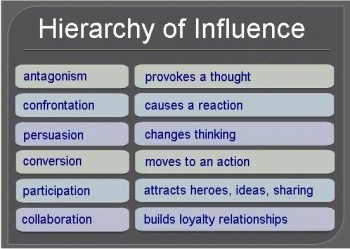
If we can agree that influence is some word or deed that changes behavior. Then plenty of influence occurred in the story I just related. I suspect that had I been privy to the whole scene in the kitchen I would have found that that single story included examples of confrontation, persuasion, conversion, participation, and collaboration. The only thing missing in this family scene would be true antagonism. Six different approaches to influence which lead to entirely different outcomes.

I’ve been reading about, thinking about, and talking to people about influence for months, because influence and trust are integral understanding to loyalty relationships. Let’s take a look at six of the usual forms of influence and the outcomes that result from them.

  1. Antagonism – provokes thought Your values are everything I believe is wrong with the world. You can’t stomach anything that I stand for. We are not competitors. We are enemies at war. Your words and actions might provoke thoughts and deeds, but what I’m thinking is how wrong you are, how to thwart you, or if I have no power, how to hide my true thoughts and feelings. An order from an enemy can influence a behavior but won’t change my thinking.
  2. Confrontation – causes a reaction You say it’s black. I know it’s white. I respond in some way — I fight back. I run away. I consciously ignore you. My response will probably change based who is more powerful. You might overpower me. I might stop responding, but it’s unlikely that you will actually change my thinking. Confrontation leads people to build a defense, to strengthen their own arguments.
  3. Persuasion – changes thinking You look at me and think about how what you want might benefit me. Rather than telling me, you show me how easy, fast, or meaningful it is go along with you. You’ve changed my about what you’re doing. I now see your actions from a new point of view.
  4. Conversion – moves to an action Your invitation to action is so convincing and beneficial to my own goals that I do what you ask. You’ve influenced my behavior to meet your goal. You have won my trust and commitment to an action. It’s not certain I’ll stay converted.
  5. Participation – attracts heroes, ideas, and sharing You reach out with conversation. We find that we are intrigued by the same ideas, believe in the same values, and share the same goals. Your investment in the relationship builds my trust and return investment. You invite me to join you in something you’re building. My limited participation raises my investment, gives me a feeling of partial ownership, and moves me to talk about you, your goals, and what we’re doing together.
  6. Collaboration – builds loyalty relationships We develop a working relationship in which you rely on my viewpoint. We share ideas and align our goals to build something together that we can’t build alone. You believe in my value to your project. I believe in the value of what you’re building. You have gained my loyalty and commitment. I feel a partnership that leads me to protect and evangelize the joint venture. I bring my friends to help.
Strauss_Hierarchy_of_Influence
Strauss Hierarchy of Influence

Not every campaign or customer situation will need to move to collaboration. But understanding each level will help us manage expectations allowing us to move naturally and predictably from confrontation to persuasion, so that we don’t expect the loyalty of collaboration from a momentary conversion.

Could be useful when looking to connect with that special valentine too.

How might you use the hierarchy to change the way you manage your business, your event, your community, and your new business initiatives?

–ME “Liz” Strauss
Work with Liz on your business!!

Buy the Insider’s Guide to Online Conversation.

Filed Under: Community, Marketing /Sales / Social Media, Successful Blog Tagged With: bc, influence, LinkedIn, relationships

Be Effortlessly Cool in Your Red Shoes and Own Your Own Life

January 9, 2012 by Liz

The Red Shoe Tragedy

cooltext443794242_influence

The rules, values, and ideas we learned growing up served us in those situations and settings. Some of those rules, values and ideas are universal to humanity, but others were built from the goals people who . Yet we often keep living by those rules long after we’ve left the group, society, or culture from which they came. We still use rules from grade school peer groups to define ourselves and make decisions as adults. The values, rules, and ideas imprint deeper and last longer than the channels for which they were developed to build, serve, and protect.

In my high school, it was a social and a fashion faux pas to EVER wear red shoes. Yet my friends who went to a Chicago high school had never heard of that “law.” It was stunning and amazing that these attractive, fun, funny, intelligent kids could live so effortlessly cool wearing red shoes whenever they wanted. It took outright clear thinking on my part to choose to set aside that rule — The tragedy was that it didn’t occur to me to stop following the red shoe rules until long after high school, long after it was even a remotely useful rule.

In every group, society, and culture that we belong, we use rules, values, and ideas to identify ourselves as members of the group, align our goals and define our roles. We use those rules, values, and ideas to attract like-minded thinkers and to channel our energy in the useful directions. But no single set of rules, values and ideas carries over completely to the next universe of people.

In increments we’ve learned to look outside us — to our parents, teachers, friends, bosses — for answers for the keys to navigate those elusive rules, values, and ideas that define good behavior and outline the clearest path to our success. What meet instead is other people who have also learned to look outside themselves.

The rules, values and ideas we collect over time grow and gather. Each one we add comes from someone else. We keep adding in more to those we’ve picked up and combine them in our own ways to make our own sense. The rules, values and ideas don’t leave our minds when we move on with our lives.

Rules, values, and ideas are like people in the way that few will fit us well-enough to earn the place of a life-long friend.

Who built the rules, values, and ideas that fuel the decisions you make?
If you haven’t named the values, rules, and ideas that are your friends for life, fair chance the answer is: not you.

Every new teacher, location, clan, situation, culture, corporation, church, organization, school, or troop offers new rules, ideas, and values slightly different from the last. Yet no person, group, or association has to live one moment of your life.

Think about that.

It’s your life.
No one has walked a mile in your shoes.
No one knows what you wish in the middle of the night.

Choose your values.
Make your rules.
Have your own ideas.
Be effortlessly cool in your red shoes.
Be your own unique value proposition.
Live your own life.

Are you ready to move the useless rules out of your head and get to a new sort of productive?

Be irresistible.
–ME “Liz” Strauss
Work with Liz on your business!!

Buy the Insider’s Guide to Online Conversation.

Filed Under: Motivation, Personal Branding, Successful Blog Tagged With: bc, LinkedIn, personal-identity, rules

Thanks to Week 325 SOBs

January 7, 2012 by Liz

muddy teal strip A

Successful and Outstanding Bloggers

Let me introduce the bloggers
who have earned this official badge of achievement,

Purple SOB Button Original SOB Button Red SOB Button Purple and Blue SOB Button
and the right to call themselves
Successful Blog SOBs.

I invite them to take a badge home to display on their blogs.

muddy teal strip A

They take the conversation to their readers,
contribute great ideas, challenge us, make us better, and make our businesses stronger.

I thank all of our SOBs for thinking what we say is worth passing on.
Good conversation shared can only improve the blogging community.

Should anyone question this SOB button’s validity, send him or her to me. Thie award carries a “Liz said so” guarantee, is endorsed by Kings of the Hemispheres, Martin and Michael, and is backed by my brothers, Angelo and Pasquale.

deep purple strip

Want to become an SOB?

If you’re an SO-Wanna-B, you can see the whole list of SOBs and learn how to be one by visiting the SOB Hall of Fame– A-Z Directory . Click the link or visit the What IS an SOB?! page in the sidebar.

–ME “Liz” Strauss

Filed Under: SOB Business, Successful Blog Tagged With: bc, blog-promotion, SOB-Directory, SOB-Hall-of-Fame, Successful and Outstanding Blogs

6 Tips to Consider When Choosing a Payment Processor

January 6, 2012 by Liz

The Right Tools and the Right Partners

If you want your online business to be successful, you need to choose the right tools for the job and the right partners for your situation. For example, one of the decisions you’re going to need to make early on is how you want to process payments. Unless you’re going to set up a fully-functional merchant account, that means a payment processor.

Payment processors are ideal when you’re first getting started. They give you the flexibility to accept credit card payments without jumping through the technical and financial hoops a merchant account requires. However, if you don’t choose the right payment processor, you’ll wind up with just as many technical hurdles and probably a higher cost, too.

Here are some of the most important things to consider when choosing a payment processor:

1. Start with security.

If you’re going to build a reliable online business over the long haul, you need a secure payment processor. Today’s web customers are security savvy. They’ve been bombarded for years with horror stories of online transactions gone wrong.

There are two areas in which your payment processor needs to address these security needs:

  • PCI compliance. PCI compliance is the basic level of security standards required by the credit card companies. Some payment processors implement their own PCI compliance, while others use a trusted source to do so. Either way, make sure your payment processor provides that level of security.
  • Fraud prevention. There’s another aspect to payment processing security you need to have. Fraud prevention methods – the two most common being Address Verification System (AVS) and CVV (Card Verification Value) – protect both you and the consumer. These are simply ways to make sure that the person using the card really is who they claim to be.

Poor security on the part of your payment processor means more unhappy customers and more charge-backs.

2. Find payment processors that are compatible with your existing system.

Payment processor choice almost always comes at a later stage of development than shopping cart choice. What this means is that you’re limited from the get-go to choosing a payment processor who offers compatible service with your shopping cart.

While payment processor support isn’t usually a consideration when choosing your shopping cart software, it probably should be. Your choice of payment processor directly affects your bottom line. While it shouldn’t be the sole determining factor in cart choice, it should be in the mix.

3. Look at all of the fees.

Different payment processors charge different fees. It’s easy to get caught up in the per-transaction fee, but you need to look at the big picture. A company with a low set-up fee might seem ideal, but after a couple thousand transactions you’re going to have paid way too much in transaction fees.

Try to build a reasonable sales model, and plug in all of the associated costs of each payment processor over the first six months you’re in business in order to get an accurate comparison.

4. Understand support for multiple cards and currencies.

If the vast majority of your website customers are going to be located in the U.S., you don’t need to worry too much about multi-currency support. On the other hand, if you’re promoting a global product or service, you don’t want currency to be a barrier to entry for your customers. Some payment processors are only able to accept U.S. payments, so find out ahead of time what restrictions exist.

The same holds true for different types of credit cards. If you’re dealing in a high-end product or service, you want to make sure that your processor can handle American Express and probably Discover, as well as MasterCard and Visa.

5. Identify special billing needs.

Depending on your business model, you might have some special billing needs. For example, you might be offering a subscription-based service, and so you’ll need to make sure that your payment processor supports Automated Recurring Billing (ARB).
Alternatively, you might want or need the ability to process customer transactions manually via a virtual terminal. This is useful, for example, if you take telephone orders.

6. Don’t get hung up on pay out details.

Sometimes, you’re anxious to get things up and running and get revenue flowing in. More than one online business has rushed into a contract with an online payment processor because they believed they’d get paid quicker.

Over the long haul, this shouldn’t be a concern. Don’t choose a payment processor just because they make weekly (as opposed to monthly) payouts. If your business is running that close to the edge in terms of cash flow, find other ways to keep things moving, such as increasing investment capital.

Your online business is only as strong as the tools you use. Choose a payment processor that creates a smooth, secure transaction for your customers, opens up your products or services to the largest possible market, and lets you maximize profits.

—-
Image Credit: Some rights reserved by 2Tales
Author’s Bio:
Sara Schoonover is Vice President of Ticket Kick , a California company that helps drivers get red light tickets and other traffic tickets dismissed by helping drivers through the trial by written declaration process.

Thank you, Sara!

Love learning this stuff!

Be irresistible!
–ME “Liz” Strauss
Work with Liz on your business!!

Buy the Insider’s Guide to Online Conversation.

Filed Under: Successful Blog, Tools Tagged With: bc, eCommerce, LinkedIn

Social Business: Past, Present, Predicting Beyond 2012

January 3, 2012 by Liz

PAST: A Brief History of Social Media

cooltext443809602_strategy

Social Media Marketing budgets are on the rise.
In 2008, I had a conversation at BlogWorldExpo with Lorelle VanFossen aka @LorelleonWP about the future of social media adoption by corporations. The basis for the conversation was my experience with the Whole Language movement — a holistic approach to interaction around information that had moved through the field of education.

The prediction I was drawing focused on four key stages that occur when a social meme moves from “first believers” to the mainstream.

Stage 1: The Community Culture and Vision Begins. Individuals come to the community through curiosity and contact with a believer. They are like-minded thinkers who see the vision, adopt the culture, join the community — they want to wear the t-shirt. They learn tools with deep interest in how and why the tools work to support the vision of the community. They learn the process, etiquette, rituals, and traditions with respect for the people who teach them as they align their goals and values and become part of the vision.

As the follower population grows, the meme moves outward from the “first believers” like rings around a stone dropped in the water.

Stage 2: Quiet Revolution Moves Outward. The ideas move out like the rings from a rock dropped into water. Spreading wider, but with less power. The new believers share their passion faster than they can learn the depths of the vision. They tell their friends how cool it is to be part of something important. Each generation further from the center gets less depth of the original vision, culture, and community. They get the vocabulary, the tools, the rules, but not the reasoning.

Stage 3: A Demographic Emerges. A critical point occurs at which the vision, culture, and community gathers a large enough following that it has become an identifiable demographic. That’s not a good or a bad thing. It’s what built great religions, great art movements, great style in architecture and fashion. It’s also what brought us Muzak, bad television, and spam.

Stage 4: Business Objectives Disrupt the Community Culture. Business establishes a reason to participate. But business comes as an entity not as individuals. They have their own vision, culture, and community. They don’t want to wear the t-shirt; they want to market to the people who do. They pick up the tools and visit the venues without changing their thinking. They will also bring organization and money. All of these will change and affect the original culture.

What dies or survives?

Present: Death and Rebirth

In her book, RenGen, Renaissance Generation, the Rise of the Cultural Consumer and What It Means to Your Business, Patricia Martin demonstrates how throughout history every rebirth of a culture is preceded by a death — the fall of Rome, the Dark Ages, the kind of changes we face today.

In a world poisoned by a century of progress at any price, it is easy to look around and believe we are in a free fall. But civilizations have cycles. The twilight moment right before one civilization ends and another emerges is often driven by cultural clashes, religious wars, polarizing viewpoints and overreaching rulers. Look around you. What you see marks the end of the end ? but also the beginning of the beginning. — RenGen

Death and rebirth? Yes.
In 2007 – 2011, when the community culture met and mixed with the corporation, neither came away unchanged.

In 3 short years, from a mildly polarized blogosphere of hobby bloggers and business bloggers emerged a group that became the social businesss-phere. An entrepreneurial and freelance culture began testing new business models where there were none. Three sorts showed up: blogging gold rushers, business pioneers, and those who watched. The evolution raced and the learning curve raised as the floor fell out under the economy. Business pioneers started playing for keeps.

At a slower, but still noticeable pace, the corporations realized the loss of their business models. Print publishing took it especially hard, responding in ways that looked a lot like Elizabeth Kubler Ross’s Five Stages of Grief — Denial, Anger, Bargaining, Depression, and Acceptance. Print publishing’s use of the term “citizen journalist” is good example. It changed from at first patronizing,, to an attempt to control and spin things, followed by public conversation by old media on how they should respond to new media, on to writing negative comments on blogs using false names, until finally they saw their advertising profits flowing out the door like so much ink on the pressroom floor — which led to sales of properties, layoffs, and new social media teams playing catch up.

So what’s working and what will be next?

The Future in a One Sentence Test

Leaders want to build something they can’t build alone.

Social media doesn’t grow a business. Strategy and service does. Great and growing companies know what business they’re in and how to take care of the people who help their business grow. Facts are that … social tools are important in the way that computers, telephones, and pencils are, but business grows the way it always did.

The companies who can’t see their customers lose my business.
The companies who use social tools, but lose at service and partnership, might count me as a friend, but I don’t buy from them.
The companies that deliver great service are growing and I love buying from them whether they’re on Twitter or not.

I say this often. I’ll say it again …

In any sentence that uses the term “social media, you should be able take out that term and replace it with “telephone,” and the sentence should still make sense.

If you want to predict where social media implementation is going in the next two years, do the sentence test. After all, there was a time once, when cutting edge businesses had only one person who had a telephone. Here’s a brief discription about the telephone as a disruptive business tool.

–ME “Liz” Strauss
Work with Liz!!
Buy the Insider’s Guide. Learn how to write so that the Internet talks back!

I’m a proud affiliate of

Teaching Sells

Filed Under: Community, Marketing /Sales / Social Media, Successful Blog Tagged With: bc, history, LinkedIn, predictions 2012, social-media

Are You Seeing the Things that Make a Difference to Your Business and Your Life?

January 2, 2012 by Liz

1200x1200--GeniusShared ReadWhere Do You Focus Your Vision?


Take a 60-second look at this lights in this photo then try not to look back again as you answer the questions that follow it.

Now look at this while space for a while as you scroll down to a few questions about what you saw.

Where do you focus your vision? What’s important in your business and your life?

Are You Seeing the Things that Make a Difference to Your Business and Your Life?

Everyday we interact with a world of information that has potential for adding something to our our business, our brand, and our life. But the ways our brains work, the way we jealously guard our time time, we as easily overlook what we’re seeing as finding the fuel and the data that might …

  • to make our work and our lives easier … It’s not that we’re not thoughtful enough to find easier ways. It’s that we’ve forgotten to take time to reflect and think while we keep up our breakneck pace, racing through time to beat a clock that would work for us if took the time to look.
  • make our work and our lives simpler … It’s not that we’re in love with the complicate and difficult. It’s that we’ve come to believe that balance is adding more and more things to juggle without stopping to sort which really deserve our time.
  • make our work and our lives more meaningful and inspired … It’s not that we’re without mission or purpose. It’s that we’ve let our heads get disconnected from our hearts, setting that inspiration at a lower priority, not letting our aspirations fuel our businesses and our lives.

And those those thoughts, those beliefs change our world by changing what we see and how we respond it.

So answer me this, when you saw photo above, did you see …

  • the three lights up front that look like stars and the fourth that did not?
  • the light in the window of the building next door?
  • the trees along the harbor?
  • the reflections in the water?
  • the way the water changes color?
  • the yellow in the sky?
  • the red light under the clouds on the horizon?

Think for a minute about what you saw and what you missed. Were looking with your heart or with your head? Or did you hardly even look?

I started taking photos of the harbor so that I would remember to look. After months of pictures what I’ve found is that the harbor never looks exactly the same twice. The light and color from the sky add mood and flavor. They communicate about the weather that is and the weather is coming. They communicate about my connection to it. And that communication has unlimited power to open my eyes, open my mind, open my heart to what inspires me to what’s important in my business and my life.

Did you believe that you didn’t have time to really look? It’s not just the beautiful harbor. It’s the clouds and colors in the sky that change one day to the next.

It’s not just the “what” of the bar graph. It’s the people behind it that tell you the “why.”
It’s in the looking that we find the nuance, the detail, and the color that inform a business, a brand, and a life. Understand those and your work and your life will become easier, simpler, and more meaningful.

Are you seeing the things that make a difference to your business and your life?

Be irresistible.
–ME “Liz” Strauss

Filed Under: Successful Blog Tagged With: bc, information, LinkedIn, vision

  • « Previous Page
  • 1
  • …
  • 31
  • 32
  • 33
  • 34
  • 35
  • …
  • 707
  • Next Page »

Recently Updated Posts

Is Your Brand Fan Friendly?

How to Improve Your Freelancing Productivity

How to Leverage Live Streaming for Content Marketing

10 Key Customer Experience Design Factors to Consider

How to Use a Lead Generation Item on Facebook

How to Become a Better Storyteller


From Liz Strauss & GeniusShared Press

  • What IS an SOB?!
  • SOB A-Z Directory
  • Letting Liz Be

© 2025 ME Strauss & GeniusShared