Successful Blog

  • Home
  • Community
  • About
  • Author Guidelines
  • Liz’s Book
  • Stay Tuned

How Do You Recognize and Attract Heroes and Champions for Your Brand?

October 19, 2010 by Liz

(Updated in 2020)

Photo by Christina @ wocintechchat.com on Unsplash

10-Point Plan: Enlisting Heroes and Champions

Those Who Are Waiting to Lead

Finding the heroes and champions who already love what you do. It seems every time I give a presentation about growing business and social business a few CEOs and business owners find me to talk. They want to know to get started raising a barn — a vibrant internal community of fans focused on growing their business — rather than building a coliseum — a huge endeavor that employees work on for them. They want to use social tools to connect all of the people — employees, vendors, partners, and customers — who might have ideas and insights that will help their business thrive.

The first question is how to find and attract those heroes and champions.

How Does a Business Identify Heroes and Champions?

Last week, I wrote about assessing and benchmarking the community with two informal tools that allow people to offer their opinions on the state of things. The second tool, a sociogram, is often used in education settings to determine social networks and influencer hierarchies. It’s a gem of a tool for finding out who already has influence within a group.

To find the heroes and champions of the change toward a stronger community look to the sociogram to find the people who were chosen most often as

  • people others would ask to teach them something new. (training stars)
  • people others would invite to attend or a gathering of your friends. (social stars)
  • people others would ask to offer you a recommendation on the quality of their work. (leadership stars)
  • people others would ask to to do all three. (influence stars)
  • Identify and enlist a core team of champions to lead the quest.

It easy to see how these four groups, particularly the last would be the people that your team and your community look to for answers, advice, and how to evaluate and navigate change.

So it follows naturally that the people who scored highest in these groups might be the first team of heroes and champions that we bring together to talk about the brand values they believe in and those that are the new mission.

Look for the Leaders You Already Know

Attracting and enlisting these heroes can be natural and easy if we really are set on raising on barn, not building a coliseum. We lay out the vision clearly, explaining the goal and the rewards of getting to it.

We’re going to build a business that will make work easier, faster, and more meaningful for us and the people who work with us. AND We’ll do it by aligning our goals and building something that none of us could ever build alone.

Are you in? What skills do each of you bring? What are the minimum processes and rules we need to keep honest, respectful communication? What problems do you see? How might we solve them before they begin? How can we best bring this message back to the rest of the team?

Yet people can respond to a clear vision for many reasons. Some are drawn to the work. Some come for personal reasons. Some come to build something they can’t build alone. Some may come because they seek approval and attention.

Look for those who show leadership qualities of their own.

  • Competence and core values – champions who love your business understand what moves the business you’re in. They add insight into how to bring the vision to life. They have integrity, are trustworthy, and respect others. They are examples of intelligence and heart.
  • Positive energy – heroes and champions bring out the best in others. They have the energy to invest in big ideas with a spirit of inclusion, gratitude, and generosity. Curiosity fuels their solutions, inviting ideas from all sources.
  • Strength of character– leaders who can carry a vision have a strength of conviction, no matter the power of their role or position.

Before you try to create brand evangelists why not reach out the ones you already know? As you look for the people you would call heroes and champions, you’ll find they’re connected to others who are much like themselves. Invite just a few to a meeting and begin planning a barn together.

How do you recognize the brand evangelists you already know?

Related
To follow the entire series: Liz Strauss – Inside-Out Thinking to Building a Solid Business, see the Successful Series Page.

Be Irresistible.

–ME “Liz” Strauss

Filed Under: Business Life, Community, Successful Blog Tagged With: branding, champions, Community, heroes, leadership, LinkedIn, strategy 10-Point Plan

How Do You Know When Quitting that Quest Is a Good Idea?

October 18, 2010 by Liz

It’s Something Like Business Infatuation

cooltext443809602_strategy

I just spent an hour working on art for a blog post that I couldn’t write. The concept was too hard, to convoluted and too stupid to deserve the time and space it would take to explain it. It didn’t deserve a diagram. It didn’t even deserve a blog post.

I’ve done that before. It happens when I get too involved with my own ideas and lose sight of the people I’m writing for. Lucky for me, I recognize the symptoms sooner and sooner each time.

Most of them have to do with working too hard to make something work right.

How to Know When to Quit

It happens with ideas, with projects, and with relationships. We get started on something small or something big. Somewhere along the line infatuation sets in. We’re inspired with a foolish or extravagant love for some part of it.

It may be that we’ve discovered a little known fact that’s fascinating to think about.

Why your friends will always have more friends that you do.

It may be the most musical sentence we’ve ever written, that doesn’t fit inside any paragraph of what we’re writing now.


When I give my soul room to breathe, everyone I know gets nicer.

It may be the person, the career, or the company that immediately caught our attention and got us thinking new thoughts. It may be the project or idea we just thought up that moved us to get to doing our most outstanding work.

Whichever it is that has captured our inspired commitment to work at some point, when things stop working, we don’t want to believe we were wrong. Rather than recognizing the problem, we keep fighting to make it right again. We unconsciously find ourselves committed to a failing course. It’s an emotional response. It’s irrational and time wasting at best. Costly at worst.

When we’re on a quest, we’re emotionally involved. Emotions filter judgment and skew our evaluations. They build cognitive bias which reinforces our beliefs and often clouds the truth. How do you know when to give it up? Here are questions you might ask to figure out if you’re working too hard to make something work.

  • Do you find yourself moving things around more than you’re moving things forward? Measure the time and effort you’re spending compared to similar situations.
  • Do you find that you’re talking more about how things could / should / might work than talking about the work itself? Talking about behavior and process is not the same as talking about the work.
  • Do you find that you’re spending time rewriting or reworking all around one detail, one person, one idea that you love? When a detail becomes more important than the work, stop to remind yourself of your goal.
  • When you try to explain to others what’s holding you up, do they suggest that you lose the exact piece that you care about most? Do you hear yourself arguing for the problem rather than looking for a solution?

If you’re finding yourself saying “yes,” you might want to get some distance to find a less personal view. Imagine what the situation or the project would be like without the part or person that you have formed a personal relationship with.

Suppose you were offered the option to move that “lovely dear” to another project where he, she, or it is a far better fit? If the feeling you get in thinking of your answer is relief, then you know you’re working too hard to make things work.

How do you know when quitting your current quest is a good idea?

–ME “Liz” Strauss
Work with Liz on your business!!

Buy the Insider’s Guide to Online Conversation.

Successful-Blog is a proud affiliate of

third-tribe-marketing

Filed Under: Business Life, Motivation, Successful Blog Tagged With: bc, cognitive bias, course correction, failing, LinkedIn

How to Defuse Customer Skepticism and Cynicism

October 15, 2010 by Guest Author

A Guest Post by Scott P. Dailey

image001-jody-mcnary

Want to eliminate the healthy skepticism your customers have of you and instead be seen as a trusted servant? Terrific. Here’s what you do: don’t give them cause to be skeptical. Trust me, they’re skeptical. Real skeptical. Mark Twain once said the wisest people are also the most cynical. That’s your target audience. Cynics – every last one of them. Don’t blame them either. It’s our fault they’re that way. Years of forcing ourselves on them has created doubters of most of our potential buyers. I’m the same way and if you’re smart, so are you. Frankly, I like being skeptical and cynical. Healthy doses of both arm me to buy smarter, shop carefully, invest intelligently – in life and in business. I can sniff out a phony and I don’t hang with them. Your prospects can sniff just the same. They’re diligently watching as much for the BSer as they are the best buy. [More…]

Being honest isn’t achieved in telling the truth alone. Being honest has an end point. Be truthful. There’s a difference between being honest and behaving truthfully. Let your actions, not merely your words, speak of your truthfulness. Truthful actions have no vanishing line. They just go on and on, resonating with your audience well after you’ve stopped yapping. Make your contribution to the networking landscape count to the skeptical buyer that’s questioning your motives. If your networking efforts are fraught with hurried, self-promoting drivel, think again before inserting yourself into the fray. If you know you’re being disingenuous and let’s face it, you do know, then what are the odds we know too? Here, let me help you with this one: the odds are extremely high.

Deputize yourself.

Do your part to clean up the sales noise found in networking and prospecting circles. On or offline, the rules are the same. Mean it! Make selfless contributions to talks, meetings and mixers. Shape and guide the conversation, not your latest opt-in initiatives. If you do this well, people will want to know what you do and what you sell and never because you forced it upon them using absurdly urgent sales tactics. Authenticity is a commodity in sales, your transparent attempt to bait me is not.

Patience, Patience, Patience

Proving to prospects that you’re not full of it takes time. After all, you’re starting out with people who suspect you’re motivated by your sales goals alone and believe nothing matters more to you. So the prospect is ready for you to strike fast – while the proverbial iron is hot. Etc, etc. Blah, blah, blah. Borrrrr-iiiiiing.

Business relationships, like those you share with your spouse, partner, brother or mother, require time to develop. This is not news to us. Yet often, I see salespeople and business owners go for the quick close and forgo the opportunity to build repeat business through authentic bonding rituals. Prove you’re interested by forgetting what you sell and instead, talk with your prospect, not at him or to him. Imagine the pleasure derived from business conversations had through conversing about stuff other than your business. Ironic, right? Try it. You’ll be surprised how effective a salesperson you become the moment you stop trying to sell your stuff. Again, ironic.

Have you ever pushed too much, too far, too fast? Maybe you got this right the first and every time. How do you dispel the myths that the sales process must include a pushy pitch?

—–

Scott P. Dailey is a Web designer, copywriter and network administrator. Recently Scott launched ( http://scottpdailey.com ), his social media blog that makes connections between social networking etiquette and the prevailing human social habits that drive on and offline business engagement patterns. You can connect with Scott via Twitter at @scottpdailey.

Creative Commons License photo credit: Jody McNary Photography

Thanks, Scott!

–ME “Liz” Strauss
Work with Liz on your business!!

Buy the Insider’s Guide to Online Conversation.

Successful-Blog is a proud affiliate of

third-tribe-marketing

Filed Under: Business Life, Customer Think, Motivation, Successful Blog Tagged With: bc, Customer Think, LinkedIn, sales, Scott P. Dailey

Social Media Book List: If I’m So Smart, Where did All My Money Go and Blog Marketing

October 13, 2010 by teresa

A Weekly Series by Teresa Morrow

I’m Teresa Morrow, Founder of Key Business Partners, LLC and I work with authors by managing their book promotion and publicity. As part of my job I read a lot of books (I love to read anyway!).

This week I will be highlighting two books; one author I am currently working with ‘If I’m So Smart, Where did All My Money Go>’ by Doug Warshauer and one book on the social media Amazon list ‘Blog Marketing: The Revolutionary New Way to Increase Sales, Build Your Brand, and Get Exceptional Results’ by Jeremy Wright.

The books I discuss in the Social Media Book List Series will cover a range of topics such as social media, marketing, blogging, business, organization, career building, finance, networking, writing, self development, and inspiration.

‘If I’m So Smart, Where Did all My Money Go?’

by Doug Warshauer

Doug Warshauer's book If I'm So Smart, Where did All My Money Go?

Book Review by Kirkus Review—-
A realistic, detailed guide to planning for your financial future.

Warshauer was a small business forecaster by trade, skilled at incorporating the myriad of financial factors that make up the universe of a small company and projecting their expenses and profitability. In a burst of insight, he decided to apply those same methods on a more intimate scale. He has thus come up with an excellent set of guidelines in the hopes of ensuring a stable financial future for individuals and families.

The plan—five big steps composed of 18 smaller steps—is very sensible, and each bears Warshauer’s hallmark: accounting for the different life goals that each person or family will have. He begins by explaining how much of our net income should be saved, spent on homes and auto, and even spent on clothing. He provides a numerical guideline for each area, insisting that if spending in one category goes up, it must drop in other areas.

These short-term goals segue into long-term planning, such as the decision to save for public school versus private, and how to understand how much each family will need for retirement. These insights take the book one step deeper than the average financial-planning instructional. The book is also unique in that Warshauer presents the rules for financial success in the form of a story. Joe, one of the main protagonists, is a generic young adult who spends more than he’s earning, and thus decides to attend one of the author’s financial seminars.

Other characters include single mothers and young parents. The fiction structure is loose, basically just a tool to help the author dispense his financial rules in a way that keeps readers engaged. Naturally, the dialogue itself tends to get tedious, as seminar attendees ask dry questions about finance, but on the whole it’s more readable than a strictly nonfiction manual.

A helpful introductory guide to financial planning for singles and families looking to get the most out of their money.

About the Book*:

How do you achieve a balanced financial life and lasting wealth?

Conventional advice does not teach people how to balance conflicting demands from living expenses, credit cards bills, mortgages, college funds, and retirement investments. Finally, there is a book that does.

“If I’m So Smart, Where Did All My Money Go?” is an engaging look at ten diverse characters who each face different financial challenges. In this story of a personal finance seminar, you will meet the following people:

* Joe, a 23 year-old college graduate who already finds himself with $20,000 of credit card debt, and wonders if he has done permanent damage to his financial future,
* Eric and Sally, a couple in their 30s who bought a home at the peak of the market and who fear they could lose all of their equity,
* Andrea, a 40ish single mother whose living expenses make saving for college and retirement seem an impossible dream,
* Mitchell, a 55 year-old with two children on the verge of college, who wonders how he will ever be able to retire.

They, and others, each learn how to best achieve their own personal objectives: how to save and invest money for cars, homes, college, and retirement.

By following these examples, you will learn how to apply the lessons to your own life. After reading this story you will have learned:

* Exactly how much YOU need to save for your Home, College, and Retirement
* How to prioritize YOUR savings goals
* Exactly how much YOU can afford to spend on everything: your house, your car, food, clothing, and entertainment
* Which debt YOU should pay off and which you should keep
* Whether YOU should buy a home or rent one
* When YOU should invest in stocks and when to choose safer investments

You will learn to balance each of your financial objectives in order to achieve all of them. Most important, you will develop a level of confidence in your financial future that you never imagined possible.

About Doug Warshauer*:

Doug Warshauer is the founder of Kessler Warshauer Ventures, a highly successful private equity investment firm. He developed the techniques presented in this book by modeling the prospects of hundreds of businesses. Here, for the first time ever, he makes these techniques available to families to help them better manage their money. Doug holds an MBA from the Kellogg School of Management, an MA from New York University, and a BA from the University of California, Berkeley. He lives in the Chicago area. Follow along each week with Doug’s financial strategies or ask him a question on his blog, www.DougWarshauer.com.

You can purchase a copy of ‘If I’m So Smart, Where did All My Money Go?’ online at Amazon or on his website, Doug Warshauer.
*courtesy of book website and Amazon

A book on the social media list on Amazon is ‘It’s Not Just Who You Know’ by Tommy Spaulding.

Blog Marketing

Blog Marketing by Jeremy Wright

“Blogs will soon become a staple in the information diet of every serious businessperson . . . . Blogs offer an accelerated and efficient approach to acquiring and understanding the kind of information all of us need to make business decisions.”
— John Battelle, Business 2.0

About the Book*:

With an exclusive look inside Google, Disney, Yahoo, IBM, and others, this book shows how your company can use blogs to raise its visibility and transform internal communications

All companies, large and small, know that reaching customers directly and influencing–and being influenced by–them is essential to success. Blog Marketing shows marketing and PR professionals as well small business owners how to do just that without spending a lot of money. Readers will learn how to tap into the power of blogs to create a direct line of communication with customers, raise the company’s visibility, and position their organizations as industry thought leaders.

In Blog Marketing, leading blogging consultant Jeremy Wright explains how and why companies of all types blog and reveals strategies for effectively interacting with customers. You’ll find out how authentic feedback from customers can lead to potential new marketing strategies, innovative new product ideas, and new concepts that will completely transform your business.

Get an exclusive look at some phenomenally successful companies currently taking advantage of blogs including Microsoft, Sun Microsystems, Google, Disney, General Motors, and others, and find out how you can reap the rewards in your own organization.

Blog Marketing is filled with real-world examples of how blogging can

* Extend company branding
* Create positive experiences with your customers
* Provide real feedback on your company and its products
* Transform the way your company does business
* Simplify a variety of project management tasks
* Impact the bottom line

The business world is undergoing profound changes, redefining marketing, public relations, and customer communications. If you aren’t inviting this change into your own business–and keep in mind, your competitors are–then the writing is on the wall. No matter what your business, blogging is essential to your success, both now and in the future.

About Jeremy Wright*:

Jeremy Wright is an author and business consultant with a passion for blogging, communications, time management, and anything else that makes people’s lives easier. He has spoken at dozens of conferences and worked with a wide range of companies — from Fortune 500s to home-based businesses — to understand the power of blogging and online marketing. His blog, Ensight.org, is read by more than 250,000 people every month.

*courtesy of book website and Amazon

You can purchase a copy of ‘Blog Marketing’ on Amazon.

I truly hope you will check out these books and please comment and let me know your thoughts on them.

Filed Under: Business Book, Business Life Tagged With: bc, Doug Warshauer, Jeremy-Wright, personal finance books, social media books

How I Take the Focus Off Money Part II

October 8, 2010 by Guest Author

A Guest Post by Scott P. Dailey

dryhead

This is part two of a two-part series on how to get the client focused on the relationship, not the costs they incur working with you. In the first installment, I discussed how we can calm the fearful and financially strained Mom & Pop by offering them guarantees. Promising struggling small business owners that you’ll share the risk is one of the best ways to demonstrate your investment in doing the job right, not just collecting some quick cash. In part two below, I turn our attentions toward specifically how we can discuss money so that money is no longer discussed. Sounds like a riddle, but I assure you it’s not. So let’s get started.

I understand that the guarantee is among the best ways to return the risk the customer takes in hiring you and I love the idea of shouldering the burden of proof. But that is only one reason I make guarantees. The other is that I want to help. I really do and nothing says so louder than making promises that remove financial risks and potential losses from the bargaining table. See, I’m not preoccupied with the money part of the sales progression and it’s made all the difference. Yes, I need money too, but I only want it from people who were happy with the way I earned it. Everything else feels like stealing. I want to be paid because we agree that I nailed the thing. The fees I’m asking are the reward I’ve earned for adding value to your business endeavors. If my earnings aren’t my reward for doing great work, well then again it just ends up feeling like I got away with something.

The relationship is the reward.

When a customer asks me, ‘Scott, what do you think?’ or ‘Scott, which direction should we head?’ I get pumped. I mean I get crazy excited. Now we’re building something before we’ve even begun building the thing you want built. We’re building that relationship baby! Killer! When you put things in my hands, you’re telling me that you want me to prove it now, earn your trust, your confidence and oh yeah, that’s the reward!

Allay their fears.

If your clients are anything like mine, they’re asking for your expertise because they don’t possess it themselves. Ever been frightened by something you did not understand? OK then. That’s how your prospects often feel: scared. They’re afraid you’re going to trick them, cheat them, screw them. My pitches are often attended by prospects concerned about wasting money on me and I’m equally concerned that I won’t form the beginnings of a trusting bond if we keep discussing money. Consequently, when this happens I attack the topic by promising to give them back their money if they’re unhappy with the results I’ve produce. Simple right? It works almost every time too. Worried about spending your money on me? Super! I’ll give it back if you’re not happy with how I earned it. Next topic. And off we go.
Defuse with candor.

When the elephant in the room is money, seize the opportunity to demonstrate with meaning how confident you are that your customer made a smart decision choosing you. Don’t allow the customer to dangle their cost fears in front of you as if your fees are a stumbling block they’re justified in bring up. Assuming your fees are sensible to begin with, they’re not a just cause to kill the deal at all. Take back control of the room by offering an out that relieves them of the very risk they’re making such a contentious talking point. Assume the risk and you can return your collective attention to what really matters, getting that relationship a’ budding. Oh yeah! That’s the stuff!

How do you help your nervous clients work with you to grow the relationship? How do you relax them when they liken you to a drill-wielding dentist hovering over them like an opportunistic vulture?

—–
This is the second in a two-part series.

Scott P. Dailey is a Web designer, copywriter and network administrator. Recently Scott launched ( http://scottpdailey.com ), his social media blog that makes connections between social networking etiquette and the prevailing human social habits that drive on and offline business engagement patterns. You can connect with Scott via Twitter at @scottpdailey.

Creative Commons License photo credit: dryhead

Thanks, Scott!

–ME “Liz” Strauss
Work with Liz on your business!!

Buy the Insider’s Guide to Online Conversation.

Successful-Blog is a proud affiliate of

third-tribe-marketing

Filed Under: Business Life, Customer Think, Successful Blog Tagged With: bc, Customer Think, customer-relationships, LinkedIn, Scott P. Dailey

Social Media Book List: Networking is a Contact Sport and It’s Not Just who you Know

October 6, 2010 by teresa

A Weekly Series by Teresa Morrow

I’m Teresa Morrow, Founder of Key Business Partners, LLC and I work with authors by managing their book promotion and publicity. As part of my job I read a lot of books (I love to read anyway!).

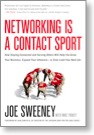
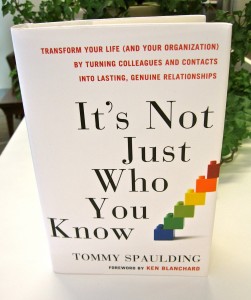
This week I will be highlighting two books I found on the new release list in the category of Business and Investing on Amazon; ‘Networking Is a Contact Sport: How Staying Connected and Serving Others Will Help You Grow Your Business, Expand Your Influence — or Even Land Your Next Job’ by Joe Sweeney and ‘It’s Not Just Who You Know: Transform Your Life (and Your Organization) by Turning Colleagues and Contacts into Lasting, Genuine Relationships’ by Tommy Spaulding

The books I discuss in the Social Media Book List Series will cover a range of topics such as social media, marketing, blogging, business, organization, career building, finance, networking, writing, self development and inspiration.

Networking Is a Contact Sport: How Staying Connected and Serving Others Will Help You Grow Your Business, Expand Your Influence — or Even Land Your Next Job’

by Joe Sweeney

Joe Sweeney book, Networking is a Contact Sport

“The concepts in Networking Is a Contact Sport have helped me in my post-Olympic years.”
Bonnie Blair
Five-time Olympic Gold Medal Speed Skater

“Joe Sweeney’s networking skills helped to significantly increase my off-the-field income.”
Brett Favre
Three-time NFL MVP and Future NFL Hall of Famer

“When you think about it, life is all about relationships, both personal and professional ones. But relationships don’t just happen by themselves. Many have to be pursued, and that’s where Joe’s book, Networking Is a Contact Sport, comes into play. A great read that proves that networking is hard work but well worth the while.”
Bill Perez
Former CEO of S.C. Johnson & Son, Nike, Inc., and Wm. Wrigley Jr. Company

About the Book*:

How did Joe Sweeney…

…get Bob Costas to come to Milwaukee (in the middle of winter)?
…become the “wingman” to the archbishop of New York City?
…take Brett Favre’s off-the-field income from $65,000 to more than $4 million?

The answer is simple. Networking.

Master networker Joe Sweeney shares his networking secrets from a long and successful career as a business owner, sports agent and executive and investment banking consultant. His first secret: master networkers are focused on giving, not getting.

With today’s difficult economy and uncertain workplace, networking has never been more important. Sweeney’s simple but effective 5/10/15 networking plan will give you a leg up in the current job market, help you stay employed, or, if you’ve been laid off, find your next job. The cliché that who you know is more important than what you know has never been truer. Sweeney illustrates his insights with dozens of helpful examples from his own life (along with a few fascinating insider sports stories).

With special sections on networking for women and minorities, insights into the usefulness (and handicaps) of social networking sites, how to get (and why you need) a wingman and profiles of other master networkers, Networking Is a Contact Sport is a practical and essential guide for anyone who wants to get ahead in today’s economy.

About Joe Sweeney*:
Joe Sweeney is a businessman, entrepreneur, former sports agent, investment banker and author.

For 28 years, Joe has built a career by combining his love of business and his passion for sports. Joe brings an extensive background in hands-on business experience. Joe has owned and operated four manufacturing companies and has more than three decades experience in the business and sports worlds. Prior to acquiring an equity position in Corporate Financial Advisors, a middle-market investment banking firm, Joe founded and was president of SMG, a sports management firm that specializes in assisting and representing coaches and athletes including three-time MVP, Brett Favre. Joe was also president of the Wisconsin Sports Authority and serves or has served on 23 boards of directors.
Joe received his BA from St. Mary’s College and his MBA from the University of Notre Dame.

He has used his 28 years of business experience as a master networker in the sports and business worlds.

You can purchase a copy of ‘Networking is a Contact Sport’ online at Amazon or on his website, Networking is a Contact Sport.

*courtesy of book website and Amazon

Another book on my Amazon Business and Investing list that I am looking forward to reading is ‘It’s Not Just Who You Know’ by Tommy Spaulding.

It’s Not Just Who You Know

img_1367-251x300

“Tommy masterfully illustrates case by case, person by person, that we’re all in this together.”
–Woody Johnson, owner of the New York Jets

“a valuable, reader-friendly guidebook for both business and personal living”
—Fort Worth Star-Telegram

Marshall Goldsmith is a world-renowned executive coach and author of the New York Times bestsellers, MOJO and What Got You Here Won’t Get You There. Read his review of It’s Not Just Who You Know:

To be successful today, leaders need more than an impressive title and superficial “friends” in high places. They need to be able to do some basic things–build partnerships, share leadership, and develop and empower people–-to name just a critical few. The challenge is that none of these are possible if people don’t trust or believe in their leaders. That’s where this new book, It’s Not Just Who You Know, fills an important gap in leadership education. In it, Tommy Spaulding hits on the important issue of building and sustaining relationships–-real relationships, authentic relationships as opposed to those less genuine, selfish relationships that do not build morale in the organization or trust between people. Tommy’s is a great book because he doesn’t just tell you that relationships are important, he tells you why, and he tells you how to practice building them. If you pick up one book today, let it be this one. You’ll be glad you did!

About the Book*:

In It’s Not Just Who You Know, Tommy Spaulding — the former CEO of Up with People — has written the new How to Win Friends & Influence People for the twenty-first century. Success — in business and in life — is all about relationships. In this powerful guide, Spaulding takes Dale Carnegie’s classic philosophy to the next level, showing how, by developing deeper relationships through giving to others and putting them first, we benefit as well.

Among the insights Tommy discusses in the book:

* It’s not just who you know, or what they can do for you, but what you can do for them.
* Motives matter.
* Establishing a deeper connection is about authenticity, not manipulation; reciprocity, not selfishness.
* Every relationship is a two-way street; we never know when a chance encounter can change the direction of our lives.

In the bestselling tradition of Dale Carnegie’s classic, It’s Not Just Who You Knowshows how each one of us can use the power of “netgiving” — of helping others — to expand our worlds and achieve our goals, and make a difference in our jobs, our careers, and our communities.

About Tommy Spaulding*:

Tommy Spaulding is president of the Spaulding Companies LLC (www.SpauldingCompanies.com), a national leadership development, consulting, coaching, and speaking organization. Spaulding rose to become the youngest president and CEO of the world-renowned leadership organization, Up with People (2005-2008). In 2000, Tommy Spaulding founded Leader’s Challenge, which grew to become the largest high school civic and leadership program in the state of Colorado. He is also the founder & president of the Spaulding Leadership Institute (www.SpauldingLeadershipInstitute.org), a non-profit leadership development organization which runs National Leadership Academy, a national high school summer leadership academy, as well as Kid’s Challenge, Global Challenge and Colorado Close-Up.

Previously, Spaulding was the Business Partner Sales Manager at IBM/Lotus Development and a member of the Japan Exchange and Teaching (JET) program.
Spaulding received a BA in Political Science from East Carolina University (1992); an MBA from Bond University in Australia (1998), where he was a Rotary Ambassadorial Scholar; and an MA in Non-Profit Management from Regis University (2005), where he was a Colorado Trust Fellow. In 2007, Spaulding received an Honorary PhD in Humanities from the Art Institute of Colorado. In 2002, he received the Denver Business Journal’s “Forty under 40 Award.”

In 2006, Spaulding was awarded East Carolina University’s “Outstanding Alumni Award,” the highest distinction awarded to an alumnus of the university. Spaulding is the Chairman of East Carolina University’s External Leadership Advisory Board and is the university’s first “Leader in Residence.”
A world-renowned speaker on leadership, Spaulding has spoken to hundreds of organizations, schools, and corporations around the globe. His inspiring book about how to create relationships that make a difference, It’s Not Just Who You Know, will be published by Random House in August, 2010. He and his family reside in the Denver metropolitan area.

*courtesy of book website and Amazon

You can purchase a copy of ‘It’s Not Just Who You Know’ on Amazon or on his website, Tommy Spaulding.

I truly hope you will check out these books and please comment and let me know your thoughts on them.

Filed Under: Business Book, Business Life, Successful Blog Tagged With: bc, books on business netoworking, books on leadership, Joe Sweeney books, Tommy Spaulding books

  • « Previous Page
  • 1
  • …
  • 76
  • 77
  • 78
  • 79
  • 80
  • …
  • 186
  • Next Page »

Recently Updated Posts

Is Your Brand Fan Friendly?

How to Improve Your Freelancing Productivity

How to Leverage Live Streaming for Content Marketing

10 Key Customer Experience Design Factors to Consider

How to Use a Lead Generation Item on Facebook

How to Become a Better Storyteller


From Liz Strauss & GeniusShared Press

  • What IS an SOB?!
  • SOB A-Z Directory
  • Letting Liz Be

© 2025 ME Strauss & GeniusShared