Successful Blog

  • Home
  • Community
  • About
  • Author Guidelines
  • Liz’s Book
  • Stay Tuned

The Biggest B2B Marketing Mistake and What It Means to Social Media

June 22, 2010 by Liz

Are You Serving the Wrong Customer?

cooltext443809602_strategy

A hot topic on the web is whether social media can work for companies who work B2B. Of course it can. Social media tools are simply tools for connection. Like email and the telephone they don’t discriminate about connecting people who at businesses to people who run businesses from connecting people at businesses to people who are considered to be end users of the products we build.

A good part of my career I spent building products for a B2B2B kind of market. The textbooks we made were mandated by politicians, sold to schools, used by teachers and students. It was a complicated sales and marketing process filled with “adoption” scenarios, standards documents, and presentations.

In the early years, I did a lot of looking in the wrong direction. Are you doing that too?

The Biggest B2B Marketing Mistake

The biggest marketing mistake B2B businesses make is considering the business they sell to as their customer. It works in these ways:

  • I build something for Larry’s Business to sell to Larry’s customers. I listen to Larry and make Larry my customer.
  • Everything I build is for Larry’s approval.
  • Larry is the only one looking out for Larry’s customer. He’s left to do all of the thinking.

That worked for me until I got to be Larry. Then I realized I should have been looking at Larry’s customers. I would have been so much more valuable to him if I had been participating in evaluating what I was doing from the point of view of the people he served.

and What It Means to Social Media

So what does that mean to social media? How can social media work in a B2B world?

If we understand that our role in working with businesses who sell to other businesses is to help them grow their businesses, then we can use the tools that the Internet gives us to

  • uncover and discover information that better defines what those customers value — what irritates them, what is essential to them, and what they consider more important than lower prices.
  • connect our business clients build networks with people in other industries who want to solve similar problems
  • offer information, research, and case studies via webinars and seminar about the latest tools and processes for serving their customers
  • show them how to use the social web to see and serve the customers of the businesses they serve.

Social media tools and models work the same for B2B as they do for B2C if we realize that that B2B businesses want networks and information.

Network Solutions and Radian6 do B2B well.

What other great examples of B2B social media come to mind immediately?

–ME “Liz” Strauss
Work with Liz on your business!!

Buy the Insider’s Guide to Online Conversation.

I’m a proud affiliate of

third-tribe-marketing

Filed Under: Strategy/Analysis, Successful Blog Tagged With: B2B social media, bc, LinkedIn, Strategy/Analysis

#DellCAP: From Behind the Curtain to Next Steps

June 21, 2010 by Liz

Fodder to Focus

cooltext443794242_influence

Wed through Friday last week I was honored to be part of the inaugural DELL Customer Advisory Panel (CAP) event at the DELL HQ in Round Rock, TX. (Thank you, DELL, for generously covering the costs of our travel.) I arrived with curiosity about the experience fueled by the information sharing that introduced the event.

Now I’m home and my mind is filled with the experience — so much “fodder.” This is a case study in a new sort of customer outreach. It was participatory anthropology. The people studying our responses were in the room asking questions, adding thoughts, and most importantly, listening and hearing.

This was NOT a focus group.

What Impressed Me

This was the first #DellCAP event.

dellcap

Here’s a little about the event that impressed me:

  • Two groups attended each on a different day. The fifteen invitees on Tuesday were people who might be considered DELL critics. Some in that group told me they didn’t see themselves as anti-DELL. The fifteen invitees on Thursday were people who might be considered DELL evangelists. Some in that group said they didn’t see themselves as particular pro-DELL either. The idea that DELL invited people they saw as both ends of the spectrum impressed me.
  • The morning sessions included C-Suite and senior executives. DELL interest in the event was high. The room had an audience and folks outside the room could “dial in.” DELL considered the event a valuable experience. Conversation with people at every level of the organization proved their excitement to be learning from outside sources what they need to change.
  • The breaks and side interviews showed DELL employees interested in extending the conversation and forming relationships that went beyond the day that we were there.
  • The tenor and the tone of the morning conversations, especially that around customer service was particularly open and centered on learning. The people who work with the outsourced and overseas help talked frankly about their goals and their focus on price. Their ownership of policy problems led to some great discussion that went beyond service to strategic positioning — ideas that could bring the awesome DELL of the past back to us.

What Might Have Worked Better

The afternoon was in the DELL Labs and took the form of a presentation. Personally I see some ways that it might have invited more interaction to pull more value from the event.

  • The product presentation about the specialists and generalists DELL serves was enlightening. It might have been fun to ask the invitees which group most described them and invite the larger group split off to explore more deeply the products designed for them. A chance to discuss one product line might have triggered a more invested discussion than a survey view of the whole product offering. Smaller groups might have offered a refreshing change in the day and a chance to see who’s most like us.
  • The upcoming new product (NDA session) naturally had to be a “talk at us” session. At this stage, our input is moot. It’s nice to get insider information, but it might have been more exciting if DELL had said, “If you’re interested, we’ll send you more information right before the release it so that you can play with it and be the first to share news about it, if you choose.”
  • The session on sustainability and recycling was also Web 1.0. Imagine how engaging it might have been if DELL had shared what they’re doing; then invited us to brainstorm ideas on how they might use social media to spread the news about the worldwide efforts on http://www.dell.com/recycle/ I had no idea they have so many sustainability partnerships going on.

Information to Strategy?

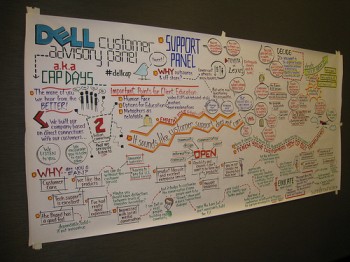
I can only imagine the wealth of ideas and information compiled throughout the two long days of conversation and demonstrations. Graphic conversationalist, Sunni Brown, recorded key points throughout in this murals like this one …

4714070461_e200a062b9_dellcap_conversation_via_paul_mooney

DELL said they’ll be displaying the murals where customers and employees can see them often. The calls to action throughout are both inspiring and almost overwhelming. It’s hard to move a huge company — every huge company becomes less adventurous and more protective of what it already owns.

DELL how will you report back on what you’re doing with what you’ve found out?

Strategy that Leverages Opportunity

The task before #DellCap is to keep the conversation going, to refocus on people who grow the company — inside and out. It takes strategy and company-wide focus to reconnect with customers in a true value relationship. Change isn’t easy. Without a deep commitment and strategic plan the vision is just a nice thought.

Some strategic thinking I’d love to see (and be part of) include:

  • Building a strategy about finding opportunities, not holding ground.

    True strategy combines mission, position, current conditions, resources, and well chosen tactics set out incrementally to move us forward.

  • Build from strengths and eliminate ‘thinking poor.”

    Thinking poor leads us to throw away the good things without seeing them and to increase our chances of following them down into that hole. Some great examples of poor thinking include … discounting prices for unlimited periods … customers who value us only for discounts will leave when they’re gone … reducing services … just tells customers we don’t value them at the time we need them most …

  • Build out the social media leadership group.

    Macro and micro businesses get stuck in process models that they’ve outgrown, but keep using. Fear of change, love of past success, bias that interprets history in our favor leads us to repeat and re-imprint bad or outdated behaviors in our organizational brains.

Tactics: Where I Might Go From Here?

I sat in a room rife with opportunities. Fine minds were jumping into help and offer ideas on how to reach out and grow.

What might I do if I were in that “OK, big shot, moment?” What next steps seem possible to gain the most traction from what started at #DellCap? Here are a few ideas to get the folks who want to stay with it moving forward with you.

Premise: You can’t be inside and outside the system at the same time. Know that the real value of the event was that the people who came weren’t part of the thinking that built the system. Every system needs a clear outside view.

What I might do:

  • Compile, reflect on, and share the ideas and issues came out of both groups in an open report available to anyone interested in the event.
  • Invite 2-3 attendees to write a presentation — a case study on the event itself.

Premise: Follow through is the loudest thank you. Honor all valid input and the time of those who contributed. Asking for opinions and insights is good. Valuing and honoring what you get is imperative to keeping communication open. A change in behavior is a tribute and shows respect to people who inspired that change. Show that commitment.

What I might do:

  • Talk about what’s been learned with gratitude online and offline. Just as you’ve been doing.
  • Blog about the event. Thank the people (inside and outside of DELL) who gave time to be part and link back to what they write with your thoughts.
  • Compile one major list of all posts people write from one main blog and use individual blog posts as fodder for ideas and future blogs posts when they might be relevant.
  • Start a newsletter that shares changes that came from this conversation. Send it out to people both inside and outside the company who have interested in #dellcap.

Premise: Intentionally extend relationships. Make room for the best. At least two people in my group are looking to work full time with DELL and several others would be delighted to keep working together.Value truth tellers who won’t let you fail. We all need to invest in the people who help us thrive.

What I might do:

  • Gather more information about the areas of expertise of the invitees. You might invite managers to consider this group when opportunities to test new products, discuss new ideas, or train new employees might benefit from an outside view.
  • Invite employee volunteers to keep in touch with one guest as a personal “customer advocate.”
  • Arrange for attendees to manage one relationship with DELL, not one with every department.
  • Invest resouces in the building the online #dellcap channel you’ve opened to solicit ideas.
  • Invite each guest to advocate for their customer segment from the “generalist / specialist” pie chart. Offer those who do a chance to be advisors, community builders, or “prototypical customers” for products in the appropriate product line. Make a long-term plan of building some ambassadors for each distinct product line.

Premise: Gather ideas and new process innovation by partnering strategically at every level and across industries. As the world becomes flatter and more social, the opportunities to raise a company to a category of one come from partnering with people and businesses who want the same things.

What I might do:

  • Build partnerships outside technology circles with companies, customers, and employees who have passionate values that align your values.
  • Invite social media, marketing, and PR students from UT to build a campaign to get the word out about DELL sustainability efforts.
  • Partner DELL interns with entrepreneurs to bring in new ideas.
  • Sponsor think tanks and events and send DELL employees to learn how other industries solve similar problems.
  • Invite experts into your building to for a learning exchange.

Premise: Claim your rewards and leverage them for the future. Find a way to commemorate and claim the investment and growth that took place. Make it something special to have been there — something special that we’ll all look back on with pride.

What I might do:

  • Build a #DellCAP Hall of Fame page as the first step in a TimeLine of Change. Include the biographies of all who attended — employees and guests. Record the event and add to it as you move forward. Share the page url with the company.
  • Pick a #dellcap team to brainstorm ways to extend the breadth, depth, and reach of the event before the momentum fades.

I’ll stop here.

The Wizard of OZ and Trust

In a sidebar discussion about the new iPhone and the DELLStreak, I was mentioning how some folks are feeling an anti-Apple sentiment over their closed system. The designer I spoke to said …

Open is a huge thing.

yes.

In the Wizard of OZ, OZ, the great and powerful, was just an image. Remember the saying?

the-wonderful-wizard-of-oz-2
Pay NO ATTENTION to man behind the curtain.

Dorothy didn’t have a relationship with OZ. She feared him.

Fear doesn’t inspire fiercely loyal fans. Trust and fear can’t exist in the same space.

It was when the little man came out from behind the curtain that the problem solving began.

Thanks for coming out from behind the curtain. Now on to the problem solving. Thank you Chris, Carly, Sarah, and Vance, for inviting us. Thank you, Mack, for an outstanding job at moderating a group who likes to talk.

What ideas do you have for DELL? What problems do you think they should be working on?

–ME “Liz” Strauss
Work with Liz on your business!!

Buy the Insider’s Guide to Online Conversation.

I’m a proud affiliate of

third-tribe-marketing

Filed Under: Blog Comments, Marketing /Sales / Social Media, Successful Blog Tagged With: bc, DELL, Dellcap, LinkedIn, Strategy/Analysis

SOB Business Cafe 06-18-10

June 18, 2010 by Liz

SB Cafe

Welcome to the SOB Cafe

We offer the best in thinking — articles, books, podcasts, and videos about business online written by the Successful and Outstanding Bloggers of Successful Blog. Click on the titles to enjoy each selection.

The Specials this Week are

brandsavant
Keep in mind, however, that only 7% of Americans are even aware of location-based services. That’s the small number that Foursquare and others in the space might really be thinking of, because that’s a fixable number. That’s a number that will grow, and when it grows, the import and business reach of these location-based networks will grow with it.

The Big Money In Small Numbers


Justin Kownacki
If they love you, their adulation becomes addictive. You learn what they like, what they respond to, and what makes them appreciate you more. Naturally, you’re inclined to pursue those reactions because they make you feel good, and that means you’re less likely to experiment with anything outside your audience’s comfort zone.

5 Reasons NOT to Listen to Your Audience


Marketing Profs Daily Fix
When they were last at your business, the light above the register hadn’t blown out yet, and it was pleasant and bright. The front door didn’t squeak each time it shut. The WiFi sticker on the window hadn’t been peeled and torn by that little kid. The floorboards hadn’t been scraped and marked by the mop bucket.

Now a week later, these small changes add up. Individually, each change is hardly noticeable. When seen all at once, they leave a poor impression.

How do you maintain the quality of the experience for your customers?

Give Your Customers a Good Show


Mack Collier
Here’s the twist that makes this event so interesting to me; The 15 customers Dell will meet on the 15th are customers that have issues with Dell, and want to voice those issues to the company. The 15 customers Dell will meet on the 17th are evangelists of the company. So over the course of 2 days, Dell will be meeting with 30 of its most passionate customers, from both ends of the spectrum. I think this event is also an example of the next evolution of social media for companies.

The next evolution of social media for business is …


Vandelay Design
Because web design and SEO are closely related, it’s a topic that designers are frequently asked about, but there is often a lot of gray area about what is the responsibility of the designer and what is within the designer’s power. While many clients want the designer to create a website that ranks well and attracts targeted visitors, SEO is really an ongoing process that involves much more than the design and coding of the site.

Effective Search Engine Optimization for Web Designers


Janet Clarey
There are those who write cautiously on the web and those who don’t. What’s your style? I try to write what I’m thinking and write it like I’d say it if I was sitting around having coffee with you. Sometimes wine

Writing cautiously blows


One Organized Business
I entered a crazy hectic working relationship on a project that practically sucked the life out of me. It was definitely stressful from beginning to end. I did manage to find the positive in the situation though. I learned that I need better boundaries when partnering with people, and I also learned that I really like the way I do things!

Does your life need to be shaken up?


Related ala carte selections include

Danny Brown
One of the folks that I’ve been fortunate to get to know through social media is John Haydon.

Hailing from Cambridge, Massachusetts, John’s someone that inspires me every day. He’s an outstanding ambassador when it comes to social media for social good; a great social media blogger; and a key part of the 12for12k community.

Why John Haydon Rocks – Literally


Neatorama
via @ChrisBrogan

Disney Photo Captured Married Couple on Film 15 Years Before They Met


Sit back. Enjoy your read. Nachos and drinks will be right over. Stay as long as you like. No tips required. Comments appreciated.

–ME “Liz” Strauss

Buy the Insider’s Guide to Online Conversation.

I’m a proud affiliate of

third-tribe-marketing

Filed Under: SOB Business, Successful Blog, Trends Tagged With: bc, Great Finds, LinkedIn, small business

How To Become A Guest Blogger

June 16, 2010 by Guest Author

cooltext455576688_blogging

By Terez Howard

Last week, we talked about the benefits that come from guest blogging on high traffic blogs. If you’re just stopping in this week, here’s a brief review:

    • Guest blogging gets people talking about you.
    • Guest blogging helps you establish connections with other business professionals.
    • Guest blogging may eventually lead to paying work.


This week, I promised to help you writers interested in getting involved in guest blogging. First let me say, there’s no one, correct way of getting your original blog posts on other people’s blogs. That said, there are two ways you can do this that I’m going to share.

The prepackaged approach

1. You search for a blog that relates to your niche or your interests. Perhaps you like to write about fashion. So, you look for fashion blogs. Be specific in your search. Perhaps you want to hone in on fashion for pregnant women.

2. Check to see if your blog of choice accepts guest bloggers. Some blogs have specific guidelines for guest bloggers. Make sure you understand what is expected of you.

3. Examine the blog to see if it seems to be a blog with high traffic. This can be difficult to ascertain. I like to look at comments, number of tweets and the amount of content the blog produces. I check to see if I can see a pattern in the number of posts per day/week.
Tip: You want to find a blog with decent traffic so that people will become familiar with your work. I’m not saying to never write for smaller blogs. But you should keep your purpose in mind.

4. Choose a topic that hasn’t been covered on the blog. Try to aim for a unique angle. For instance, with my pregnancy fashion example, you could write a post about swimsuits and cover-ups that flatter that baby bump.

5. Write the post.

6. E-mail your post to the blog’s owner. Most blogs will have a contact page, where you can find an e-mail address.

7. Wait one week, and respond with a follow-up e-mail if you don’t hear anything. Your short, simple follow-up e-mail could read as follows:
I wanted to make sure you received my guest blog post “Flattering That Baby Bump At The Beach.” I sent it on Wednesday, June 12. Will you be able to publish it?
Tip: You might want to attach your post again in case it has been overlooked. It will save your contact the time of having to ask you for your blog post and waiting for your response.

8. Wait another week. If you still don’t hear anything, use that guest blog post on your blog, pitch it to another relevant blog or use it for article marketing.

The opened package

1. Follow the first four steps of the prepackaged approach.

2. E-mail the blog owner your idea. Make your guest blog post pitch short and sweet. You could say:
I enjoy reading your blog posts about fashion for pregnant women, especially the one about (name a specific example). I would like to write a guest post on swimsuits and cover-ups that flatter that baby bump, such tankinis and pareos, but still keep pregnant women cool on the beach. Please let me know if I can move forward on this idea.

3. Wait one week, and then follow up with another e-mail.

4. Wait another week. Again, if you hear nothing back, use your idea for another blog, your own blog or another avenue.


No pay, high exposure

Most guest bloggers are not paid. I say most because some guest bloggers are paid. You must remember that guest blogging is not meant to be your source of income. It will hopefully lend a hand in leading to a client or two. It will definitely give you a following.

How do you go about guest blogging?


—
Terez Howard operates TheWriteBloggers, a professional blogging service which builds clients’ authority status and net visibility. She regularly blogs at Freelance Writing Mamas . You’ll find her on Twitter @thewriteblogger

Thanks, Terez!

–ME “Liz” Strauss
Work with Liz on your business!!

Filed Under: Successful Blog, Writing Tagged With: bc, blogging, LinkedIn, Terez Howard

Social Media Book List: Get Out of the Way and Six Pixels of Separation

June 16, 2010 by teresa

A Weekly Series by Teresa Morrow

I’m Teresa Morrow, Founder of Key Business Partners, LLC and I work with authors and writers by managing their online book promotion. As part of my job I read a lot of books (and I love to read anyway!). I am here to offer a weekly post about one book author I am working with and one book I have put on my reading list. This week I will be highlighting ‘Get Out of the Way’. and ‘Six Pixels of Separation’ by Mitch Joel. The books I discuss will cover topics such as social media (Facebook and Twitter), organization, career building, networking, writing, self development and inspiration.

Get Out of the Way by John Levy

get-out-of-the-waymid

“John Levy’s book is an essential read for managers of product development and innovation. John offers practical guidelines managers can use and signs they should watch out for to help them improve results of their teams. His book is a valuable resource for creating a highly effective product development organization.” Jan Richards, J. G. Richards Consulting

In the forward, Marks S. Williams shares, “In his book ‘Get Out of the Way!’ John Levy gives managers the tools to solve the unique problems of innovation: unpredictable customers; challenging technology; bright, opinionated people; and corporate environments that can be capricious. With all the buzzwords that attend the term “innovation,” the work fundamentally comes down to how people work together to make technology work for people. This is learnable, teachable, and trainable. But it is not easy. ‘Get Out of the Way!’ extends specific actions you can take to increase your odds of success.

About the Author:

John Levy is a management consultant who helps product development and IT organizations get consistent, predictable, and innovative results.

John has over thirty years of experience in the computer and software industry, including engineering management positions with Quantum, Apple Computer, Tandem Computers, and Digital Equipment. He earned a PhD in Computer Science from Stanford University and holds engineering degrees from Cornell and Caltech.

You can purchase a copy of ‘Get Out of the Way’ online at ThinkAha Books or at Amazon.

This blog post is part of a virtual book tour done by Key Business Partners and I have received a complimentary copy of ‘Get Out of the Way ‘ by the author.

Six Pixels of Separation by Mitch Joel

Now I would like to highlight a book on my “review” reading list–Six Pixels of Separation: Everyone Is Connected. Connect Your Business to Everyone..

Want to know more? Read here–

Exploring how and why online forums such as Facebook, Twitter, and blogs have gained such popularity—and credibility—with consumers, this practical guide offers proven strategies for organizations to leverage these new internet-based social media outlets. The differences between traditional and new media are explored, as are simple ways business owners and marketers can use these new resources to communicate with their customers. Practical tips on gaining the attention of and interacting with influential bloggers, the pros and cons of creating a company blog, guerilla marketing on the internet, and restructuring marketing expectations are also discussed.

About Mitch:
When Google wanted to explain online marketing to the top brands in the world, they brought Mitch Joel to the Googleplex in Mountain View, California. Marketing Magazine dubbed him the “Rock Star of Digital Marketing” and in 2006 he was named one of the most influential authorities on Blog Marketing in the world. Mitch Joel is President of Twist Image – an award-winning Digital Marketing and Communications agency. He has been called a marketing and communications visionary, interactive expert and community leader. He is also a Blogger, Podcaster, passionate entrepreneur and speaker who connects with people worldwide by sharing his marketing insights on digital marketing, new media and personal branding. In 2008, Mitch was named Canada’s Most Influential Male in Social Media, one of the top 100 online marketers in the world, and was awarded the highly-prestigious Canada’s Top 40 Under 40 (recognizing individuals who have achieved a significant amount of success but have not yet reached the age of 40).
*courtesy of Amazon

You can purchase a copy of ‘Six Pixels of Separation’ on Amazon

I truly hope you will check out these books and please comment and let me know your thoughts on them.

Filed Under: Business Book, Business Life, Successful Blog Tagged With: bc, Business Book, LinkedIn, social-media

12 Major Social Media Myths about Big Brands that Need Taking Down

June 15, 2010 by Liz

cooltext443809602_strategy

Late December 2009, I was knocked over by two conditions:

  • the huge number of social media job descriptions appearing on job sites
  • a simple statistic predicting that 86% of Companies were planning a Social Media Marketing Bump in their Budgets for 2010.

They prompted me to write — the 10 Crucial Roles of a Social Media Director. That piece brought me fact to face with something I’d suspecting for some time …

To bring a new business to the web, the culture has to become a beginner again. The larger the business the harder that is … they have more past success, more to lose, more to fear, less to win. — 10 Crucial Roles of a Social Media Director in 2010

I’ve been watching the differences between how individuals and small business use social media and how big brands do ever since. What strikes me now is a number of myths that have grown around how brands incorporate social media into their cultures.

Though it can be said that big brands move more slowly than a smaller, more flexible startup might move, we can’t assume that slowly means blind, uncaring or mentally inept.

Big brands didn’t get to be big brands by getting everything wrong.

So I asked some of the people I admire most about navigating the social web while working in a brand culture. What myth about brands, business, and social media would you most like to put to rest?
I’ve sorted their answers into 12 major myths. Their words are filled with the mysteries they’re facing and the magic it takes to move a big company to serve customers well.

[I’ve included their names, their industries, links and their twitter streams. Each individual is offering his or her own opinion and observations — not those of his company or brand.]

Myth 1: Social Media Is a Science

Working with people is rarely all tools and numbers. It’s called the “web,” because we link and connect in myriad ways — site to site, message to message, comment to comment, Facebook to Twitter — which all comes down to person to person.

Even one to many is really one to one, one, one, one, one, one, one. Count me as a many; I’ll still feel it like a one.

Social media isn’t a ‘science’ one can master, but the ‘art’ of treating people well. — Robyn Tippins, Community Director

Myth 2: We Can’t Separate the Person and the Company

Great companies realize that people have been meeting and making friends with people who work at companies all of our adult lives — in person, on the phone, through email. Sometimes we meet friends who work at companies. Sometimes company folks become friends. Words in text online might seem to make this more important, but it’s not.

We don’t share the same with all of our colleagues, friends, and acquaintances offline. Why assume that we would online?

I’m not sure if I can be of much help; I deliberately keep my online activities separate from my employer’s brand. I don’t generally engage in social media on my employer’s behalf (though I think this would be a fun career, it’s not the one I have). And I don’t want to have to plaster disclaimers on all of my blog posts. Beyond this, I don’t know what “myths” you’re talking about. Tell me some, and maybe I can put them to rest. — Holly Jahangiri, author, Tech Writer, Information Developer @Holly Jahangiri

Myth 3: All We Do Is On Twitter and Facebook

Great social media teams and their directors spend much of their time managing change — making sure that folks understand the relationships, not just the tools. They “get” that people learn and adapt at their own speed. Great companies serious about taking on more social presence realize both the opportunities and the responsibilities.

Understanding before action is a smart move.

One of the biggest myths is that the fruits of our labor are summed up by our brand’s Twitter or Facebook presence. A response from a company representative doesn’t necessarily indicate they’re actually listening in a meaningful way. Many companies that don’t have the same type of social media presence per se really are listening by doing things like analyzing conversational information and transforming it into data that can be used to improve products and services. This may change someday, but right now, most of the “work” involved with social media centers around helping the company adapt and get contextual understanding of conversations happening online, how they can participate in a meaningful (and legal) way, and re-orient the interface of the business toward the real-time web. — Shannon Paul, Social Media Director, Insurance Industry, @ShannonPaul

Myth 4: Legal Is the Enemy

Great social media companies know how diverse teams build strong strategies through dialogue. It’s easy to find people who think the same as we do. But the best ideas stand the test of different points of view.

People who think differently add value.

I would like to put to rest the idea that Legal is always the roadblock to social media adoption. More times than not, my experience has been that the Legal folks have a ready willingness to help and provide the best counsel for their clients. My advice to anyone starting a social media program at a brand is to involve a member of the Legal team as early as possible. — Michael E. Rubin, Social Media Director, Financial Industry, @merubin

Myth 5: B2B Can’t Rock Social Media

Maybe it’s because consumer companies got into the game sooner; or maybe it’s because their consumer groups are larger and sometimes louder; whatever the reason, some folks are stuck on the idea that companies who sell to and partner with other businesses can’t use the social web to grow their businesses.

I’d love to dispel the myth that B2B can’t “do” social media. There are so many outstanding businesses proving that not only can it work, but that B2B might actually have advantages around content, relationship cycles, and niche communities. It’s time we look at social media as an enhancement to business as a whole, and adaptable to many different models. — Amber Naslund, Director of Community, Social Media Monitoring Industry, @ambercadabra

Myth 6: Social Media Is Just Another Marketing Channel

Great companies see the shift in relationships allowed by the speed and reach of new tools. Yet, they never lose sight of their values and the value of the relationships those tools touch.

Social is part of every business function and relationship.

The notion that social media is just another marketing channel is one that is short sighted and flawed. Sadly, many businesses charge junior staff with social media initiatives. Those efforts exist in a vacuum—and consequently come up short. The reality is that social media extends and enhances advertising campaigns, direct mail messaging, sales efforts, recruiting and just about every business goal if utilized correctly. When was the last time you heard of business tasking a bunch of interns to formulate a “telephone strategy?” — Rob Birgfeld, Director of Audience Development, Marketing and Communications Industry @robbirgfeld

Myth 7: Social Media Is Free Broadcasting Platform

Social media spammers might not understand this one.

Community respects and listens.

The notion that social media is a free platform to blast out your brands message is honestly, complete crap and yes, a myth. First off, social media sites like Facebook and Twitter are free, but the time and energy it takes to build and maintain an interactive community on them is not. Second, if you only want to talk about your brand and how fantastic it is, buy a print advertisement or a billboard that targets nameless, faceless people. — Sarah Caminker , Fundraising Manager, Nonprofit and Social Good, @SarahCaminker

Social media may be free, but it’s not just another broadcast platform. It requires a significant shift in how to think about connecting with customers, and it takes work and attention. — Richard Binhammer , Corporate Communications @RichardatDell

Myth 8: Brands Can’t Be Nimble

It’s true. Great brands know jack!

… the myth that I’d like to put to rest is that brands can’t be as nimble on social media as the rest of us. In fact, this depends on the brand and the visionaries who are responsible for driving communications for that brand. — Alexandra Levit , Business/Workplace Author, Journalist, Speaker @alevit

Myth 9: Brands Use Social Media Selfishly

Successful businesses large and small focus on supporting the people who help them thrive. The ROI of being selfish is negative. Great companies know that.

If I had to try and dispel one myth about brands and their use of social media it would be that companies only use social media to their exclusive advantage. Everyone has seen a few brands attempt to use social media to push their own agenda. Everyone has also seen these same companies falter … in public. Most everyone knows of a few companies that have had success with social media too. I think these companies have figured out a secret about social media — it’s that employees are passionate about being able to use their voice to do good.

These companies have figured out that the simple act of empowering their employees allows for a huge return. Not necessarily a traditional return on investment (ROI) – although that is often one of the effects. It’s more of a return on engagement. When people are engaged – they engage back. One way to think of this is that’s like a “corporate hug” – Most people don’t think about hugging a brand, but they will hug back when the brand makes the effort to engage them.

There are so many companies using, and I do mean the word USING, their corporate brand for the social good. Everyone knows of a few huge brands that are using their brand for corporate good. Which is great to see. There are also a few smaller companies using their brand to engage the community that deserve to be highlighted. One that comes to mind is the clothing company Life is Good. They put on a festival that combines outdoor and in-person activities with a great cause. Another is a subset of the work @ShaunaCausey of Comcast is doing with Voluntweetup – where Comcast sponsors community based efforts on a local scale.

There are countless companies using their brand to do some social good. I hope to see more and more of these stories start to be highlighted in the coming months and years. The smart companies are leveraging their brand and the power of social media to do some good.

Life is Good Festival – http://www.lifeisgood.com/festivals/history-of-Life-is-good-festivals.aspx
Voluntweetup – http://www.voluntweetup.net/wp/ — Jeff Shuey, Director of Business Development, @jshuey

Myth 10: Social Belongs in Marketing or PR, or…

From the first comment, the social web has been about conversation. Communication cannot be shoved into a single department or made a one-sided event. Everyone is responsible for owning and sharing what works. Every employee is the brand.

As with most things, being balanced is a very important and an often forgotten principle. Personally or professionally, folks usually operate on one side of the spectrum instead of somewhere on the mid line. Social media for business is no different and in my experience, I’ve seen people spend a lot of time arguing where social media should be housed or if it pertains to certain disciplines more than others instead of sitting down with each different group that social media will touch and say, “How in the heck can we bring to our people (clients, audience, constituents, what have you) the message in the way they want and is best for them to digest it.” Social media has many facets that touch about how an organization speaks with its publics, so it should be discussed from the top down and all around in an organization’s goals and business strategies. The reason this is so difficult and why so many struggle is because marketing, PR and other disciplines have been segregated or siloed in most organizations. People and departments need to collaborate in order to succeed long term and with the masses. Social media is no exception, and its existence in fact could very well be the thing that starts holding organizations accountable to collaboration. — Lisa Grimm, Digital PR Specialist, @lulugrimm

From General Motors’ standpoint, our social media outreach efforts are not just another PR program. We are interested in keeping the relationship going. Once you are family – we want to keep you in the family. — Connie Burke, Communications Manager, Social Media, @connieburke

Myth 11: Brands Think Too Much, Too Little, Not Enough

Brands are people. We all do all of that.

I think most brands, large and small, worry far too much about how they, themselves, should manage social media, and far too little about how customers use it, and more importantly, how customers interact with the products we offer up. — Robyn Tippins, Community Director, Internet Developer Network, @duzins

Myth 12: Social Media Is a Waste of Time

Time spent without meaning and value is a waste of time. That’s not a social media problem that’s something else.

The social media myth that is no longer valid is that “social media doesn’t work or is a waste of time.” You are reading this, engaging this, using this, retweeting this, arguing this, and thinking about this statement because of social media. There’s no denying it, whether you agree with the termonolgy or not, social media is the new means of communication and connection. It’s no longer a matter of standing out, it’s a matter of relevancy and ultimately existence for your brand. — Kristen Rielly, New Media Developer, @GeekGirls

When we learn, we take in new information and test it against old models we’ve built on information we’ve gathered in the past. Sometimes, we forget to let the new information replace the old … and a myth forms.

What myths about brands and social media do you think need taking down?

–ME “Liz” Strauss
Work with Liz on your business!!

Buy the Insider’s Guide to Online Conversation.

Get a Great Deal When You Join Third Tribe Before June 1, 2010. I’m a proud affiliate.

third-tribe-marketing

Filed Under: Business Life, Successful Blog Tagged With: bc, brands, LinkedIn, myths, social-media

  • « Previous Page
  • 1
  • …
  • 114
  • 115
  • 116
  • 117
  • 118
  • …
  • 190
  • Next Page »

Recently Updated Posts

Is Your Brand Fan Friendly?

How to Improve Your Freelancing Productivity

How to Leverage Live Streaming for Content Marketing

10 Key Customer Experience Design Factors to Consider

How to Use a Lead Generation Item on Facebook

How to Become a Better Storyteller


From Liz Strauss & GeniusShared Press

  • What IS an SOB?!
  • SOB A-Z Directory
  • Letting Liz Be

© 2025 ME Strauss & GeniusShared