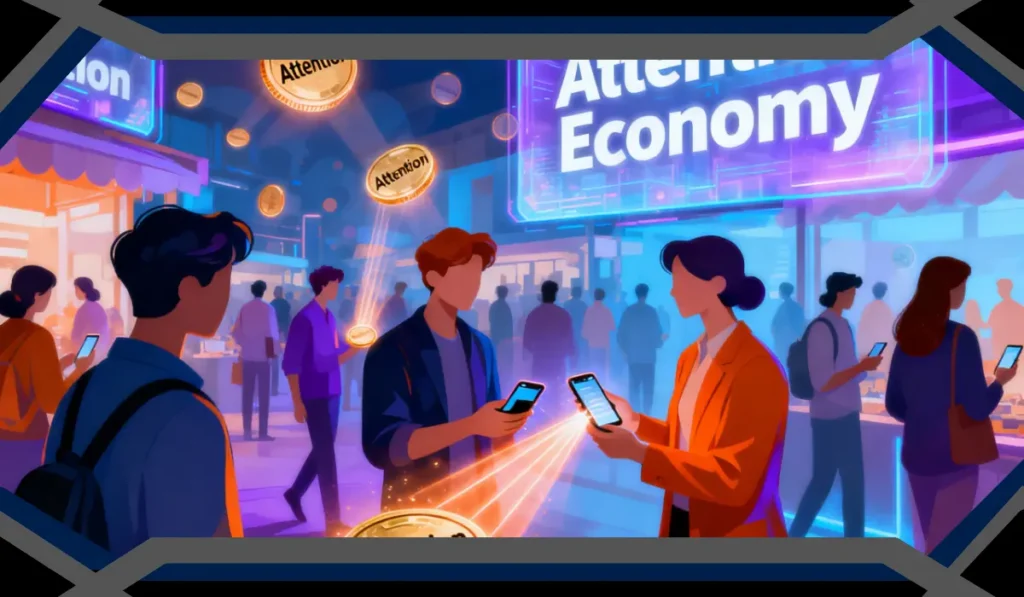
In today’s saturated digital landscape, businesses spend billions on advertising, yet many struggle with declining returns. The core issue isn’t the ads themselves but the fleeting nature of paid exposure. Audience attention-earned, owned, and sustained-represents a far more valuable asset. It delivers higher ROI, builds lasting brand equity, and creates compounding growth that advertising alone cannot match.
This article explores why attention trumps traditional advertising, backed by data, real-world insights, and actionable strategies for 2025 and beyond.
The Attention Economy: Understanding the Shift
We live in an attention economy, where human focus is the scarcest resource. Consumers encounter 6,000–10,000 ads daily, ignoring roughly 75% of them. Traditional metrics like impressions and CPM (cost per thousand) no longer suffice because visibility does not equal impact.
Attention metrics-such as active viewing time, emotional engagement, and focus quality-prove far more predictive of success. Higher-attention impressions can achieve double the success rate of low-attention ones, correlating strongly with better recall, brand awareness, and conversions.
McKinsey research highlights that a 10% increase in average consumer focus across media links to a 17% rise in spending and 20% higher likelihood of purchasing from ads. Top-quartile focus consumers spend twice as much as bottom-quartile ones.
Key takeaway: Quality attention drives revenue more reliably than quantity of impressions.
Limitations of Traditional Advertising: Rented Attention
Paid advertising provides speed and scale but remains “rented” attention. When budgets stop, reach vanishes. Platforms control algorithms, costs rise with competition, and ad fatigue reduces effectiveness.
Challenges include:
- Rising costs and declining efficiency – CAC (customer acquisition cost) climbs as ad platforms mature.
- Poor measurement – Viewability (ad loaded on screen) differs sharply from actual attention. Many “seen” ads receive zero meaningful engagement.
- Trust deficit – Consumers often distrust or skip interruptive ads. Emotional or contextual content performs better, but scaling it remains difficult.
Studies show audio ads or contextual placements can outperform visuals in attention, yet most budgets flow to high-volume, low-attention formats.
TV sometimes offers an “attention bargain” with more seconds of genuine focus per ad than digital, but overall, reliance on paid channels creates vulnerability.
The Power of Owned Audience Attention
Building an owned audience-email lists, social followers, communities, subscribers, or loyal customers-delivers earned attention that compounds over time.
Advantages:
- Lower long-term costs – Content marketing generates 3x more leads than paid advertising at 62% lower cost over time.
- Higher trust and conversion – Audiences who opt in engage more deeply and convert better.
- Resilience – Growth continues even if ad platforms change algorithms or increase prices.
- Data ownership – Direct relationships yield first-party insights for better personalization.
Owned attention fosters loyalty and advocacy. A strong audience turns customers into promoters, reducing future acquisition needs.
Data-Backed Comparison: Attention vs. Advertising
| Aspect | Paid Advertising | Owned Audience Attention | Winner |
| Cost Structure | High ongoing (CPM/CPC) | Higher upfront, lower maintenance | Audience |
| Durability | Ends when spending stops | Compounds over time | Audience |
| Trust & Engagement | Lower (interruptive) | Higher (opted-in, relevant) | Audience |
| Measurement | Impressions, clicks | Time spent, loyalty, LTV | Attention |
| ROI Predictability | Variable, ad-fatigue prone | More stable, emotional connection | Audience |
| Scalability | Fast but expensive | Slower initially, sustainable | Depends |
Attention metrics outperform traditional ones: 6x more predictive of ad recall and 7x better for brand awareness.
Why Attention Drives Superior ROI
Genuine attention serves as the gateway to all advertising outcomes-memory, emotion, persuasion, and action. Longer engagement directly correlates with stronger brand results.
Mechanisms:
- Emotional connection – Feeling-driven ads succeed more (31% vs. 16% for rational ones).
- Memory and recall – Sustained attention builds stronger associations.
- Conversion efficiency – Focused consumers are far more likely to buy.
- Efficiency in media buying – Optimizing for attention reduces waste and improves overall campaign performance.
Brands investing in high-attention environments (e.g., certain streaming, gaming, or contextual placements) often find better value despite potentially higher nominal costs.
Strategies to Capture and Monetize Audience Attention
1. Shift to Attention-Based Metrics
Move beyond viewability to measure active attention, dwell time, and emotional response. Use tools and standards from IAB, Lumen, or similar for better planning.
2. Create High-Value Content
Produce useful, entertaining, or educational material that earns attention. Short-form video, interactive formats, and storytelling align with modern consumption habits.
3. Build Owned Channels
- Grow email/SMS lists
- Develop communities (Discord, forums, social groups)
- Invest in SEO for organic search dominance
- Leverage user-generated content and influencer partnerships
4. Hybrid Approach
Use paid ads to accelerate audience building (e.g., lead magnets), then nurture with owned channels for retention and lower CAC.
5. Personalization and Relevance
Tailor experiences to context and user intent. Relevance captures attention better than broad targeting.
6. Test and Optimize Creatives
Prioritize formats proven for attention: motion with purpose, humor, emotional hooks, and platform-native styles.
Challenges and How to Overcome Them
Shrinking attention spans? Evidence is mixed-people binge long-form content when interested. The real issue is competition and relevance, not biological decline.
Measurement complexity – Adopt standardized attention metrics and integrate them into media mix models.
Balancing speed and sustainability – Use paid for quick wins while systematically building owned assets.
Conclusion: Invest in Attention for Sustainable Growth
Audience attention outperforms advertising because it is earned, owned, and enduring. While paid ads remain useful for reach and acceleration, they cannot replace the compounding power of a dedicated audience.
Businesses that measure, optimize for, and nurture attention will achieve better ROI, stronger brands, and resilient growth. Start by auditing current efforts: How much of your budget buys fleeting impressions versus building lasting attention?
Shift your strategy today. In the attention economy, those who earn focus don’t just survive-they thrive.
Also Read: How CEOs Use Personal Branding to Grow Companies Successfully