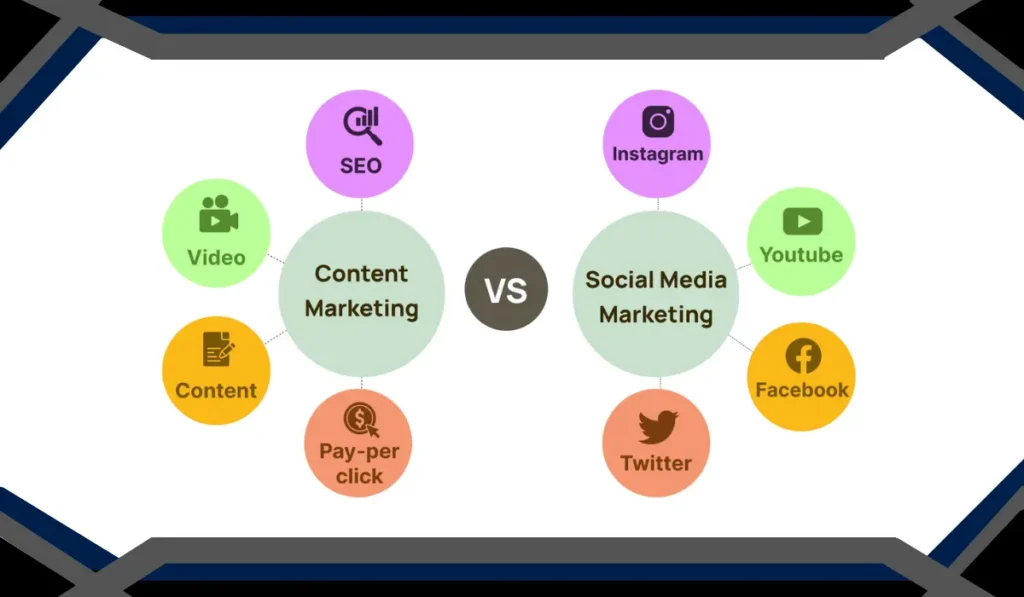
Content Marketing vs Social Media Marketing is one of the most debated topics in digital strategy today, especially for businesses trying to scale visibility, leads, and long-term brand authority. While both approaches aim to attract and engage audiences, they work in fundamentally different ways and often complement each other more than they compete.
Content marketing focuses on creating valuable, evergreen material such as blogs, videos, guides, and case studies that continue to attract organic traffic over time. Social media marketing, on the other hand, is built around real-time engagement, distribution, and conversation across platforms like Instagram, LinkedIn, TikTok, and X (Twitter).
Businesses often struggle to decide where to invest more resources. Should they prioritize long-form content that builds authority slowly but sustainably, or should they focus on fast-moving social platforms that deliver instant visibility? The answer is not as simple as choosing one over the other. It depends on goals, audience behavior, and the stage of business growth.
In this article, we’ll break down both strategies in depth, compare their strengths, and help you understand how to decide what works best for sustainable growth.
Understanding Content Marketing and Its Role in Growth
Content marketing is a long-term strategy designed to attract, educate, and convert audiences by delivering high-value information. Unlike paid ads or social posts that disappear quickly, content marketing assets can continue generating traffic and leads for months or even years.
At its core, content marketing builds trust. When a brand consistently publishes helpful blogs, in-depth guides, or insightful videos, it positions itself as an authority in its industry. Over time, this trust translates into higher conversions and stronger customer loyalty.
One of the most powerful advantages of content marketing is its ability to support search engine visibility. Well-optimized articles rank on Google and bring in organic traffic without continuous ad spend. This makes it especially effective for businesses aiming for sustainable, compounding growth.
Content marketing also supports the entire customer journey. For example, educational blog posts attract new audiences, comparison guides help prospects evaluate options, and case studies help close deals by providing proof of success. This layered approach ensures that potential customers are nurtured at every stage.
However, content marketing does require patience. Results are not immediate, and consistency is critical. Brands that publish sporadically often struggle to gain traction. But when done correctly, it becomes one of the most cost-efficient growth engines available.
Understanding Social Media Marketing and Its Impact
Social media marketing focuses on building brand awareness, engagement, and community through platforms where users spend a significant portion of their time daily. Unlike content marketing, which is often search-driven, social media relies on algorithms, trends, and audience interaction.
The biggest strength of social media is speed. A single viral post can generate massive exposure in hours, something content marketing typically takes months to achieve. This makes social media extremely powerful for brand visibility, product launches, and time-sensitive promotions.
Another key advantage is direct engagement. Brands can interact with their audience in real time, respond to comments, gather feedback, and build relationships. This creates a sense of authenticity and accessibility that is difficult to achieve through other marketing channels.
Social media also allows precise audience targeting through paid advertising. Businesses can reach highly specific demographics based on interests, behaviors, and location, making it an efficient tool for driving conversions quickly.
However, social media has limitations. Content visibility is heavily dependent on algorithms, meaning organic reach can fluctuate unpredictably. Additionally, posts have a short lifespan what performs well today may be irrelevant tomorrow. This creates a constant need for fresh content production.
Despite these challenges, social media remains essential for modern brands because it amplifies visibility and complements other marketing efforts, especially when paired with strong content assets.
Comparing Strategies: Where Each Approach Excels
To understand how each strategy contributes to growth, it’s important to look at how they perform across key business objectives such as visibility, trust-building, cost efficiency, and scalability.
Content marketing excels in long-term value creation. It builds a foundation of evergreen assets that continuously attract search traffic and educate audiences. This makes it ideal for businesses focused on sustainability and authority-building. Over time, it reduces dependency on paid ads and creates predictable inbound traffic.
Social media marketing excels in rapid distribution and engagement. It is particularly effective for brand awareness campaigns, community building, and real-time marketing. Businesses can quickly test ideas, receive feedback, and adjust messaging based on audience response.
While content marketing builds depth, social media builds reach. One creates lasting value, while the other accelerates exposure. This difference is why many successful brands do not choose one over the other but instead integrate both strategies.
For example, a company might publish a detailed blog post (content marketing) and then promote it across social media platforms to drive immediate traffic and engagement. This combination ensures both short-term visibility and long-term discoverability.
Ultimately, growth depends on how well these two strategies are aligned rather than which one is used in isolation.
Which Strategy Works Best for Growth?
The answer depends on your goals, resources, and timeline.
If your primary goal is long-term organic growth, content marketing is often the stronger foundation. It builds authority, improves search visibility, and generates consistent leads without continuous spending. Businesses in competitive industries especially benefit from this approach because it helps establish credibility over time.
If your goal is fast growth, audience engagement, or brand awareness, social media marketing is more effective. It allows you to reach large audiences quickly, test messaging, and create viral opportunities that content marketing alone cannot achieve.
However, the most successful brands integrate both. Content marketing acts as the backbone of authority and SEO, while social media marketing acts as the distribution engine that drives attention to that content.
A balanced approach often looks like this: high-quality content creation supported by consistent social media distribution, engagement, and amplification. This synergy creates a growth loop where content fuels social reach, and social engagement drives content visibility.
Businesses that treat these strategies as separate often miss out on exponential growth potential. Those that combine them strategically tend to outperform competitors in both visibility and conversion rates.
Conclusion
In the debate of Content Marketing vs Social Media Marketing, there is no absolute winner. Each serves a distinct purpose in the digital ecosystem. Content marketing builds long-term authority and sustainable traffic, while social media marketing delivers speed, engagement, and reach.
When used together, they form a powerful growth system that balances immediate visibility with long-term brand equity. Businesses that understand this synergy are better positioned to scale effectively in competitive markets.
The real key is not choosing between them, but learning how to integrate both into a unified strategy that supports consistent and measurable growth.
Also Read: From Unknown to Influencer: A Step-by-Step Personal Branding Strategy