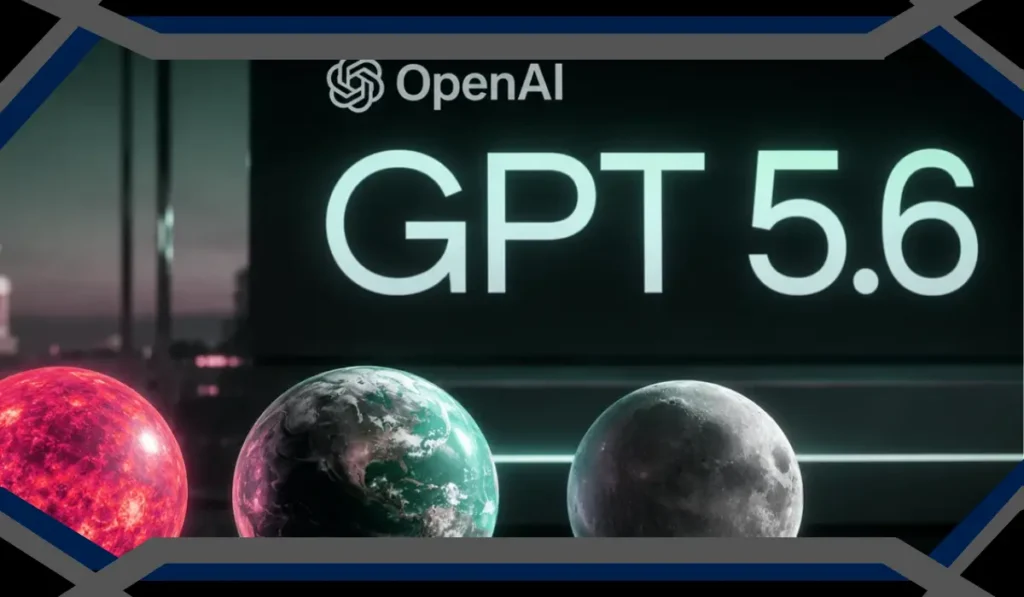
OpenAI dropped a major update on June 26, 2026: the OpenAI GPT-5.6 model family. Instead of releasing one new model, the company introduced three specialized versions, Sol, Terra, and Luna, marking a shift to a durable tiered system. This guide breaks down everything you need to know: official features, pricing, benchmarks, access details, rumors, and what it means for users and developers.
Understanding the New Naming System
With GPT-5.6, OpenAI moved away from confusing suffixes like “mini” or “Pro.” The number 5.6 represents the generation, while Sol, Terra, and Luna are capability tiers designed to evolve independently. This gives developers clearer choices based on intelligence, speed, and cost.
- Sol (Flagship): The most powerful model for complex, high-stakes work.
- Terra (Balanced): A strong everyday performer at lower cost.
- Luna (Fast & Affordable): Optimized for high-volume, lightweight tasks.
This cosmic naming (Sun, Earth, Moon) has drawn attention and sparked plenty of discussion.
The Three Tiers in Detail
GPT-5.6 Sol stands as OpenAI’s new frontier model. It excels at deep reasoning, long-horizon agentic workflows, advanced coding, scientific research, and cybersecurity tasks. Sol introduces two new reasoning modes: “max” for deeper single-pass thinking and “ultra” for parallel sub-agents that tackle extremely difficult problems.
GPT-5.6 Terra serves as the practical workhorse. It delivers performance competitive with GPT-5.5 while costing roughly half as much, making it ideal for business applications like customer support, document analysis, internal tools, and high-volume knowledge work.
GPT-5.6 Luna targets speed and efficiency. Built for routine tasks such as summarization, classification, drafting, and high-throughput automation, Luna offers strong capabilities at the lowest price point.
Pricing Breakdown
OpenAI published clear per-million-token pricing for the family:
| Model | Model ID | Input Price | Output Price |
| GPT-5.6 Sol | gpt-5.6-sol | $5.00 | $30.00 |
| GPT-5.6 Terra | gpt-5.6-terra | $2.50 | $15.00 |
| GPT-5.6 Luna | gpt-5.6-luna | $1.00 | $6.00 |
These rates are competitive and make advanced AI more accessible for different workloads. Luna, in particular, enables cost-effective scaling for high-volume operations.
New Prompt Caching Features: GPT-5.6 adds more predictable caching with explicit breakpoints and a 30-minute minimum cache life. Cache reads enjoy a 90% discount, while writes are billed at 1.25x the input rate. This can dramatically reduce costs when working with large documents or repeated contexts.
Confirmed Capabilities and Benchmarks
According to OpenAI, the GPT-5.6 family pushes boundaries in several areas. Sol achieves state-of-the-art results on challenging evaluations, notably Terminal-Bench 2.1 for complex command-line and agentic coding workflows. It also shows strong gains in biology benchmarks (GeneBench) and cybersecurity tasks (ExploitBench and ExploitGym).
Early reports indicate Sol can match or exceed competitors like Anthropic’s Mythos on certain agentic tasks while using fewer tokens. The models improve reliability in long-context reasoning and professional knowledge work.
Safety remains a priority. GPT-5.6 ships with OpenAI’s most robust safeguards to date, including enhanced protections for high-risk biological and cybersecurity queries. Some legitimate requests may experience delays due to real-time checks during the preview phase.
Release Status and Access
As of July 1, 2026, GPT-5.6 is in limited preview. Access is restricted to a small group of trusted partners and organizations through the OpenAI API and Codex. It is not yet available in ChatGPT.
The phased rollout follows coordination with the U.S. government for additional safety testing. OpenAI plans to expand availability “as soon as possible,” but no firm general availability date has been announced. Individual users and standard ChatGPT subscribers currently have no direct path to access.
Organizations with an OpenAI account representative may receive invitations, but approval is selective and subject to review. Previous alpha access does not guarantee entry.
Rumors, Reactions, and Context
The names Sol, Terra, and Luna quickly went viral in the crypto community. They echo popular cryptocurrencies (SOL, LUNA, and the collapsed Terra ecosystem), leading to memes about “Sam Altcoinman” and playful speculation about OpenAI’s intentions. OpenAI has not confirmed any crypto connection, the names appear inspired by cosmic themes.
Behind the scenes, the tiered strategy reflects a maturing market. By decoupling generation from capability tiers, OpenAI can advance each model on its own schedule while giving enterprises predictable options.
Some analysts see the government-coordinated preview as part of broader efforts to balance rapid AI progress with national security considerations.
How to Choose the Right Model
- Choose Sol when accuracy and complex reasoning matter most (research, advanced coding, security analysis).
- Choose Terra for balanced day-to-day production workloads where cost-efficiency is key.
- Choose Luna for high-volume, latency-sensitive, or budget-conscious applications.
Many teams will likely route different tasks to different models within the same application for optimal performance and cost.
What Comes Next?
While the preview is limited, expectations are high for broader rollout in the coming weeks. Future updates may bring Sol’s advanced modes to consumer products and further efficiency improvements.
GPT-5.6 represents OpenAI’s clearest strategy yet for serving diverse needs, from frontier research to everyday automation, while maintaining strong safety standards.
Conclusion
In summary, OpenAI GPT-5.6 marks a maturing phase for the company. The three-tier family, Sol, Terra, and Luna, addresses diverse real-world needs more effectively than any previous release. Sol pushes the frontier in reasoning and specialized domains, Terra provides excellent value for mainstream use, and Luna makes high-quality AI truly scalable and affordable.
With new reasoning modes, advanced caching, and reinforced safety, OpenAI GPT-5.6 balances power with practicality. Although access is currently gated, the preview signals that OpenAI is preparing frontier capabilities for wider, responsible deployment. As the models roll out more broadly, they are likely to redefine workflows across development, research, business operations, and automation.
This release isn’t just about raw performance , it’s about giving users meaningful choice and predictable economics. OpenAI GPT-5.6 could set the template for how leading AI labs structure their offerings going forward, making advanced intelligence more accessible than ever before.
Frequently Asked Questions
When will GPT-5.6 be available in ChatGPT?
It is not available during the limited preview. OpenAI plans broader rollout, including ChatGPT access, in the coming weeks, though no exact date has been confirmed.
What are the model IDs for API use?
gpt-5.6-sol, gpt-5.6-terra, and gpt-5.6-luna.
Can individual developers or small teams access it now?
Access is limited to selected organizations with OpenAI account representatives. There is no public waitlist or self-service signup.
How does prompt caching work and what are the savings?
It allows the model to remember large contexts. Cache reads get a 90% discount, significantly lowering costs for iterative conversations or document-based tasks.
Is Sol significantly better than previous models?
Yes, particularly in agentic coding, scientific reasoning, and cybersecurity. It sets new benchmarks while introducing “ultra” mode for the hardest problems.