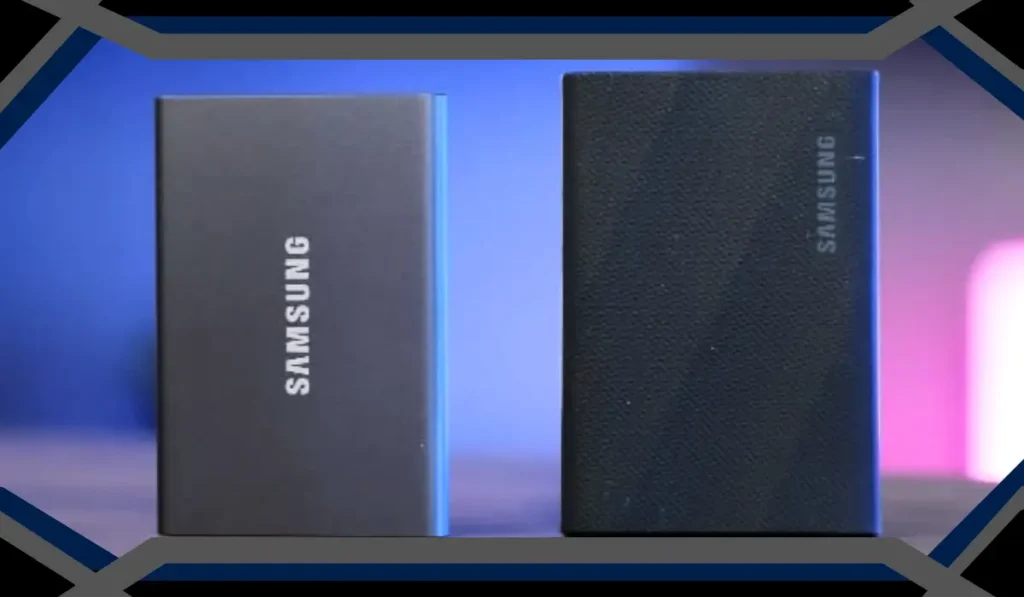
Portable SSDs have become essential for creators, professionals, and gamers who need fast, reliable storage on the go. Among the most trusted options, Samsung’s T-series continues to lead due to its balance of speed, durability, and portability.
The comparison between the Samsung Portable SSD T7 and the newer Samsung Portable SSD T9 is especially important in 2026 as file sizes grow larger and workflows demand faster data handling for 4K/8K video, game libraries, and enterprise-level backups.
This guide provides a clear, data-driven breakdown to help determine which SSD delivers better value based on real-world usage.
Design and Build: Portability Meets Performance Evolution
Both models maintain Samsung’s signature compact, pocket-friendly design with a durable outer shell that resists drops and everyday wear.
The T7 is built with a lightweight aluminum body that prioritizes portability. It is extremely easy to carry and fits comfortably in small bags or even pockets, making it ideal for students, travelers, and casual users.
The T9 introduces a slightly more robust structure designed to improve heat dissipation during sustained workloads. While it is marginally larger, the trade-off results in better stability during long file transfers and professional usage scenarios.
In essence, the T7 focuses on simplicity and mobility, while the T9 emphasizes performance consistency under pressure.
Samsung T7 vs T9 Comparison Table
| Feature | Samsung T7 | Samsung T9 |
| Max Speed | ~1,050 MB/s | ~2,000 MB/s |
| Interface | USB 3.2 Gen 2 | USB 3.2 Gen 2×2 |
| Best Use Case | Everyday storage, light editing | Professional video, large data workloads |
| Thermal Control | Standard passive cooling | Improved sustained thermal design |
| Durability | Shock-resistant aluminum body | Enhanced heat-optimized build |
| Price Range | More affordable | Premium segment |
| Future-Proofing | Moderate | High |
Thermal Management and Sustained Workloads
Heat management plays a crucial role in portable SSD performance. When drives get too warm, they reduce speed to prevent damage.
The T7 handles short bursts of activity efficiently but may slow down during long continuous transfers due to thermal limitations. This is typical for portable SSDs in its category.
The T9 improves significantly in this area with a redesigned thermal structure that allows it to maintain higher speeds for longer periods. This makes it more reliable for professionals who frequently move large datasets or work in extended editing sessions.
Real-World Usage Scenarios: Who Benefits Most?
Everyday Users and Students
For general use cases such as storing documents, media files, backups, and casual photo editing, the T7 is more than sufficient. It offers a balance of speed and affordability that fits most non-professional workflows.
Content Creators and Video Editors
For video editors working with 4K or 8K footage, the T9 provides a noticeable advantage. It reduces rendering delays, improves timeline responsiveness, and allows smoother handling of large media files. This becomes especially valuable in professional environments where time efficiency matters.
Gamers and Game Libraries
Modern games often exceed 100GB in size, making external storage increasingly important. The T7 performs well for storing and running games, but load times are faster and more consistent on the T9, especially for large open-world titles.
Developers and Data Professionals
Software development environments, virtual machines, and datasets benefit from sustained high-speed access. The T9 maintains performance consistency under prolonged usage, making it more suitable for demanding technical workflows.
Compatibility and System Requirements
Both SSDs are compatible with Windows, macOS, Android devices, and gaming consoles, but performance depends heavily on system support.
The T7 works efficiently with USB 3.2 Gen 2 ports, which are widely available across modern devices. It offers near-maximum performance in most setups.
The T9 requires USB 3.2 Gen 2×2 support to unlock its full speed potential. Without it, performance may drop closer to T7 levels, meaning users should verify compatibility before upgrading.
Security Features and Software Ecosystem
Security is consistent across both models. Samsung includes AES 256-bit hardware encryption and password protection, ensuring secure storage for sensitive files.
Both drives also support Samsung Magician software, which provides tools for:
- Drive health monitoring
- Firmware updates
- Performance optimization
- Security configuration
This software layer enhances usability and ensures long-term reliability across both SSDs.
Pricing and Value Considerations
Pricing plays a key role in choosing between these two models.
The T7 remains a strong value-oriented option. It delivers high-speed performance at a relatively affordable price, making it ideal for students, general users, and budget-conscious buyers.
The T9 is positioned as a premium product. Its higher cost reflects improved speed, better thermal design, and enhanced long-term performance stability. However, its value is most visible in professional workflows rather than casual usage.
Which SSD Should You Choose?
The decision ultimately depends on usage requirements rather than raw specifications.
The Samsung Portable SSD T7 is best suited for users who need fast, reliable storage for general tasks such as backups, media storage, and light creative work. It remains one of the most practical and cost-effective options available.
The Samsung Portable SSD T9 is designed for professionals who regularly handle large files, high-resolution video editing, or data-heavy workloads where every second of transfer time matters.
Final Verdict: Balanced Performance vs Professional Power
Both SSDs represent excellence in portable storage, but they serve different audiences.
The T7 prioritizes affordability, portability, and dependable performance, making it ideal for most everyday users. The T9 pushes boundaries with significantly faster speeds and improved sustained performance, making it a future-ready solution for demanding workflows.
In summary, the T7 remains the best all-round value choice, while the T9 is the clear winner for performance-focused professionals who need maximum efficiency in 2026 and beyond.