Successful Blog

  • Home
  • Community
  • About
  • Author Guidelines
  • Liz’s Book
  • Stay Tuned

5 Ideas for Gamification in the Workplace

June 6, 2019 by Guest Author

By Kayla Matthews

Gamification is a tool used by businesses to achieve new goals. However, with the emphasis on fresh new technology, many small companies are hesitant to adopt the strategy.

Implementing gamification is easier than you think and can lead to significant results. That’s why many large brands, including Microsoft, Target and Nike, have already undertaken the challenge.

What Is Gamification?

Gamification is a tool that implements game design and content elements into non-game applications to motivate participation, engagement and loyalty. It doesn’t have to be digital, relegated to your website, apps or social media. It can also be analog and relate to day-to-day operations.

The elements of gamification are referred to as game mechanics, covering competition, challenges, collaboration, levels, badges, instant feedback and more. These elements can be used in various combinations to achieve your desired goal.

While some businesses use gamification as a way to connect with customers, many have already realized the benefits of bringing the tool into the workplace.

How to Gamify Your Workplace

For gamification to be successful, it has to be well-planned, executed and maintained. If done right, it can increase engagement and motivation in employees.

When considering how to gamify the workplace, ask yourself the following questions:

  • What goal or objective do you wish to achieve?
  • What is your target employee behavior?
  • How do you think gamification will help?
  • What motivates your employees?
  • What tech will employees be comfortable with?

The gamification process isn’t an instant one. It’s a method you should test and tweak each time you implement a new idea.

  1. Train New Hires

Training new hires can be tedious, especially when there’s a lot of information to cover in a short amount of time. At the end of orientation, it’s not uncommon for trainees to feel they learned very little. By implementing gamification into the new hire training process, you can create a system that promotes learning through gaming mechanics.

One example of this is using badges as a user progresses. Samsung developed a similar program dubbed Samsung Nation, which rewards users with badges as they create content, watch videos, review products and engage with the community. Other companies are using a similar gamification process where new hires can gain achievements as they train.

  1. Boost Employee Performance

Outside of new hire training, gamification is used as a tool to enhance employee job performance, with 90 percent of employees rated more productive when using gamification. It can add a fresh and healthy competitive air to your office space, spurring employees to have fun as they work harder.

One example of using gamification to boost performance is Salesforce, which introduced its Big Game Hunter program to entice sales representatives to use the customer relationship management (CRM) system. Each team member started at the first level as a chicken hunter. As they became more aware of the CRM features, they could work their way up in status.

  1. Implement Team Goals

To make gamification work, you need to understand what your employees want. Once you have a goal in mind, create a path with actionable tasks to achieve it. By creating a clear objective, using a focus both you and your employees can agree on, you can use gamification to align employee goals with your own.

One example of a goal that can benefit both employees and management is a new R&R space, which can easily be added with an office pod. While you may think napping during work hours can’t possibly be beneficial, research shows there’s a strong correlation between rest and recovery and workplace productivity.

  1. Use Clear Communication

From new hires to top-tier managers, employees need clear communication and feedback to perform well. This can be a major issue employers face, especially those with a large workforce. Without open and clear communication, workers often feel disconnected and unpassionate about the work they do.

One way to combat this is to learn from Target, which wanted to connect with front-of-the-line staff — cashiers. Target decided to create a game they could play when checking out items for customers, providing real-time feedback in the form of red and green blinking lights. Before this method, cashiers had no way of knowing if their methods were effective.

  1. Improve Workplace Efficiency

Employees may be knowledgeable and hardworking, but that doesn’t mean they’re being as efficient as possible. One method businesses have used to evoke leaner practices is to introduce gamification in the form of challenges, achievements, rewards and recognition.

One company utilizing gamification is Omnicare, which created a series of achievements sales representatives could work toward, starting with a challenge at the beginning of each shift. As workers progress through the day’s problems, they can earn rewards. This led to less wait time for customers, an increase in customer satisfaction and a reduction in employee turnover.

Utilizing Gamification in the Workplace

When implementing gamification in your workplace, the key to success is understanding precisely what you wish to achieve. Listen to your employees to better understand their wants and motivations. Try to come up with a rewards or achievement system that works with their unique desires and limitations.

Once you’ve used this tool, be sure to assess if it’s effective and what areas can use improvement. You should always be searching for new ways to optimize and improve results, even when you’ve already achieved your desired goal.


About the Author: Kayla Matthews writes about communication and workplace productivity on her blog, Productivity Theory. Her work has also appeared on Talent Culture, MakeUseOf, The Muse and Fast Company.

Featured image: Eric Tompkins on Unsplash

Filed Under: Business Life, Motivation

Is the Personal Development Trend Killing Teamwork?

May 30, 2019 by Guest Author

By Wendy Dessler

In this day and age, it’s all about focusing on your own growth. How can you improve your career outlook? How can you push farther in your personal life? You have to put yourself first, but is this really the best mentality when it comes to success?

At least in the western world, things are increasingly built “for one.” It’s not uncommon to see solo-travelers, solo-workers, solo-diners, and so on. While, in the past, doing things alone might not have been seen as normal, recent trends are skewing in the opposite direction.

It turns out this might not be bad thing. There are a lot of benefits to wanting alone time. This isn’t just personal observations, but actually science-backed evidence. For example, there’s ample evidence supporting the idea that being surrounded by people actually reduces productivity. So is personal development really killing teamwork?

Let’s take a closer look at this trend to see what it means for the workforce today.

man sitting at desk

Image via Pexels

The Rise of Solo-Living

First, let’s take a look at this rise of solo-living culture. What exactly is solo-living culture? Basically, there’s a push for people to take more control of their lives and more control of their future. This spans both professional and personal life. It’s no longer uncommon to see workers cutting ties with their 9-5 and starting their own business. Similarly, you might see people dining alone at a restaurant or just going through lives on their own.

This is seen most acutely in solo travel. While solo travel would have been too expensive and intimidating for most people in the past, the world is smaller than ever. A study from the Solo Traveler Blog reveals that 80% of respondents prefer independent solo travel. Independent travel is empowering, and it might lead people to make more solo-decisions throughout the rest of their lives.

Solo-living is also seen in people choosing to hold off on marriage and other coupling milestones. The average age of married couples is getting older and older, and many people are putting big life decisions on hold until they’re later in life. As you can see, there are a lot of solo-living changes that are affecting the way we live today. These stem from the personal development movement. We all want to live better, but does that mean we have to do things alone?

woman at laptop

Image via Pexels

A New World of Solo-Businesses

One of the biggest professional trends in this solo-living landscape is the new world of solo-businesses. What do we mean by solo-businesses? We mean businesses that are intended to be run by a single person. Usually, these include freelancing and consulting businesses. In the digital age, these are more popular and accessible than ever before.

People are becoming increasingly unhappy in “traditional” office jobs. They want their freedom to set their own hours, work from anywhere, and be their own boss. Basically, people are thriving on their own without the structure of a team.

One potential challenge to this trend is the concern over health insurance, but even that is being overcome. Many people were afraid to leave their employer because it would leave them without health insurance benefits. However, it’s now possible to find full group health insurance for self-employed individuals. While health insurance might still be complicated for the self-employed, new legislation and changes are making it more affordable and accessible.

Ultimately, all of these changes in the professional workforce are making it easier for people to strike out on their own. While a full team might have been needed in the past to run a business successfully, the internet makes tools and networking easier than ever. All of these changes are continuing to impact business as we know it.

The Evolution of Teamwork

To answer the original question: is personal development killing teamwork? In short, no. However, teamwork is changing. On the surface it might seem like teamwork is becoming less and less needed as more people focus on themselves both in their personal and professional lives. While this might be true on some level, teamwork is popping up in new ways.

For instance, more people are working together digitally than ever before. Remote work is on the rise, and while freelancers, contractors, and self-employed professionals might not physically work together in the same office space, they’re still contributing to the same projects, helping others, and working in a cohesive way.

Ultimately, teamwork is evolving to fit our new way of life. Yes, it’s true the work is changing. People are choosing to focus on themselves in different ways than we’ve seen in the past, and some of this is due to the way technology gives us other ways to connect with people from around the world. Only time will tell how this personal development trend affects us as a community. As of now, teamwork is still very much alive and well, though it’s taking a new shape that we’ve never seen before.


About the Author: Wendy Dessler frequently writes about the latest advancements in tech and digital marketing. She currently focuses on helping SaaS businesses create a better world for our kids.

Filed Under: Personal Development, Productivity Tagged With: personal-development

Why All Employees Should Take a Sabbatical Leave from Work

May 23, 2019 by Guest Author

By Kayla Matthews

Asking the boss for time off can be tricky. Unless you’re one of the lucky minority who hasn’t spent most of their life reporting to a 9-to-5 type job, you’ve probably tried a few different methods to get some “me time.” You might request a day off ahead of time, or you could take a not-so-sick day.

What if you need more than a day or two, though? What if you need more than a few weeks? You might be surprised at how willing many employers are to allow someone to take a sabbatical leave. Although you will miss work, there are substantial benefits to taking a sabbatical. Here’s why it’s a good idea to give yourself the green light for some time away, and why your employer should, too.

What is a Sabbatical Leave from Work?

The word sabbatical goes back to biblical texts, which refer to farmers allowing their fields to go fallow once every seven years. This ancient idea has, like so many, been modernized. It has taken on a different meaning than it had when a sabbatical was just an opium pipe short of a mystical vision quest.

Not long ago, you really could disconnect by staying out of the office for a little while. These days, things are more complicated. We have smartphones.

Our ever-shrinking sphere of private life has become the motivator for many people to take what we think of as a sabbatical leave in the modern era. In general, it’s six or more weeks of leave that may not be paid, with the intent of fulfilling some life goal or pursuing a great understanding of self. You might consider it an active pursuit of purpose, which can easily become lost in the chaos of the modern workplace.

The Things You’ll Bring Back

Millennials are often over-categorized and talked about prescriptively. Employers obsess over advice the media or their social circle gives about how this new generation values experiences over things — as if that was such a new concept. The value of life experience has never been in question — just consider what you put on your resume. Is work experience not life experience in another form?

You don’t have to have been born after 1986 to get value from a sabbatical. Not every employer is going to see it your way, but if you and your company share the same values, it’s easy to make the connection between the importance of getting some out-of-work time to experience life and performing when you’re in the office.

For many people who take breaks, their trip is a way to purge the mind of noise and cruft that accumulate in the modern workplace. A sabbatical from work eliminates the symptoms of burnout and anxiety that are so widely experienced in our 24/7-connected reality.

Even if you don’t come back with authentic trinkets from a faraway land, you’ll return to the job with a clear head and a renewed vigor for what you do. Taking some time to remind yourself of your purpose and goals will make you a more effective asset for the business, and could even lead you to take the next step forward in your career, within or outside of your current company.

Making the Pitch

Of course, you can’t just get up and leave one day. Proposing to your employer that you want to take a significant amount of time off is difficult. What if they don’t see it your way? Will you still be looked at as a loyal employee after you suggest this?

These are real risks, and ones you should weigh. However, if your sabbatical plans don’t align with your employer’s values, that might be a red flag. A good idea is to organize your reasons for going and present them in an articulate way. Draw parallels for your employer to see where a refreshed version of you will bring new wins to the company and how your time off can inform your further development. Remember, you are a valuable asset. The business wants to send a positive message to its employees in how they treat your request.

You might be surprised at how many employers are willing to endorse a well-planned sabbatical. If you believe this is what’s needed to take your life and your career further, start taking those steps today.

Featured photo by Dino Reichmuth on Unsplash

About the Author: Kayla Matthews writes about communication and workplace productivity on her blog, Productivity Theory. Her work has also appeared on Talent Culture, MakeUseOf, The Muse and Fast Company.


Filed Under: Personal Development Tagged With: sabbatical

Customer engagement on a budget

May 20, 2019 by Rosemary

Customers typically want two things when they seek out your company online:

  • fast answers to their questions
  • someone to listen to them

If you’ve delegated your customer engagement to a “free” social network, you’ve automatically made it more difficult to accomplish either of those goals.

Have you ever tried to search for something that was posted a while ago in a Facebook Group? You know, that amazing answer you wrote to that customer who wanted to know if you offer discounts to dog owners? Go ahead and try it…I’ll wait…

No bueno, right?

Now try digging up a Tweet or a Twitter DM in your corporate account from a month ago where you solved that nagging login question.

See what I mean?

What if you had a space that you controlled, where you and your customers could easily find answers? A forum gives you a central hub, connected to your website, where PDFs, images, tutorial videos, Q&A, ideas, and more can be found.

The bonus? If you’re using your own domain, all of that useful information is also helping your SEO.

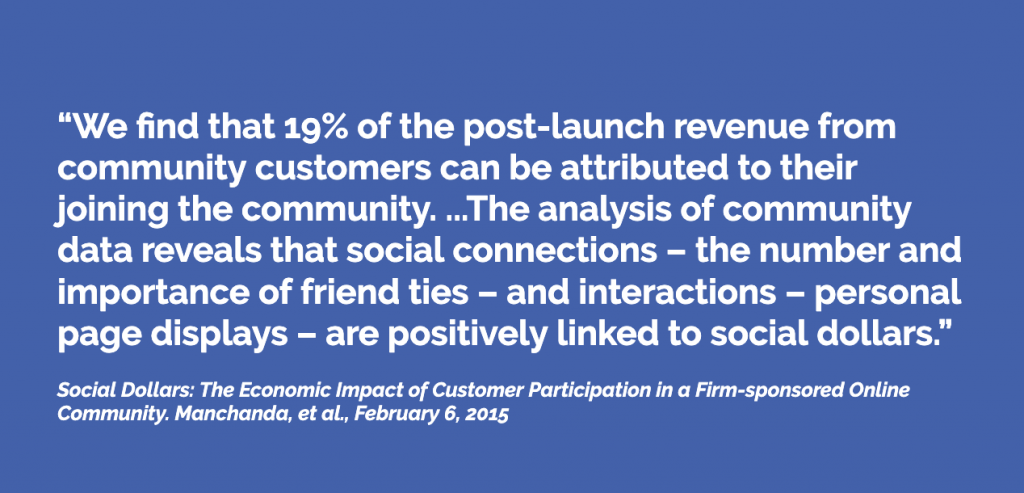
Some customers who have incorporated your brand into their identity (how awesome is that) may want to reinforce that by helping other customers. Research shows that customers who participate in an online community stick around longer than those who don’t.

revenue attributed to community members

This article will show, using Convolio forums as an example, how you can engage with your customers like a boss (even if you’re an army of one). These same tips apply, regardless of your community platform; the bottom line is to provide value to your customers.

Make Your Customers Insiders by Sharing Useful Resources

Set aside one of your forums for resources. You can attach files, embed media, and include pull quotes in your forum topics, which makes it easy to share all sorts of information in one place. It’s all searchable (including the attached files)!

Your customers will appreciate being able to comment or ask questions inline too. For example, if you post the menu for your upcoming event, they can ask whether there are gluten-free options (that’s always the first question, isn’t it?).

Collaborate with Your Customers by Getting Feedback and Suggestions

The only bad feedback is no feedback at all. Whether you’re building a product or providing a service, you should always be listening when your customers tell you things. You can give them space to offer constructive criticism, ideas, and real use-case responses. Because it’s a forum, you can actually have a back-and-forth conversation about the idea, gathering more details to flesh it out, and getting input from multiple different customers in the same thread. Best practice is to go back and let them know once you’ve implemented their idea. Customers who have contributed their own ideas to your business, and seen them come to life, become your most loyal fans.

Communicate Proactively and Specifically

You should be sorting and segmenting your members so that you can send customized emails based on their interests, or introduce them to other customers who have similar interests. When they join the forums, give them a quick dropdown menu to tell you something about themselves. That information then gets you closer to knowing them as people, and then being able to give them what they actually want, rather than just guessing at personas.

Create a New Revenue Stream with Premium Memberships

Use paid memberships to monetize your forums. Offer enhanced features or content to paid members of your forum community. You get to decide the rate, the frequency, and what is included in the membership. When you are offering so much value through your forums that members are willing to pay, you’re doing it right.

See How it’s going, At a Glance

You don’t have to be a Google Analytics junkie to see how your forums are doing. Use built-in Advanced Reports to see your member leaderboard, top topics, and more. In Convolio, it’s all downloadable if you want to go all spreadsheet on it.

How does this serve your customers? Double down on the topics that are seeing the most traction. If forum content that offers how-to information is getting the most page views and comments, make more of it!

Clone Yourself with Automation Tools

The secret recipe is….Recipes! In Convolio, you can automatically screen out posts that include specific words, take a look at posts that include images before they go live, reply to someone who’s made their first post, and ban spammers who get in the way of real customer engagement. Use your community’s moderation tools to create a fun, interactive space for your customers.

Subscribe to administrative email notifications and get alerted when new members join, when someone mentions you, or when there’s new content that needs review. That means you can spend more time working on your real job, which is making cool things for your customers, not dealing with forum technology.

Conclusion

It’s time to stop blurting out marketing messages all over the web, and hoping your customers will bump into them. Time to provide real value for them, in a place where you can give customers the experience that fits your business promise, without algorithms dictating your reach.

Convolio is the new low-cost hosted forum from Social Strata, the pioneers of engagement software. Some other forum options include Discourse (open-source software) and Vanilla Forums (priced  for the Enterprise).

How are you engaging with your customers?


Author’s Bio: Rosemary O’Neill is Co-Founder of Social Strata, makers of Convolio forums and the Hoop.la community platform, and Narrative, a new social content platform for consumers.  You can find Rosemary on Twitter as @rhogroupee.

Featured Photo by Roman Kraft on Unsplash

Filed Under: Community

Does Your Brand Market Success?

May 15, 2019 by Thomas

How good of a job are you doing these days when it comes to marketing your brand for success?

If you responded to say not all that good, don’t you think this will need to change?

This is especially the case if you are in an industry where you face a lot of competition on a daily basis.

So, does your brand market success or do you need to focus more on your marketing efforts?

What Marketing Initiatives Are You Using?

In looking at your brand’s marketing efforts, are you focused where you should be?

To start, are you doing the bulk of your marketing in-house or out-sourcing what you need done? If the latter, you want to be sure you are working with a top-notch agency.

Whether you look at Klicker or another inbound marketing agency, find one that works for you.

One of the ways to find the right agency for your marketing needs is using the Internet.

Many marketing agencies have websites. As such, it is not all that difficult to find them online.

With a Google search or if you already have an agency’s website URL, get online and begin the hunt. Before long you may have the agency you need to partner with for more brand success.

In looking at which agency to work with, consider the following:

  • How long has the agency been around? While there are some great young agencies out there, one with experience may be your best bet. Either way, find the agency that will get to know you and your brand and help you succeed.
  • What does the agency have to offer? – Different marketing agencies will have a myriad of offers available. That said find the one best suited to your brand’s marketing needs.
  • Will the customer service be first-rate? – Last, you need a marketing agency that provides you with first-rate customer service. Anything short of this will not cut it. That said get some feelers on how agencies you consider working with treat customers.

What is Your Competition up to?

While you do not want to become fixated on what your competitors are doing, do not go to sleep on them either.

With this thought in mind, do you know what they do, especially as it concerns their online efforts?

In checking out their efforts, you should get a better understanding of what works and what does not. As a result, it can help you become more in tune with what marketing steps you may well need to take.

Finally, look for ways to push the envelope when it comes to your online marketing efforts.

From contests to podcasts and more, make your brand stand out from others. This is why seeing what the competition is up to and finding ways to one up them is key.

When you stop to look at what you are doing, is your brand marketing making its case?

In the event the answer is no, you need to get working on a successful brand marketing operation.

Photo credit: Pixiebay

About the Author: Dave Thomas covers business topics on the web.


Filed Under: Business Life, Marketing Tagged With: brand, business, marketing

Business Reports You Need on a Regular Basis

May 9, 2019 by Guest Author

By Wendy Dessler

Running a business, whether offline or online, can be a lot of work. While many people dream of becoming an entrepreneur or running a business, the chances of success are unfortunately not as high as you might hope. In fact, only around half of all small businesses will survive into their 5th year.

One of the best ways to ensure your business is successful is to make sure you remain in tune with all that is happening. To do this successfully, you will often need to see actual reports that outline your success. Thankfully, technology has made it easier than ever to produce a wide range of reports that you can analyze. These business reports can be quite important to your business for a number of different reasons.

Without any further ado, this article is going to look at a few different reports that your business needs to check out on a regular basis.

Website Analytics Report

With more and more people using the internet to shop or influence purchases, it is important to have a good business website. You should also be monitoring the various different analytics produced by your site. This can give you insights on your customers and the overall success of your business. However, in addition to knowing things like traffic, traffic sources and demographics, there are many more analytics and information that you should familiarize yourself with. For example, you should be sure to frequently check out your logs.

Your website or software will create logs, which are essentially a time-stamped documentation of events. Anything that happens on your site such as successful logins, failed logins, security threats or dozens of other events will be logged. By checking these logs, automatically or manually, you will have a good idea what is going on behind the scenes. If you want to learn more, be sure to check out the advantages of Apache Logging Basics.

A Productivity/Time-Tracking Report

The employees at your company are incredibly important to the success or failure of your business. If they are productive and on-task, you will likely be successful. However, if they are wasting time or generally being unproductive, it can hurt your bottom line. And unfortunately, while the internet has helped businesses in a lot of ways, it can also be a massive distraction for employees.

To ensure everyone is on-task and productive, you should be sure to use a software that can produce a productivity or time-tracking report. These types of reports will be able to tell you what your employees are really doing while they are clocked in at the office. This can help you address potential issues directly and ensure everyone remains productive while at work.

A Variety of Financial Reports

cartoon hands on laptop Image by mohamed Hassan from Pixabay

Of course, one of the single biggest indicator of the success of your business is your finances. Not only do you have to be making money, but you also need to ensure you are spending less than you are making, too. Thankfully, there are a variety of different financial reports that can provide you with all of this information and more.

You should be checking sales and revenue reports, expense reports, your balance sheet, your budget and even cash flow statements. Each of these reports can provide you different information about the finances of your business. They can help you notice if anything needs to be changed and can assist in making important business decisions.


Featured Image by rawpixel from Pixabay


About the Author: Wendy Dessler frequently writes about the latest advancements in tech and digital marketing. She currently focuses on helping SaaS businesses create a better world for our kids.

Filed Under: Strategy/Analysis Tagged With: status reports

  • « Previous Page
  • 1
  • …
  • 20
  • 21
  • 22
  • 23
  • 24
  • …
  • 1050
  • Next Page »

Recently Updated Posts

The Creator’s Edge: How Bloggers and Influencers Can Master Dropshipping

Is Your Brand Fan Friendly?

How to Improve Your Freelancing Productivity

How to Leverage Live Streaming for Content Marketing

10 Key Customer Experience Design Factors to Consider

How to Use a Lead Generation Item on Facebook


From Liz Strauss & GeniusShared Press

  • What IS an SOB?!
  • SOB A-Z Directory
  • Letting Liz Be

© 2025 ME Strauss & GeniusShared