Successful Blog

  • Home
  • Community
  • About
  • Author Guidelines
  • Liz’s Book
  • Stay Tuned

#GetMomentum – Interview with Jason and Jodi Womack

June 2, 2016 by Rosemary

Everyone has felt it at some point in their lives. You have the desire, but can’t seem to start moving in the right direction. Maybe you haven’t even figured out what the right direction is, yet.

With Get Momentum, the new book from Jason and Jodi Womack, you’ll be able to work through a series of exercises and guided thought processes and come out the other side with a clear set of actions. I enjoyed having a paper copy of the book, so I could write in the margins and create my own roadmap along with the activities provided. There’s also a wealth of additional information on the GetMomentum.com website.

Jason and Jodi were gracious enough to answer some of my questions.

What inspired you to write your new book Get Momentum: How To Start When You’re Stuck?

We’ve been working together for more than 20 years, and over the past 9 years we’ve served as leadership and executive coaches helping busy professionals improve their productivity – and their lives. We wrote this book to share the secrets to success that we know will help people achieve more, work smarter, and be happier.


What are the key themes of the book?

When you know what you want to be known for, it’s easier to decide what to do and what not to do. As you read through each of the 5 stages of momentum that we describe, you will begin to understand the approach you can take to Get Momentum on projects you want to start or changes you want to make.

There are 5 distinct stages you’ll pass through; they are:

  1. Motivation: Here, you decide what you want to be known for so that you can more easily decide what to take on and what to let go of.
  2. Mentors: At this stage, you identify the people you can learn from, the ones willing to help you by sharing what they have learned (often, the hard way) so you don’t make so many mistakes.
  3. Milestones: By choosing 3 subprojects (milestones) you can complete over the next 90 days, you are spreading the work out. Even a project that will take you a year or more NEEDS to be divided into chunks that you can work on.
  4. Monitor: At the end of the day, you must reflect on success. You have to look back and recognize that you “moved the mission forward”. Identify what you want to watch for, what you’ll want to have completed, and celebrate what you accomplish.
  5. Modify: Along the way, you’ll make small changes, consistently, that act as guard rails that pull you back on track as you continue moving toward the goals you’ve set. As you become what you want to be known for, you’ll be ready to take on new goals.

What is the most important thing you want readers to learn from the book?

Ask for help. So much time is lost and so much hardship is endured because we wait too long before we ask for the assistance we COULD have used to achieve success. Once you know what you want to be known for, and as you surround yourself by people willing to help you, it’s easier and easier to make progress on those subprojects you’ve set for yourself.


Why do you think it’s so hard for people to get and keep momentum?

Many leaders subconsciously believe that they should already know everything there is to know about how to work, manage teams and projects, and make progress on their goals. When people lose momentum it is usually because they’re comparing themselves to someone who has it different than they do. There’s only one person to compare yourself to, and that is you!

Reflect back on what you DID get done today and think about what you can do tomorrow. Create a plan, ask for the help you need, and honor the process as you move from where you are to where you want to be.


How did the two of you meet?

We met in the front row of a history class at the University of California. Jodi asked Jason if she could borrow his notes. He said, “No”, and that was the beginning of what has become a beautiful relationship.

After spending time as school friends, the “No” turned into many “Yeses” and 23 years later we are still sharing our notes and editing each other’s writing. We’ve grown up together as we worked in our local, small town high school where Jason taught history and Jodi worked in the Counseling office. We moved on to found our own consulting firm, The Womack Company. We help busy professionals be more productive through coaching, consulting, our Get Momentum Leadership Academy, and now the book… Get Momentum: How To Start When You’re Stuck (Wiley, May 2016).


What is your favorite thing to do together?

Our version of nothing… That’s going for a hike in the hills of Ojai, California or Costa Rica… a long road trip, singing (badly!) to the 80’s tunes we both grew up with…dreaming of the next article or book we could write that would help the people we love working with and serving all over the world. Basically, we love doing life together!


How do you balance being partners in both work and in life? How does that play out in a practical way for each of you?

We are different. Sure, some days it’s tough because we both can see the very same problem from two different perspectives, or with one perspective we see two very different problems. However, what our Get Momentum Leadership Academy members tell us is that the “she said / he said” approach is a healthy way to recognize the many ways they can address the projects they are working on and the problems they are solving. In a practical way, we work very well together when we recognize the strengths each of bring to the work we do.


What was it like writing your first book together?

Oh, it was easy! Jason wrote the book. Jodi deleted it! Seriously, we played to our strengths. Jason is prolific. He can write hundreds and even thousands of words in a sitting. Jodi can read through all that “raw material” and choose the best lines and paragraphs that are going to help readers Get Momentum!


Author’s Bio: Rosemary O’Neill is an insightful spirit who works for Social Strata — makers of the Hoop.la community platform. Check out the Social Strata blog. You can find Rosemary on Google+ and on Twitter as @rhogroupee


I was given a free copy of this book for review purposes. Opinions expressed are my own. ~Rosemary
Filed Under: Personal Development, Uncategorized Tagged With: momentum

How to buy technology without going crazy

May 26, 2016 by Rosemary

Q: How many technology vendors does it take to screw in a lightbulb?

A: Depends, what’s your budget?

Technology buyers have changed, and so has the buying process. According to recent research, if you’re a baby boomer, you’re likely to rely heavily on industry analysts for advice in the early stages of the decision. If you’re a Gen X decision-maker who’s about to pull the trigger, you prefer live or in-person demos.

But you may not even realize the generational or experiential biases you are bringing to your purchase decision. You’ve probably formed habits that may or may not be helping you make an effective technology choice.

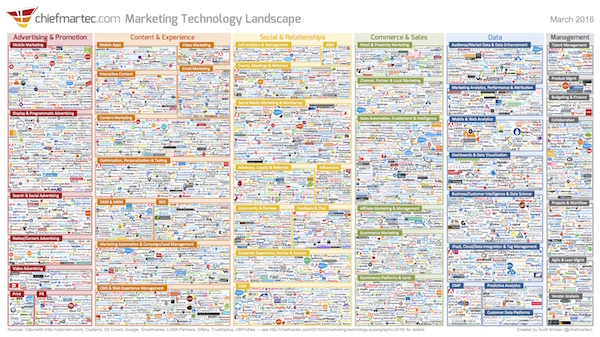
And you have a LOT of choices. Not to freak you out, but this graphic is just for marketing technology.

ChiefMarTec Technology Landscape 2016


Become a better technology buyer

Over the last 20 years, I have talked with hundreds of technology buyers in various stages of the decision process.

One scenario that comes up often is the disconnect between the person who will ultimately use the technology and the person who is procuring it. The most effective organizations put those two people (or teams) in the same room and lock the door, not letting them out until they understand thoroughly what will be purchased.

Another frequent issue is “champagne dreams on a beer budget.” If you’re a buyer on a strict budget, assume that you’re going to need to triage the feature set you’re getting. Figure out what’s a must-have and what’s a nice-to-have, so you can live without paying for expensive customizations.

Don’t start Googling technology vendors until you know your business goals, your budget, and your timeline.


How to buy technology efficiently

  1. Start at the beginning. What business challenge are you trying to solve, what business goal are you looking to achieve? How is your own success measured? If you have answers to those questions, it will be pretty obvious whether a particular technology can help you or not.
  2. Nail down your budget and resources. If you don’t have either of those things, you shouldn’t waste time getting software demos. (Dude, that’s boring anyway.) Knowing how much you can spend, over what period of time, will help you know if you should visit the Ferrari dealership or look at the used cars on Craigs List.
  3. Let the mission drive your feature set, not the other way around. Design mockups and super-detailed feature requirements are fun to brainstorm, but don’t let them drive the whole process. You may discover new ways of achieving your goals if you allow the technology vendor to share their expertise. They are probably talking to others in your niche all day long, trying to solve the same problems, and they may have a fresh take on things. There may be features you didn’t even dream up. If you need to provide a pixel-detailed mockup, expect to make a significant investment.
  4. Know the process. For larger technology purchases, you may need to have legal resources to review the agreement you’ll be signing (particularly if it’s software-as-a-service, where you’re accessing a platform from your browser). Make sure that you have buy-in and participation from anyone on your team who needs to sign off on the purchase.
  5. Establish a timeline. When do you want to start actually using the technology? Will it be available? Do you need training before it’s released into the wild?

It’s easy to see technology vendors as adversaries in the sales process…after all, they want your money, right? However, the good vendors also want to build a strong partnership with you so that you can work together over the long haul. Look for sales teams who treat the purchasing process as a partnership and give you sound advice along the way. That’s probably a good clue as to how you’ll be treated as a customer, too.

What are your lessons-learned for buying technology?


Author’s Bio: Rosemary O’Neill is an insightful spirit who works for Social Strata — makers of the Hoop.la community platform. Check out the Social Strata blog. You can find Rosemary on Google+ and on Twitter as @rhogroupee

Filed Under: Tools Tagged With: buy technology

10 Time Management Apps to Help Enable the Perfect Work/Life Balance

May 17, 2016 by Rosemary

By Outreach Mama

It’s undeniable that new and innovative technology has created immeasurable benefits for all of us. The high-tech lifestyle that we currently lead allows us to quickly connect with our peers, perform important tasks throughout the day, leverage resources and improve our productivity much speedier and simpler than we’ve ever imagined possible.

Are you currently using time management applications to help improve productivity with the completion of day-to-day tasks? Which apps are you using? And how many do you find useful for time optimization?

There are currently hundreds of apps and other tools to help with time management. If you choose to miss out on the advantage that they provide, you are making a big mistake and costing yourself hundreds of hours a year that could have otherwise been put to better use if time management productivity was taken more seriously.

With that said, we will share 10 time management apps that will make a positive impact on your time and schedule if you’d only begin using them.

Our Top 10 Time Management Applications

Here are our favorites in no particular order:

● Rescue Time – we often wonder and doubt whether or not we are using our time to our advantage. Rescue Time runs as a background application on your computer and/or mobile device. It tracks time spent on applications, websites, and shows you (through weekly reports) where and how you are spending your time online. You’ll find out your biggest time wasters and learn how to manage your Internet usage in a more productive way.

● Dropbox – this free and simple to use application allows you to store content in the cloud. This cloud server helps you quickly move content from one device to another. You can gain access to and share your most important files no matter where you happen to be while on the go.

● Clockspot – this app is a favorite of business owners in many industries. It is the perfect alternative to cumbersome timesheets. It makes it simple to track the amount of time spent on personal and business projects. Clockspot is the ideal tool to help manage and analyze projects and tasks quite effectively.

● Launchy – this easy, tiny tool will allow you to use a few simple keystrokes to launch project files, bookmarks, folders and documents. It makes it very simple to access programs without fumbling through your start menu.

● Universal Password Manager – if you happen to forget your passwords, and have Post-it notes piled up on your desk completely disorganized and out of sorts; this is the best way to keep your passwords stored and safe without compromising security.

● MyLifeOrganized – if you find it difficult to manage to-do lists and tasks, this app will help you get your life organized and back on track.

● Remember the Milk – this tool helps keep you organized and is compatible with computers, mobile devices, Outlook, Gmail and more.

● Evernote – keep track of articles, notes, images, voice messages and more with this free productivity tool.

● Focus Booster – based on Pomodoro technique principles, this application is perfect for those who continuously procrastinate and experience task management overwhelm. It helps improve your focus and relieve time related anxiety.

● Focus at Will – this application uses music and neuroscience to help enhance productivity. It’s perfect for those trying to stay focused while reading, working or studying.

Begin using these time management apps and get your life back on track without any further delay.


Featured Image Source: kaboompics.com


Filed Under: Tools

Why Successful People in Business Lean on Their Friends

May 10, 2016 by Rosemary

By Mindy Mackenzie

Celine Dion singing “All By Myself” is one of the great clips on YouTube of all time. [Click here for a little spine-tingling inspiration.]

But as Celine sings about how she doesn’t want to be all by herself I can’t help but think about the CEOs and executives I advise who feel exactly the same.

Being a senior business leader can be a notoriously lonely place. But all the successful people in business I know have a group of advisors they rely on and most have had this group for many, many years.

Why? Because going it alone in business is a bad proposition.

You need what I call a personal pit crew: a handful of trusted, credible people who can give you insight, advice, counsel, and painful feedback, when you need it. This is a crew committed to your success in your business and personal life. And while these folks may have started out in a more advisory capacity, they ultimately become dear and lifelong friends.

Here’s the painful truth: the more senior you get the less the people around you will tell you the truth. Messages start to get managed. All your ideas begin to get agreed with –enthusiastically. Those around you are more careful in handling you because they want or need something from you. As the parable of the nude emperor indicates, the process that resulted in him traipsing around town in his birthday suit did not occur in a day.

It is these very factors that successful people are aware of. Because they are self aware. Which gets increasingly difficult the more powerful and successful you become. Friends by their very definition are people who love you in spite of yourself. For who you are inside and out. Not just for your public personae.

There’s another aspect to why successful people in business lean on their friends: they are smart enough to know they don’t have all the answers. They know they need a fresh perspective or a challenging point of view. And they crave and value that degree of truth.

Finally, at the end of the day, the friends and advisors who have known and supported your journey the longest are also your biggest cheering squad. They know from whence you came and are proud of all you have accomplished and their part in being able to help you get there.

They have observed firsthand the growth and evolution. They know the struggles, insecurities, fears, failures and flops. They are truly your pit crew.

Like all successful business leaders, you need an external group of people committed to your success in your work and your life.

Here’s how to put your personal pit crew together:

  1. Have the right mindset by being willing to lower your guard, be vulnerable and ask for help.
  2. Identify people you trust and whom you respect and admire for their competence and character.
  3. Invest the time necessary to cultivate deep, lasting, open relationships. Reciprocate the support and remember to express gratitude.

There is no need for you to be all by yourself in business any more!


About the Author:

Mindy Mackenzie is an accomplished corporate executive, a highly acclaimed speaker, and CEO advisor. Before starting her advisory practice, Mindy served as Chief Performance Officer of Beam, Inc., where she earned the nickname of the “Velvet Hammer.” She was revered for being the truth teller amongst the executive team by exhibiting a bold combination of honesty and empathy. Her impressive career also includes five years at Campbell Soup Co, where she lived and worked overseas, and nine years at Wal-Mart, where she advanced through various Senior Leadership HR and Organizational Development roles. An expert on truth telling in the workplace, her expertise includes leadership and organizational effectiveness, transformational change, culture, and strategy. Mindy is the author of The Courage Solution: The Power of Truth Telling with Your Boss, Peers, and Team (Greenleaf Book Group, May 3rd 2016). For further information please visit http://mindymackenzie.com/.

Filed Under: Business Life Tagged With: successful people

How to Use Content Marketing to Retain Existing Customers

May 5, 2016 by Rosemary

When my twins were born, it was around-the-clock, crazy, unstoppable madness. For the two and a half months they spent in the NICU, we commuted every day to spend time with them, feed them, and learn how to take care of them.

It could have completely consumed our attention, to the exclusion of everything.

Except…

The twins had a brother who was 20 months old at the time.

One of the most important things we did was to make sure he was included, cared for, loved, and given his own personal time with us. Ten years later, he still talks about the special time he spent in the park with his dad while I was at the hospital.

Why am I sharing this?

Because most of the focus right now is on cranking out a steady stream of content that will attract leads. Content marketing can be a useful tool in the marketer’s toolbox, but don’t forget to share the love with your existing customers.

How to Use Content Marketing to Retain Existing Customers

Blog posts – Yes, you want to use your blog for outreach, thought leadership, and lead generation. Why not sprinkle in the occasional post that specifically addresses a need for your existing customers? It could be a how-to, could be an inspirational case study (two birds with one stone), or it could be corporate news.

Training/tutorials – Create visual content that helps your customers do their jobs better. Listen to their most frequent questions, and create training materials that speak directly to those questions.

Knowledge base or FAQ – Your knowledge base can be a place to apply content marketing skills. Concise writing, engaging visuals, and use of keywords will get your expert content found by both existing customers and potential customers.

External guest posts and articles – Typically you would think of a guest post as an opportunity to get “new eyeballs.” What if you focused your next article on the needs of your current customers? Provide insights that make your product or service more valuable in their eyes; make them feel smart for choosing you.

In-person events – If you have on-site events for your customers, are you offering them anything of tangible value? Think about collaborating with them during the event to create content they can use themselves. (Because they’re probably trying to create content the same way you are.)

Chat events, Blabs, Periscopes, etc. – Streaming video or text-based chat is being heavily used to demonstrate expertise, as a way to get brand awareness and leads. I’d suggest experimenting with these formats for customer communication as well. What if you invited your best customers to participate in a streaming event to discuss your product roadmap?


Are you using content marketing techniques to retain your existing customers? Please share your ideas with us!


Author’s Bio: Rosemary O’Neill is an insightful spirit who works for Social Strata — makers of the Hoop.la community platform. Check out the Social Strata blog. You can find Rosemary on Google+ and on Twitter as @rhogroupee

Featured image via Flickr CC: rachaelvoorhees

Filed Under: Content Tagged With: content marketing

Stop being productive, you will get more done

April 28, 2016 by Rosemary

Planners, calendars, bullet journals, Trello boards, post-it notes, Moleskines–are supposed to make you more productive.

Newsletters, books, podcasts, e-books, blogs, live events– are supposed to teach you how to use those things to become more productive.

You’re a busy little bee with your productivity studies.

Tell the truth.

How deep is your productivity “to read” pile right now?

How would you feel if you could purge all of that for a while and just do your work?

That article on “sleeping habits of super-successful people?” Delete it and get an extra half hour of sleep tomorrow.

That blog series about “becoming super-productive in seven days?” Unsubscribe and write some original content yourself.

Those five weeks of podcasts on “super-charging your morning” that are stacked up in your “unplayed episodes” stream? Get real and delete the old episodes.

In fact, stop reading this article right now and go write/create/do something important.

Then you’ll feel super.

Once you’re feeling all super, come back here and share what you accomplished!

Author’s Bio: Rosemary O’Neill is an insightful spirit who works for Social Strata — makers of the Hoop.la community platform. Check out the Social Strata blog. You can find Rosemary on Google+ and on Twitter as @rhogroupee

Featured image via Flickr CC: Garry Knight

Filed Under: Productivity Tagged With: Productivity

  • « Previous Page
  • 1
  • …
  • 8
  • 9
  • 10
  • 11
  • 12
  • …
  • 84
  • Next Page »

Recently Updated Posts

Is Your Brand Fan Friendly?

How to Improve Your Freelancing Productivity

How to Leverage Live Streaming for Content Marketing

10 Key Customer Experience Design Factors to Consider

How to Use a Lead Generation Item on Facebook

How to Become a Better Storyteller


From Liz Strauss & GeniusShared Press

  • What IS an SOB?!
  • SOB A-Z Directory
  • Letting Liz Be

© 2025 ME Strauss & GeniusShared