Successful Blog

  • Home
  • Community
  • About
  • Author Guidelines
  • Liz’s Book
  • Stay Tuned

Are Complaints the Biggest Social Media Traffic Drivers?

October 29, 2024 by Jessy Troy

Have you ever had the opportunity to moan about something via social media? Did you do it? Put your hand up if the answer is yes…

Was it the stale bread in your lunchtime snack, a broken product, or something that you purchased but it didn’t work or was it something bigger? 

Did you complain about bad service?

So let’s talk about the dark side of social media traffic

I work with brands as well as small businesses to help them create and implement the right social media strategy for their business. If a company does its due diligence, it’ll find the Virgin Media post. They will see me bashing a brand to good effect – it got a resolution to a problem. But does that mean they will want to work with me? Am I biting the hand that feeds me?

When starting a business and considering various domain name ideas, keep branding in mind: How will it be perceived on social media?

Let’s look at it from their perspective. A company starts to follow me on Twitter. We interact a few times, start chatting and then they click on a link and find my site. They’re intrigued. Like all good social media marketers, I provide lots of valuable content for free and they can read through and see that I really know my stuff. 

They will also see that one of my busiest posts is one that shows how fed up I am with the responses from another company. They may feel empathy, they may feel annoyance or they may just lose a little respect for me.

Not all social media complaints get an easy resolution, just because you can blog and kick up a fuss doesn’t mean you’ll get the outcome you desire.

If you are looking for traffic and love to complain, be careful because it can quickly spiral out of control. It’s not just bloggers that complain, it’s irate customers.

If you are in business, great service is the way that you avoid bad social media traffic and the cost of a reputation management expert. If you experience bad service and are tempted to air it via social media, remember it can get out of hand, and not all social traffic is great traffic.

Have you or your company experienced the dark side of social media traffic?

Image by Azmi Talib from Pixabay

Filed Under: Marketing

5 Reasons Your Company Should Not Use Online Videos

June 8, 2024 by Jessy Troy

There are a lot of very good reasons to use online videos for your company, and it has been effective for both B2B and b2c companies.  

However, the internet is littered with videos that should have never been made, and here are some obstacles that may keep you from creating a lesser video for your brand.

1. Your Boss Doesn’t Think It Is Necessary

Even if you are confident that your company can use video effectively, at the end of the day, if the decision-makers aren’t convinced, it’s not going to happen. 

You can try to explain to your boss why it may be beneficial to the company, but the reality is that videos cost money and not everyone’s going to want to spend the amount necessary to make a good video.

2. You Don’t Have a Budget

The worst thing you can do for your company is risk your brand’s reputation by being attached to poorly made content of any kind. If you don’t have the budget, don’t try to go the “cheap” route. It is much better to not have  video at all than to have a bad one. 

Video production costs money: the equipment, time and experience are all important pieces to producing a good video. If you don’t have the budget now, it’s probably best to wait until you do.

3. You Have Unrealistic Expectations

You need to be aware of how much a video can really help your business and what your expectations are for it. It is good to have clear and focused expectations. Does this video heighten brand awareness? Is it supposed to be funny? Is it supposed to be informative? How do you want people to respond when they see it? Who is going to see it? 

These are all important questions to ask to help clarify exactly what your expectations are for your video. A video you use internally can’t be judged by the same criteria that a YouTube video is. This is why it is important to know your target audience.  If you have unrealistic expectations, you are setting yourself up for disappointment.

4. Your Goal Is Viral Online Videos

One way your goal can be unrealistic is if you hoping for your video to go viral. If a video goes viral, that generally means that it is being shared and re-shared by a large number of blogs, Facebook pages, and other social media outlets. 

The problem with expecting this is that it is incredibly uncommon and unlikely for it to happen to your video. While it’s true that the most popular viral video may have over 100 million views, the reality is that you only have a 0.3% chance of even reaching 10,000 views. It would be better to focus on creating a video that is sharable rather than viral.

A better goal is to make your site engaging. There are so many plugins and CMS solutions that integrate videos easily and make pages more attractive and useful. Shopify allows to add product videos which make product pages so much more effective. Here is a Shopify discount code for you to try this feature!

5. You Don’t Have a Goal For the Online Videos

Even worse than unrealistic expectations is to not have any goals at all. How are you supposed to evaluate the success or failure of your video if you don’t know how to measure it?

 It also makes it difficult to brainstorm on the creative end without having clear goals in mind. The possibilities of video are endless so having an end in mind helps narrow down what kind of video you need. You shouldn’t make a video just to make a video, so it’s crucial to be able to articulate your goals clearly.

There are plenty of good reasons to use video for your company.  However, if your  company is facing any of these roadblocks, you need to sit down and think through solutions to them before hiring a video production company.  

It’s always better to wait until you are ready to move forward and create a video than it is to rush into production and come away with a video that isn’t right for you.

Image by StockSnap from Pixabay

Filed Under: Marketing

10 Social Media Reporting Apps You Can’t Live Another Day Without

February 28, 2024 by Jessy Troy

Do you have a dedicated social media reporting app? If the answer is no, I have only one question for you: how are you getting through the day?!

Social media campaigns are no longer just a matter of posting links and offering news of specials. You need to really stand out, and that takes time, energy, and a ton of data. Not only for businesses, but just for blogs and personal brands as well. Without the proper information at your disposal, you don’t have a chance.

Social media platforms offer native analytics, which can be consolidated if you have a good link in bio tool but if you need to go deeper, these are the ten social media tracking and reporting apps you can’t afford to go another day without using.

SumAll

This isn’t just a social media dashboard, it is also an ecommerce monitoring tool. So if you want something more well rounded than analytics, it can be a great option for your business. it is all based around leads and conversions, unlike many other platforms that are purely about social growth.

The two pronged approach makes it an effective tool for using social media in the way it is best utilized: as a way to build a customer base, not just your clout online.

Agorapulse

Just need a simple (but good) social media manager? Agorapulse is compatible with three platforms: Twitter, Facebook, and Instagram. Which are going to be the three primary social networks for most businesses anyway, given their ever growing list of features aimed at companies.

You can get detailed reports, manage all messages from a single dashboard, and launch both contests and promotions customized to fit your needs. After the free trial pricing starts at $24 a month, with plans up to $199. But they also have three free tools: Facebook barometer, contest manager, and a Facebook Marketing University course.

Sprout Social

One of the bigger names in social media analytics, Sprout Social is a complete management software that can be compared to other giants like Hootsuite. Used by many major brands, such as Dove and UPS, it covers all your social bases from planning, to scheduling, to posting, to analyzing.

They have a smart inbox, live monitoring, tracking,  social CRM, analytics, team collaboration, and other features you would expect from such a large scale dashboard. Pricing can be a bit steep, starting at $59 a month. But if you are running a branding campaign, it is worth it.

Cyfe

This is probably the most impressive tool to come out in a long time. Cyfe is a full business monitoring platform that aims to handle literally every possible avenue of your online engagement and tasks from a single service.

Cyfe can help you with social media, analytics, email marketing, sales, customer support, and infrastructure.

But what is more incredible is the price. The basic features are free, but you will want Premium. For $19 per month (or $14 if you pay annually), you get unlimited everything, and access to all of the monitoring software for what was listed above.

Social Report

Just want social tracking? Social Report is a great metrics tool that shows all of your social accounts in cross-platform reports that show you progress on all of your projects.

They also have team collaboration and backup tools, so you and your social team can track progress over time and make decisions accordingly. All of their plans also have wider web analytics, which can be helpful in giving you a fuller picture.

Hootsuite

Hootsuite is a mixed bag. On one hand, there is no denying it has become a powerhouse in analytics and social management. But it is also one of the more expensive, and the credit system it uses is annoying.

For example, you get some very basic reports as part of Pro, but others have to be purchased with credits that can only be bought in bulk, and so cost hundreds to replenish. Not really an option for small operations. The good thing about it is the many features it provides. Their tools are very in depth, so much so that they have dozens of webinars exploring what can be done on their platform.

Simply Measured

Simply Measured is usually mentioned on lists less for their premium features, and more for their free tools. They have a long list of them, and are also one of the few platforms that offers monitoring capabilities for Google Plus and Vine.

In fact, you can incorporate quite a lot of services in with their free tools, and end up with a great system without spending a penny. Which is good, because their premium tools start at $500 per month. They are a full social analytics and solutions company and tend to work with larger businesses as a result. If you can afford them, they are worth it. If not, their free tools are excellent.

Raven

Raven is the marketer’s ultimate tool. While it has plenty of analytics features, scheduling and more, it is much more focused on creating extensive and beautiful reports that show clients and bosses how things are progressing.

It is a social analytics tool made to make you, the marketer, look good. So while it is practice, it is also a bit of a job-justifier.

Tailwind

Pinterest has been pretty stingy on sharing their API. They don’t want a lot of competition for their analytics and marketing tools, which are frankly not good enough to stand on their own, yet.

Tailwind is the last standing Pinterest monitoring and marketing tool, and luckily it is a good one. It can also be integrated with Hootsuite using the third party app selection, so you can monitor it from there.

Keyhole

Most people who use Keyhole know it for its real time hashtag tracking. But it also has historical data, influencer identification, and a few other features that make it a great platform for Twitter campaigns.

They have short term campaigns available, which make it a unique monitoring tool, and attractive for special events like conventions that don’t need year round campaign management.

Have a tool that belongs on this list? Let us know in the comments!

Image source

Filed Under: Marketing, Marketing /Sales / Social Media

How to Boost Your Product Sales

November 1, 2022 by Jessy Troy

Selling online is getting more and more challenging as the web gets too crowded with businesses and entrepreneurs.

How to sell more and boost your ROI?

Here are six sales strategies you can use to get started:

1. Provide a Short Product Demo

Showing a prospective customer how your product works by using a demo can improve your sales quickly.

A good demo lets a potential customer see how your product provides a solution to their problems.

It’s important to showcase how your product addresses the challenges faced by your customers. It’s essential not just to show features but to demonstrate the ways your product can make them more efficient or increase profits.

Prospects aren’t interested in a bunch of features if they won’t help them reach their business goals.

2. Use Storytelling

Humans have been enjoying and telling stories for thousands of years. Incorporating this method into your sales strategy can gain the interest of a potential customer on a deeper level.

You can utilize this technique at every stage of your sales funnel. It might include explaining the features of your product and highlighting how you solved the problems of one of your customers by utilizing one or more of the specific elements.

If your prospects present objections, use storytelling to show them how previous customers had the same reservations before using your product.

3. Make Your Sales Pitch Exciting

In some situations, you may need to provide an effective sales pitch that’s both exciting and informative. This sale strategy requires confidence and the ability to demonstrate your expertise.

It’s essential to quickly let your prospect now that you understand their problems and can provide the solution to their business that helps them quickly and efficiently. This strategy requires researching up front so that you can immediately take control of the conversation.

4. Listening to Your Prospects by Using Revenue Intelligence

If you frequently get some type of pushback from a prospect, it can help to listen to them. Using revenue intelligence provides this by tapping into the power of AI.

Utilizing this strategy allows you to capture customer interactions such as email, face-to-face meetings, video interaction and phone calls. The system delivers insights dealing with topics, messaging and competitors, which are all current data and facts you can use to help them.

Sales and marketing have changed dramatically by using AI. It cuts out the noise and understands what’s being said, which allows you to focus on the essential factors.

For bigger companies, it is essential to set up a reliable contact center because all those interactions should be managed effectively.

5. Always Follow Up Until You Get an Answer

It can take time for some customers to make a final decision. You have to remember that they have a business to run, and buying a product from you is probably not their number one priority.

If you’ve given them your time and let them think about it, it’s essential to follow up and get a response. Until you receive a definitive answer, you should continue to perform this sale strategy — no matter how long it takes for them to tell you yes or no.

When using email follow-ups, make sure to use your business email address as this creates brand awareness. You will need to use your own domain name for that.

6. Highlight Both Risks and Opportunities

Individuals who are selling a product will often only focus on the benefits and quick results that can be achieved. In some cases, your product may provide more solutions than a prospect needs.

Rather than having a customer hit a speed bump immediately after selling them your product, it’s best if you highlight the risks as well. Some of the features of your product may be highly beneficial when used, but your prospect may not have implemented this factor. Letting them know why the future is essential by sharing other experiences via case studies can help.

By looking at your sales team and seeing how these sales strategies relate, you can choose one or more of them to assist with your process.

Image source

Filed Under: Marketing

How to Humanize Your Brand

September 21, 2022 by Jessy Troy

Have you ever had an amazing experience with a company and taken right to social media to express your feelings? What about a not so great experience? If you have, what were your expectations of the people behind the brand’s social media accounts?

With technology platforms on the rise, it is important to humanize companies and brand messages. It is necessary to make companies personable to foster good relations and trust, and even to drive engagement and sales. Companies also need to communicate well online because it helps people understand what they do and what they stand for, as well as stave off miscommunication and misunderstandings.

Nielson’s report estimates that 33% of users prefer to contact brands using social media as opposed to using the phone. With all of the stressors of online customer service, it is important to improve service by humanizing and communicating the brand message online.

Consumers are more likely to identify with a brand that has values in alignment with their own, and this connection will make a customer more likely to engage with the brand on an ongoing basis.

So, how can you improve online customer service by humanizing and communicating your brand message?

Lose Anonymity

A great way to help customers see a company as a personable entity, and less as a corporate business, is by personifying it and giving it a face. It also helps to garner publicity by using a company’s personality. 

It all starts with the name. Find a domain name that represents your brand and creates niche associations.

Showing personality that stands for the brand message helps to authenticate a company and increase perceived transparency, leading to customer trust and improved service. Having an authentic brand is also one of the strongest ranking factors, according to UR Digital, so being authentic will likely improve your organic search visibility as well!

Businesses can emulate personality and create brand personas by doing some of the following:

  • Feature real-life employees or customers on websites or advertisements
  • Post photos of the human elements of the business, from candid photos on the job to snapshots from employee functions
  • Publish articles and other literature from the company’s employees on a blog or by guest blogging
  • Host and/or give talks sponsored by the company that pertain to the company’s area of expertise
  • Add a phone support! Even small businesses can now afford phone support with solutions like Cloud PBX.

Stay Active on Social Media Accounts

Upkeep of social media accounts is extremely important in maintaining a presence online, with 63% of millennials staying updated on companies through social networks (Leaderswest Digital Marketing Journal study).

Keeping up on accounts not only establishes the company’s existence and innovation, but also helps to stand as evidence of what the company does, promotes, and is involved in. Up-to-date accounts show the public that the company itself is online and paying attention, and shows the consumer the company is more likely to be responsive to any comments or concerns that they may have.

Some ways that a company can work on customer service via social media accounts include:

  • Being responsive and have a quick turnaround time for comments, questions, and complaints
  • Paying attention to what is being said about the company, and other companies in the industry
  • Being interactive through new postings, trend followings, and consumer engagement
  • Partaking in active listening, admitting mistakes and sharing apologies, and showing implementation of customer suggestions

“Over” Communicate

To improve your customer communication, it is a good idea to do what may seem to be over communication. Take time to ask yourself some of the following: Is your brand message clearly stated? Are there more than adequate ways for customers to contact you? Is your message expressed in terms that are easily understood?

Businesses can improve on communication by taking some of these things into account:

  • Blatantly stated brand messages, or easily accessible mission and value statements
  • Easy to understand language and tone (in fact, a study from Carnegie Melon showed that most presidential candidates speak at a 6th-8th-grade education level)
  • Regular check-ins with customers
  • Phone, chat, email, and other communication support availability and offerings at all times

Research Your Current Brand’s Sentiment

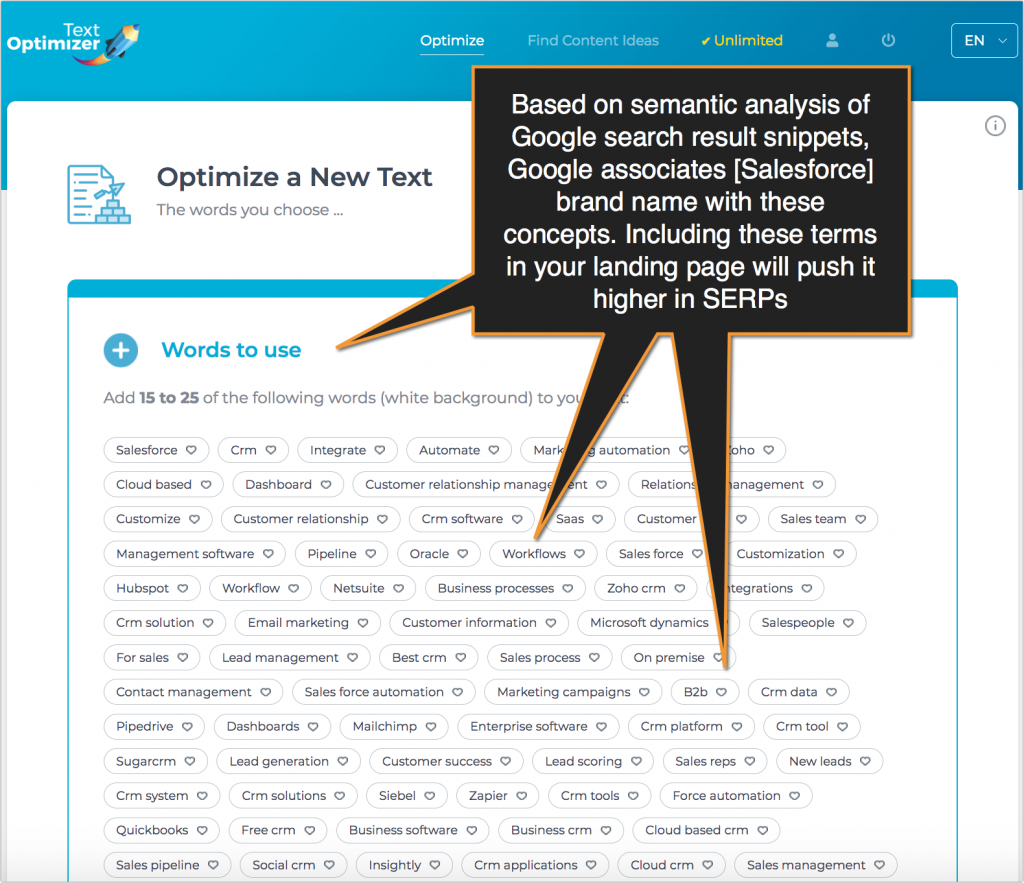
What do people think of you and your brand? Which associations does it currently trigger?

Text Optimizer helps you find answers to all those questions by searching for your brand name in Google and analyzing search snippets that show up for that search.

Here’s how semantic search works if you are curious!

Cater to the Audience

Showing interest in the audience is an important part of good communication with consumers because it often cultivates further engagement.

By incorporating and inviting feedback from customers, it not only allows for businesses to assess their target audience, but it also lets the audience feel included and important. In addition, adding content that the audience is interested in helps the audience see the company as a more human entity with a shared interest, something that will encourage the audience to take a liking to the company.

Companies can cater to the audience in many ways, such as:

  • Posting things for enjoyment, not simply promotion of the brand
  • Using consumer generated or created content
  • Hosting audience involvement initiatives such as social media campaign competitions or giveaways
  • Sharing, liking, or re-tweeting pertinent customer mentions or tags

Cultivating Communication and Humanization Habits

Taking the first steps towards brand humanization and communication is no doubt important, but it is also imperative to continue the routine of good communication with customers.

Maintaining open lines of communication with consumers is a great way to constantly improve upon the service being offered, it enables businesses to hear how customers are feeling and adjust practices accordingly.

By taking customer thoughts and feelings into consideration, customers and businesses can foster positive and long-term relationships, which culminate into giving customers the service they want.

Filed Under: Marketing

How to Generate Online Leads for Your Local Business

May 26, 2022 by Jessy Troy

I was thinking the other day about lead lists. Do you remember those? They were lists compiled by marketing or sales agencies, occasionally by individuals, then sold.

The idea was to have a huge list of potential customers right there at your fingertips, cutting out the work involved in generating your own leads.

Unfortunately these lists were sold to everyone who searched for them, making them an over-saturated collection of names and email addresses that did more harm than help.

The truth is that lead generation takes effort. We can’t take shortcuts and expect results, because the process of finding leads is such an important and necessary part of the overall process.

Does that mean we can’t find ways to do it a little more efficiently? Not at all!

Set up your site

It is astounding how many local businesses still have no websites to link to from their Google Local or Yelp profile pages.

In any digital marketing strategy starting a website is fundamental to any business.

Use this cool brand name generator to set up your brand identity and go from there!

namify

Utilize other forms of media

Take your time to make the most of your social media profiles:

  • Add your address and phone number wherever you can!
  • Keep your response time prime. On business pages there is a little box by the Send a Message option that states how long pages respond. You want yours to be immediate. So make sure you are keeping up on those direct messages.
  • Take advantage of pinned posts. You can pin a post to the top of your page, where every other post will fall underneath it without dislodging its spot. That allows you to provide a message to everyone who visits your page… like maybe a CTA to visit your site?
  • Use GREAT branded images. People can sometimes skimp out on adapted logo images for social sites. You need to go the extra mile here and make sure it is the highest possible quality. There are a variety of WordPress plugins which you can use for that. Colorlib has a great collection of those!

But don’t just stop there: Integrate your online and offline marketing efforts whenever you can. It is shocking to see how effective TV and radio ads can be on a local level. If you happen to be in a position to run ads, or you have been already, put your URL in there, then mention your social media pages.

Make sure it is all very easy to remember, though! No one is going to visit if your URL or social media tags are overly complicated.

Create an app that can be used both online and in stores

Apps are pretty much the standard these days, as it is rare to come across someone who doesn’t have a smartphone. Even brands like McDonald’s have created apps, which allow people to order food in ahead of arriving, or use QR code coupons to take advantage of deals you can’t find anywhere else.

Having an app that can be used both in and out of physical stores nicely ties together those leads, while giving you a goldmine of customer information that normally you would have to pay a marketing agency to find for you.

Find other local businesses to cross-promote with

There is a restaurant that also has a food truck that sells to local businesses during lunch time, traveling from lot to lot for fifteen minute intervals. They also have a static location that is mostly ignored.

In order to improve their sales at the actual restaurant they teamed up with a local brewery that creates craft lagers that have been growing in popularity. They offer half-off appetizers with the purchase of one of these beers, at one per table.

The brewery also offers this promotion on their end. You can pick up a coupon from their on-site store for the half off appetizer when you go into the shop. That way people don’t have to buy the beer during their meal but can still get the benefit.

All of this is promoted – you guessed it – online. It is a great example of how you can integrate cooperative strategies both online and offline for the mutual benefit of both brands.

Other businesses are looking for the same chance for backlinks that you are. Cross promotion can be a great way to get that. Say you own a bike shop that is known for bikes of all types and purposes. In your city there is another shop that is known for outdoors gear like tents, hiking boots, etc.

You two can combine forces to offer discounts for goods at one another’s store, or perhaps come up with a bundle package that appeals to mountain bikers. Post about this cross promotion on social media and one another’s websites for some powerful backlinks that also lets you each target one another’s established audience.

Use local directories to find those local businesses to partner with!

Inject yourself into local communities

A nearby Atheist group was looking for local sponsors to provide event spaces and items for their community get-togethers, parties and charity galas. About a dozen local companies obliged and have given food, merchandise and free use of business space for parties.

Every time an event is hosted these companies are named as sponsors online through social media, newsletter emails, on their official site and during reviews. This is a great opportunity for online presence building for those businesses and that is resulting in an increase in the local companies getting involved.

Local communities of all types are a perfect platform for visibility, while building a feeling of goodwill with local customers. Many of those businesses also gained lifelong customers. One local burger joint providing food for the past several events have credited that particular organization for an almost doubling of their weekly sales!

Small businesses have a great advantage of using online marketing these days! So don’t neglect those opportunities!

Image source: Pixabay

Filed Under: Marketing

  • « Previous Page
  • 1
  • 2
  • 3
  • 4
  • …
  • 11
  • Next Page »

Recently Updated Posts

Is Your Brand Fan Friendly?

How to Improve Your Freelancing Productivity

How to Leverage Live Streaming for Content Marketing

10 Key Customer Experience Design Factors to Consider

How to Use a Lead Generation Item on Facebook

How to Become a Better Storyteller


From Liz Strauss & GeniusShared Press

  • What IS an SOB?!
  • SOB A-Z Directory
  • Letting Liz Be

© 2025 ME Strauss & GeniusShared