Successful Blog

  • Home
  • Community
  • About
  • Author Guidelines
  • Liz’s Book
  • Stay Tuned

5 Top Collaborative Tools for Content Marketing Efficiency

May 11, 2017 by Guest Author

By Jessica Davis


Content creation has been identified as one of the biggest challenges that marketers face. Some companies work with in house teams, while others work remotely with freelancers or agencies to create their content. Regardless, managing everything from planning to approval requires some coordination, and the process can be frustrating. Low content productivity can affect your company’s content output and slow down your content marketing efforts.

Check out these collaborative tools that can streamline the process and boost your content productivity.

Trello

As a content strategist, you have to oversee content production from start to finish. Managing that job is a nightmare, with dozens of files for different clients being passed between writers, reviewers and SEO analysts. A hangup in any stage can cause a drop in content productivity. You can use a collaborative content management system to add some structure to that chaos. That is where Trello comes in.
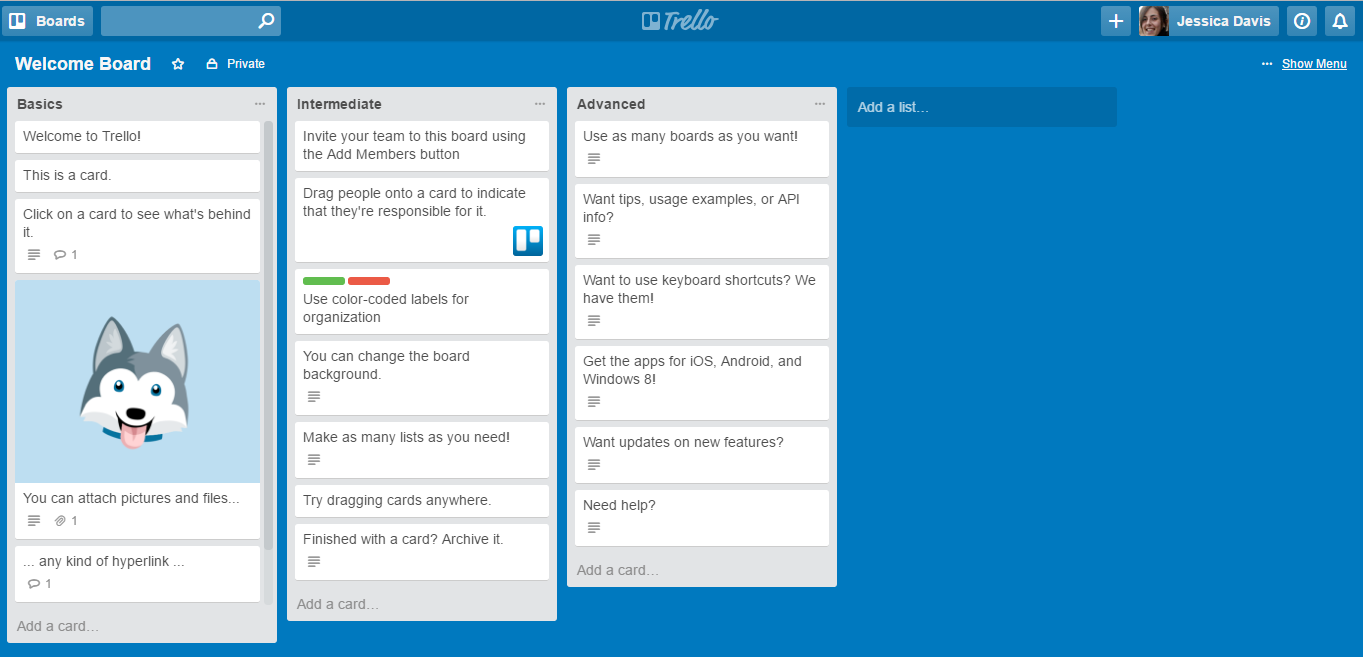
Trello screenshot

Creating projects

You can add a new project by creating a card and labelling it. Once you have invited team members to join your project board, you can assign projects to them by tagging them on cards.

Managing projects

You can set a deadline for each project and hold that person accountable by commenting on his/her card, when the project is overdue. You can move a project between phases (say topic – in process – to be reviewed – to be posted).

Reviewing content

People working on projects can upload files on their cards on completion. You can view files on cards and share suggestions via comments or make changes to the files and upload them again.

You can create an account for anyone and invite them to your project board for collaboration. By shifting your team to the app, you can oversee all your projects, virtually, in one place.

DrumUp

As a social media manager, you have to work with copywriters, graphic designers and brand strategists to create your content. Even if you manage your brand’s social networks by yourself, doing it on more than one social media page can be tough.

With an app, you can manage multiple social media accounts with ease.
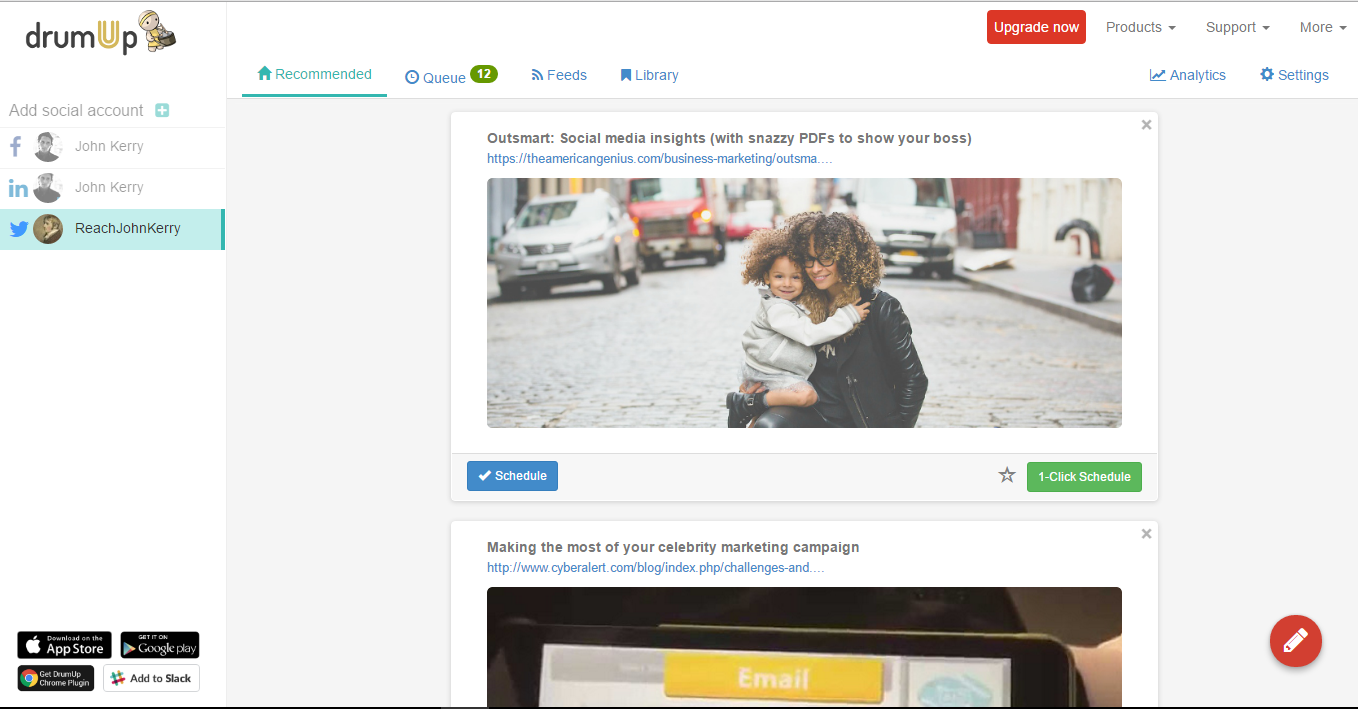
DrumUp screenshot

Collaborative social media management

You can add team members and give them different levels of access to the content stored on your app dashboard. You can provide them with access without having to giveaway your social media account passwords and review all the content they create before it gets posted.

Managing original content

You can store your content online where it is easily accessible in a content library and schedule content from there, to be posted on your Facebook, LinkedIn and Twitter accounts when needed.

You can also view the queue of your scheduled content in calendar form to get a sense of how many posts you have set for each day and what the overview or general theme seems to be.

Curating content

Your industry probably has great publications and experts who create brilliant content on a regular basis. You could curate that content for your social media audience, to show them that they can trust you with content in your niche.

You can also use the @mentions and #tags that the app recommends with suggestions to build powerful relationships with influencers in the industry, so you can collaborate with them for content.

GetResponse

As a content marketer, email marketing is probably an important responsibility. If you are working with a large team for multiple clients, or working for a large organization globally, you need to collaborate on concept, content and execution.

That’s where GetResponse can be used, to make collaboration effective.
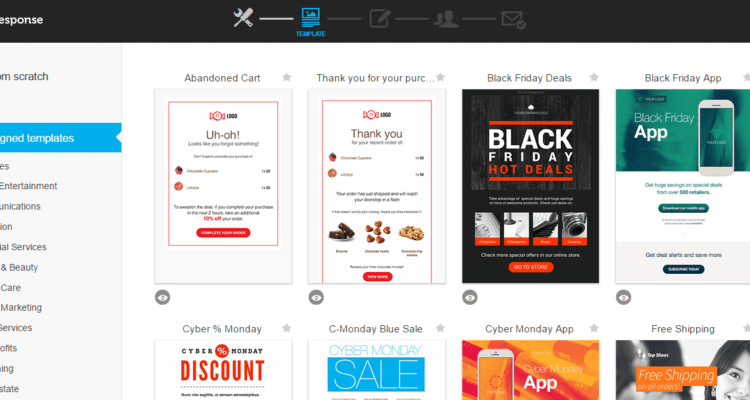
GetResponse screenshot

Collaborative email marketing

You can provide users different levels of access to the company account and overview all of their content before it gets delivered to your client base. You can also give read-only access to certain people of required (reviewers or clients).

Creating newsletters

If creating newsletters is only a part of your responsibility, you can streamline the process by using built-in templates and stock images.

Optimizing newsletters

If mobile view is a priority (and it should be), you can preview your designs in mobile view before scheduling it to be sent to your email database.

You can also personalize emails by inserting the custom name field wherever necessary in your email text.

If needed, you can also automate the responders to ensure that your email recipients don’t feel ignored when they write back to you.

Finally, if your email database is diverse, you can target your content better by segmenting your email lists by custom data, geographical location, subscriber engagement, date and more.

You can also provide teammates access to analytics so they can stay in the loop about email marketing performance.

WorkflowMax

If you work for multiple clients and collaborate with a team of people responsible for the content production, managing trivial but crucial tasks like proposing quotes and tracking payments can be a hassle that takes focus away from the content.

WorkflowMax is an interesting means to solving that problem and streamlining client communication.
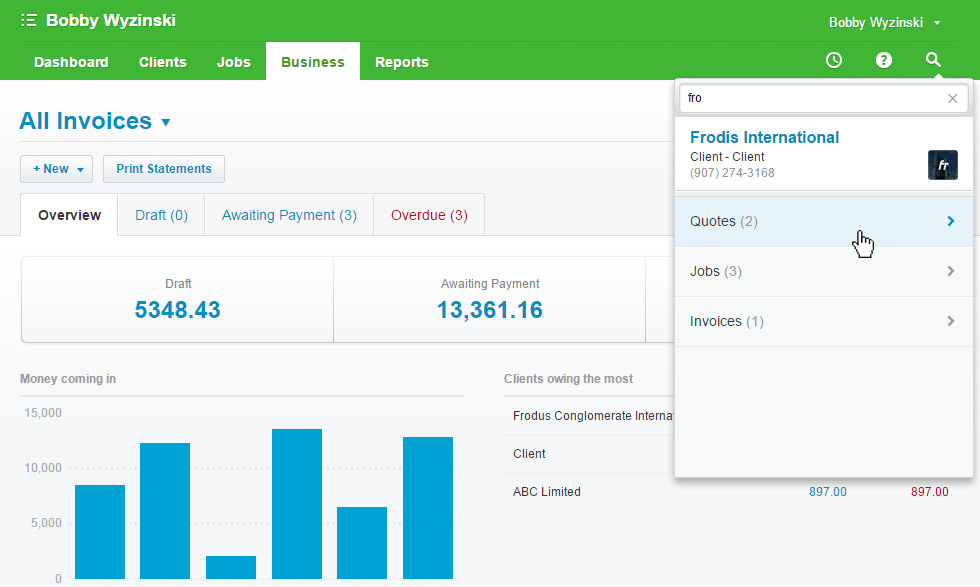
WorkFlowMax screenshot

Customizing client interaction

Your brand is a promise of the content you intend to deliver. You can make your brand a part of all the communication between you and your clients by enabling automated insertion of brand insignia on quotes and invoices.

Storing project details

Manually forwarding data between teams can be a cumbersome task to manage each time a client comes on board.

You can use the app to store and share account details like emails, documents and other information where your team can access them.

Assigning and tracking projects

You can assign projects from the main dashboard, set deadlines and track them. You can also automate reminders so your teammates receive emails to notify them of projects that are past their deadlines.

The tool helps you see who’s working on what, so you can allocate your resources better. You can also monitor the budget being spent on each project and analyze which projects earn you most revenue.

The dashboard can be accessed from anywhere, making it easy to work on the move.

You can also provide clients access so they can follow progress and add their comments on the work that is taking shape.

MailShake

As a content marketer, emails sent to clients aren’t the only ones you have to worry about. You probably also send emails for guest post pitches, content promotion, link-building, co-marketing partnerships, lead generation and PR pitches.

Managing email campaigns can be a challenging task. That’s where MailShake can make a difference.
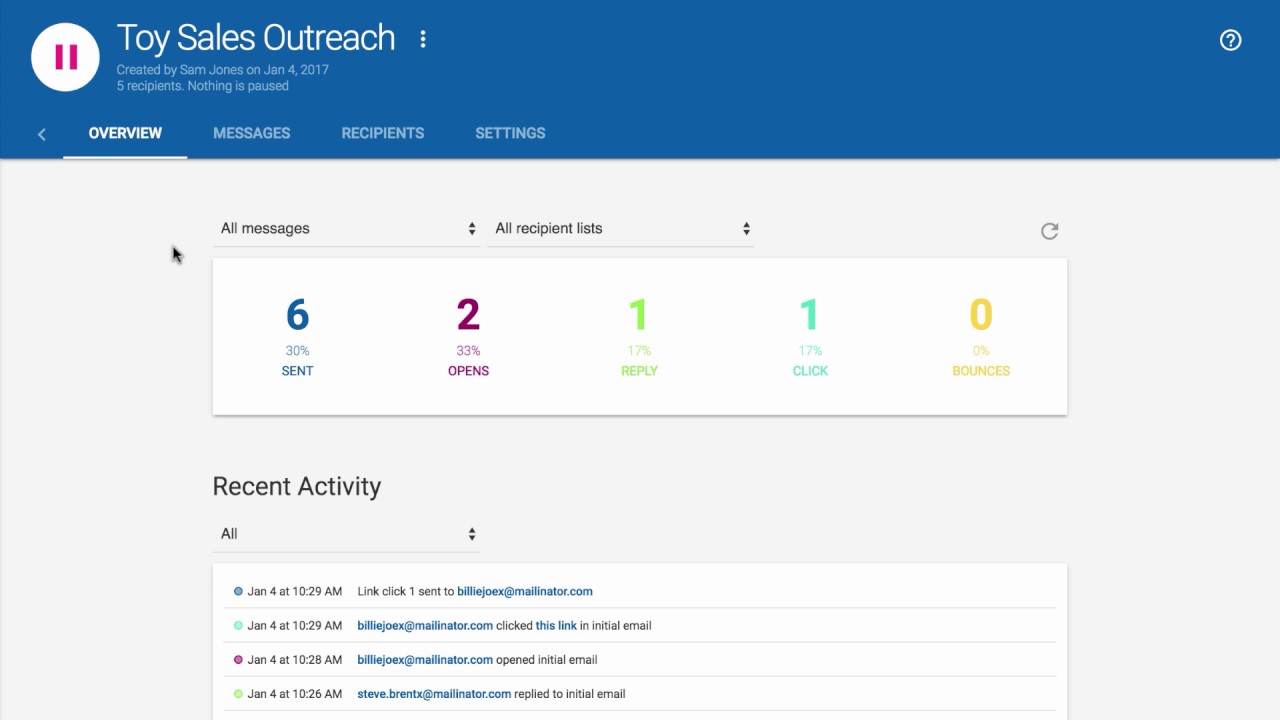
MailShake screenshot

Collaborative email management

You can create an email management team and provide certain people access to edit, pause or stop your campaigns.

You can also set long-term campaigns on an automated loop to avoid doing it manually every single time.

Creating email copy

You can enter your deliverables into the app to generate copy for your emails. Further, you can store drafts for each type of email that you intend to send out.

Following up with emails

Sending an email is just the first step – you have to follow-up when needed and ensure that you get through to the person you’re trying to reach.

You can set up reminders to follow-up with certain people based on triggers. Set up alerts to be notified when someone clicks on a link, or no reply is received to an email within a previously decided interval of time. You can rely on those reminders and relieve yourself of the burden of remembering too much.


Author bio

Jessica Davis is a Content Writer at Godot Media, a leading content agency. represents Godot Media. Her areas of interest include social media and content marketing, science and fashion.


Featured image via Pexels.com
Filed Under: Content Tagged With: content marketing

11 Stress Relievers You Can Try At Your Desk

May 7, 2017 by Jessy Troy

Even the easiest and most enjoyable job can get stressful at times.

If you take a few minutes to de-stress, however, it will make your job easier to handle, and also will prevent you from suffering the ill effects of continued stress.

Here are 11 stress relievers for inter-office relaxation you can exercise at your desk.

1. Do relaxing exercises while sitting in your chair. Close your eyes, take a deep breath, release it, and concentrate on relaxing your whole body from your toes to your head. This is something you can do on your break, perhaps in the employee lounge or somewhere else other than your desk, so you can put all thoughts of work out of your mind for a few minutes.

2. If your job is particularly stressful, ask your supervisor if you can take shorter but more frequent breaks, instead of one long lunch and two extended breaks. Offer to shorten your lunch hour in exchange for them. The more frequent breaks may leave you feeling more refreshed than long ones. If you get permission, take those opportunities to do a few stretching exercises.

3. Keep a book of short devotionals, jokes, poems, or similar subjects at your desk. Take a few minutes to read one after you have finished one project and before you start on another one.

4. Diversify your snacks. Prepare some healthy, yet delicious snacks that have proven to give you joy. Mine is fruit and berries. I love doing some fun stuff with fruit (salads, smoothies, etc.) and enjoy it as snacks.

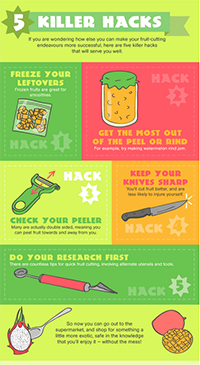
BucknBear Knives has a great infographic teaching you cut fruit in various creative ways. Steal the idea!

Fruit

5. Play “trashcan basketball” by simply wadding up paper and aiming for the wastebasket. Just remember to pick up the ones that missed! You can do this on one of your frequent breaks or on your lunch hour.

6. Ask your supervisor if you can set up a basketball goal for quick lunchtime games during nice weather. In cold weather, ask if you can bring in portable exercise or indoor game equipment and borrow some empty space. If you can’t think of any type of indoor game equipment, remember this: A ping-pong net stretched across a couple of unused tables will work perfectly. Just add paddles, balls, and players.

7. Play trivia games during downtime. Use online or hard copy materials, or the Trivial Pursuit game. Challenge co-workers to compete against you.

8. Work puzzles during downtime. Keep an actual puzzle book at your desk instead of using online puzzles, unless you have received permission to use online resources for this.

9. Take a walk during your lunch break. On nice days, get outside. On the days with bad weather, walk around the different floors. Not only will you be getting exercise, you may even meet new people.

10.Video games (played only on your personal time, of course) can be a great way to clear your mind. Find someone to play a game that requires two people and get a game going during your lunch break.

Teksocial lists some free meditation apps to help relieve stress.

Meditate

11. If the stress is getting too bad, take advantage of employee-sponsored counseling services. Confidentiality is observed, so nothing you say will get back to anyone.

Don’t be afraid to use de-stressing techniques while at work. Your physical and mental health is more important than any project will ever be. If you’re too stressed to perform at work to your peak capacity, then everyone, yourself included, will be affected.

Filed Under: Business Life

Get Your Career Back on Track after a Serious Incident

May 6, 2017 by Thomas

car-wreck-1618179_640For many workers all across the nation, their jobs are their lifelines.
Stop for a moment and think about where you would be if you were not working.
Among the factors to consider:

  • Money – How would you support yourself without a regular job? For most people, the answer is they would not be able to. Even if they are in a low paying job or jobs, that works keeps them off the streets.
  • Career – Any significant breaks in your working life can lead to more problems. Many employers will avoid individuals who have sizable gaps on their resumes. As a result, it can be hard to get back into the working field.
  • Trouble – Without a regular work routine, would you end up getting into trouble? For some folks, too much free time on their hands can be trouble.

For you to avoid your career get sidetracked, you need to see that your work life stays together.

That said a serious incident in your life can derail your career at the snap of a finger.

If that happens, will you be able to rebound?

What Kind of Events Can Derail You?

Among the types of serious incidents in life that can derail your work life:

  1. Accident

If you’re hurt rather seriously in an accident, the ripple effects can be tough to overcome.

You are trying to get your physical and mental health back, two tasks that can be difficult to achieve.

Making matters worse is when the accident wasn’t even your fault.

For instance, did the driver who injured you get away?

Unfortunately, hit-and-run accidents are all too common nationwide.

If there is no police report, you already are behind the eight ball. Were there any eyewitnesses or video evidence? Again, if you can’t find either, where do you turn for help?

If you were able to catch the vehicle plate of the hit-and-run driver, you at least have something to work with.

License plate searches following a vehicle accident can help you out. In finding the other driver, police can look for damage to their vehicle. They may have also sought medical attention right after the accident.

Even though it may seem at first like a long-shot, be sure you exhaust all your options.

Not only has someone hurt you and, they may have put your career on hold for a significant amount of time.

  1. Illness

A serious illness is another obstacle you might need to overcome to get back to work.

Examples of this can include treatments for cancer and other life-threatening diseases.

While many employers will work with employees, some may choose otherwise.

If you find yourself dealing with that latter, you may have to fight for your job through the legal system.

As if the physical suffering from cancer isn’t bad enough, now you’re dealing with the mental stress too.

The best thing you can do is focus on your health.

Yes, your ability to work is important, but how can you do a good job if your health is far from what it should be?

If you do get a serious cancer diagnosis, take time to sit down with your employer and discuss your options.

By being upfront, there’s a good chance you two can come to an understanding to benefit both parties.

  1. Death

Losing a loved one can be one of the hardest things many people deal with on a regular basis.

Not only is there the physical loss of having that person in your life, but also the emotional fallout.

Any point in the day can remind you of that person. When that occurs, the thoughts are happy ones. Even when they are, yet, it can give you a sense of grief and loss.

Although some people are able to immerse themselves in their jobs to dull the pain, many others can’t.

If you are having trouble focusing on or even going to work after the death of a loved one, don’t be afraid to seek help.

By getting things off your chest, you can bring some comfort to the situation.

Sure, you will likely never get over losing that individual.

That said you will be able to get back some semblance of normalcy in your life, including in the workplace.

Photo credit: Pixabay

About the Author: Dave Thomas covers business and career topics on the web.

Filed Under: Business Life, Personal Development Tagged With: business, career, finance, illness, injury

Types of Commercial Real Estate Leases: Finding the Right fit for Your Business

May 4, 2017 by Rosemary

By Kris Lindahl

Commercial real estate leases are vastly different than those used for residential properties. While a residential lease is typically a pretty straightforward matter with the tenant being responsible for the rent, as well as any utilities, commercial real estate leases are typically determined by the type of commercial business. Four of the most common types are outlined below.

1. Gross Lease

Sometimes also referred to as a full-service lease, a gross lease is one in which the landlord is responsible for paying for the insurance, taxes and maintenance of the property. In most cases, the landlord collects a fixed amount from each tenant and pays the expenses noted above from it. Many gross leases also contain escalation clauses that build in rent increases over time in an effort to offset the higher landlord costs that are projected in the future.

A gross lease is the ideal choice for industrial properties, as well as single- and multi-tenant office buildings. Accountants, attorneys and some types of consultants would also find a gross lease to be a good fit. Prior to signing a contract on a gross lease, however, it’s a good idea for the tenant to be able to project their rent expenses in the future given the presence of the escalation clauses and avoid any surprise rent increases.

2. Triple Net Lease

A popular commercial real estate lease option that is often found in use for those retail and industrial properties that have multiple tenants, a triple net lease works for the landlord when renting to those businesses whose expenses fluctuate widely. The bulk of the expenses associated with operating the property is placed squarely on the tenants.

Because businesses such as manufacturing plants, auto repair shops and other commercial ventures that are utility-heavy and/or tend to be harder on the structure, the triple net lease is the ideal choice for the landlord.

Tenants, on the other hand, need to be more vigilant about their expenses to ensure that their costs don’t spiral out of control. Tenants that rent space in older buildings might find that their utility and maintenance bills are higher because the building needs to be renovated due to its age.

3. Percentage Lease

A percentage lease could be the ideal fit for those commercial tenants whose sales fluctuate a great deal depending on the time of year and other economic factors. This type of lease works by the tenant paying a base rent, as well as an additional percentage that is determined by their monthly sales volume.

Ideal for a retail business that must rely on much of its sales around a season such as the holidays or summer to stay solvent, a percentage lease doesn’t mean that the landlord is entitled to all of the company’s earnings. In fact, because the landlord only gets a percentage of the sales volume once a certain threshold is met, this type of lease is ideal for businesses located in a mall setting or whose sales vary over time.

4. Modified Net Lease

The modified net lease can be described as a compromise between a triple net lease and a gross lease. It leaves more room for negotiations between the tenant and landlord with the maintenance expenses typically being split between them in some fashion. Utilities are another aspect of a modified net lease that is likely to be split between the two entities.

That being said, with a modified net lease, the tenant is typically responsible for paying taxes and insurance, along with their rent. Modified net leases are a popular compromise for those commercial businesses that have high expenditures for utilities. Older buildings that require more and higher maintenance costs are another good candidate for a modified net lease.

The above overview of the most common commercial real estate leases gives tenants a starting point when finding a good fit for their business. Reading over a proposed contract carefully before signing provides clear expectations for both parties.


Author Bio:

Minnesota real estate broker Kris Lindahl’s “All In” approach to life is key to success in his career as a leading real estate professional. His energy and devotion are a perfect fit for the lighting-fast pace of today’s real estate industry.

Find him at https://www.krislindahl.com/ or on Twitter @krislindahl.


Featured image via Flickr CC: Travis Wise

Filed Under: Business Life Tagged With: office space, real estate

Is Your Small Business on Solid Financial Ground?

April 28, 2017 by Thomas

dollar-1362243_640Does anything scare you when it comes to managing your small business?

If you are like many other small business owners, you know all too well how things can change in a heartbeat.

At one point and time, things are humming along. Take a look a couple of months down the road and you’re nearing or in the red.

So, how do you go about doing all you can to keep your small business on solid financial ground?

While there are many ways to approach this, some work better than others.

Are You on Top of Your Business Needs?

To do your best to keep your small business running along, file away these tips:

  1. Expenditures

One area of major importance is of course your office expenditures.

Are you spending too much money, money that can be saved with some ingenuity on your part?

Always look to see where you can cut costs without cutting performance.

Areas to scale back on include supplies, transportation, and how many hours the office is open.

With that last one, letting employees work from home one day a week can lessen your need to be open five days a week. How much could you save with an extra day a week having the office closed?

Also, go back and review what you spend for office supplies.

In many instances, you are not doing needed things like recycling or buying supplies in bulk.

And when it comes to transportation needs, think how you use any office vehicles.

For instance, if you have to make deliveries to and/or meet with customers, think about how you schedule them.

Try and get with several customers all in a period of time the same day, avoiding running in and out of the office.

  1. Growth

Understanding when to grow your small business is important.

While you might be timid, know that increasing your company’s capacity can be what the doctor ordered.

In doing this, you might need some fast cash for your small business.

If you do need some cash infusion, be sure to research the options available to you.

Knowing where that money will be coming from, what to expect in return etc. are both quite important.

Take the time to think about any growth plans.

The worst thing you could do is rush into an expansion. This would be one in which you were not prepared on many fronts.

  1. Security

Even if wanting to grow moving forward, don’t fall asleep on your company’s security.

As an example, has your company ever faced a security breach? If not, consider yourself lucky.

Too many companies over the last decade have in fact suffered security breaches. They can be even more impactful when it is the small business owner taking the hit.

To keep on solid financial ground, be sure to invest in whatever security needs are necessary.

From your online efforts to what you do as a small business owner offline, never think it can’t happen to you.

So, as you move forward this year, do you consider your small business to be on solid financial ground?

Photo credit: Pixabay

About the Author: Dave Thomas covers business topics on the web.

Filed Under: Business Life, management Tagged With: business, expenses, finance, growth

Technology, the Future, and You

April 27, 2017 by Rosemary

by Amy Blankson

For those of us born before 2005, I’m sure you can think back to a time in your life that was not lived side by side with technology. When you had to go down to the library to look something up instead of searching for it on Google. When you had to make plans with your friends in advance of showing up somewhere. When you had no idea how many steps you had taken that day or how many times you asked a girl named Alexa a question.

The younger generation, on the other hand, spends an average of six-plus hours per day on their phones, literally changing a quarter of their life experiences from what we have known in the past.

With technology living in tandem with human beings, supporting nearly every function of our busy lives, the question now being asked is, are we happier? Would we be better without technology? Where are we heading?

These are some of the questions I ask in my new book, The Future of Happiness (April 2017, BenBella Books), which outlines several strategies for balancing productivity and well-being in the Digital Era. When people ask me these questions, I respond with some of these ideas:

Is technology making us happier?

Knowing that technology is here to stay, we need to learn how to live with the complexity of technology, not escape from it, but that doesn’t mean we have to sacrifice our well-being. That is not the price we pay for having access to information.

That being said, in order to live in harmony with technology, we must make a conscious effort to focus on what’s most important in our lives and to not get distracted.

Consider this: when you’re flipping through Facebook, posting pictures on Instagram or using any of the apps on your phone, stop and ask yourself, ‘is this making me happy?’ If you don’t know the answer to that question, create a trial period for the app that you’re using. If you feel happier or more productive after a month of using the app, make a mental note of your progress and continue to use the app.

If the opposite is true, you know what to do. Toss it out like yesterday’s newspaper. Life is too short to be wasted on apps that are not contributing to our overall well-being.

When it comes right down to it, technology is merely a tool to help us, not the answer to all of our problems. It is up to us whether or not we will allow technology to control our lives and our happiness. We all have the innate power to control technology so we can continue to live positively and productively.

What can we do to maintain a well-balanced technology diet?

In order to maintain a satisfying level of happiness and well-being in the Digital Era, it is important to consciously curate the amount and quality of technology consumed every day.

There are several strategies you can implement to find the right level of technology consumption that does not affect relationships or productivity in other areas of your life.

Establish tech-free brain breaks throughout your day to help your brain recharge, whether it’s right before bed, taking a phoneless walk on your lunch break, or playing with your kids. When interacting with others, close your laptop, and take your earbuds out to say hello when someone walks into the room.

Establish hard-and-fast rules for your use of technology and model digital citizenship in a way that makes sense for you. Not only will your life become more productive, but as you start to form good tech habits, it will create a ripple effect for those around you, especially your kids.

Beyond these ideas, one of the most important things to keep in mind is that you have the ability to change your mindset. Just like Dorothy had the power inside of her all along to go back home to Kansas, you have the innate power to shape the future of technology and your happiness. You are welcome to let technology run your life, but just as simply, you are allowed to take control of your technology. Our devices can have a positive effect in our lives, but only if we allow it. As Shakespeare once said, “there is nothing either good or bad, but thinking makes it so.”

To learn more about strategies that can help you be more productive and happier with technology, click here to order The Future of Happiness.


AUTHOR BIO:

Amy Blankson is a happiness expert on the forefront of testing new technologies to foster well-being.  Amy’s upcoming book, The Future of Happiness: 5 Modern Strategies for Balancing Productivity and Well-Being in the Digital Era, (BenBella, April, 2017), brings her years of experience in happiness research and consulting to deliver a roadmap for those feeling overwhelmed by the wave of technology. She has a BA from Harvard and a MBA from Yale School of Management. She has been called upon by the likes of Google, NASA, the US Army, and the Xprize Foundation to consult on positive psychology strategies.


Filed Under: Personal Development, Uncategorized Tagged With: happiness, technology

  • « Previous Page
  • 1
  • …
  • 36
  • 37
  • 38
  • 39
  • 40
  • …
  • 1050
  • Next Page »

Recently Updated Posts

The Creator’s Edge: How Bloggers and Influencers Can Master Dropshipping

Is Your Brand Fan Friendly?

How to Improve Your Freelancing Productivity

How to Leverage Live Streaming for Content Marketing

10 Key Customer Experience Design Factors to Consider

How to Use a Lead Generation Item on Facebook


From Liz Strauss & GeniusShared Press

  • What IS an SOB?!
  • SOB A-Z Directory
  • Letting Liz Be

© 2025 ME Strauss & GeniusShared