Successful Blog

  • Home
  • Community
  • About
  • Author Guidelines
  • Liz’s Book
  • Stay Tuned

Women in Small Business: Why They Thrive

August 18, 2015 by Rosemary

By Jennifer Jope

Women and business might just be the perfect match.

While we should applaud the recent growth in multi-million dollar female-owned organizations, women are also instrumental in bringing success to small businesses. An added perk? We’re gaining valuable experience at the same time. The best news? There are benefits both for the employers who employ women and for the women themselves.

For Employers: Women Are Good For Business

The numbers don’t lie. Women bring more money to the table.

According to the infographic, Women Rising: Women, Work and What’s Next, companies whose boards include the sustained representation of at least three women board directors outperform those with no female directors:

  • Return on sales: +42%
  • Return on invested capital: +66%
  • Return on equity: +53%

Today, women are better educated than men earning 60% of bachelor’s and master’s degrees. Despite having the smarts, they have faced an uphill battle in the workplace, but we’ve turned it into a positive. Faced with challenges, women are better than ever at strategic thinking and finding creative solutions.

And, any good business owner knows that women influence the economy. As a recent Forbes article points out, the majority of consumer spending is female-driven indicating that women know what makes a good product or service.

For Women: Small Business Gives You Experience

Forbes called 2014 a breakout year for female entrepreneurs and 2015 is looking the same way. Why? Women have proven they can build robust teams and problem-solve differently than men. We’re experts in a variety of industries, but perhaps most importantly, we support each other.

By doing this, we are going from unknown status to business mogul status.

Women in small business are seeing their visions come to fruition. Strong communication skills and great networking chops are often innate in us, but as small business leaders, we can hone these abilities even further. With a stronger skill set, you’ll be able to conquer larger challenges that come your way.

Running a small business forces you to fight for what you believe in, get scrappy when necessary and thoroughly understand the bottom line. Who doesn’t want to be good at that?

Tips to Succeed:

  • Ditch perfectionism: Failures will happen. Learn from them.
  • Be supportive: Empower, mentor and support fellow women. It will pay off.
  • Keep learning: No matter how high you climb, learning should never stop.
  • Keep your eye on the prize: Stay passionate and trust your instincts to stay focused.
  • Have a voice: Speak up to make a difference.

If your small business is ready to expand, hiring women for the development phase could be the smartest move you make.

Running a company will always have uncertainties, but one thing is crystal clear: Women have the power to learn new skills on the job and shape the next generation of business.

Featured image via Flickr CC: Steve wilson

Jennifer Jope is a content manager for AllBusinessSchools.com. She is a former banking and real estate reporter and personal finance writer.


Filed Under: Trends Tagged With: Trends, woman-owned business

5 ways to become a referral magnet

August 13, 2015 by Rosemary

“I’d get more done, if only I could clone myself!”

Productivity is an elusive beast.

And if you’re a solo entrepreneur or small business owner, you’re always limited by the number of hours in the day.

Or are you?

Set yourself up as a referral magnet, and leverage those 24 hours.


What do I mean by “referral magnet?” I mean someone who has meaningful business relationships with people who are willing and able to refer potential customers to him/her.

Let’s break that down:

  • Meaningful business relationships = established, mutually beneficial support network of business colleagues (not friends and family, not drive-by Twitter contacts, not cold called sales leads)
  • Willing to refer = someone who has been asked if they will refer business, and has said they will do so
  • Able to refer = someone who has the knowledge of your skills and expertise in order to refer appropriate leads

It helps immensely if you are also a “referral machine,” willing to refer and connect others as well.

5 ways to become a referral magnet

  1. Put yourself out there. You can’t start building meaningful business relationships unless you’re attending conferences, joining online chats, and routinely talking to your customers (and I don’t mean by email). Just like it was in the schoolyard when you were the new kid, you have to be willing to jump into the double dutch.
  2. Establish a habit of asking for referrals. It’s not obnoxious to ask your fellow professionals, happy customers, or business partners to connect you with people who need what you offer. It’s good business practice, and yet so many are afraid of being “salesy.” It’s only “salesy” if you make it so. You’re not asking for “prospects,” you’re asking to be connected with people who are in need, so that you can help them. Simple as that.
  3. Arm your referral partners with information. They can only refer people if they know what you are offering, so come up with a crystal clear, punchy way to describe how you can help. Leave out the industry jargon, and the mission statement, and embed an easy phrase that they can associate with you. When they hear someone say “I really need to get my taxes sorted out,” they can simply say “Jane Doe does an excellent job. Want her number?”
  4. Reciprocate. It doesn’t always have to be quid pro quo, but look for opportunities to connect the right people, with no thought of “payback.” If you do this often enough, it will work magic all on its own.
  5. Say thank you. I don’t want to publicly “out” this person, but someone I referred potential business to once sent me a beautiful bottle of champagne with a note.  What a lovely way to say thanks. If someone gives you a referral, always follow up with a note, a call, or some gesture of thanks.

Have you activated a business referral network yet?


Featured image via Flickr CC: Jeremy Keith

Author’s Bio: Rosemary O’Neill is an insightful spirit who works for Social Strata — makers of the Hoop.la community platform. Check out the Social Strata blog. You can find Rosemary on Google+ and on Twitter as @rhogroupee


Filed Under: Marketing /Sales / Social Media Tagged With: business referrals

Build Your Online Portfolio from the Ground Up

August 12, 2015 by Thomas

White Keyboard with My Story Button.Is your online portfolio ready to impress?

With potential employers checking out new hires online, having an online portfolio makes good business sense, providing a valuable introduction to your skills.

Your choice of information and how you organize it could make the difference between being hired and being overlooked, so just what should you include?

Start with these six things:

Lead Off with an Introduction

Visitors want to get a feel for the person behind the portfolio, so be sure to include an introduction.

Your introduction should inspire confidence, giving a brief background on what you do, and who you are. Keep it short, but relatable. Your visitors are interested in the person you are and what you are like to work with – you don’t need to include your life story.

Industry Awareness

As the article “The Power and Impact of an Online Portfolio” points out, it’s a good idea to start by asking yourself about the expectations within your industry.

What skills, qualifications and personal attributes are employers in your industry looking for?

By cultivating an awareness of what employers want, you can tailor your profile to make sure it answers those needs.

Clear Focus

Avoid confusion by keeping your focus clear.

An overcrowded portfolio will fail to make an impact. Instead, summarize your key skills in one or two sentences that will leave visitors in no doubt as to what they’ll get when they work with you.

Be sure to include a strong introduction, an easy to browse selection of your work, a clear call to action to encourage contact, and visible contact details to facilitate that.

Qualified Statements

The maxim “show, don’t tell” holds true when it comes to your online portfolio. It’s not enough to simply list what you’ve done – details about your achievements are a must.

For example, if you re-designed a website for a restaurant, don’t just show your design. Talk about how many more visitors they got as a result, or how much revenue increased after it went live.

Leave your visitors with a clear impression of what you can achieve for them when they hire you.

Your Best Work

Choose your work for your portfolio carefully.

This is your chance to show your best work. It can be tempting to include everything you’ve done. However, it makes better business sense to take the opportunity to showcase the best of your work.

As well as choosing your best work, be sure to include some background on each project, such as the remit for each one and how you set about completing it.

Provide the Right Layout

Layout matters when it comes to your online portfolio.

The focus should be on your work, not on the layout surrounding it. Aim for a clear, professional look that easily draws attention to what you want to say.

Your portfolio should be easy to browse, leaving your reader free to focus on the quality of your work.

Make sure your portfolio is mobile-friendly too, or you could risk losing mobile visitors.

Your online portfolio gives you an opportunity to make your first impression count.

Take the time to plan and build it with this in mind so potential employers will like what they see when they visit your online home.

Photo credit: BigStockPhoto.com

About the Author: Tristan Anwyn is an author who writes on a range of topics including social media, SEO that works, and careers.

Filed Under: Business Life, Personal Branding Tagged With: branding, business, Careers, online portfolio

On Being Entrepreneurial For Another’s Benefit (And Your Own)

August 11, 2015 by Lindsey Tolino

You can be entrepreneurial in many ways and through many venues. However, most of them revolve around seeing a new opportunity, taking it, and seeing it through, even if it’s difficult.

A movie I watched a few weeks ago, McFarland USA, exemplified this. Have you watched it?

In it, Jim White (played by Kevin Costner) loses two football coaching jobs, the most recent at McFarland high school. McFarland is shown as a poor, Mexican-American town. Though he lost his coaching job, Jim stays at McFarland, working as a PE teacher. In PE, he notices how fast some of the students can run. He observes them further and finds that they run to and from school and working in the fields. He even follows one student, without his permission, to clock his speed (which ends up being around a 5 minute mile).Running

Jim then works to create a cross-country team, despite his lack of cross-country coaching experience. He works through various obstacles – principal’s permission, lack of interest and parental permission – to put the team together and see it through.

In the movie, Jim saw an opportunity, a significant strength, in the school and capitalized on it. He embodied entrepreneurship – and not just for his own benefit. His entrepreneurial skills benefited his players as well, with many of his runners receiving scholarships to college, which they may have not received otherwise.

I often think of entrepreneurship as a numbers game. I think of it as comparing the cost of an opportunity with its potential income. I think of it as taking an opportunity so I can make money off of it. Yet I love how McFarland turned that on its head.

Our entrepreneurship doesn’t have to serve us alone. We can be entrepreneurial for those around us. We don’t need to be all about ourselves. We know this, but sometimes we need a reminder.

I know I do. I sometimes get caught up in looking out for me and living much smaller than I should. I miss too many of opportunities to use my observations and skills to benefit others. And here’s the clincher – I’m pretty sure I’d be better off personally if I always used my entrepreneurial skills to serve others rather than to serve myself.

I mean, isn’t customer service a tenet of great business? Plus, I’ve been far more satisfied when I’ve used my skills primarily to serve others rather than to make money.

So, when we notice an opportunity that will serve others, maybe even more than it will serve us – let’s use it, let’s take it, let’s do it.

Because the most beautiful life we can create is one in which we use our skills, including our entrepreneurial ones, to benefit others. It truly is better to give than to receive.


Image info: Original image by Stefania Bonacasa.

About the Author: Lindsey Tolino comes alongside artisans, craftsman and people monetizing their passions to help them create healthy businesses. She shares her heart at ToBusinessOwners.com. Follow her on Twitter @LindseyTolino or connect with her on Google+.

Filed Under: Uncategorized

Top 5 Content Recommendation Tools for Social Media Managers

August 8, 2015 by Guest Author

By Jessica Davis

With the continuous need to come up with new content to keep your social media audience engaged, curating great content can seem like a challenging task.

As they say, content is king, and its importance in the world of social media marketing cannot be understated. In order to do a good job of sharing interesting content with your audience and keeping them hooked to your page, you need to know and understand their preferences and post content that interests them.

Here are five content recommendation tools that can help you curate unique content for your readers.

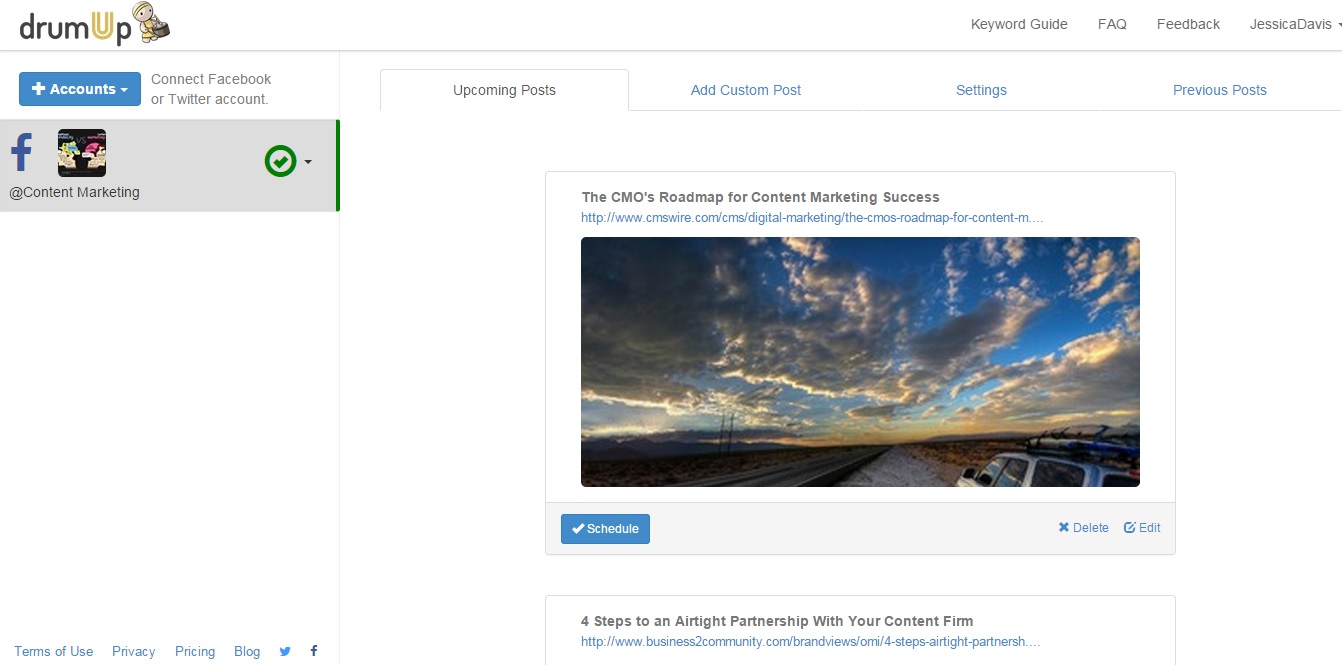
DrumUp

DrumUp provides you with free content recommendations through its tool and allows you to schedule your posts too, freeing you from the worries of what you should post and when you should post on your social accounts. All you have to do is insert a few keywords into the tool and DrumUp will process them to give you the most fresh and relevant content suggestions in your stream. It also features an added control of negative keywords to refine your results even further.

DrumUp screenshot

Flipboard

This app brings to you all the recent content published in newspapers and magazines from all over the world. Flipboard offers you more than 34,000 topics to choose from, and you can access all this content through a smartly designed graphic interface that offers easy navigation and even allows you to store articles for later reading.

Flipboard screenshot

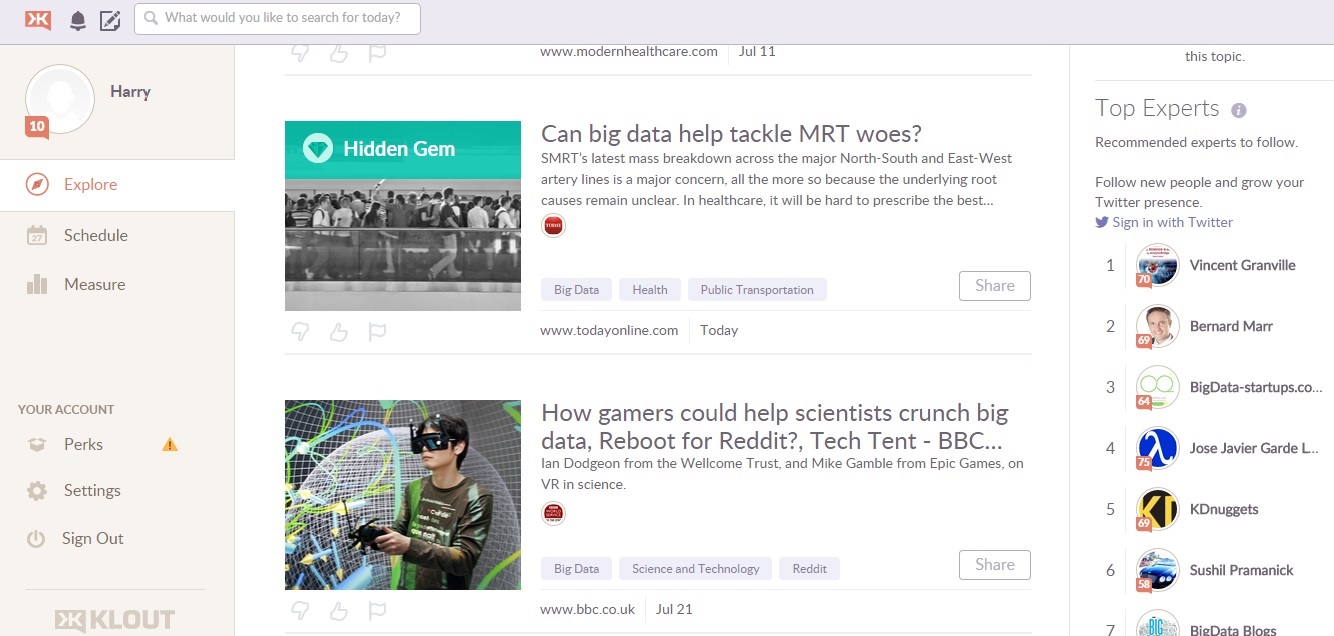
Klout

Klout works as a content recommendation search engine. By keying in the topics and keywords relevant to your business, you can unlock Klout’s suggestions in the form of articles and blog posts that will be useful in your social media marketing efforts. You can review and choose the ones that you think will generate most engagement and share them on your social accounts. The app, with its Klout Score feature, lets you measure the success of your social media posts and presents the data in the form of a graph for easy understanding.

Klout screenshot

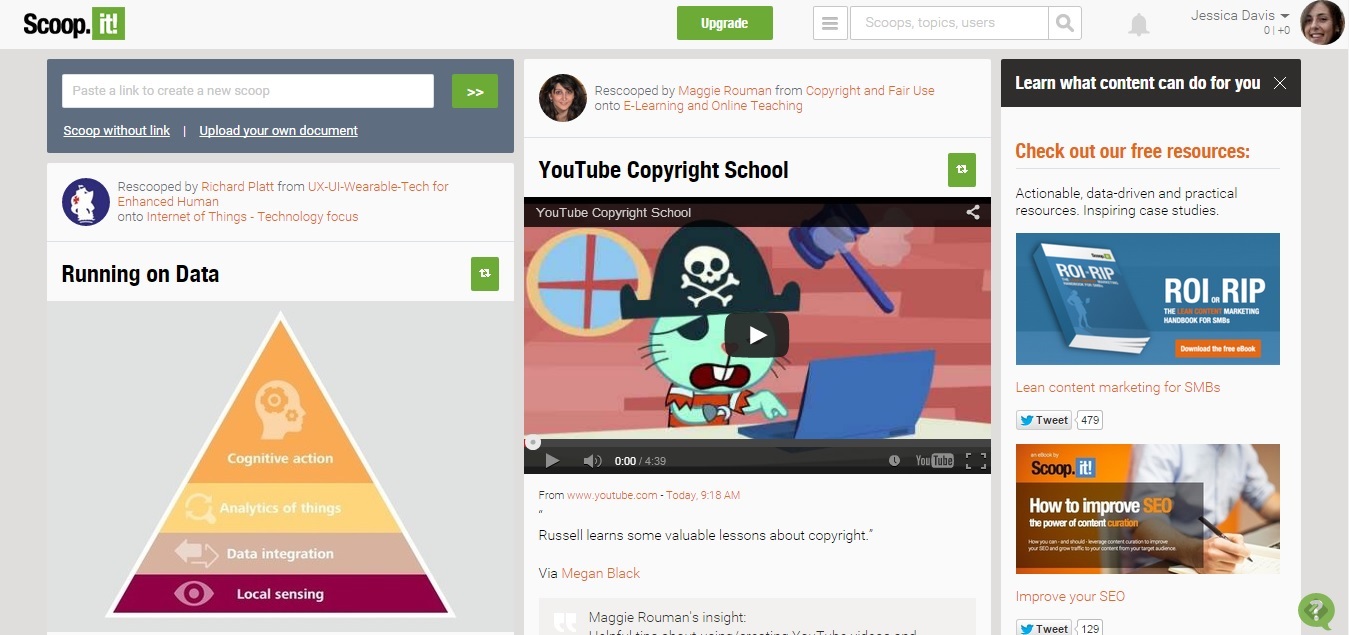
Scoop.it

Scoop.it recommends articles for you to share in your social media circles based on the keyword search you run. Once you find the articles of your choice you can add a customized message to the article before posting it online for your audience. The good thing about scoop.it is it allows you to post on multiple platforms at one go.

Scoop.it screenshot

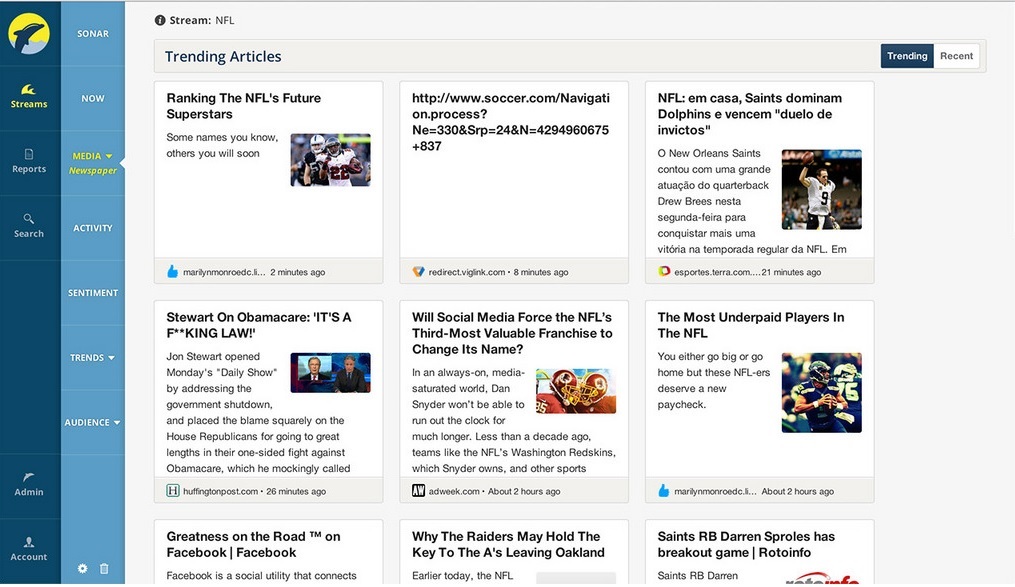
Bottlenose

This social media management app brings to you real time news and data. Bottlenose helps you identify new trends and directs you to opportunities that you can explore to create content and share it on your social accounts. It keeps you updated with trending stories allowing you to ride the social media wave with the most relevant and fresh industry stories.

Bottlenose screenshot

With these five topnotch content recommendation tools you will never face a dearth of content options as they will bring you the best and most effective content suggestions for all your social media marketing efforts.

Author’s Bio: Jessica Davis follows the social media and content marketing space closely, and writes about it extensively. She represents Godot Media – a leading SEO writing services firm.

Filed Under: Tools Tagged With: recommendations, tools

How to Ace Your Business Website Design

August 7, 2015 by Rosemary

By Linda Parker

There was a time when people assumed you did not need a website if you were not planning to sell your products online.

But with Internet usage exploding like there is no end to it, every business – big or small, local or international – needs a good website to establish brand presence, maintain customer confidence and boost sales.

So if you are planning to build a new website for your company from scratch or upgrade your existing one, you can use this handy infographic compiled by AddPeople to get your website design started on the right foot.

infographic - basics of a winning website

Featured image via Flickr Creative Commons: Team Dalog

Filed Under: Web Design Tagged With: website design

  • « Previous Page
  • 1
  • …
  • 78
  • 79
  • 80
  • 81
  • 82
  • …
  • 1050
  • Next Page »

Recently Updated Posts

The Creator’s Edge: How Bloggers and Influencers Can Master Dropshipping

Is Your Brand Fan Friendly?

How to Improve Your Freelancing Productivity

How to Leverage Live Streaming for Content Marketing

10 Key Customer Experience Design Factors to Consider

How to Use a Lead Generation Item on Facebook


From Liz Strauss & GeniusShared Press

  • What IS an SOB?!
  • SOB A-Z Directory
  • Letting Liz Be

© 2025 ME Strauss & GeniusShared