Successful Blog

  • Home
  • Community
  • About
  • Author Guidelines
  • Liz’s Book
  • Stay Tuned

Are You Ready to Claim the Right Things You’ve Done?

March 21, 2011 by Liz

We’re Awfully Good at Debriefing Failures and Just Toasting Our Success

insideout logo

It takes a team to achieve a major business initiative. The research, the trials, the final product, the sampling effort, the trade shows, the tests and metrics, the PR, marketing, and social media effort designed amplify the buzz all took people, time, money, resources invested where it counts.

And when that sort of investments fails, we’re all over it to figure out where it went wrong. We hold meetings to debrief our choices, our missteps, and errors like so many grains of broken glass ground down to sand. In the name of learning from our mistakes we own our loses like so many merit badges. Sometimes we beat the losing horse until it’s long past dead with a mantra never to forget or to repeat the mistakes we made again.

But when we win, we toast to our success and move ahead.
What if we put the same rigor to debriefing our success?

How to Claim the Right Things You’ve Done

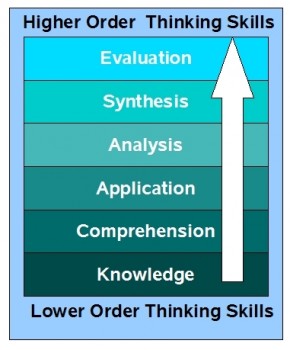
We’re great about learning from our losses. We’re not so great a learning from our success. A quick look at Bloom’s taxonomy will show that what we often do when we debrief a losing situation is we work all of the way up from knowledge through evaluation of what didn’t work.
blooms_taxonomy

Suppose we followed that toast to our success with an equally granular discussion of what worked with our success? It might look like this.

  • Knowledge – What it is we accomplished? What were the key parts that led to the success?
  • Comprehension – What do we know now about the project, the team, the customers that we didn’t know before?
  • Application – How can we use what we’ve learned from this success to build the next initiative like this one?
  • Analysis – How is this project similar and different from other projects we undertake?
  • Synthesis – What overall learnings can take forward from this success?
  • Evaluation – How as this win change what we understand about what we do as a business?

Raise that toast to your success. Then ask the six simple questions to claim what you’ve won.
The moments of reflection that bring you to the answers are the time you need to incorporate, internalize, and own what you’ve done — to move the “winning behavior” from a possibility into a natural response.

The evaluation of the win is the way to claim your rewards, to own them, and to leverage that learning from then on.
When you own your success, it shows every time you walk into a room. That’s how claiming rewards from success leverages itself into more success.

The good news is we can all go back — alone or with our teams — and claim our rewards for every success we’ve ever won.

Not everything we learn has to come from what we do wrong. Are you ready to learn from every right thing you’ve done?

Be irresistible.

–ME “Liz” Strauss
Work with Liz on your business!!

Buy the Insider’s Guide to Online Conversation.

Successful-Blog is a proud affiliate of

third-tribe-marketing

Filed Under: Blog Comments, Business Life, Marketing /Sales / Social Media, Motivation, Successful Blog, Writing Tagged With: bc, claiming your rewards, LinkedIn

Thanks to Week 282 SOBs

March 19, 2011 by Liz

muddy teal strip A

Successful and Outstanding Bloggers

Let me introduce the bloggers
who have earned this official badge of achievement,

Purple SOB Button Original SOB Button Red SOB Button Purple and Blue SOB Button
and the right to call themselves
Successful Blog SOBs.

I invite them to take a badge home to display on their blogs.

muddy teal strip A

geo-blog
hollyhouse-studio
flowing-data
marketing-places-spaces-people-ideas
social-commerce-today

They take the conversation to their readers,
contribute great ideas, challenge us, make us better, and make our businesses stronger.

I thank all of our SOBs for thinking what we say is worth passing on.
Good conversation shared can only improve the blogging community.

Should anyone question this SOB button’s validity, send him or her to me. Thie award carries a “Liz said so” guarantee, is endorsed by Kings of the Hemispheres, Martin and Michael, and is backed by my brothers, Angelo and Pasquale.

deep purple strip

Want to become an SOB?

If you’re an SO-Wanna-B, you can see the whole list of SOBs and learn how to be one by visiting the SOB Hall of Fame– A-Z Directory . Click the link or visit the What IS an SOB?! page in the sidebar.

–ME “Liz” Strauss

Filed Under: Successful Blog Tagged With: bc, blog-promotion, SOB-Directory, SOB-Hall-of-Fame, Successful and Outstanding Blogs

Be Irresistible: Want to Own Your Space? Own Up to Your Highest Standards!

March 15, 2011 by Liz

10-Point Plan in Action

What’s It Mean to Own It?

insideout logo

Going back down to SxSW reminds me of a conversation I had with @copyblogger, Brian Clark at SxSW 2008. It was in the early hours. We were at a club and found a place where we could talk for a minute or two. We were talking about SOBCon and how it had grown. We were talking about how people were coming because of the people who were in the room who were coming because of the people who were in the room.

It wouldn’t surprise me at all if Brian doesn’t remember what he said that night, but I do.

He said: “You and Terry are doing something important.

I said: “i know.”

Then he said: “But you gotta OWN it! Because without it where would I be?”

I replied something flippant like: “Still running the stealth intelligence network of the universe?”

He ignored my attempt at humor and continued with: “You gotta OWN it seriously.”

That advice stayed with me. I told Terry about it.

“Gotta OWN it! We own it, don’t we?”

But for the next year that idea became a mantra, “I’m OWNING it.”
Now I know what that simple sentence means.

Want to Own Your Space? Own Up to Your Own Standards

A few months later, I was at SOBCon 2008 with Brian’s words ringing in my ears. The thought kept running through my mind, “What am I not owning here?”
And as I opened my eyes, I realized that, in an effort to be “easy to work with,” I’d been holding back my best. My job is the content design an execution and we’ve always delivered more, different, and better than the rest, but not as well as I was capable of delivering. I’d let speakers slide just a little, then felt they could’ve shined more for themselves and for the audience. I’d been nice to sponsors and let them be less engaging than they might.

I realized then and there that companies make that mistake all of the time. We lower our price, change our offer, compromise for a vendor. We don’t own what we’re doing, instead we give away what we own.

What we should be doing instead is building trust and proving we’re the best at doing what we do to attract the people who recognize excellence and want to work be in a space that we own.

Every teacher, saloonkeeper, consultant, great business of one or corporation has a responsibility to own our role as a leader, to set the standards of our business so that the people who are in it with us know why and how to reach their greatest potential and so that the business can thrive and grow.

Here’s what I learned about how to do that:

  • Have a vision that is huge, powerful, and worth working toward to building. No smaller vision is worth owning or asking people to take part in. No lesser quest will bring you to put your heart, mind, hands and soul behind it.
  • Set goals that are worth reaching. If you want commitment and high performance, give everyone something to go for that feels like a massive win when they achieve it.
  • Invite only the best to participate in what you’re doing. Own the potential of your investment in the people you ask to come along. Friends are fun to play with, but owning a business requires that you own the responsibility of giving folks a team that they want to work with and for.
  • Make the vision and the goals far bigger than you can control, but the outcome and your belief in it so inspiring that everyone is drawn to work in the same direction . That way people can bring their own best potential to the building, but be building one vision that you protect for them.
  • Be a model of your version of the standard of ethics and excellence. Then layout the challenge for everyone to bring their own version of how they might add value to same standard with their own talents in ways that show their own excellence.

Owning our role, our values, our standards and our value proposition makes it easier for everyone else to own their role with the same values, standards, and value proposition. Like a great bartender or a community manager, we keep the space safe for people to be extraordinary without fear that they will lose by winning.

Own it. Don’t telephone it in.
Make a space, a place where people can show you what their best is and feel that you’ll notice, celebrate it, and protect it.

Do that and they’ll think of your business as owning the space you’re in, because to them it will be better than home.

That’s irresistible.

How do what you do, hold it up to the highest standards, so that the people who work with and for you can know they are working with the best in the business?

–ME “Liz” Strauss
Work with Liz on your business!!

Buy the Insider’s Guide to Online Conversation.

Successful-Blog is a proud affiliate of

third-tribe-marketing

Filed Under: Community, Marketing /Sales / Social Media, Successful Blog Tagged With: bc, Community, LinkedIn, management, owning your offer, value prposition

How to Turn Lurkers and Listeners into Advocates

March 14, 2011 by Liz

(Updated in 2020)

Photo by Christina @ wocintechchat.com on Unsplash

10-Point Plan in Action: Living Online and Off

The Cameras Are Always Rolling

Many years ago, I commuted from California to Boston for my job as VP of Product Development for a Publishing Company. I also took several international trips to work with other publishers that had me out of the office for weeks. The travel meant that I often attended executive meetings via teleconference. Basically I was at the office on the phone sitting in the middle of the table.

When I first started attending meetings this way I had no idea how powerful it was to be in lurking inside the telephone during those meetings. Then I started to notice as folks began talking, particularly when they became invested in a conversation, they would forget that I was listening. In essence I was the proverbial fly in the room — they couldn’t see or hear me so I wasn’t there.

But I was.
And I heard everything they said, how they said it, and often when I jumped back in the conversation, they were startled in their seats. My voice had more power than if I had been sitting across the table because they’d lost their sense of what I knew and what and I didn’t because I hadn’t been a visible part of their experience.

And from that unique position, I could often bring a perspective that the people in the room couldn’t see. We all came to value the idea of having an observer — a lurker / listener outside of the room.

Would Your Lurkers and Listeners Advocate for You?

I think about those meetings when I consider the number of people who follow me on Twitter and the number I actually talk to, the number of people who read my blog and the ones I actually see. I think of those listeners and lurkers even more when events happen online that get folks riled up and defending their position on an issue that has more than one side. During those events, it’s easy for us to forget the far larger number of people who follow the story, but hardly ever, maybe never, comment on what they see.

Their silence doesn’t mean they don’t have opinions of our behaviors and our thinking. Their silence doesn’t mean that they won’t remember if they meet us somewhere in another context one in which we might want their support or partnership.

Lurkers and listeners can be powerful advocates, great sources of referrals, and even become customers and clients if we remember them and serve their needs. They can also remember our worst behavior. Here are three things to remember about the Internet and the lurkers, three ways to keep lurkers and listeners on your radar so that they stick around and become your advocates.

  • The Internet is the World’s Largest Reality Show. It’s not good to forget that “cameras” are always on. Lurkers and listeners are in the audience watching and thinking about what they see. In the heat of a moment offline we might have the luxury of forgetting our manners or ranting away with emotion on someone else in a private setting. Not so here.
  • The Internet might move quickly but it archives everything. I can still find a huge row that occurred in 2005 on a blog that’s been deleted and point you to the bad behavior that took place that day. Everything we do is indexed somewhere. Some of it sits in places we can never reach or erase. Lurkers and listeners now and in the future can find and see it on a distant day. One of those watching might be yourself looking back at yourself in a few years.
  • On the Internet it gets easy to tell what you value. Listeners and lurkers can be potential clients. When we make a public mistake or when we react to one, it’s important remember that those silent watchers — the people who might be our next bosses, vendors, partners, or clients — have a better chance to figure out whether they want to work with us than any interview, meeting, presentation, or resume would ever afford them. They if we “forget” that folks are listening — when we rant about a customer on our blog or complain about a client — we don’t know when they leave us without giving us business, thinking they could be our next victim. If you make a huge mistake and try to sweep it under a rug, they won’t be trusting us ever.

A wise man once said behave as if everything you do is going to be published. That pretty much describes the Internet.

That idea can make us better at our business. It can bring us to always align our values with our customers’ values. It can move us to keep the people we serve at the center of everything we do.

On the other hand, it can be what kills us. If we have a fatal flaw, if we forget that people like to be treated like people, some will find a way of reminding us we’re serving only ourselves. And the lurkers and listeners who decide that we’re self-serving will unsubscribe, click away, and never say a word – to us. That doesn’t mean they don’t have opinions that they share other ways.

Loyalty is a relationship with all the people we serve, not just the one who sing our praises. Lurkers and listeners are watching and perhaps deciding whether they want a relationship with us. How do we make sure the lurkers and listeners stay clearly on our radar? What can we do to serve them better so that lurkers and listeners are advocates too?

–ME “Liz” Strauss

Filed Under: Marketing /Sales / Social Media, Successful Blog Tagged With: LinkedIn, lurkers, online behavior, relationships

Thanks to Week 281 SOBs

March 12, 2011 by Liz

muddy teal strip A

Successful and Outstanding Bloggers

Let me introduce the bloggers
who have earned this official badge of achievement,

Purple SOB Button Original SOB Button Red SOB Button Purple and Blue SOB Button
and the right to call themselves
Successful Blog SOBs.

I invite them to take a badge home to display on their blogs.

muddy teal strip A

convene
finger-candy-media
food-service
inbound-marketing-pr
serene-journey

They take the conversation to their readers,
contribute great ideas, challenge us, make us better, and make our businesses stronger.

I thank all of our SOBs for thinking what we say is worth passing on.
Good conversation shared can only improve the blogging community.

Should anyone question this SOB button’s validity, send him or her to me. Thie award carries a “Liz said so” guarantee, is endorsed by Kings of the Hemispheres, Martin and Michael, and is backed by my brothers, Angelo and Pasquale.

deep purple strip

Want to become an SOB?

If you’re an SO-Wanna-B, you can see the whole list of SOBs and learn how to be one by visiting the SOB Hall of Fame– A-Z Directory . Click the link or visit the What IS an SOB?! page in the sidebar.

–ME “Liz” Strauss

Filed Under: SOB Business, Successful Blog Tagged With: bc, blog-promotion, SOB-Directory, SOB-Hall-of-Fame, Successful and Outstanding Blogs

Be Irresistible: 10 Steps to Consistently Develop Highly Viral, High ROI Products

March 8, 2011 by Liz

How Good, Great, and Elegant Is a Product that No One Uses?

insideout logo

Yesterday while I was talking with @MichaelPort about solid.ly the software system he’s developing to support his Book Yourself Solid System. He told me about a conversation he had with venture capitalist who asked him, “What makes you think you can move from writing books into developing software?” I was taken by the perfectness of his answer. It was something like …

“I’m hiring the best people to do the development, but I know and care about the people who will be using it.”

That lead us into a discussion of what a product developers job is.

I spent almost 3 decades developing products for teachers — books, CD-Roms, websites, videos, audios, and others. During that time, I learned a lot about how products were made — what works, what doesn’t, and that the great idea that hasn’t made it to the market probably isn’t there NOT because someone hasn’t already thought of it, but because

  • it’s too expensive,
  • too labor intensive — to build or to use
  • or no one really wants it.

If I can’t afford it, don’t have time to use it, or don’t want it, it doesn’t matter how elegant, great, clever, cutting-edge, award-winning or beautifully you produce it.

10 Steps to Consistently Develop Highly Viral, High ROI Products

But the most crucial thing I learned as product person was that no matter how much I thought about my products, I had to think about my customers more. My role wasn’t to produce great products, but to produce great products people wanted to buy and use. Those are the products that folks buy again and tell their friends about. Here’s the secret I discovered …

It’s not my brilliance that makes a product irresistible. It’s not the awards the product might win that makes a products go viral and gain loyal long-term fans. It’s understanding my role as the product person is to know, love, and serve the customer.

Most of my intelligent customers could do or learn to do what I do.
But if they did what I do, they wouldn’t have time to do what they do.
My job is to make the customer’s life easier, faster, more meaningful and, if possible, more fun.

We turned around a failing company by developing highly viral, high ROI products by getting as close as we could to our customers. Here’s a few ways to do that before you even start planning that product execution …

  1. Know and live with the people you’re building for. Talk to the people you want to use what you’re building. Live in their natural habitat. Know the issues of their lives. Know the little things that bring joy to them. Know the prickly things that they don’t even realized irritate them daily. Know the influencer group of your customer group. Know the folks who understand both groups intimately and best. Invite the most interested from all three groups into your process as participants not just advisors.
  2. Use measurements appropriately. Data supports how people do things but rarely gets down to the why they do or the patterns of what moves them emotionally. When you think you know something, then, test and measure it. Don’t build a profile of customers through measurement only. Think about what companies would get wrong about you if they only used the quantitative data and scores from your medical check ups and school reports about you, without ever finding out about your personality.
  3. Respect the products that your customers are already using. Don’t fall into the trap of only seeing the faults of what’s already out there. That product you see so many flaws in has already solved a huge number of problems for your customers or they wouldn’t be using it. If it’s so bad, why does it have 100,000 or a million people using it? Ask people what they love about it. Be careful not to build something that takes away something they’ve made a part of what they’ve come to enjoy and they’re regularly doing. Lose what they hugely love and it won’t matter if you offer something that fixes a minor irritation.
  4. Start with a small offer built to your highest standards. Respect your customers’ time. Make the first release your best work, not a beta test. If you know your customers, if you’ve lived with them and invited them into the the development process, you know what works for them. Deliver it. Don’t play with their time or ask them to work out the bugs for you. That’s your job. If you want to attract the best, be the best.
  5. Simplify until there is no learning curve. Simple is not only elegant. It allows us to focus on why we got the product not learning the product first. Apple has mastered this. They can put the entire manual for using a product in a pamphlet that no one reads because we can pick up the product already knowing how to use it.
  6. Get paid for your product. Free samples are fine. Free products are not. The model of building things for free costs those who build products more than we might think. We release things unfinished at standards less than our best. We don’t build the appropriate support or service into them and we ask too much from our “free” customers who take us for granted. We work with people on promises. We lose money, reputation, and if nothing else, time we don’t have. Ever seen a tweet the equivalent of, “I’d gladly pay for Twitter if they’d guarantee service.”
  7. Systematically and strategically build your customer base as you build your product line. We no longer need to build a huge department store and fill it will products to prove we exist. We don’t need to stress our resources, cash, or infrastructure like that. Release one product that does one thing well for one audience. Let that product and that customer base finance the next. One customer group well served is better than 12 products less well defined — and one product is easier to market and easier for our friends and networks to share on our behalf. Know, love and serve that first group and they’ll tell their friends. They’ll also tell you what they want next and what group of their friends are your next best bet.
  8. Learn the life cycle of your product and know when to revise. Every product has a life cycle. It seems the way of the Internet to let the product die a slow death. Know how long that product is likely to sell well, then just after the peak selling point, carefully revise it to add new features. Once you’ve got a history to rely on do this on a predictable schedule. If your product life cycle is 9 months to a year. Plan your next revision at 11-12 months. Be careful not to revise out the features that customers love and not to add features they don’t care about. Look to make your product even easier, faster, and more meaningful at doing what it does. .
  9. Release new products on a predictable schedule. High tech companies might be slaves to the fast-changing conditions, but not every company is. If you can provide a predictable release schedule get fully behind that. It will build discipline into your infrastructure and your process. Predictability also builds trust. Customers will come to know that they can look forward to something knew from you when they’re planning their budgets. .
  10. And go back to Step 1 by getting to know your customers even better after they buy from you. Think of that first purchase as the first date in a long-term relationship. Value the customer who’s already shown a commitment above all others. Respect them by giving the best offers to them, not to the “potentially new” customers who haven’t been listening to you. .

These 10 steps work. I know because I’ve used them successfully and two well-respected financial guys have put their names on that fact.

It takes two things to win a loyal and growing customer base,

  1. products customers truly want that live up to their promise
  2. and more opportunities to get those kinds of products from a business they can trust..

Simply being that business who knows, loves, and serves their customers better than anyone else can save those customers the time of having to look in other places when they need what you offer. Who wouldn’t value that?

Have you had any experience with a company that consistently builds highly viral, High ROI products.

–ME “Liz” Strauss
Work with Liz on your business!!

Buy the Insider’s Guide to Online Conversation.

Successful-Blog is a proud affiliate of

third-tribe-marketing

Filed Under: Business Life, Content, Successful Blog, Writing Tagged With: bc, high roi, LinkedIn, Product strategy, vial product

  • « Previous Page
  • 1
  • …
  • 55
  • 56
  • 57
  • 58
  • 59
  • …
  • 707
  • Next Page »

Recently Updated Posts

The Creator’s Edge: How Bloggers and Influencers Can Master Dropshipping

Is Your Brand Fan Friendly?

How to Improve Your Freelancing Productivity

How to Leverage Live Streaming for Content Marketing

10 Key Customer Experience Design Factors to Consider

How to Use a Lead Generation Item on Facebook


From Liz Strauss & GeniusShared Press

  • What IS an SOB?!
  • SOB A-Z Directory
  • Letting Liz Be

© 2025 ME Strauss & GeniusShared