Successful Blog

  • Home
  • Community
  • About
  • Author Guidelines
  • Liz’s Book
  • Stay Tuned

Book Review: The Art of the Start 2.0, by Guy Kawasaki

March 5, 2015 by Rosemary

Have you ever wished you could pick Guy Kawasaki’s brain?

Like, sit down with a pitcher of beer and just pepper him with questions until the pub closes or his head explodes?

This is your lucky day. Guy has done a “brain dump” in the form of an update to his 2004 book, The Art of the Start.

However, The Art of the Start 2.0 is not just a quickly busted-out update, it’s a complete overhaul. It covers everything you want to know about starting a new business, from idea to exit, written by someone who has literally been-there, done-that.

I would recommend it for anyone who is considering answering that little voice in their head, telling them to start something.
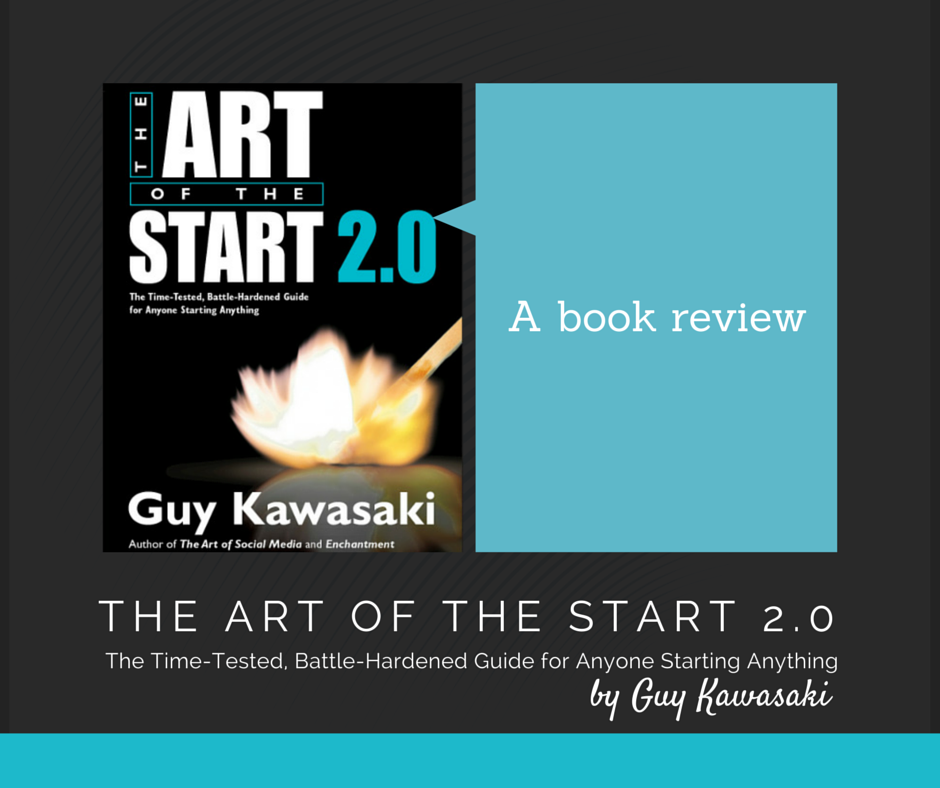
Art of the Start 2.0 book review

Guy Kawasaki was the first person I ever knew to hold the job title “Evangelist.” He has been on the giving and receiving end of pitches, and advised companies large and small. He’s seen the heights of the tech boom and the lows of the bubble burst.

He’s the person who will stand over your shoulder and remind you to spend more time on the product than on the furniture in your conference room.

The style of the book brings you right into Guy’s world. There are pithy stories, lessons-learned, exercises, and Q&A galore. It’s not the type of page-turner that you spend a weekend curled up with; it’s a manual that you dog-ear, highlight, and refer to over and over again.

Each chapter ends with recommended reading, so you can dive deeper into any subject as necessary.

“Customers don’t care if you want to destroy the competition. They want to know what benefits they derive from using your product. Also, evangelism is about what you do for your customers–not about what you want to become.” Guy Kawasaki

There is solid business advice in The Art of the Start 2.0, but by far my favorite bits were the hard-won little insider tips.

Remember to bring two thumb drives to your presentations, pick a company name with “verb potential,” and find your Morpheus (someone who will tell it like it is).

Some of the major topics covered include:

  • The Art of Starting Up
  • The Art of Launching
  • The Art of Leading
  • The Art of Bootstrapping
  • The Art of Fund-raising
  • The Art of Pitching
  • The Art of Building a Team
  • The Art of Evangelizing
  • The Art of Socializing
  • The Art of Rainmaking
  • The Art of Partnering
  • The Art of Enduring
  • The Art of Being a Mensch

In my own 20 years of business experience, I’ve been in many of the situations described in the book. It can be intimidating navigating conversations with potential investors, knowing when to hire more staff, and figuring out how to get the word out about your project.

With Guy’s advice in your arsenal, you’ll be ahead of the game.

Author’s Bio: Rosemary O’Neill is an insightful spirit who works for Social Strata — makers of the Hoop.la community platform. Check out the Social Strata blog. You can find Rosemary on Google+ and on Twitter as @rhogroupee

Disclosure: I was given a digital copy of the book for purposes of this review. My opinion is my own.

Filed Under: Business Book Tagged With: bc, book review, startup

6 Non-Obvious Entrepreneur and Founder Resources

February 26, 2015 by Rosemary

This blog was recently listed by the folks at GetVOIP as one of the “35 best entrepreneur blogs.” We appreciate the recognition, and it got me thinking about other lists of resources that might be out there for us “doers.”

It’s always good to refresh your toolkit, so I came up with six somewhat non-obvious resources for information, inspiration, and support related to entrepreneurship.

entrepreneur with laptop dog
  1. Startup Stash directory/
  2. 7 Great educational resources for entrepreneurs, from Upstart
  3. Kauffman Founders’ School video series/
  4. Quora, Startup Founders & Entrepreneurs category
  5. Pinterest “Entrepreneurship” category
  6. Top 25 Business Podcasts for Entrepreneurs

Have you found any useful new resources to help you in your entrepreneurial journey? Please share!

Author’s Bio: Rosemary O’Neill is an insightful spirit who works for Social Strata — makers of the Hoop.la community platform. Check out the Social Strata blog. You can find Rosemary on Google+ and on Twitter as @rhogroupee

Filed Under: Personal Development Tagged With: bc, business, entrepreneurship, founder

Who do you want in the trenches with you?

February 19, 2015 by Rosemary

Spoiler alert: this post contains a spoiler about the conclusion of Celebrity Apprentice.

You’re building a business. It has some similarities to going into battle.

  • You don’t really know what’s going to happen.
  • You need to equip yourself properly.
  • You must be in it for the long haul.
  • You need a strategy.
  • You must know what you want to get out of it. What’s the mission.
  • You need to have a thick skin and confidence.
  • You have to be able to handle unexpected events.
  • You need to know when it’s time to retreat with honor.

And.

You need the right people in the trenches with you.

Band of Brothers in the trenches

But how do you know who will be there, handing you the last cigarette as the artillery fire is landing all around you? Who will jump out of the trench with you and charge into the unknown, eyes fixed on the next hill? Whom do you want to share victory with?

Perhaps I’ve watched Band of Brothers one too many times, but I’ve always known that surrounding yourself with the right people is crucial to success. Jim Collins calls it “getting the right people on the bus.”

How can you discern who will be really invested in what you’re doing…as a colleague, partner, or customer?

How can you ensure that you have the right people?

Here are some tips:

  • Work with someone smarter. Surround yourself with people who inspire you with their resourcefulness, their savvy, and their education. If you need to be the smartest person in the room, you’re not cut out to be a business leader.
  • Work with someone who knows something different. If your special skill set is marketing, hire someone who’s an ace at finance. Know your own strengths, and choose people who compliment them.
  • Work with someone who’s been somewhere different. Find people who have a different life story, a different perspective. You don’t want to be surrounded by yes-men and yes-women. Find people who will argue with you if you’re wrong.
  • Give your people a way to shine. Leeza Gibbons won Celebrity Apprentice this week because she consistently took advantage of her team’s talents and allowed them the room to perform.
  • Stop trying to convince people. As an entrepreneur, your resources are best invested in people who already “get it.” When you describe your mission, look for the light to go on in the other person’s eyes. If it’s not there, you don’t have a good fit, and it’s best for both of you if you move on.

Who’s in the trenches with you?

Author’s Bio: Rosemary O’Neill is an insightful spirit who works for Social Strata — makers of the Hoop.la community platform. Check out the Social Strata blog. You can find Rosemary on Google+ and on Twitter as @rhogroupee

Filed Under: Leadership Tagged With: bc, Hiring, HR, leadership

5 hot call to action tips for business bloggers

February 12, 2015 by Rosemary

You’re blogging for a reason, right?

If your blog is part of your business strategy, it’s time to do a check-up on your call to action (CTA).

A call to action is something that is intended to provoke a response in your reader.

It could be a bright red box that says “click here,” it could be a pretty picture of the cover of your e-book saying, “download now,” or it could be “set an appointment today.” Those are overt calls to action.

call to action

It could be more subtle, like a series of recommended blog posts. Those are calling the reader to read more, to explore your useful content.

Without any call to action, your blog posts are just spaghetti tossed against the wall.

Read these five tips that will help you clarify and enhance your calls to action right now (see what I did there?):

  1. First, consider what action you want to provoke. It should be obvious to your audience what they’re supposed to do when they land on your blog. Do you sell a product? Are you a consultant? Are you a thought leader/speaker? Your purpose must be clear in your own mind before you can communicate it to your visitors.

    And if you don’t know why you’re blogging, that might be ok (you’re just a writer who needs to write), just don’t expect to be getting revenue from your blog.

  2. Color me beautiful. Color theory is its own course of study, but there are some basic tenets you can apply. The folks at crazyegg.com produced a great infographic that summarizes the psychology of different color choices. Your CTA should be differentiated and appealing.
  3. Location, location, location. The human eye tends to read a web page in a zig-zag pattern, starting at the top left corner. We know that images and videos attract the eye, too. Consider putting your CTA in an attractive image that sits above the “fold”.
  4. Copywriting 101. Be brief.
  5. Track success and change it up if necessary. Know in advance what success looks like. Is it number of e-books downloaded? Is it number of paid consulting gigs? Is it number of unique visitors to your site? Think about using a unique link identifier on your CTA so that you can see it in your Google Analytics as a goal completion.

If I visited your blog today, would I know what you want me to do?

Author’s Bio: Rosemary O’Neill is an insightful spirit who works for Social Strata — makers of the Hoop.la community platform. Check out the Social Strata blog. You can find Rosemary on Google+ and on Twitter as @rhogroupee

Filed Under: Blog Basics Tagged With: bc, blogging, call to action, CTA

Quotes that work (and don’t work)

February 6, 2015 by Rosemary

By Mickie Kennedy

A solid quote can round out a press release or blog post in ways nothing else can. Not only can it encapsulate what you’ve been trying to say throughout the whole of your content, but if the quote is from the right source it can also add an air of authority to the piece. Not only this, but a well-placed quote from the right source can put a face on what may have otherwise been very dry material, and make the reader take notice.

But just throwing in a random quote from your CEO won’t work. You have to be very careful with the quotes you use in your press releases for several reasons. Here are a few examples to give you an idea of what to do and what not to do.

Press interview with microphone

The Boring Quote

Ugh! This is absolutely the worst thing you can do. If your quote is dull, uninteresting, or otherwise pointless, it’s dead before it’s even left the ground. This is the textbook example of just inserting a quote simply for the sake of doing it:

“Our new Apple Corer 5000 will certainly core your apples, so you should probably buy one,” says President Bob Yawnsville.

This quote says nothing, essentially – it’s just there for filler. If the person reading your release doesn’t stop reading right then and there, you’re lucky. What’s more, the statement is just a thinly disguised plea for a sale. It’s not even a pitch. At least a pitch can be interesting.

If you’re going to put a quote in, make it worth the reader’s time.

“The Apple Corer 5000 uses brand-new coring technology invented in a lab deep inside the Earth’s core while our scientists listened to metalcore. At Apple Town Inc. we fully embrace the word ‘core’ in all its uses, and we transfer this thinking to each and every corer we release,” says President Ted McCool.

This quote does two things: it adds new information describing the mentality of the company, and it also gives a behind-the-scenes look at what goes into the products. It’s not just slapped in there.

Bottom line: quotes should add their own unique angle and perspective to your content. Here’s a trick. Read your piece with the quote, and then read it without the quote. Have you lost any information, any interesting context? If not, then it’s time to get a new quote.

Controversial or Standout Quotes

Not to overstate it, but quotes have to be in your press release for a reason. This also goes for the actual content – if the material in the quote is there just for the heck of it, you’re better off leaving it out. This goes doubly so for anything controversial or something you know will stand out.

For example, let’s say that apple corer business has a rival that’s been known to invest in overseas interests. They could call the rival out by attacking them for not investing in American interests with something like:

“We’re extremely proud to be an all-American company, keeping our production and profits tied to American interests rather than shipping jobs and money overseas — unlike some other coring businesses I know,” says CEO Jan Appleton.

See how that comes off as a little snarky? Even though it may sound a little snarky, going after your rivals is perfectly fine, and it certainly draws attention. Use caution and common sense, though. Going on the offensive for the sake of a few more eyeballs is going to do nothing but hurt you in the long run. Make sure you have a leg to stand on and some ground to defend before launching an all-out assault.

The same goes for outright controversial quotes, like using current events to make your point. Something like:

“The latest ebola outbreak only plays up the global need for higher apple consumption” says CEO Barb Corringstone. “If people were getting their fair share of phytonutrients and vitamin D from apples, the world would be a safer, healthier place.”

Is this really necessary? Does it add anything or are you just trying to stir up a hornet’s nest? This can truly backfire on you if you’re not careful. Remember Barilla Pasta CEO Guido Barilla’s homophobic comments on Italian radio? That sure did earn Barilla quite a bit of attention – but for a company that (a.) is famous for its penne and not its politics, and (b.) had previously expressed no opinion on matters more controversial than the proper diameter of campanelle, the attention wound up seriously injuring the company. So use your head.

As with every quote, make sure you’re putting it in your content for a good reason, as readers can detect when you’re being disingenuous. Bottom line: quotes should add their own unique angle and perspective to your content.

Here’s another trick. Read your piece with the quote, and then read it without the quote. Are you needlessly going to rankle the wrong people for the wrong reasons? If so, strongly reconsider replacing your quote.

Do you often use quotes in your press releases?

Author’s Bio: Mickie Kennedy is author of the PR Fuel blog and President of eReleases Press Release Distribution.

Filed Under: Writing Tagged With: bc, PR, press release, public relations

Four steps to your best day ever

February 5, 2015 by Rosemary

“Make 2015 your best year ever!”

All of the confetti has landed on the ground. January is in the rear view mirror, and if you aren’t paying attention, the first week of February is almost done.

confetti on the ground

Did you have big planning sessions the week before New Years? Did you set up your new calendar, your new systems, new routines?

Many of us do that, and by the first week of February, some of it has begun to crumble already.

But let’s not sit around being depressed. Let’s switch our thinking up a bit.

What if we applied the “best year ever” thought process to a single day?

What if we decided to wake up tomorrow and focus on making it a success?

Here are some typical planning steps for an “annual planning” session:

  1. Set aside time to dream and visualize.
  2. Decide what you intend to do and why you intend to do it.
  3. Break the goal down into manageable steps with a timeframe.
  4. Take action immediately.

That looks a lot like a perfect day, doesn’t it? Let’s re-frame:

  1. Use your first 30 minutes to visualize the day and let creative juices flow, without external interruption.
  2. Decide what you intend to accomplish that day, and think about why you intend to do it.
  3. Choose which steps you want to advance on that day, and schedule them in.
  4. Take action immediately.

It’s still necessary to do the annual and quarterly planning. However, those longer-term plans are much more likely to happen if you get in the habit of a daily refocus.

Don’t forget to include all aspects of your day in the plan.

When you set your intentions for the day, you should incorporate your afternoon run, your manicure, your visit with a sick friend alongside the business luncheon, the copywriting, and the pitch meeting.

How do you make sure that your days are moving you toward a successful year?

Author’s Bio: Rosemary O’Neill is an insightful spirit who works for social strata — a top ten company to work for on the Internet . Check out the Social Strata blog. You can find Rosemary on Google+ and on Twitter as @rhogroupee

Photo Credit: AndrewButl3r via Compfight cc

Filed Under: Productivity Tagged With: bc, goals, planning, Productivity

  • « Previous Page
  • 1
  • …
  • 18
  • 19
  • 20
  • 21
  • 22
  • …
  • 84
  • Next Page »

Recently Updated Posts

Is Your Brand Fan Friendly?

How to Improve Your Freelancing Productivity

How to Leverage Live Streaming for Content Marketing

10 Key Customer Experience Design Factors to Consider

How to Use a Lead Generation Item on Facebook

How to Become a Better Storyteller


From Liz Strauss & GeniusShared Press

  • What IS an SOB?!
  • SOB A-Z Directory
  • Letting Liz Be

© 2025 ME Strauss & GeniusShared