Successful Blog

  • Home
  • Community
  • About
  • Author Guidelines
  • Liz’s Book
  • Stay Tuned

A 3-Step Social Media Reality Check

October 15, 2008 by Liz

Are We Listening to Conversations about Us?

The Living Web

We’ve had some time to learn the social media tool kit — sort the hammers from the levels, figure out which goes with which . . . People who’ve been watching are getting curious.

But don’t get confused. The folks from outside the social media fish bowl aren’t using the same yardstick to decide who knows what and what they need to know for their business.

Ever notice how human it is to forget to follow the same rules that we teach? We might be singing to the choir while we’re networking on the web, but are we practicing what we preach when we’re working with folks who want to join in?

In deliciously ironic way, the best example of customer conversation not being listened to might be those of customers WE are looking to serve. How do WE check?

We can’t Google folks who are talking about us offline.

A 3-Step Social-Media Reality Check

Everyone needs a reality check to stay on track. In a new industry, where the standards are being set and credibility is still a question, it’s vital to keep our game at its best. Here’s a simple way to ensure that we’re in touch with the world and not only hearing what bounces back. I’ve named it a 3-Step Social-Media Reality Check.

Make a point to have regular conversation with friends, acquaintances, and people you’ve just met. Plan to ask these questions and actively listen.

  • Three Buzz Words — Offer three buzz words that you use every day on social networking sites. Ask your conversation partners what each word means.
  • One tool — Name one social media tool that you use daily. Ask each person to say everything he or she knows about it and how it’s used. Then ask about the web tool he or she uses most.
  • The Internet — Ask each person to describe what the Internet is, how it works, and what it’s biggest impact is on the world.

If you made it this far only listening, you’ve got a wealth of information about how the rest of the world thinks.

If you didn’t, . . .

If you couldn’t resist telling folks about what the words really mean, what the tool really is, how the Internet is changing the world . . . hmmmm . . . I suspect you’re might have trouble explaining how social media is different from traditional push marketing.

Reality check: We tell people to listen first. Do we do that?

–ME “Liz” Strauss
Work with Liz!!

Like the Blog? Buy my eBook!

Filed Under: Marketing /Sales / Social Media, Successful Blog Tagged With: bc, best practices, conversation, social-media reality check

Is That Noisy Guy On Twitter Creative or Just a Pain in the . . . ?

October 13, 2008 by Liz

It’s Complex

Paradoxical Creativity

When Csikszentmihalyi wrote Creativity: Flow and the Psychology of Discovery and Invention, he found that it wasn’t easy to pin down what determines a creative life, it seemed to hinge upon the determination to follow a creative instinct.

What Dr. C. did was describe how creativity works. He laid out how culture evolves as curious and determined individuals transform domains. He explained how we might learn from the lives of those men and women to add creativity to our own. He found the commonalities in their struggles and strategies. This is what he said about them.

Are there no traits that distinguish creative people? . . . If I had to express in one word what makes their personalities different from others, it would be “complexity.” By this I mean that they show tendencies of thought and action that in most people are segregated. They contain contradictory extremes — instead of being an “individual” each of them is a “multitude.” Like the color white that includes all the hues in the spectrum, they tend to bring together the entire range of human possibilities within themselves.

The qualities are present in all of us, but usually we are trained to develop only one pole of the dialectic. We might grow cultivating the aggressive, competitive side of our nature, and disdain or repress the nurturant, cooperative side. A creative individual is more likely to be both aggressive and cooperative either at the same time or at different times, depending on the situation. Having a complex personality means being able to express the full range of traits that are potentially present in the human repertoire but usually atrophy because we think that one or the other pole is “good,” whereas the other extreme is “bad.” . . .

Perhaps a central position, a golden mean, is the place of choice, what software writers call the default condition. But creative persons definitely know both extremes and experience both with equal intensity and without inner conflict. —Csikszentmihalyi, p. 57

He named ten antithetical traits both present integrated in dialectical tension and called them the Ten Dimensions of Complexity. I call them the Ten of Paradoxes of Creativity.

Either way, they make us crazy.

The 10 Dimensions of Creative Complexity

Each trait that Dr. Mihaly uncovered is a contradiction, a complexity, a paradox. Each contributes to making it hard to predict creative responses. If you consider the list as a whole, you’ll see how such a “complex individual” might find “fodder” that fuels curiosity, innovation, and original ideas. It’s also easy to see how less “exhuberant” people might find these contradictions confusing, difficult, and frustrating. What do you see?

  1. Creative individuals have great physical energy, but they become extremely quiet when they are at rest. This restful period can lead others to think that they are not feeling well or that they are unhappy, when the truth is they are fine.
  2. Creative folks tend to be both highly intelligent and naive at the same time.
  3. Creative people are disciplined and playful simultaneously. In some creative people, this can mean that they are responsible and irresponsible at the same time as well.
  4. Creative minds move between a spectrum of fantasy and imagination and a firm grounding in reality. They understand the present and need to keep in touch with the past.
  5. Creative individuals seem to be both introverted and extroverted, expressing both traits at once. An image to explain this might be that they are shy showoffs, if you can picture that.
  6. Creative people are sincerely humble and extremely proud in a childlike way. It requires ego to have a risky, fresh idea. It takes self-doubt to hammer it out to a workable form.
  7. Creative folks don’t feel as tied to gender roles. They feel distinctly individual. They don’t feel the barriers of authority or the rules of what they are “supposed to do.”
  8. Creative individuals are thought to be rebellious. Yet, in order to be creative one has to understand and have internalized the traditional culture. Therefore creativity comes from deep roots in tradition. Creative people are traditional and cutting edge.
  9. Creative people are deeply passionate about their work, yet can be extremely detached and objective when discussing it.
  10. Creative people are highly open and sensitive, which exposes them to pain and suffering, but also allows them to feel higher values of joy and happiness.

I plan to pair Dr. C.’s research with my educational background to offer some actionable ideas for stretching our creativity as we go about our business and our lives.

Creativity in Action

So is that noisy guy on Twitter nuts or creative? So if I’ve made you curious, even just a little bit, that’s start. Curiosity is the cure for boredom. Curiosity fuels ideas. Ideas keep blogging alive.

Move it forward by asking everyone you meet today one question. Make today “one question interview day.” What will your question be?

Mine is this . . . Do you have paradoxes in your personality?

–ME “Liz” Strauss

Related articles
Finding Ideas Outside the Box
Brand YOU–What’s the BIG IDEA?
Start in the Middle 3: Alligators and Anarchists
The 10 Skills Most Critical to Your Future

Buy the eBook and get your voice!

Filed Under: Inside-Out Thinking, Marketing /Sales / Social Media, Successful Blog Tagged With: bc, csikszentmihali, paradoxical creativity

Are You Sending Visual Mixed Messages?

October 8, 2008 by Liz


It’s about Mixed Messages

In preparation for SOBCon09, I’ve been researching the importance of visuals as social media connection points. Visuals are power in helping us recognize where we’re safe, where we want to eat, what we want to buy, who we trust, who’s like us and who’s not.

Unfortunately, one thing is true about visual communication.

When we don’t know what we’re about, our visuals often contradict what we’re saying.

In that research, I came across this page in a report —

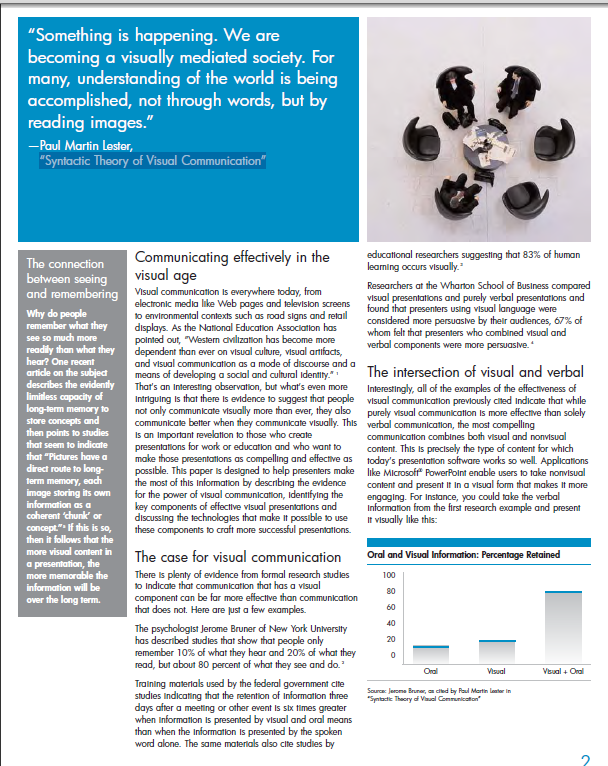
The page below is a screenshot from a pdf., called the Power of Visual Communication.

Visuals_Are_Important 2

The document leads with a quote in a blue box that says . . .

“We are becoming a visually mediated society. For many, understanding of the world is being accomplished, not through words, but by reading images.”
–Paul Martin Lester

I’m not a designer, but I’ve played a VP of Design and Editorial in a Publishing Company. My experience is that most people respond to a type heavy page like this by looking at the quote, the gray box, and the chart, and then skipping over the rest.

This page wasn’t communicating nearly as well as it might. The text and visuals say different things. The blue box quote says visuals are important. The page layout says they’re not. The visuals on the page — the picture up on the right and the chart below — are overwhelmed yards of tiny type.

  • I can’t “read” the photo in the upper right or understand how it relates.
  • This page walls me in with words.
  • Unnecessary words and long sentences make the reader dig to find what’s important. The whole first section is really unnecessary information with no real impact.
  • The most important sentence on the page is hidden in the tiny type. The blue box quote is not the most important they want you to carry forward to the next page.

How might it have worked with more power and more consistency? Few things are more fun than editing other people’s stuff. I looked at what I might do highlight key information on this page and how they might underscored the point about visual information by using the text in more visual ways.

I reproduced the page cutting and moving text — please use your imagination for precise alignment. (I repeat. I’m not a designer. These are thoughts, not a professional design.)

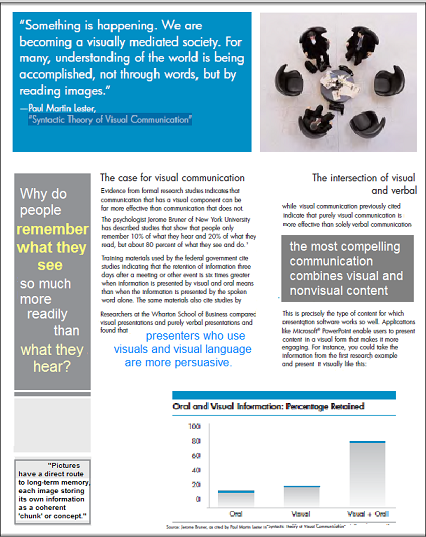
This is the new version.

Visuals_Are_Important Visual Version2

Some of the changes I made include these.

  • I enlarged the type in the blue box and the photo in the upper right corner.
  • I kept only the two most important sentences in the gray box and reset one far larger with visual emphasis. They work now a question and answer.
  • I deleted the entire first section and added white space above the type block.
  • I made pull quotes of two key thoughts, giving emphasis with a gray box to the most important idea.
  • I enlarged the chart to give it more importance, to the reflect the position of the blue box quote, and because the information relates to both columns of text.

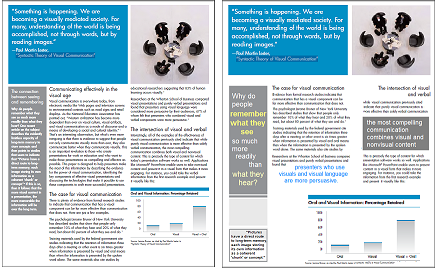
Because they’re hard to compare full size, here they are side by side:

Visuals_Are_Important Visual Version3

My aim was to get the visuals and the text delivering that same message — the richer story that was hidden in the text.

We all make this mistake when don’t stop to access what we’re saying with our visual presentation.

Have you thought about the visuals that represent you — your avatars, your blog, your social media profile photos, your clothes, your videos, your words in text?

And can anyone tell me what that picture in the upper corner has to do with all of this?

–ME “Liz” Strauss
Work with Liz!!

Get your best voice in the conversation. Buy my eBook.

Filed Under: Marketing /Sales / Social Media, Successful Blog Tagged With: bc, mixed messages, social-media, Visual communication

Have You Organized Your Social Media Thinking Lately?

September 30, 2008 by Liz


Answers Included

The Living Web

You may be wondering about this organized thinking . . . I’ve been asked twice in the past few weeks to write up educational standards for writing social media training materials. This part two of that endeavor.

I’ve found that organizing my thinking around social media has been a good thing. Have you organized your thinking lately?

It’s a

Social Media Expertise Pop Quiz

Don’t worry it comes complete with answers.

Answer Key

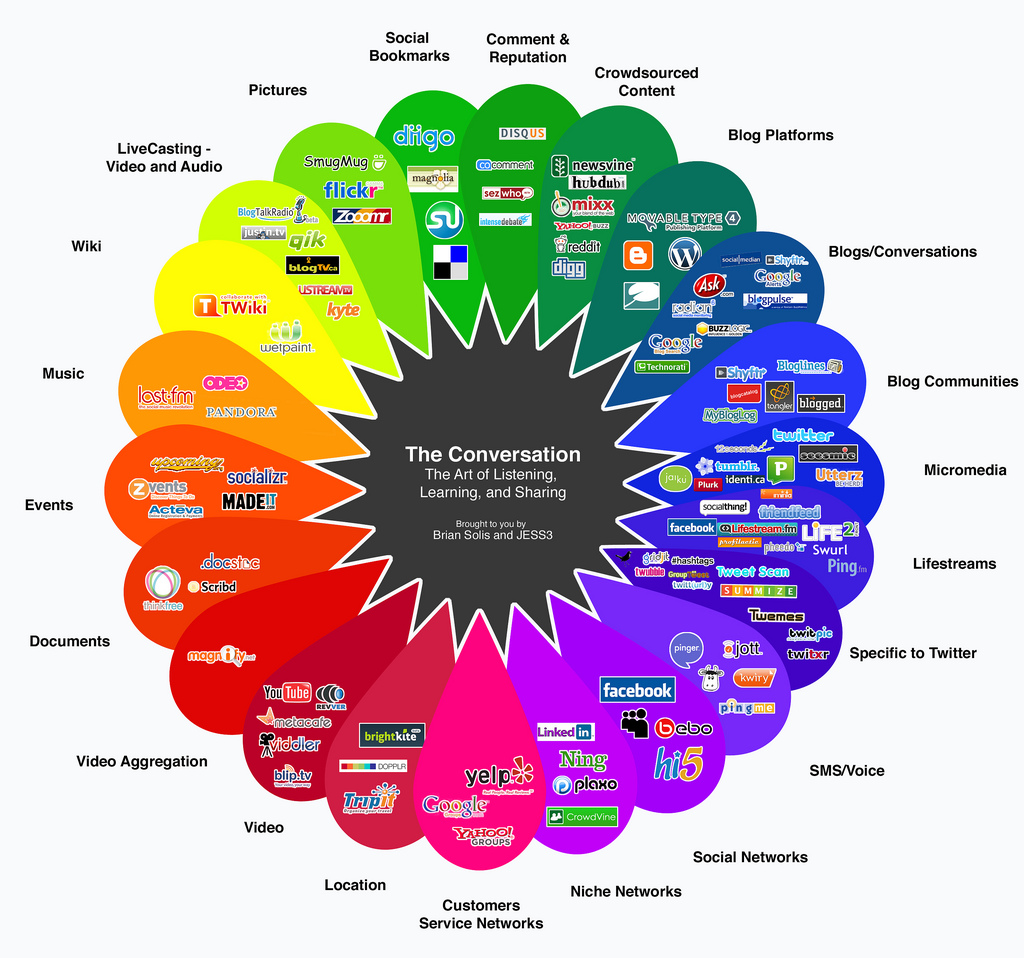
Knowledge — click twice to see the image in its largest form.

Conversation Prism

Comprehension — Key values include

  • Markets are conversations in control of customers.
  • Great products connect people to people.
  • Permission and attraction gain attention.
  • Customers remix what was consistent.
  • Helpful and relevant beats hypeful and sell-avant.

Application — One possible answer might be:

  • LinkedIn — because you’re in the biotech industry. Your key influencers are already there. Start a group with a biweekly article submission from your R&D staff. Investment of about 5-10 hours setting up a profile and connecting initially and then about 5-10 hours/month.
  • A blog to keep current information flowing and start connecting with key customers through interviews and articles.
  • Twitter — because a background study has shown that younger members of your industry are there. Find one employee to champion both Twitter and the blog. Choose this employee as you would choose any outward facing informational representative of the company.

Analysis — We’ll know what’s working by the response. We’ll get relevant, interesting human answers and comments. When we ask questions, real customers will give us real feedback. Measurement to be determined by goals of the client.

Synthesis and Evaluation These are agreements made with the client, but they should be specific, quantifiable and measurable.

What Do You Care?

Whatever you do in some manner you’re a teacher. If you look at the list in the pop quiz above what’s laid out there is merely a list for organizing thinking of subject matter from art lessons to how to cook. Take a long look.

Just as it’s a fine and fun thing now and then to clean off my desk. It’s a delight to do some serious organized thinking. We’ll now return to my right brain and creativity for the rest of the week.

How have you organized your thinking lately?

–ME “Liz” Strauss
Work with Liz!!
Related
PART ONE: A Rubric for Social Media Expertise

Like the Blog? Buy my eBook!

Filed Under: Marketing /Sales / Social Media, Successful Blog Tagged With: bc, social-media expertise pop quiz

A Rubric for Social Media Expertise

September 29, 2008 by Liz

People at All Levels Are Teaching

The Living Web

As the living web begins to seamlessly integrate into our concrete cultures and as our lives become globally intertwined, businesses are beginning to investigate what this means. Though the idea of markets as conversations may have started with Cluetrain ten years ago, but it has only become business credible with the advent of what we’re calling Web 2.0 and social media.

In recent years, major enterprise, telcos, cablecoms, and mainstream media have found more reason than not to look at social web models as unsound. Meanwhile we’ve been exploring concepts such as influence, authority, transparency, permission marketing, and experimenting with social media tools and networks to understand how a customer-centered market actually works.

It’s a story of a

  • returning to the culture of a village,
  • reversing the marketing paradigm,
  • and changing the scale from
    what was set in concretely in time and space
    to what is virtually asynchronous and instantaneously lasting.

It’s totally different from what went before and yet, in many ways, it’s still the same. Can you spell paradox?

Now companies are investigating how social media might move them forward. They’re hiring people to show them how to use social media tools and networks in the most effective and efficient ways.

How does a company recognize an expert from a beginner?
How do we explain that we know what we know?

A Rubric for Establishing Social Media Expertise

The development of any intellectual skill set follows an ordered sequence of Cognitive steps that was published in 1956 by Benjamin Bloom and a team of cognitive psychologists at the University of Chicago. Bloom’s Taxonomy was laid out to measure capability in three domains — Cognitive (mental), Affective (emotional), and Psychomotor (physical). In Bloom’s Taxonomy, it’s understood that each level must be mastered before the next level can take place.

Since Bloom’s is thought to be the most widely applied rubric for building and measuring educational and training programs to this day. It makes sense to use it when building a rubric for a field of knowledge or thought, such as social media expertise. So pulling from educational background and a couple of decades at using Bloom’s taxonomy in writing critical thinking programs I apply it here now.

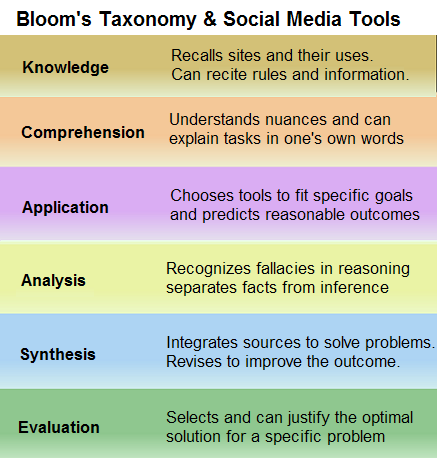
This chart is outlines the Cognitive Skills.

Bloom’s Taxonomy Chart

Social Media Knowledge — Recalling data and information.

If we’re working at the knowledge level we can name the social media sites and their uses. We can probably repeat the demographics of Digg or StumbleUpon and recall the differences between those sites and Flickr. We still have a problem explaining or interpreting the appeal of one tool over another.

Social Media Comprehension — Understanding the meaning of the data, translating the experience, interpreting instructions, and restating in one’s own words.

If we comprehend the use of social media tools and sites we’re able to explain why people use the various networks. We can generalize about how the tools work. We’re able to introduce the tools to a new user. We can summarize the rules, generalize the codes of behavior, and even model how to use them. We’re still exploring the depth and breadth and variety of uses for each of the tools. We’re also discovering the pros and cons of using each of them. However while we’re still gaining comprehension, we’re not ready to explain the return of specific tools to a specific client situation.

Social Media Application — Putting abstract thought to work in new situations.

If we’re at this level, when like problems are mentioned, we no longer automatically offer like solutions. We’re beginning to ask more questions. We’re looking at each tool to see how it meets goals. We might start with a benchmark plan, but we modify it as we gain information. Predicting outcomes with certainty is mostly luck while we’re at this level.

Social Media Analysis — Troubleshooting a plan, separating the whole into component parts to understand the most efficient course of action. Finding hidden fallacies and untested assumptions.

This is the point at which we get to the “concrete” of the situation. We deconstruct the tools to their component parts. We start to describe the kinds of traffic, the kinds of social sites, the kinds of sharing and conversation. We look to the time lines of engagement, the ROI of participation, and how they apply to each client’s schedule and budget constraints. We can talk about what works and what doesn’t. We can identify the influencers, the common wisdom, and the myths that cause problems. We know what what we should be tracking and testing. This level is tactical. True strategy requires more experience.

Social Media Synthesis — Building a pattern from the bits of information, forming a new meaningful whole that we can articulate.

When we’ve synthesize the experience of working with the tools, sites, and culture of social media, we’re able to predict and develop true strategy and process. We can design business models that we can rely on with some confidence, because they’re backed by history we recall, understand, have applied, analysed, and can articulate. This is strategic integration. It doesn’t mean we can’t make a mistake or misread a situation.

Social Media Evaluation — Judging the value of ideas, performance, process, or products. Testing, constantly testing. . . .

And it scaffolds up again and again through the cognitive skills levels. Just as we think we know something, we’re learning more again.

This is part of the reason we end up specialists. You get to synthesis on Twitter and FriendFeed is waiting around the corner.

Naturally, if you come to social media with years of marketing or customer service background, you’re probably at the top of the scale. But in a new frontier no one can claim full status quite yet.

How to Use the Rubric

What’s the use of this information? Change those “We can” statements to questions and you’ve got an evaluation or appraisal tool. Use it as it is to benchmarck a starting point or to frame the outcomes for training clients. Check your current practices to see whether you’re offering training in the right order.

What would you add to this rubric? How can we make it more useful for us and our clients?

–ME “Liz” Strauss

Work with Liz!!
Related
PART TWO: Have You Organized Your Social Media Thinking Lately?

Like the Blog? Buy my eBook!

Filed Under: Marketing /Sales / Social Media, Successful Blog Tagged With: bc, Bloom's Taxonomy, social media expertise, social-media rubric

Promote your Book Online with Virtual Blog Tours

September 22, 2008 by Liz

Two weeks ago I had a conversation with Teresa Morrow about her business. Right off it was easy to spot that this woman loves her work and loves the people she works with. Everything she said about it made me want to hire her, even though I didn’t have a need. So I did next best thing. I asked her to write about what she does. Meet Teresa.

Promote your Book Online with Virtual Blog Tours
by Guest Writer Teresa Morrow

For any author who wants to place his or her book before online audiences who are most interested in the book’s message, there are many options to consider. Making choices about what to do when can be overwhelming.

A good option to consider is the creation of a virtual blog tour. This online promotional opportunity is similar to a traditional book tour. However, unlike the brick and mortar tour, the virtual blog tour does not include the hassle of packing clothes, complications of travel, including airport congestion and airplane, train or bus schedules.

The virtual blog tour allows you to bypass the often-tiring and expensive task of traveling from city to city and state to state. Your journey as the author through the virtual tour wanting to reach his or her market is primarily handled through establishing a presence on the blogs of cyberspace.

The process initially begins by the development of a list of bloggers whose audiences would be interested in the topic of your book. The list can include bloggers who have already responded to your book as well research results of new bloggers whose audiences and professional ratings are in keeping with yours.

Ask these online citizen journalists to become one of your virtual blog tour hosts by reviewing the book, allowing you to be a guest blogger, and/or accepting another writer’s review of the book. You can also offer the book as a promotional giveaway item as this has become a very popular and successful virtual blog tour strategy.

The length of a virtual blog tour can vary from seven days to three weeks or more. Ideally, the schedule would be set up to feature your book through on a daily basis for the selected length of your tour. You can further assist blog tour horsts by providing them a book cover image, your author picture and your biography.

In addition you can create a mutual beneficial relationship with your blog tour hosts by highlighting them on your blog or website. The many options for doing this can include links to the hosts’ sites and invites to select hosts to be a guest blogger for you. If the hosts are also authors you can even offer to review their work at a later date.

Don’t forget to share virtual blog tour details (tour date, site links and host names) with social networking sites, such as Facebook, Linked In and Twitter.

Promoting your book online through a virtual blog showcases your book and builds important relationships with bloggers with whom you share common reader interests.

Teresa Morrow is on the Florida Board of Advisors with The WECAI Network â„¢ and an Editor at Large at WE Magazine for Women â„¢. She is passionate about working with authors, speakers and writers to manage their business online promotion. She cares about her clients and is available for 20 minute free consultation. You can contact her via email at keybusinesspartners@verizon.net or visit her website at http://www.keybusinesspartners.com.
________________

Thanks, Teresa! You’re inspiring!

–ME “Liz” Strauss

Filed Under: Marketing /Sales / Social Media, Successful Blog Tagged With: bc, Teresa Morrow, Virtual Blog Tours

  • « Previous Page
  • 1
  • …
  • 104
  • 105
  • 106
  • 107
  • 108
  • …
  • 174
  • Next Page »

Recently Updated Posts

The Creator’s Edge: How Bloggers and Influencers Can Master Dropshipping

Is Your Brand Fan Friendly?

How to Improve Your Freelancing Productivity

How to Leverage Live Streaming for Content Marketing

10 Key Customer Experience Design Factors to Consider

How to Use a Lead Generation Item on Facebook


From Liz Strauss & GeniusShared Press

  • What IS an SOB?!
  • SOB A-Z Directory
  • Letting Liz Be

© 2025 ME Strauss & GeniusShared