Successful Blog

  • Home
  • Community
  • About
  • Author Guidelines
  • Liz’s Book
  • Stay Tuned

Open Mic 7pm Chgo Time: It’s about Shiny Object Syndr-

September 30, 2008 by Liz

Join Us Tonight

Oh Look at . . .

Surely, you’ve heard of Shiny Object Syndrome — that behavior that allows any small change to be a distraction. Are you plagued by it? Shiny objects seem to be everywhere these days.

  • Do you get distracted easily?
  • Is it getting harder and harder to hold people’s attention?
  • Do you think shiny objects are a bigger problem than they once were?
  • Is shiny object syndrome only found on the Internet?
  • ahem . . .

Oh, and bring example links to share — shiny objects are fun.

The rules are simple — be nice.

Do be nice. 🙂

–ME “Liz” Strauss

Related article
What is Tuesday Open Comment Night?

Filed Under: SOB Business, Successful Blog Tagged With: bc, blog_promotion, discussion, letting_off_steam, living-social-media, Open_Comment_Night

Have You Organized Your Social Media Thinking Lately?

September 30, 2008 by Liz


Answers Included

The Living Web

You may be wondering about this organized thinking . . . I’ve been asked twice in the past few weeks to write up educational standards for writing social media training materials. This part two of that endeavor.

I’ve found that organizing my thinking around social media has been a good thing. Have you organized your thinking lately?

It’s a

Social Media Expertise Pop Quiz

Don’t worry it comes complete with answers.

Answer Key

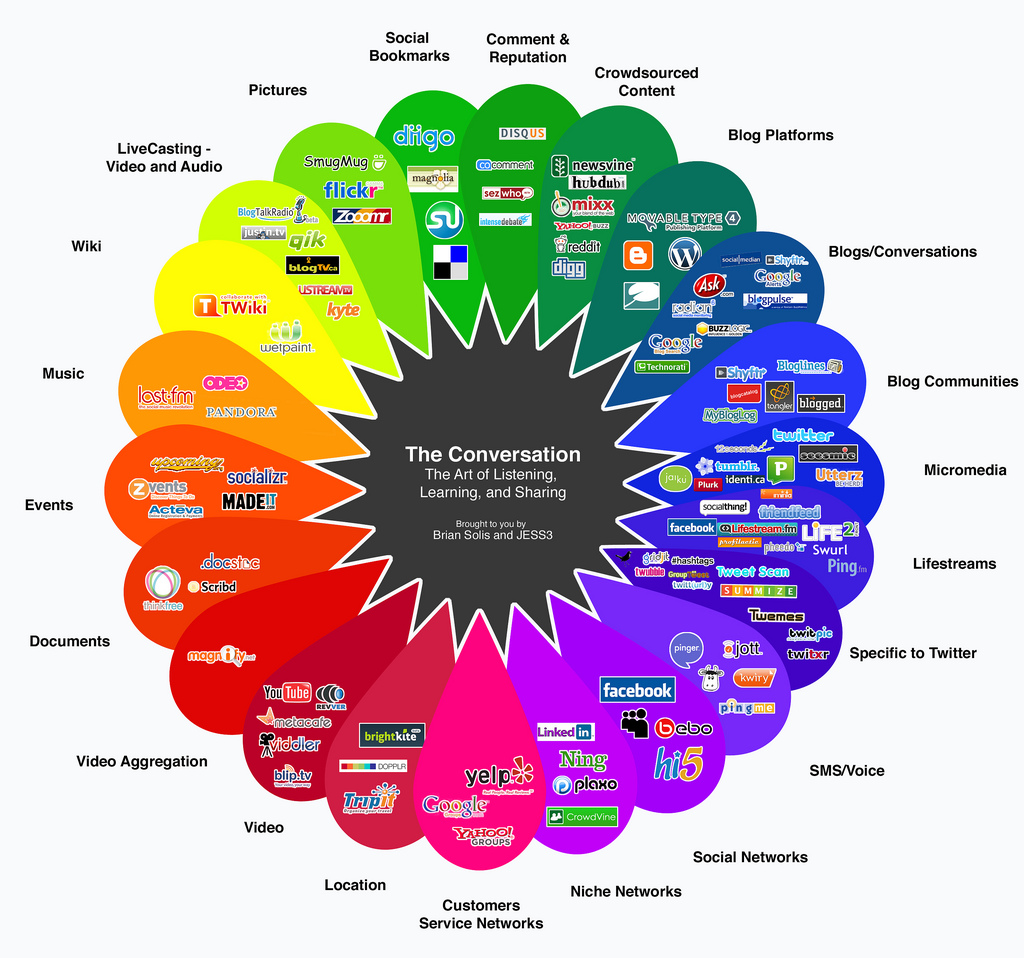
Knowledge — click twice to see the image in its largest form.

Conversation Prism

Comprehension — Key values include

  • Markets are conversations in control of customers.
  • Great products connect people to people.
  • Permission and attraction gain attention.
  • Customers remix what was consistent.
  • Helpful and relevant beats hypeful and sell-avant.

Application — One possible answer might be:

  • LinkedIn — because you’re in the biotech industry. Your key influencers are already there. Start a group with a biweekly article submission from your R&D staff. Investment of about 5-10 hours setting up a profile and connecting initially and then about 5-10 hours/month.
  • A blog to keep current information flowing and start connecting with key customers through interviews and articles.
  • Twitter — because a background study has shown that younger members of your industry are there. Find one employee to champion both Twitter and the blog. Choose this employee as you would choose any outward facing informational representative of the company.

Analysis — We’ll know what’s working by the response. We’ll get relevant, interesting human answers and comments. When we ask questions, real customers will give us real feedback. Measurement to be determined by goals of the client.

Synthesis and Evaluation These are agreements made with the client, but they should be specific, quantifiable and measurable.

What Do You Care?

Whatever you do in some manner you’re a teacher. If you look at the list in the pop quiz above what’s laid out there is merely a list for organizing thinking of subject matter from art lessons to how to cook. Take a long look.

Just as it’s a fine and fun thing now and then to clean off my desk. It’s a delight to do some serious organized thinking. We’ll now return to my right brain and creativity for the rest of the week.

How have you organized your thinking lately?

–ME “Liz” Strauss
Work with Liz!!

Related
PART ONE: A Rubric for Social Media Expertise

Like the Blog? Buy my eBook!

Filed Under: Marketing /Sales / Social Media, Successful Blog Tagged With: bc, social-media expertise pop quiz

Do You See Your Wallflower Self Wrong?

September 30, 2008 by Liz

Ever Seen One?

Yesterday at Brogan’s blog, Mark Hayward wrote a great post about being shy when attending conferences and other social situations. He called it Wallflower Syndrome.

Perhaps you’ve had some experience with that condition?
I have and still have moments when it returns. Truth is if I don’t plan well, a room filled with new people easily can shake my thinking.

I read what Mark wrote with interest and found a lot of what I do in his suggestions, but what surprised me what the photo that he chose to illustrate the feelings of wallflower-edness. He picked a sweet kitten in the grass.

Maybe that’s been part of the problem . . . I’ve been seeing the wallflower me all wrong.

Somehow I had this picture in my head that wallflowers were scraggly. dark green, barely surviving plant-like things. In my fish-eye imagination, a wallflower was a limp spinach mess with small wilted purple petals in a brown granny dress sitting in front of yellowing wallpaper.

How did I get that picture in my head?

Awkward and ugly was what wallflower always meant to me.

From junior high school school dances to certain networking events since,
that image of a spinach thing in a granny dress defined me the first second I felt shy or self-conscious in a group of more than three.

If I made the unfortunate mistake of walking near a wall, the game would soon before I could miss the thought of a wallflower and the image would make me feel even smaller.

Wallflower_from_sxc.hu

Then this morning, I saw this picture of a wallflower.

I’m feeling sort of duped and wondering . . .

I’m thinking that I’ve been seeing my wallflower self all wrong. I wonder whether you’ve been doing that?

What if I had seen myself as Mark’s kitten or known a wallflower could look like this one? Would shyness have been a different experience?

Do you suppose that could make a difference?

–ME “Liz” Strauss
Work with Liz!!

Get your best voice in the conversation. Buy my eBook.

Filed Under: Motivation, Successful Blog Tagged With: bc, Ive-been-thinking, shyness, wallflowers

A Rubric for Social Media Expertise

September 29, 2008 by Liz

People at All Levels Are Teaching

The Living Web

As the living web begins to seamlessly integrate into our concrete cultures and as our lives become globally intertwined, businesses are beginning to investigate what this means. Though the idea of markets as conversations may have started with Cluetrain ten years ago, but it has only become business credible with the advent of what we’re calling Web 2.0 and social media.

In recent years, major enterprise, telcos, cablecoms, and mainstream media have found more reason than not to look at social web models as unsound. Meanwhile we’ve been exploring concepts such as influence, authority, transparency, permission marketing, and experimenting with social media tools and networks to understand how a customer-centered market actually works.

It’s a story of a

  • returning to the culture of a village,
  • reversing the marketing paradigm,
  • and changing the scale from
    what was set in concretely in time and space
    to what is virtually asynchronous and instantaneously lasting.

It’s totally different from what went before and yet, in many ways, it’s still the same. Can you spell paradox?

Now companies are investigating how social media might move them forward. They’re hiring people to show them how to use social media tools and networks in the most effective and efficient ways.

How does a company recognize an expert from a beginner?
How do we explain that we know what we know?

A Rubric for Establishing Social Media Expertise

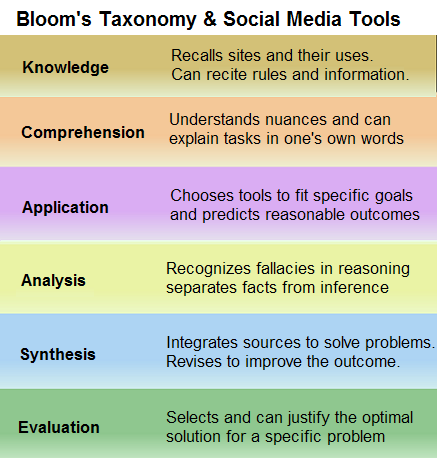
The development of any intellectual skill set follows an ordered sequence of Cognitive steps that was published in 1956 by Benjamin Bloom and a team of cognitive psychologists at the University of Chicago. Bloom’s Taxonomy was laid out to measure capability in three domains — Cognitive (mental), Affective (emotional), and Psychomotor (physical). In Bloom’s Taxonomy, it’s understood that each level must be mastered before the next level can take place.

Since Bloom’s is thought to be the most widely applied rubric for building and measuring educational and training programs to this day. It makes sense to use it when building a rubric for a field of knowledge or thought, such as social media expertise. So pulling from educational background and a couple of decades at using Bloom’s taxonomy in writing critical thinking programs I apply it here now.

This chart is outlines the Cognitive Skills.

Bloom’s Taxonomy Chart

Social Media Knowledge — Recalling data and information.

If we’re working at the knowledge level we can name the social media sites and their uses. We can probably repeat the demographics of Digg or StumbleUpon and recall the differences between those sites and Flickr. We still have a problem explaining or interpreting the appeal of one tool over another.

Social Media Comprehension — Understanding the meaning of the data, translating the experience, interpreting instructions, and restating in one’s own words.

If we comprehend the use of social media tools and sites we’re able to explain why people use the various networks. We can generalize about how the tools work. We’re able to introduce the tools to a new user. We can summarize the rules, generalize the codes of behavior, and even model how to use them. We’re still exploring the depth and breadth and variety of uses for each of the tools. We’re also discovering the pros and cons of using each of them. However while we’re still gaining comprehension, we’re not ready to explain the return of specific tools to a specific client situation.

Social Media Application — Putting abstract thought to work in new situations.

If we’re at this level, when like problems are mentioned, we no longer automatically offer like solutions. We’re beginning to ask more questions. We’re looking at each tool to see how it meets goals. We might start with a benchmark plan, but we modify it as we gain information. Predicting outcomes with certainty is mostly luck while we’re at this level.

Social Media Analysis — Troubleshooting a plan, separating the whole into component parts to understand the most efficient course of action. Finding hidden fallacies and untested assumptions.

This is the point at which we get to the “concrete” of the situation. We deconstruct the tools to their component parts. We start to describe the kinds of traffic, the kinds of social sites, the kinds of sharing and conversation. We look to the time lines of engagement, the ROI of participation, and how they apply to each client’s schedule and budget constraints. We can talk about what works and what doesn’t. We can identify the influencers, the common wisdom, and the myths that cause problems. We know what what we should be tracking and testing. This level is tactical. True strategy requires more experience.

Social Media Synthesis — Building a pattern from the bits of information, forming a new meaningful whole that we can articulate.

When we’ve synthesize the experience of working with the tools, sites, and culture of social media, we’re able to predict and develop true strategy and process. We can design business models that we can rely on with some confidence, because they’re backed by history we recall, understand, have applied, analysed, and can articulate. This is strategic integration. It doesn’t mean we can’t make a mistake or misread a situation.

Social Media Evaluation — Judging the value of ideas, performance, process, or products. Testing, constantly testing. . . .

And it scaffolds up again and again through the cognitive skills levels. Just as we think we know something, we’re learning more again.

This is part of the reason we end up specialists. You get to synthesis on Twitter and FriendFeed is waiting around the corner.

Naturally, if you come to social media with years of marketing or customer service background, you’re probably at the top of the scale. But in a new frontier no one can claim full status quite yet.

How to Use the Rubric

What’s the use of this information? Change those “We can” statements to questions and you’ve got an evaluation or appraisal tool. Use it as it is to benchmarck a starting point or to frame the outcomes for training clients. Check your current practices to see whether you’re offering training in the right order.

What would you add to this rubric? How can we make it more useful for us and our clients?

–ME “Liz” Strauss

Work with Liz!!

Related
PART TWO: Have You Organized Your Social Media Thinking Lately?

Like the Blog? Buy my eBook!

Filed Under: Marketing /Sales / Social Media, Successful Blog Tagged With: bc, Bloom's Taxonomy, social media expertise, social-media rubric

Open Up a World of Solutions with One Idea

September 29, 2008 by Liz

Mondays Are for Trying New Things

Change the World!

When I write something that moves me, when I smile at a worried over presentation, when I flesh out a particularly elegant idea, a high joy overflows my boundaries. I share that feeling with a friend who does the same when the joy of accomplishment is shining through her.

And when I’m overwhelmed with a problem or misstep, a bad hair day or a dark dead end. I dial through to that same friend again.

This time it’s not joy I’m sharing. It’s a state of confusion, a search for solutions, a total frustration with my inability to make things connect in the direction that was my intention.

The answer is get in return is always the same, “What would you say to someone else? You’d be brilliant, wouldn’t you? So go be brilliant for yourself.”

One idea: Be as brilliant for you as you would be for everyone else.

Every time I hear that, I shake my head in recognition. My outlook changes and a world of solutions opens up.

One idea. I’m learning to say it to myself.
I still call though because I like to hear her say it.

We can change the world — just like that.
–ME “Liz” Strauss

______________
If you’re ready to change the world, send me your thoughts in a guest post. Feel free to take the gorgeous Change the World image up there that Sandy designed back to your blog. Or help yourself to this one.

Change the World!.

Email me about what you’re doing or what we might do. Let’s change the world one bit at a time together. Together it can’t take forever.

Filed Under: Motivation, Successful Blog Tagged With: bc, be brilliant, Change-the-World

Great Graphic Ideas: crowdSPRING

September 28, 2008 by Liz

Looking for a Little Creativity or Maybe a LOT?

If you know an outstanding design site, email me a link and tell me why you think it’s important to share. Then I can pass it along.

This week at the Feast for Smart Marketers I met Pete Burgeson of crowdSPRING. We had quite the conversation about this Chicago-based business that calls itself a “marketplace for creative services.”

Great Find: crowdSPRING
Permalink: http://www.crowdspring.com/
Target Audience: Design clients, creatives

Content: When Pete I started talking I asked how crowdSpring worked. He described the basic model as they do on the website.

crowdSPRING project model

I questioned a model based on work done on spec, but after a closer look I’m quite taken by what’s happening at crowdSPRING. Their model is intelligent and built to grow with their community.

  • crowdSPRING serves the new guys. Small businesses just launching need a professional presence that won’t cost them out of the market. Talented creatives starting out need to build visibility and a portfolio of clients.
  • It also serves who’ve been “around the block.” I’m fully confident that buyers looking for serious design work can find it here because there seems to be no requirement to participate in the “projects.”
  • I was able to browse projects, portfolios, profiles, and forums. Personal messages and forum conversations make it easy to connect with creative suppliers.

  • Creatives can upload portfolios next to their profiles. Profiles include a record of performance on projects completed through the site.
  • It’s community for learning and thinking, as well as a marketplace. The forums are filled with insightful discussion of design and of the projects on the site.

crowdSPRING is using social media in the best way . . . by making it easy for people to connect around ideas that they care about.

Go on, have a look. See how easy it looks when it’s done well.

–ME “Liz” Strauss
Work with Liz!!

Related
Great Graphic Ideas: Nebon Media
https://www.successful-blog.com/1/great-find-yudu-freedom/
Sandy’s Great Graphic Find: block posters
Great Find: PDF Online — Free

Get your best voice in the conversation. Buy my eBook.

Filed Under: Design, Successful Blog Tagged With: bc, creativity, crowdspring, Design, social-media

  • « Previous Page
  • 1
  • …
  • 195
  • 196
  • 197
  • 198
  • 199
  • …
  • 707
  • Next Page »

Recently Updated Posts

The Creator’s Edge: How Bloggers and Influencers Can Master Dropshipping

Is Your Brand Fan Friendly?

How to Improve Your Freelancing Productivity

How to Leverage Live Streaming for Content Marketing

10 Key Customer Experience Design Factors to Consider

How to Use a Lead Generation Item on Facebook


From Liz Strauss & GeniusShared Press

  • What IS an SOB?!
  • SOB A-Z Directory
  • Letting Liz Be

© 2025 ME Strauss & GeniusShared