Successful Blog

  • Home
  • Community
  • About
  • Author Guidelines
  • Liz’s Book
  • Stay Tuned

Simon Mainwaring says We First – Do You?

June 8, 2011 by Liz

We First: An Invitation to Build a Better World
By Simon Mainwaring
Founder, We first

cooltext443794242_influence

Let me start out by saying this is a big picture blog. I am seeking your support for a movement to build a better world. That’s a sizeable request, I know, but let me explain because this will be important to you both personally and professionally.Several years ago, I read a speech Bill Gates gave at the World Economic Forum in Davos. He asked corporate leaders to come up with new models to justify doing business in the poorest regions of the world. He exhorted that corporations have an obligation to raise the standards of living throughout the world, even if they cannot capture their usual profit margins. Gates called it “creative capitalism” and he challenged the business world to get involved.

Does this message resonate with you? Do you think the world could be in better shape were capitalism to function better?

I did. Gates inspired me and I began thinking. Since then, I have devoted myself to formulating ideas that could fundamentally alter how we practice business. I call it We First capitalism in opposition to Me First capitalism. It is based on the premise that we are now living in a complex, interconnected, globalized world of 7 billion people in which our economic decisions and business practices ripple everywhere to impact millions of other people. We can no longer accept that capitalism functions as an engine of selfish short-term wealth creation, winner-take-all, profit-for-profit’s sake system of commerce. Capitalism cannot remain an elite economic activity whose results provide happiness and prosperity for a limited group of stakeholders, leaving billions of others living without opportunity or hope, and our planet in shambles.

My purpose in formulating We First capitalism is to persuade corporations and businesses of all sizes that we all must accept greater social responsibility. Building a better world must become what our businesses do every day as part and parcel of our operations, not something we do after we make our profits. The scale of crises in the world needs more than charitable contributions reluctantly squeezed out of pre-tax net profits. Business itself must become a smarter engine of constructive contribution to solving the world’s problems, not just a mindless motor churning out profits from our consumer culture.

In recent years, we have seen many of the leading companies in the world start to tackle their social responsibility. Brands like Nike, Starbucks, Pepsi, Patagonia, and even the largest brands like P&G and Unilever are responding with programs to implement sustainable manufacturing, develop Fair Trade suppliers who support indigent farmers, and assist NGOs on the ground not just with their money but with their expertise, distribution resources, and leadership. We First is not wishful thinking for two reasons. First, research shows that consumers are increasingly attracted to companies that practice social responsibility. They prefer to do business with socially-oriented companies and they are even willing to switch brands to a product that supports a cause if the price is about equal, especially Moms and Millennials who are the major markets for many consumer products.

Secondly, social media is connecting up consumers and empowering them as never before to have a voice and communication outlets to talk back to irresponsible businesses. Through their fan pages on Facebook and twitterstreams, consumers have new opportunities to protest against the bad actors of the business world, to organize boycotts and buycotts, to reward the good and punish the offenders. New smart phone apps are giving consumers the tools to scan barcodes and get information right in the shopping aisle about a product’s ecological and social footprint so they can make smarter choices about which companies they want to support.

So whether you are a corporate executive, manager, entrepreneur, or small business owner, the movement to temper capitalism and bring social responsibility to the forefront is going to impact you and your business. If you are looking for guidance as to how to respond, I hope you will order We First and join other individuals and companies in building a better world.

——
wefirst-book

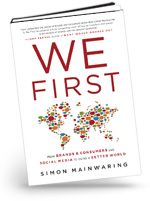
Simon Mainwaring is the founder of We First, a social branding consultancy that helps companies, non-profits and consumer groups build a better world through changes to the practice of capitalism, branding, and consumerism using social technology. You can find more about We First capitalism and its principles in his book, We First: How Brands and Consumers Use Social Media to Build a Better World (Palgrave/Macmillan, June 2011) at www.wefirstbook.com

Simon writes at SimonMainwaring.com and you find him on Twitter as @simonmainwaring

Thanks, Simon! It was easy to feature what you’re doing. I know your head is connected to your heart.

–ME “Liz” Strauss
Work with Liz on your business!!

Filed Under: Business Book, Successful Blog Tagged With: bc, creative capitalism, LinkedIn, Simon Mainwaring, We First

7 Solid Business Outcomes of Comradeship, Cause, Communication, and Compassion.

June 7, 2011 by Liz

All Leaders Motivate People

insideout logo

The day before SOBCon 2011, Jackie Mitchell, (@Your_MsSunshine) of the Red Cross Chicago, stopped by the event site. I was explaining to Terry St. Marie, (@Starbucker) my business partner, that Jackie is that rare person who hires to a team — meaning that she interviews people to find individuals whose skill sets will add up to a stronger single unit simply by the act of teaming them together. During that conversation, Jackie mentioned how stunning it was to her to realize that the majority of the people who work for her (80% ?) don’t get paid cash for the hours they work.

Volunteers are motivated by a currency other than money.

Paid employees aren’t motivated by money either. Peter Drucker proved that money is a disincentive … rather than moving us to work more — money has the most powerful effect when it’s missing or too small.

Leaders understand that more powerful currencies attract, engage, and motivate people.

7 Solid Business Outcomes of of Comradeship, Cause, Communication, and Compassion.

If you’re looking to build a team of employees as volunteers or volunteers as employees place your investment in offering comradeship, cause, communication, and compassion. These deeper currencies will draw other leaders to build something they can’t build alone. The call of a community quest to build something strong, lasting, and meaningful is a powerful payoff in itself.

Thinking minds perform amazing feats when we are dedicated to purpose they believe in and love. We rise to our better selves when we find a group willing to invest in us and each other for a quest bigger than any one of us alone.

When an organization offers meaningful engagement of head, heart, and purpose, it reaps seven deeply solid business outcomes.

  1. Self-Awareness — Remembering. The unique value is the person, his or her skills, talents, experience, and wisdom, not the job.

    Employees who see themselves as people who do a job, rather than people who are a job offer perspective, humanity, maturity, and balance that people filling a role have lost. The faster paced the situation, the more we need time for reflection, to check in, to ensure that we don’t leave behind the learnings of our failures AND our successes. We can’t remember, reenergize, and reignite what we’ve forgotten, devalued, or not taken time to realize, claim and internalize.

  2. Meaning — value and values. Meaning — the “why” we work — it is the values inside our value proposition.

    Money can’t buy love … or loyalty. To invest our best in a common vision, we have to know what we offer and how our contribution has meaning. Meaning allows us to express our value and attracts other who have value to offer. Meaning gives us a reason to show up to become a part of something bigger than ourselves – the ultimate share the risk, share the benefit of a common cause, building a business that no one person can build alone.

  3. Peak performance — productivity. Loving you do is a simple shift to seeing that doing good work is less stressful, more fun, more fulfilling, and more profitable.

    People who love their work bring more, invest more, do more, go further for the company and the customer.
    They’re constantly seeking faster, more efficient, better answers. They get satisfaction from satisfying coworkers and customers in ways that makes the company grow. They recognize and protect the company where that’s going on. Peak performers attract other peak performers who love

  4. Communication — Value-Based Leadership. Employees who love their job find ways to communicate their values and their level of commitment in clear ways that other people can understand and trust.

    We value what we earn and what we love. As employees undercover their core values, they learn how to communicate what those values are and what they are not. That values base line helps them sort their own stories. Employees begin to see how their values build as confidence, clarity, competence, integrity, respect, and more predictable behavior, the hallmarks of leadership. That leadership inspires and attracts the other leaders who hold the same values.

  5. Focus — Balanced View. Employees who view their role as integral to the business zoom out to see the customer (values) and the company (value proposition) and back in to focus their best balanced thinking to deliver for both.

    The people who conceive, design, build, and share with customers what we sell have always know what works best and delivers value. Whether the job is building a product, answering a phone, responding on Twitter, closing a deal, or moving a box in the warehouse, a meaningful view toward serving both customers and company is within every employee’s grasp. Thoughtful decisions happen where they make sense, at the right moment, and by the person at the right level. Time is saved. Costs decrease. Quality goes up.

  6. Teamwork — Problem-Solving. Employees doing what they love have more patience, time, and energy for problem solving and for each other.

    Invested employees see the value of teaching newcomers the culture and helping those learning new skills. They align their goals to protect the environment which benefits them, the community in which they work, the business that is growing, and the customers they serve. The essence of teamwork is the idea of building something no one can build alone.

  7. Influence – Benefits of Relationships. Leaders who love their jobs understand the value of aligning their goals to build lasting relationships.
    They reach out to coworkers, vendors, partners, customers, clients, stockholders and families and make them a part of building the business. They live collaboration without fearing mutation, knowing that their values and value proposition will guide the big decisions. They talk benefits and focus on others when they build and handle the product, when they tell the company story to the customers, and in how they talk about the company as a value in serving others. The respect of a loyal community shows in everything it does.

    They build a barn, not a coliseum, inviting everyone who picks up a tool to help them. They are mission critical to their coworkers’ and customers’ missions. That loyalty becomes its own barrier to entry. No competitor can that knock that off.

And those seven outcomes result in powerfully persuasive ROI — Market Share, Market Differentiation, and Market Value. Rolling all seven into one, nothing beats the 360 degree investment of brains, heart, energy, resources, goals, and dreams all in the same direction. Any financial firm worth its salt looks for that combination when funding a business.

So when we look to engaging a great team for our business — large or small. Focus first on finding leaders who want to build something they can’t build alone. Focus fast on finding ways to bring them fully into the experience. And fund them and their work the best you are able, knowing that money can’t buy love.

How might you build more comradeship, cause, communication, and compassion into every role you offer the people who work with you?

Be irresistible.

–ME “Liz” Strauss
Work with Liz on your business!!

Buy the Insider’s Guide to Online Conversation.

Filed Under: Marketing /Sales / Social Media, Motivation, Successful Blog Tagged With: bc, cause, communication, compassion, comradeship, LinkedIn

What Soundbyte Do People Use to Describe YOU?

June 6, 2011 by Liz

cooltext443809602_strategy

The importance of a professional personal identity isn’t hard to explain. We all want to let business contacts see us as high caliber individuals with strong positive qualities and competence. A strong professional personal identity can differentiate and position us an irresistibly attractive asset when we want to work with a most prestigious team.

But a great professional identity more than clever packaging. It’s more than a 30-second pitch on who we are. To set our personal potential into action takes self-awareness, reflection, information, conversation, consideration, reorganization, and a vision that we can translate into action.

By identifying personal and professional brand synergies, aligning your personal brand goals to your professional pursuits you can have your cake and eat it too. By identifying opportunities that serve both your personal and professional brand objectives, you can effectively multitask, utilizing the professional support and resources at your disposal while building your own brand. Dan Schawbel

It takes work to identify, understand, define, and articulate the unique value that is your personal value proposition. But it’s worth it to get the right words, the right values, and the right talents and skills to talk about when we talk about ourselves in a business context.

It’s harder yet to take that down to a shareable sound-byte that’s clear, concise, and dead on true.

What Soundbyte Do People Use to Describe YOU?

Call Tony. He can fix anything.
That Vanessa, she’s so sweet.
If you want it organized, accurate, and complete, Anne’s the one.
Ryan’s a problem solver. He’ll have this figured out in a matter of minutes.
David will give you the shirt off his back. Don’t take it. He never forgets that he gave it.

Those soundbytes, mini-descriptions, might be accurate, or they might be legend. The point is that the people talking believe and share them. The people they’re describing have communicated those traits strongly over time.

What do people share about you when you’re not around? Being able to articulate and highlight your value can define and even change what folks share with each other about who you are.

You probably have a sense of your strengths and some of your weaknesses. It’s hard to get through school and get a job without having a sense of what they might be. But few of us actually take some time to pinpoint what they are. Take the time to determine your most outstanding assets–your highest proficiencies, your core competencies. Ask yourself these questions to gather the relevant data.

  1. What am I often asked to teach others?
  2. What responsibilities are often delegated to me?
  3. What kinds of meetings and tasks am I asked to lead?
  4. What special skills and competencies do I have that others rely on?
  5. What parts of my job description would be hardest to fill?
  6. What traits make me a valuable and unique member of the team?
  7. What work isn’t work at all?

Spend serious time reflecting on each question. Reflection is how we understand what we know. You might think about one question for set time or for a few minutes at different points in a day. As you get ideas and remember things, take notes. Write down what comes to mind. When you’ve got notes on all seven, roll up what you have gathered into one single big idea — the short bio that we hear people use all of the time — something like …

Liz can articulate what could make any product irresistible and how to turn any problem into a win.

Make your big idea a statement of your unique value in ways that others can see it, can believe in it, and can share it easily.

What is the sentence that people should be saying about you?

–ME “Liz” Strauss
Work with Liz on your business!!

Buy the Insider’s Guide to Online Conversation.

Filed Under: Marketing /Sales / Social Media, Successful Blog Tagged With: bc, LinkedIn, personal-branding, value proposition

Thanks to Week 293 SOBs

June 4, 2011 by Liz

muddy teal strip A

Successful and Outstanding Bloggers

Let me introduce the bloggers
who have earned this official badge of achievement,

Purple SOB Button Original SOB Button Red SOB Button Purple and Blue SOB Button
and the right to call themselves
Successful Blog SOBs.

I invite them to take a badge home to display on their blogs.

muddy teal strip A

alzheimers-reading-room
authopublisher
bald-hiker
chris-pirillo
thomas-hawks-digital-connection

They take the conversation to their readers,
contribute great ideas, challenge us, make us better, and make our businesses stronger.

I thank all of our SOBs for thinking what we say is worth passing on.
Good conversation shared can only improve the blogging community.

Should anyone question this SOB button’s validity, send him or her to me. Thie award carries a “Liz said so” guarantee, is endorsed by Kings of the Hemispheres, Martin and Michael, and is backed by my brothers, Angelo and Pasquale.

deep purple strip

Want to become an SOB?

If you’re an SO-Wanna-B, you can see the whole list of SOBs and learn how to be one by visiting the SOB Hall of Fame– A-Z Directory . Click the link or visit the What IS an SOB?! page in the sidebar.

–ME “Liz” Strauss

Filed Under: SOB Business, Successful Blog Tagged With: bc, blog-promotion, SOB-Directory, SOB-Hall-of-Fame, Successful and Outstanding Blogs

Audience Is Everything – Do You Know Your Audience as Well as You Know Yourself?

May 31, 2011 by Liz

Content Isn’t Audience, But You Knew That

cooltext443809437_relationships

When I gave a keynote at the EdNet conference, where I met with many old and new friends in the business of publishing. I ended up in the most interesting conversation with one in particular, a man who was connected to me from years ago when publishing in print was my life. We got to talking about how publishers were facing the need to move from shelves of books to information that moved across the Internet.

He said, “I love books. I love seeing them stand on the shelves. I understand why everyone wants to keep making them. But I also see why we need to move our thoughts and ideas to PDFs.”

First I winced, then I smiled, then I laughed.

“What?” was what he said.

“You’re thinking of the paper web. A PDF is just a digital form of a paper document and almost as much of a pain. It’s not really part of the web. It’s a gated and separate location. I have to leave where I am to click over to where it is, wait for it to load, and then I’m stuck inside it. Switching back and forth takes for ever. It’s like asking me to go to the corner to buy a book.”

“Ah, I suppose I should be saying content.”

“Content on a blog or a website is easier to access. Yep that’s for sure, but content isn’t the end.”

I asked him to tilt his head to consider this question, “How many books sit on library and living room shelves that were chosen with great intentions then never read?”

If your goal is to sell books or to sell content, then keep your eye on them.
That will happen is that you’ll grow your sales and find ways to get more books in peoples hands and more visitors to your content.

But all of the thoughts that writers worried to express and the reams of ideas that could be changing the world may become good piled in the good intentions of book shelves and feed readers — parts of collections that never get read.

The book, the pdf, the website, the content isn’t the destination the audience is.

Know Your Audience as Well As You Know Yourself

An airplane traveling from New York to Chicago is off course 98% of the time. Still it gets there. Why? The pilot is always adjusting with his destination in mind. Do you listen to your best audience and tweak what you do to keep your content in their sweet spot?

The audience is your destination. If you’re writing for yourself, you’ll head in a different direction than if you’re writing for people learning what you know. It may sound obvious, but it’s still worth stating — if you don’t know where you’re going, you’re not going to get there. If you think you’re going everywhere or writing for everyone, you’ll end up nowhere.

Too often authors and bloggers don’t think through who their readers will be. As a result a blog post or a book title gets our attention but doesn’t keep us interested. Don’t write for the fad or the lastest content trend, write for the people who are exploring the idea behind it. Then when they change their direction, you can change yours with them because your relationship is with the audience not with the content.

Have you really thought through who your audience is? Here are some questions to help you do that. Take a shot at answering them all in one sentence.

  • Who am I writing for?
  • How are they like me and how are they not?
  • What do they care about?
  • What will get their interest and keep it to the very end?

Write down your audience profile. Revisit it often. Adjust it as your readership grows and you get to know them better.
Use it to guide what you choose to write.

Now that you’ve got a clear destination. Other decisions get a whole lot easier.

Do you look at what you offer from the audience view? How does that work for you?

–ME “Liz” Strauss
Work with Liz on your business!!

Buy the Insider’s Guide to Online Conversation.

Filed Under: Audience, Successful Blog Tagged With: audience, bc, Content, LinkedIn, relationships

Thanks to Week 292 SOBs

May 28, 2011 by Liz

muddy teal strip A

Successful and Outstanding Bloggers

Let me introduce the bloggers
who have earned this official badge of achievement,

Purple SOB Button Original SOB Button Red SOB Button Purple and Blue SOB Button
and the right to call themselves
Successful Blog SOBs.

I invite them to take a badge home to display on their blogs.

muddy teal strip A

brandtailers
never-stop-marketing
nakeva-photography
pear-mentor
the-quick-base-blog

They take the conversation to their readers,
contribute great ideas, challenge us, make us better, and make our businesses stronger.

I thank all of our SOBs for thinking what we say is worth passing on.
Good conversation shared can only improve the blogging community.

Should anyone question this SOB button’s validity, send him or her to me. Thie award carries a “Liz said so” guarantee, is endorsed by Kings of the Hemispheres, Martin and Michael, and is backed by my brothers, Angelo and Pasquale.

deep purple strip

Want to become an SOB?

If you’re an SO-Wanna-B, you can see the whole list of SOBs and learn how to be one by visiting the SOB Hall of Fame– A-Z Directory . Click the link or visit the What IS an SOB?! page in the sidebar.

–ME “Liz” Strauss

Filed Under: SOB Business, Successful Blog Tagged With: bc, blog-promotion, SOB-Directory, SOB-Hall-of-Fame, Successful and Outstanding Blogs

  • « Previous Page
  • 1
  • …
  • 49
  • 50
  • 51
  • 52
  • 53
  • …
  • 707
  • Next Page »

Recently Updated Posts

Is Your Brand Fan Friendly?

How to Improve Your Freelancing Productivity

How to Leverage Live Streaming for Content Marketing

10 Key Customer Experience Design Factors to Consider

How to Use a Lead Generation Item on Facebook

How to Become a Better Storyteller


From Liz Strauss & GeniusShared Press

  • What IS an SOB?!
  • SOB A-Z Directory
  • Letting Liz Be

© 2025 ME Strauss & GeniusShared