Successful Blog

  • Home
  • Community
  • About
  • Author Guidelines
  • Liz’s Book
  • Stay Tuned

Put the Boiler Back in Your Boilerplate

January 30, 2015 by Rosemary

By Mickie Kennedy

Think back to the last time you wrote a press release.

I bet you spent hours dreaming up the concept, digging up the right quote, and crafting that perfectly pointed inverted pyramid. You probably had a colleague or two proofread it before lovingly releasing it out into the world over the wire.

Now think about the last time you wrote the boilerplate that goes at the end of your press release. How long did you spend on it? Did you have a friend proofread it?

I’m willing to bet you didn’t. And I’m not blaming you. I’m guilty of the same sin. And I have a challenge for the PR pros out there. It’s time to put the “boiler” back in boilerplate.

steam engine

Where has all the steam gone?

The term boiler conjures up intense heat, sweat, clanging metal and honest hard work. It’s a powerful image. So why are our current boilerplates so wimpy?

I blame it on our current all-encompassing focus on content. In today’s increasingly digital world, the challenge is to get as much content out there as we can. We want to build credibility, get found through search engines, and best of all, see our carefully written words in print or on our favorite news website.

But it pays to remember that well-written boilerplate can facilitate all of that. Put yourself in the shoes of an editor. Say you receive a similar press release from two t-shirt companies. Apparently they have both noticed a sharp uptick in consumer’s buying t-shirts based around the 80’s television series Diff’rent Strokes. A trend has been spotted! But which company would you trust, just based on their boilerplate:

“Novel-Tees has been selling novelty t-shirts on the web since 1999. Visit us at novelteesz.comm.”

“Arty-Tees provides the most comprehensive collection of 1980’s nostalgia t-shirts on the web. Arty-Tees’ collection of over 60,000 designs includes limited edition signed t-shirts as well as hard-to-find designs straight out of the MTV heyday. Awards include a “T-Shirty” for innovative original t-shirt design, and stars as diverse as rocker Keith O’Keef and ingénue Marylin Maryland have been spotted in our swag. Backdate your look at arty-tees.commm.”

Arty-Tees is the hands-down winner. Here’s why:

  • It’s comprehensive – By the time you finish reading the Arty-Tees boilerplate, you really have a sense of the company and what they do.
  • It’s specific – it mentions exactly what the company sells, who they sell to and why you should also buy from Arty-Tees.
  • It’s repetitive – Will you forget that Arty-Tees sells t-shirts? Doubtful, because the boilerplate makes repeated mention of the company name and the product they specialize in.

Best of all, your boilerplate is the only place in your press release where it’s allowed, and even expected, for you to promote your company. So don’t waste this smoking hot opportunity!

How much time do you spend writing company boilerplate? Has this post inspired you to pump up your boilerplate? Let us have a look in the comments!
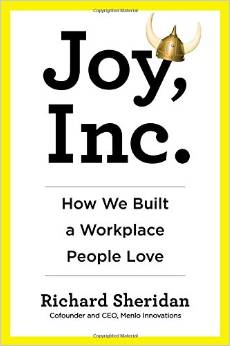

Photo Credit: midcheshireman via Compfight cc
Author’s Bio: Mickie Kennedy, author of the PR Fuel blog and founder of eReleases.

Filed Under: Marketing /Sales / Social Media Tagged With: bc, press-releases, public relations

Book review: Joy, Inc., by Richard Sheridan

January 29, 2015 by Rosemary

Corporate joy? Is that an oxymoron?

It doesn’t have to be, according to Richard Sheridan. His company, Menlo Innovations, is devoted to “ending human suffering in the world as it relates to technology™.”

Sheridan’s book, Joy, Inc., (which was originally released in 2013), is a fascinating look inside his team’s “joy factory.”

book cover Joy, Inc. by Richard Sheridan

The casual reader might be tempted to approach this book with some healthy skepticism. The title conjures up a mental image conjured of a bunch of forced-wacky Kool-Aid drinkers.

In reality, the book provides a detailed explanation of systems, methods, and daily processes that are intended to result in joy. Joy for the employees, for the clients, and for the lucky end-users of the software being created.

Learning and teaching are at the core of the Menlo system, where colleagues work in pairs and progress is quite visibly measured on the walls. Humans need to feel that they are making progress in order to be happy, and that need is systematized at Menlo.

Here are just some of the ways Sheridan and his crew build joy:

  • Avoid having “knowledge towers,” employees who are the sole repositories of certain information.
  • Eliminate bureaucracy, and unnecessary meetings wherever possible. Consider having a daily standup where only those with useful information to share speak.
  • Use what Sheridan calls “High-Speed Voice Technology.” Talk to each other, openly and frequently. Stop texting and emailing people who are in the same building. Build relationships, which build value.
  • One of the key elements of a joyful culture is having team members who trust one another enough to argue. Stop hiring people who all agree with each other.
  • Consider reverse show and tell. Rather than presenting your client with a progress report, ask the client to tell the team what is going on with the project.
  • Use physical artifacts for planning and task execution, so that everyone can immediately see progress and status.
  • Hire for joy and build that into the entire process. Look at the human, not the resume.
  • Whatever you’re making, build in the delight/joy for the end-user as well. Find a way to build links between your staff and whomever will be using the work product. Menlo has a special position called “high tech anthropologist,” which is the link between programmers and end-users.
  • Create an atmosphere free of fear. You can fail, you can experiment. Don’t get stuck on something just because you’ve already invested a lot of time in it.
  • Break important HR rules, etc., like having babies or dogs in the office, as long as it’s part of your authentic culture.
  • Share leadership, and be vulnerable. Share your vision and encourage new leaders.
  • Strive for clarity and discipline.
  • Incorporate flexibility as part of the culture, as much as possible. This makes it easier to start new initiatives.
  • Accountability is important, but only when everyone is accountable, top to bottom.
  • Employees need the “ability to go to work and get meaningful things done.” Values must be pervasive and visible in every aspect of the business, from the work space to contracts, to partner agreements.

Menlo is serious about transparency. The conclusion of the book punctures the idea that it is utopia. There are problems, as there always will be when humans are involved. The key difference is that here, problems are openly acknowledged and tackled as a team, not behind closed doors.

I’d strongly recommend this book to anyone who is considering building a business, and especially those who are already running a business. There are ideas galore, and even if you aren’t producing software, Sheridan challenges you to find the joy in your daily business.

Do you look at joy as a business value?

Disclosure: I was provided a digital review copy of this book. My opinion is from the heart.

Author’s Bio: Rosemary O’Neill is an insightful spirit who works for Social Strata — makers of the Hoop.la community platform. Check out the Social Strata blog. You can find Rosemary on Google+ and on Twitter as @rhogroupee

Filed Under: Business Book Tagged With: bc, book review, project management

Simple Ways to Make Your E-Newsletter More User Friendly

January 27, 2015 by Rosemary

By Shaun Chatman

Your newsletter is an important way to get relevant information across to your customer base, clients, or readers. But all of these people will be viewing it on different devices. Use these tips to simplify your newsletter’s content and formatting, to enhance readability and keep your content user-friendly.

Format in a Single Column

You may be tempted to use fancy design work in your newsletter, but the best way to go is a simple format that puts all your information into a single column. Go for a column 500 to 600 pixels wide, and be sure to take into account special formatting for mobile devices. You won’t be able to keep formatting completely uniform over all devices, but you can take many steps to ensure that it doesn’t fall apart and become unreadable on certain devices. Simplicity is your best friend in these instances. Choose a few design elements (like text formatting and social media linking) that make the content easier to consume and then stick with those and ignore the impulse to go over the top.

Break Content into Headings

Your newsletter probably contains multiple points you want to communicate to your readers. Rather than writing it in the style of a letter with each paragraph flowing into the next, create a new heading every time you come to a new newsletter item. Make that heading obvious and separated from the rest of the content. By doing this, readers who are skimming through on a device with a smaller screen will know where to stop and start reading.

Use Images Sparingly

One or two interesting images will enhance the content of your newsletter, but overloading your newsletter with images is a surefire way to make it more difficult to read on multiple devices. Images, by default, require different formatting than text does, so no matter how careful you are, the more formatting you add to your newsletter, the more likely it is something will go wrong. Also, images take longer to load, especially on hand held devices like phones or tablets that may be connected to a 4G network rather than wi-fi.

Streamline Your Content

While skimming through paragraphs of content may be easy on a laptop screen, if someone is reading from his or her phone, it takes longer to scroll through a lot of text. Even with headings, keep your newsletter’s content relevant and brief. If you’re wondering about types of content apt for your newsletter, go for content that your readers can consume in bite-sized chunks. Tips and tricks for your customers, a short letter from the CEO of your company, or lists of significant blog posts or news articles are great places to start.

Remember, it’s not just about formatting. Good content also keeps your newsletter fresh and interesting for your readers. Each newsletter will look different, but by keeping it simple and following these tips, you’ll be well on your way to creating a newsletter that works on as many devices as possible.

Author’s Bio:Shaun Chatman is a seasoned writer featured on many authority blogs. Writing is his passion, and he spends most of his waking hours writing about everything from Tech to Education. He lives in Dunedin, Fl.

Filed Under: Content Tagged With: bc, Content, formatting, newsletter

A spoonful of sugar for your next blog post

January 22, 2015 by Rosemary

In every job that must be done
There is an element of fun
You find the fun and snap!
The job’s a game

And ev’ry task you undertake
Becomes a piece of cake
A lark! A spree! It’s very clear to see that

A Spoonful of sugar helps the medicine go down
The medicine go down-wown
The medicine go down
Just a spoonful of sugar helps the medicine go down
In a most delightful way ~Walt Disney’s Mary Poppins

I’m not saying that your blog content is medicine, but if it’s useful information for your audience, there’s no harm in adding a bit of sugar to make it go down easily.

Ways to Enhance Your Blog Posts

View more lists from Rosemary O’Neill
Author’s Bio: Rosemary O’Neill is an insightful spirit who works for Social Strata — makers of the Hoop.la community platform. Check out the Social Strata blog. You can find Rosemary on Google+ and on Twitter as @rhogroupee

Filed Under: Content Tagged With: bc, blog content, blogging-tools

Find out where your ideal client is hiding

January 15, 2015 by Rosemary

My parents used to live near a famous fishing stream, the Yellow Breeches. Over the years, I noticed that on certain days, there would be a lot more fisherman out there in the water, decked out in their waders, waiting hopefully.

Turns out it wasn’t coincidence. They stock the stream periodically, and the fishermen know when that happens, so they show up to fish when there is a newly stocked stream.

(This seems like cheating to me, but whatever.)

fisherman in stream

The point is, fish where the fish are biting.

It’s so important to find out where your ideal client likes to hang out.

Once you have established a strong picture of the person or business that will absolutely love and benefit from your service, go out and find where that person spends time.

How to find out where your ideal client hangs out

1. Ask Them

This seems obvious, but many business people forget to actually talk to their customers.

Either do a formal survey of your existing customers, or do it more casually. Next time you’re in conversation with a prospect who you think fits your ideal profile, ask them what their go-to social network is, what magazines they read, what association they belong to, what conferences they attend.

2. Look at Available Data

There are resources online that will help you sort through the demographics and composition of most of the social networks. Check out the Pew Research Internet Project for yearly updates on social network usage. Edison Research has a wealth of information on social habits.

3. They Gather in Pools

If your ideal customer’s industry has a trade association or magazine, this is a good place to find them congregating.

Look for the association website and see if they have an online community. If it’s open, you can join the community and be helpful (no promoting, just be useful). See if they accept guest posts on their association blog.

Don’t ignore print magazines–many associations have print materials that present an opportunity for articles or advertising.

Another offline opportunity is the time-honored trade show. You don’t have to drag an exhibit with you, just attend and form some relationships. Seek out the chance to be a presenter if the show includes sessions or workshops. Just keep your “knowledgeable expert” hat on and leave the “sneaky marketer” hip waders at home. The more helpful you are, the more leads will naturally flow in your direction.

And then maybe you’ll land the “big one!”

Author’s Bio: Rosemary O’Neill is an insightful spirit who works for social strata — a top ten company to work for on the Internet . Check out the Social Strata blog. You can find Rosemary on Google+ and on Twitter as @rhogroupee

Photo Credit: Chris | christopherharrison.net via Compfight cc

Filed Under: Marketing /Sales / Social Media Tagged With: bc, marketing, relationships, sales

Are you trying to win? Or win them over?

January 13, 2015 by Rosemary

By Deb Bixler

Dale Carnegie says that the only way to get someone to do something that you want them to do is to make them want to do it themselves.

If you are always trying to win, then you are fighting. It doesn’t matter whether you are using logic or a club, then you are not communicating. Communication takes practice.

Good communicators do not focus on winning.

Good communicators practice the art of communication and compromise.

Good communication is not winning, but winning others over.

Logic rarely works

Anyone who has tried to argue with children can tell you that logic never works. The same is true with adults. When you couple logic with emotions, then you have a better chance of effective communication.

Humor, anger, virtue, pride, happiness, excitement or even irony can be very effective communication tools. When you are emotionally involving the participant in the conversation, there is a better chance of creating a situation in which they may want to do what you want them to do.

Using logic as a tool to “win” an argument is not effective. Incorporating emotional connections into the conversation will bring better results.

Anger prompts action

It has been proven that people who are angry are more prone to action. However, this type of emotional involvement might not result in the type of action you are looking for. A hole in the wall or a black eye is not the result we are after in most communication efforts.

Creating the emotion of anger in someone is one sure way to get results. The problem is that the result may not be predictable nor the one you want.

Humor is a connector

The ability to use humor in communication efforts will almost always elicit good response even when the co-communicator is not prone to your opinion. The challenge here is to get the other party to see the humor in the situation.

A recent conversation with my 5 year old niece about combing her hair is a good example.

She hates to comb her hair, as it is long and pulls when being brushed out after sleeping.

She would go forever without combing her hair if allowed to do so.

For example, on a recent 2-day sleepover, on day one no amount of convincing on my part could get her to allow me to comb her hair. We ended up going out and about with her hair looking like a rat’s nest.

I am sure that people we met thought I was terrible for allowing her out like that.

It was that or anger! I chose the rat’s nest.

Day 2 brought a new scenario.

I got up and did not comb my hair.

My hair always comes out of bed looking like a total lunatic. Flat on one side, sticking straight out on the other and in 10 different directions all over.

If I went out in public anyone who would see me surely would think I escaped from the insane asylum.

We got ready to go to “Special Persons” day at kindergarten and I asked her if I could comb her hair, and she said no.

I said That’s ok, me neither, I’m not combing my hair either.

She looked at me and we both laughed and we ate breakfast. After breakfast she went upstairs and combed her hair and we both laughed at mine again and I combed mine and we went to school.

Three things happened here.

1. I allowed her to win. She didn’t have to comb her hair if she didn’t want to.

2. We laughed together

3. She chose to comb her hair.

The emotion of humor coupled with me not “needing” to win, allowed her to make her own choice. When I stopped trying to win, I won her over!

Emotions always sell

In sales, when someone has an emotional experience they buy.

The same is true in almost all communications.

Learning to communicate on a level of connection takes practice. It is easier to depend on convincing people of our way through logic than it is to take the time to actually learn their motivations and then make an emotional commitment to connect.

People buy with their emotions. They view products and services emotionally and they also buy into what it is you are communicating when they are emotionally involved.

Author’s Bio: Deb Bixler Google+ is a direct sales educator who teaches proven systems that work in all direct sales companies. Treat your business like a profession and you will get professional results. Learn more home business systems at: http://www.CreateACashFlowShow.com

Filed Under: Leadership Tagged With: bc, communication, leadership

  • « Previous Page
  • 1
  • …
  • 19
  • 20
  • 21
  • 22
  • 23
  • …
  • 84
  • Next Page »

Recently Updated Posts

Is Your Brand Fan Friendly?

How to Improve Your Freelancing Productivity

How to Leverage Live Streaming for Content Marketing

10 Key Customer Experience Design Factors to Consider

How to Use a Lead Generation Item on Facebook

How to Become a Better Storyteller


From Liz Strauss & GeniusShared Press

  • What IS an SOB?!
  • SOB A-Z Directory
  • Letting Liz Be

© 2025 ME Strauss & GeniusShared