Successful Blog

  • Home
  • Community
  • About
  • Author Guidelines
  • Liz’s Book
  • Stay Tuned

How Love Inspires Us to Write

February 21, 2013 by Rosemary

By Tiffany Matthews

I had come to write about truth, beauty, freedom and that which I believed above all things, love. But there was only one problem…..I’ve never been in love!

This opening monologue in the movie Moulin Rouge, follows young writer Christian, who is faced with a serious dilemma. How can he write about love without even experiencing what it feels like to fall in love?

Love Acts Like a Muse…

For writers and artists, love is a muse that inspires them in their craft, be it through literary works or through masterpieces in art. Have you ever noticed how the words seem to flow easier when you’re in love? Elizabeth Barrett Browning is a fine example of how love can inspire us to write. She immortalized her love for her husband, Robert Browning in How Do I Love Thee? Let Me Count the Ways, one of the most famous love sonnets of all time.

Lack of Love or Heartbreak…

Love, or lack of it, inspires us to write about our free flowing emotions that lift us up to cloud nine or bring us crashing down to reality when our illusions of love are shattered. Some writers thrive in loving relationships while others relish the angst of unrequited love. Yes, we need angst to write. Some writers, however, would choose not to fall in love because they don’t want to be brokenhearted. But even a broken heart can be a dark muse, as proven by some of musicians whose albums were inspired by their heartbreak.

After breaking up with her boyfriend, Adele penned her best selling album, 21, which earned her six Grammy Awards last year, including Album of the year. Taylor Swift is another example of how heartbreak can be transformed into words or in her case, songs.

Falling in Love…

Some writers may not be part of the talkative lot, but when they fall in love, expect pages or letters filled with sweet nothings and lovely verse–the only way they know how to articulate their feelings. When you are in a relationship with a writer, expect to be immortalized in poems, stories and songs.

David Levithan’s book, Every Day, has this quote that perfectly describes what love does to us writers, “This is what love does: It makes you want to rewrite the world.”

Stephen King contributes his own thoughts on love in his profession as an author. “Writing is a lonely job. Having someone who believes in you makes a lot of difference. They don’t have to makes speeches. Just believing is usually enough.” This line of course, speaks of his wife Tabitha, the loving constant throughout the ups and downs of his writing career.

Even with our increasingly digital and mobile world, writers will still take the time to write you a letter or dedicate a poem to you. Neil Gaiman is one of the more vocal authors, who is not ashamed to speak about his love for his wife, Amanda Palmer, on Twitter. The more bashful wordsmiths will send you notes coming from a supposed secret admirer. The more courageous ones will wear their hearts on their sleeve and declare their love on every social media around. In fact, writers can use online tools, to help them update their social networks and emails simultaneously in one place.

Love in any form–not just the romantic kind–will always inspire us to write. Open your heart and don’t be afraid to fall love. If you do get your heart broken, cry and let your written words speak for you. But don’t ever be afraid of finding love again. Just as Christian in Moulin Rouge learned, “The greatest thing you’ll ever learn is just to love and be loved in return.”

Author’s Bio: Based in San Diego, California, Tiffany Matthews writes about travel, fashion and anything under sun at wordbaristas.com. You can find her on Twitter as
@TiffyCat87.

Filed Under: Motivation, Successful Blog, Writing Tagged With: bc, inspiration, Writing

3 Killer Collaboration Tools

February 21, 2013 by Rosemary

Great collaboration is about sharing, accessibility, and trust. As more and more people are telecommuting and working with remote teams, it can be tricky trying to coordinate tasks and stay connected.

Today’s tip includes three of my favorite remote collaboration tools that I use every single day.

Flow by MetaLabs

Flow app

You know how, when you’re doing something you love, time just slips away unnoticed? They call that the state of flow, and this app is appropriately named. It’s available as a web interface as well as an iPhone app, and it keeps the whole team together.

I get notifications when someone posts to a Flow task, it kills the whole chain-of-emails torture, and everything syncs up nicely. It’s so easy and fast, I have been able to provide input on an urgent Flow task while standing in line at Disneyland.

HipChat by Atlassian

HipChat

When you’re working in the same office, you can yell through the wall when you have quick questions (or if you want to talk about the latest Survivor episode). HipChat gives you the same immediacy, with public and private text chat rooms, notifications, and file sharing. It’s totally cross-platform on mobile, and available as a web client or desktop app.

Picture this scenario…you are on the phone with a client and they ask a question you can’t answer. You pop into HipChat, and get the answer from another member of your team, without skipping a beat. You look like a genius.

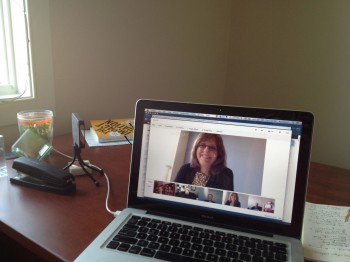
Google+ Hangouts

Google+ Hangout

Sometimes text just isn’t enough. If you really want to build strong team relationships, there’s no substitute for face-to-face. Google+ Hangouts are a wonderful solution for remote teams to share project information and — hangout. They are so simple to set up and use that there’s no excuse for not trying it yet. How else are you going to bust that colleague you suspect is working in their pajamas?

How do you collaborate with remote colleagues? Share your favorite tools in the comments.

Author’s Bio: Rosemary O’Neill is an insightful spirit who works for social strata — a top ten company to work for on the Internet . Check out the Social Strata blog. You can find Rosemary on Twitter as @rhogroupee

Filed Under: P2020, teamwork Tagged With: bc, collaborate, collaboration, Productivity, team, telecommute, tools

3 Techniques To Help You Begin Delegating Responsibilities

February 19, 2013 by Rosemary

By David Tully

Learning to delegateBusiness owners and CEOs tend to err on the side of caution when considering the amount of work they delegate to colleagues and employees. A big part of the problem is there can be a lack of trust. You probably ask yourself: why should I delegate this responsibility if I can complete the job to a higher standard?

The three techniques in this article should stop that nagging question in your head from ever occurring.

1) See Delegation as Investing in People

By not delegating, you are restricting the ability of your employees to develop their own skills. The lack of trust can be derived from the fact that you believe they lack the experience to carry out the task properly. In some circumstances this may well be the case but how can they learn if they are not given a chance?

By providing them with new tasks, you are aiding their long-term development. In the future their value to you and the company as an employee will be increased. Just like going on a training course, delegation provides a way of increasing the skill set of those working for you. As long as you are clear about the task in hand, aware of their abilities and are patient with providing help initially, you can begin to free up time for more pressing tasks.

2) Realise that by not Delegating you are Losing Time and Money

You may find yourself being bogged down in book keeping, arranging meetings, contacting clients and other administrative duties, and I think it is important to ask yourself whether any of these daily tasks are actually helping you to grow your business. If they are not; why are you committing so much time to them?

They maybe essential duties, but there is no reason why you cannot delegate these to an assistant (virtual or otherwise). Of course, this would cost you more money, but just think about the amount of time you are wasting by not focusing on ways to expand your business. In some ways it could be said you are losing money because you are not delegating, probably more than if you hired an extra member of staff to help with these basic administrative tasks.

3) Relinquish Control and Let Employees do What They are Paid to Do

This is easier said than done. If you decide to delegate responsibilities while still choosing to micro-manage and control every aspect of the business, you can do more harm than good. In some ways it can cause resentment among the employees who have been given responsibilities but aren’t allowed to work in their own way because of interference from you. Allow them to perform the roles they are paid to do, as otherwise, why did you hire them in the first place?

What is your delegating style?

Author’s Bio: David Tully is an SEO training and Digital Marketing Strategist for Fast Growth Club, an innovative new coaching program for small businesses.

Photo credit: “Nguyen Vu Hung (vuhung)” under the Creative Commons license.

Filed Under: Successful Blog Tagged With: bc

Four Case Study Tips That Will Have Clients Finding YOU

February 18, 2013 by Rosemary

By Jennifer Escalona Dunn

You’re trying to convince a client that you have what it takes to make their business sing with your work. However, they want to see what you’ve done in the past to warrant even a conversation in the first place. It’s time to take a walk down memory lane and write up a case study or two to prove you can do what you say you can do!

This is not a task to treat lightly. The first impression you make with your case study can literally make the difference between getting hired and going home with empty pockets. With the following tips you can make sure your case studies knock their socks off every time.

1. Make it Interesting

Take a look at what you have now for your case studies. Why do you think a potential client would be interested in your work? Why would they read it? Would YOU read it?

Making the case studies interesting cannot be understated. Nobody will care about your work if the way you present it is dull and lifeless. You could have the best ideas in the world but if they come off as yawn-worthy nobody will bite. You have to give them something to hold on to. Make it a story, or visually engaging, or controversial – just don’t make it boring!

2. Not Everyone Learns the Same

You probably remember this from school, but no two people learn the same way. Some are very visual people and love graphs and pictures. Others prefer to read text with lots of examples. Some just like watching a simple video that gets the point across quickly.

If you treat your audience as one mass who only learns one way, you’re going to miss out on others who would rather view your work another way. You can have great samples set up with nothing but pictures but a reader’s eyes might skim right over that nice infographic and think your case study lacks substance.

Try to vary it up for your visitors. This can also help with point #1 as it keeps your site interesting and different.

3. Aim it at Your Clients

If you know who’s interested in your work, you have a chance to make it as focused as possible towards their interests. You don’t want to load them up on a bunch of examples they simply don’t care about.

For example, if you’re courting a restaurant, you may not want to point them to all the office supply companies you once worked with unless you have something in there that pertains to them. Otherwise, they may not understand why they should hire you instead of someone with experience in the food industry.

4. Don’t Fudge

Nobody likes a braggart, yet you have to talk yourself up on your case studies. You have to convince clients why you’re the best around and the only one who can make their project fly. It’s basically why case studies exist.

However, fudging results isn’t the way to go about it. That’s where the “braggart” label comes in. Keep it in the real world.

If you improved sales for a certain company by 25%, say that. Don’t say you “literally changed this company’s life forever” or things like that. That’s just silly, and a potential client will roll her eyes. “A 25% increase in sales” is a real number she can sink her teeth into.

Do you have case studies on your website? Leave a link to your case study portfolio in the comments!

Author’s Bio: Jennifer Escalona Dunn is the owner of Social Street Media where she writes about small business, tech and finance for sites like WePay and Outright. You can find her on Twitter @jennescalona.

Filed Under: Successful Blog Tagged With: bc

Positive Attitude Tips for Business

February 15, 2013 by Rosemary

By Sarah Gotheridge

Starting a business requires a number of things, including the initial capital, a business plan, and a location. An equally important factor is the right attitude.

A negative attitude is always bad for business. It is bad for you, bad for your colleagues and employees, and bad for the work environment in general. Potential customers and clientele are equally put off by a difficult or negative attitude. They will quickly take their business elsewhere.

It is easy to become jaded in the world of business if you don’t have strong emotional resources to draw from. Having the right attitude in business requires a positive attitude towards life in general. A negative attitude in business is like a runaway train that increasingly picks up speed. It will be a constant drain on the energy, creative drive, and ambition necessary for keeping a business viable and profitable.

In other words, if you approach life with a gloomy or negative outlook, you are doomed before you start

Business Tips

Business Relationships

Establish cordial relationships with similar business operators and owners. This will provide a broader perspective by which to gauge the strengths and weaknesses of your own business. Establishing a good working relationship with your competitors will also provide ideas and insights for improving your business.

Know When to Take a Break

It is difficult to maintain a positive viewpoint if everything remains dull and boring. Knowing how and when to take a break is an important skill to hone and savor. Many new business owners feel guilty if they take time away from the business. This means late hours, missed lunches, and taking work home. Now and then it may be necessary to work excessive hours to cover all the bases, but knowing how to take a break will pay off in the long run.

Avoid Unrealistic Goals

While it is important to be goal-oriented, unrealistic expectations will disappoint rather than fulfill your business aspirations. It is sometimes difficult to discern the balancing line between whimsy and inspiration. Inspiration can lead to creative innovations and solutions. Whimsical ideas, on the other hand, can be a useless expenditure of money and time. This can easily lead to a negative attitude, self-doubt, and the inability to make the important decisions. It helps to have a way of critically and objectively evaluating business practices and decisions. Strategy meetings and/or bringing in an outside consulting firm are two such options.

Networking

Once the business is up and running it is important to continue networking and developing contacts. Connections and contacts will continue to be a good resource for ideas and insights. A good contact base will also help you to stay up-to-date and more objective about how well your business is functioning.

Life Tips

Self Reflection

Our personalities are not set in stone. It takes courage to confront oneself and deal with our insecurities and perceived flaws. The Greek philosopher, Socrates, said the beginning of wisdom is to “know thyself.” One of the insights of psychoanalysis is that many people choose to keep many aspects of their personality in the dark. Taking the time to be reflective helps keep things in perspective. You will have a much better appreciation and attitude towards yourself and life in general.

Enjoy Life

Nourish other interests and desires besides the passion for work. This could be any number of things such as playing your guitar in a band on the weekend, going white water rafting and hiking, visiting museums, or reading some of your favorite authors. It may simply involve spending more time with family and friends. A person that doesn’t find time to enjoy things will have a difficult time keeping a positive attitude about life.

Author’s Bio: Sarah Gotheridge represents a site called Monetise.co.uk. She enjoys writing about business online and giving advice to new businesses.

Filed Under: management, Motivation, Successful Blog Tagged With: bc, Motivation, positive attitude

Learning By Doing

February 15, 2013 by Rosemary

By Jeannie Walters

It’s sad to me how many people think they can’t do it. Whatever it is, they truly believe they cannot do it because they don’t have a rule book.

I remember interviewing a young woman who told me, in a job interview, that she could do whatever I outlined for her on a list and trained her carefully to do. “What if it’s not on the list?” I asked. Her answer was if it wasn’t on the list, she didn’t see it as one of her duties.

“It must be on the list.”

She didn’t get the job. Not because she wasn’t capable, because I believe she probably was, but because she was scared of the unknown. She was scared of trying new things. She felt she had to be taught every little thing before she would attempt it.

Baptism by fire is not a bad way to learn. It’s uncomfortable and scary, sure, but if you can survive, you can really make things happen.

There is no degree for customer experience. And yet that’s the focus of my career. Every day I’m doing something that scares me a little bit. And why not? Humans are awesomely unpredictable. What worked last time will not necessarily work this time.

How do you learn by doing?

Jump in, the water’s fine.

Next time you find yourself saying, “But I’ve never done that before” as an excuse to NOT do it – stop yourself. Rephrasing helps me. “I get to do this for the first time!”

Learn from the masters.

Since the dawn of time, humans have been learning from one another. If you’ve never hosted a webinar before, be sure to attend a few to see what works and what doesn’t. If you’re scared to start that kickboxing class, go to the gym the day before and scope it out a little. It’s ok to do research and recon.

Ask for help.

While this seems to be an issue for many of us, it’s a critical part of learning. Ask for support and help, even if it’s just having a few friends there to cheer you on.

Keep up.

The best people I know are perpetual students. With so much information so readily available out there, it’s easy to keep learning. If you are in a role that is about marketing, make sure you read and follow and watch what’s out there about that role. Do your homework, but don’t let that be a crutch, either. Sometimes you have to stop the surfing and get stuff done.

Forgive your missteps.

Have you ever noticed we are often kinder and more forgiving to others than we are to ourselves? Doing things we haven’t necessarily been taught how to do means we will learn from our inevitable mistakes. If something doesn’t work, examine what didn’t work about it so you can improve the next time. Cut yourself some slack. Forgive and move on.

Give it your all.

Creating something from nothing requires brain power, stamina and determination. There will be times you want to give up, mostly because it’s outside your comfort zone. Don’t do it. Set a small goal and accomplish it. Then set a loftier one and accomplish that. You can do this.

The world is such a cool place these days. We can connect with like-minded people all over the world and create our very own dream jobs. Don’t let a lack of “a list” prevent you from accomplishing great things. Do it. The learning will happen.

Author’s Bio: Jeannie Walters is the Chief Customer Experience Investigator™ and founder of 360Connext, a customer experience consulting firm. Walters has been focused on customer experience issues for more than 15 years and works with organizations all over the world.

Walters now speaks, writes, consults and generally thinks about how the small experiences we have each day – going to the bank, ordering online, tweeting – create the greater experience of our lives. Walters lives outside of Chicago with her husband Mike and their two young sons. As such, her current hobbies include cheering on distracted t-ball players and building impressive Lego villages.

Filed Under: Business Life, management, Productivity, Successful Blog Tagged With: bc, education, Learning, Motivation

  • « Previous Page
  • 1
  • …
  • 66
  • 67
  • 68
  • 69
  • 70
  • …
  • 84
  • Next Page »

Recently Updated Posts

Is Your Brand Fan Friendly?

How to Improve Your Freelancing Productivity

How to Leverage Live Streaming for Content Marketing

10 Key Customer Experience Design Factors to Consider

How to Use a Lead Generation Item on Facebook

How to Become a Better Storyteller


From Liz Strauss & GeniusShared Press

  • What IS an SOB?!
  • SOB A-Z Directory
  • Letting Liz Be

© 2025 ME Strauss & GeniusShared