Successful Blog

  • Home
  • Community
  • About
  • Author Guidelines
  • Liz’s Book
  • Stay Tuned

Book Review: Absolute Value, By Itamar Simonson & Emanuel Rosen

January 23, 2014 by Rosemary

What happens when marketers get naked?

Absolute Value: What Really Influences Customers in the Age of (Nearly) Perfect Information, is the answer to that question.

Stripped of their exclusive access to broadcast media, stripped of their information monopoly, stripped of their banner ads, stripped of their SEO tricks, marketers in 2014 have awakened to a new reality. Consumers have access such a diverse array of data that they can (if they choose) make much more informed purchasing decisions.

This book explores how this state of affairs came to be, how consumers are dealing with their access, and how marketers might still be able to add their voice to the mix.

“In a world with improved access to high-quality information, more and more decisions will be based on absolute values, resulting in better choices overall.” Absolute Value, Simonson & Rosen

The Marketer is Being Stripped, Bit by Bit

Tools like positioning and persuasion are less effective because consumers can see behind the wizard curtain by reading blogs, talking to other consumers, and reading reviews.

The value of brand and loyalty is disappearing as consumers are able to rely on a huge amount of actual information from experts and weak-tie fellow consumers. Simonson & Rosen suggest that a consumer’s decision to buy is affected by a mix of three related sources: individual preferences, beliefs, and experiences (P); other people and information services (O); and marketers (M). Marketers need to be aware of where their audience lies on the POM continuum so that they can respond accordingly. Which information does your typical customer rely on most heavily?

The power of advertising has been undercut as well. There must be a shift away from random banner ads to get “top of mind” awareness, and toward ads that are closer to the decision point and provide actionable information to the person as they are about to buy. Top of mind ads are less effective because they get overwritten by other info that comes along in the noise stream.

Another tool in the marketing arsenal was the traditional funnel. There used to be a reliable, predictable path from awareness to action. The new consumer doesn’t care about the funnel. He/she will now often employ what Simonson & Rosen term “couch tracking,” accumulating lots of information over time, even before the need for a product is identified. Marketers need to focus more attention on the couch-trackers, who frequent online communities and forums as they have a certain product or brand “on their radar,” because they are likely to make a decision before marketers are even aware of them.

What Happens Now?

When power is taken away from the marketers, does it come at the expense of good business decisions? Will consumers use the big data available to them to support good decisions or will it lead to more irrationality as they choose the sources of data they want to use?

Will consumers with limited or no access to the additional data be more susceptible to manipulation because they don’t have access? Will marketers be hip to that and use it to their advantage?

Perhaps we will end up with “less sugar in our information diet” and “less sugarcoating” as real-world reviews and referrals take the place of rotating banner ads.

The release of this book could not be more timely. Within the conversations about big data, content shock, and influencer marketing, there must be a discussion of the absolute value proposition.

Disclosure of Material Connection: I received an advance copy of this book free from Harper Business. I was not required to write a positive review. The opinions I have expressed are my own. I am disclosing this in accordance with the Federal Trade Commission’s 16 CFR, Part 255: “Guides Concerning the Use of Endorsements and Testimonials in Advertising.”

Author’s Bio: Rosemary O’Neill is an insightful spirit who works for social strata — a top ten company to work for on the Internet . Check out the Social Strata blog. You can find Rosemary on Google+ and on Twitter as @rhogroupee

Filed Under: Marketing /Sales / Social Media, Personal Branding, Successful Blog, Trends Tagged With: bc, book review, consumer, marketing

How to Boost Revenue by Up-Selling & Cross-Selling

January 10, 2014 by Rosemary

By Jacklin Altman

Most of us recognize up-selling in its most basic form: “Would you like fries with that?” Cross-selling too, “would you like to pair that with a soda?” Sticking with that same example, if just half of the people asked say yes, think about that bump in revenue.

Seems pretty nice, doesn’t it?

Up-selling and cross-selling are valuable skills that you should engrain into all of your sales and customer service representatives. If a customer comes to you looking to buy a certain item, there is no harm in suggesting an upgraded version or attempting to cross sell an item that would pair nicely with it.

Who knows, they might love the pairing and always buy both from now on. They might recommend those items to their friends and so on. Now you’ve started a chain reaction that is sure to boost revenue.

Now, you see the benefits of up-selling and cross-selling but how do you go about it? Train your people. Have your customer service representatives be as well-versed in sales as your sales people. You will increase the efficiency of your workforce while simultaneously increasing your bottom line. There are many ways to go about educating your employees, and what you choose is entirely up to you.

You could go the old-fashioned route and hold a seminar where you, a sales rep, or a hired professional could teach up-selling and cross-selling tactics.

You could distribute reading material (though there is the chance that it will be ignored).

You could also try to pair your customer service reps with your sales reps to have your salespeople teach some of their best tips and tricks to your customer service employees. This will help foster healthy inter-workplace relationships, while also cross training your employees.

Additionally, your customers benefit. Their needs are better met when they receive better products and upgraded services, and more satisfied customers mean more customers, period.

A word of caution; avoid being too sales-y. People are quick to catch on when they’re being fooled, so don’t lie to your customers. Give them honest facts as to why your product is superior to others, and why they should buy an upgraded version or another item with it. If they politely refuse, don’t push it. You risk upsetting customers and scaring away business if you push too hard, so learn to suggest rather than force. Still not quite sure how to up-sell? Check out these up-selling and cross-selling tactics that work.

With you, your employees, and your customers all potentially benefiting, don’t delay. Train your customer service operators (as well as your salespeople) to up-sell and cross-sell to ensure that your company stays profitable and your customers receive the best products and services possible.

Author’s Bio: Jacklin Altman is the current Digital Marketing Specialist at LiveHelpNow (www.livehelpnow.net), a PA-based customer service software company. Jacklin handles new marketing initiatives, maintains the company blog, and handles customer outreach.

Filed Under: Marketing /Sales / Social Media, Strategy/Analysis Tagged With: bc, revenue, sales, strategy

Planning Effective Sales Team Meetings

December 31, 2013 by Rosemary

By Deb Bixler

Your business thrives on making sure that everyone on your sales team knows what’s going on at all times. Whether you are introducing a new product or wanting to expand your service, your team needs to know your intentions.

As such team meeting planning is highly important to the strength of your direct sales business structure. Follow these simple guidelines to keep your entire team informed and involved so no key information falls through the cracks.

Plan Meetings At Same Time Every Time

home party plan meetingsSure, changes may come up that require impromptu team meetings, but in general try to keep your sales team meetings the same time every month or week. This way, your entire team will know that on a set date of the week or month a discussion will be held to discuss upcoming events and prior concerns.
A regular schedule insures regular attendance.

Make sure you email or message your team before meetings start to remind them of upcoming discussions.

Invite Team Discussion

If you begin each meeting with open discussion for your team, everyone will feel more involved in the planning of your business and you can get great feedback for what is going on in your business.

It’s important that your team knows they can speak their mind, so begin each meeting with an open discussion of concerns or questions of your team before you jump into what is on your mind.

Meetings Should Be Fun

Make meetings fun by offering snacks for the entire team and when ever possible keep the sales meetings or meeting sessions at an hour or less.

If you need to go over, let your team know beforehand so they can be prepared for a longer stay.

Provide supplies for your team to keep notes and thank each person for attending so they will know that their time is valuable to you.

Have An ‘Open Door’ Policy Team

Your sales team members need to know that they can come to you any time with issues, concerns, or suggestions for your business. The should not feel as though they need to wait for the meeting day to bring up concerns.

In having an open door policy, your team can feel comfortable to come to you outside of meetings in a private setting. Let them know that they can contact you personally, via phone, email or other avenues if they have anything come up that they feel is too important to wait for the next meeting.

You should always stay on top of situations and let your team know that their opinions are valuable to you.

Author’s Bio:
Deb Bixler retired from the corporate world using the proven business systems that made her a success working for others by incorporating them into her home business. In only 9 months Deb replaced her full time income with the sales and commissions from her home party plan business. Find her on Twitter: @debbixler.

Filed Under: management, Marketing /Sales / Social Media, Successful Blog Tagged With: bc, sales

The How & Why of Adding to Other People’s Twitter Lists

December 12, 2013 by Rosemary

By Nick Kellet

Until now first person curation has been the name of the game when it comes to Twitter Lists.

Making lists on Twitter has been a solo task.

If anyone wanted to be suggest omissions to your lists it meant asking. Asking always causes friction. The need to ask stops people from acting.

No longer. Enter Listly. Friction free crowdsourced Twitter Lists.

Now you can make a list on Twitter and manage it from Listly.

You get the best of both worlds:

  • Curate on Listly
  • Subscribe on Twitter

What that means is:

  • Anyone can add suggested omissions directly to the list
  • You can seed your lists from any number of other lists
  • Duplicates will be ignored.
  • You can auto accept suggestions or moderate suggestions via the Listly list queue
  • Items accepted to the list are added to your Twitter list (and the person added is notified via Twitter as normal)
  • Items removed from list or sent to the queue will be removed from your Twitter list.

People can get discovered for being on your list as you can embed the list on your blog (as can anyone).

If your blog is on WordPress (self-hosted), you can use the Listly plugin.

If not you can use the Javascript version, which works on just about every blogging platform except WordPress.com.

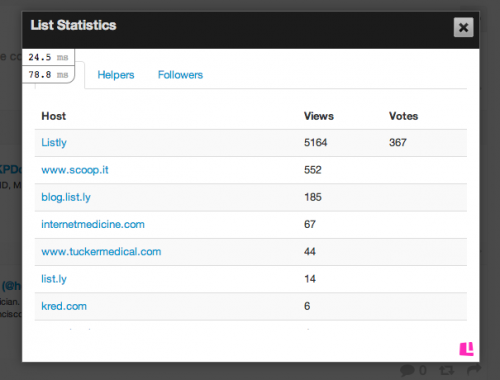
Here’e an example of a list of Doctors on Twitter – 600+ and growing fat – it’s been viewed 6k+ time and embedded on multiple blogs.

150+ people have helped to create this list.

List.ly list example

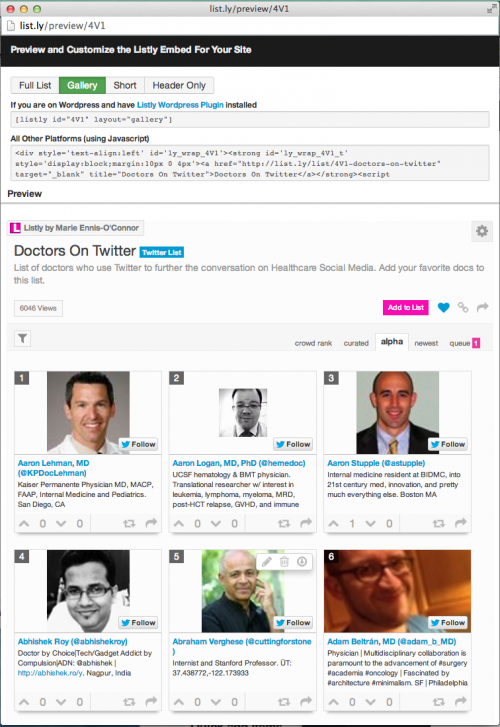
You can choose the layout you’d like to use to embed the list on your blog. Here’s a preview of this list in “Gallery” mode.

List.ly Example

Your Twitter lists become embeddable content that helps everyone on the list get found and in so doing, drives traffic to your blog.

As people can suggest omissions to your list over time your blog post will keep changing. People can also vote to change the ranking and order of the list. This keeps your content fresh in the eyes of search engines.

As your content evolves over time, new people will discover your lists and potentially share, vote and contribute. It’s a process that extends the lifecycle and value of your content.

With Listly, lists get better over time.

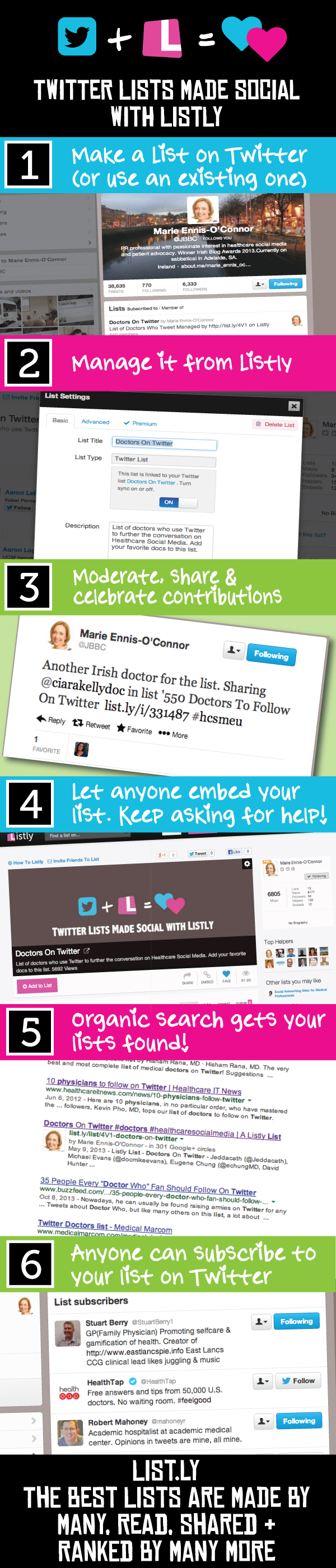
Here’s the workflow.

List.ly Twitter Infographic

Are you using Twitter Lists today?

Lists let you be more focused in the way you listen and engage. Lists are a segmentation tool. Smart marketing folk stay focused and segment their markets into targeted niches.

Segmenting on Twitter on your own is hard. It’s also a never ending task if you need to do all the work.

The Internet & The 1% Rule

Today we expect to be able to create, contribute or consume.

Regular Twitter Lists don’t follow this rule (no contribution) and that’s the issue Listly’s Twitter integration addresses.

Modern internet users expect to be able to participate.

Now, because anyone any can contribute Twitter Lists can follow the 1% rule

  • Create (1%)
  • Contribute (9%)
  • Consume (90%)

This means List become valuable resource where many people can help and consume what others have created. These lists get more valuable over time. People gravitate to trusted resources. Better lists get more subscribers.

These could be your lists.

You could be providing utility to your audience.

The real magic happens when you choose to collaborate and work with others.

Will you create resource for your local community?

Will you serve a global niche and help surface everyone in that niche?

This is how real communities form.

People connect around a passion.

Where will you begin?

Author’s Bio: Nick Kellet is Co-founder of Listly. Founder @Gifttrap & @AnswerSets. He creates & curates ideas, loves software & games, and is a master community builder. Connect with Nick on Google+ or LinkedIn.

Filed Under: Marketing /Sales / Social Media Tagged With: bc, curation, lists, Twitter

Marketing Your Blog in the Real World

December 6, 2013 by Rosemary

By Kelly Edwards

Blogging is not limited to cyberspace, and neither is promoting your blog to boost its recognition. In fact, marketing at events is an opportunity to access a whole range of readers and contributors that you might not have otherwise interacted with. But how do you assess if an event is worthwhile for your blog? Traveling to a networking event, paying for a ticket to a convention and even renting a stand to promote your blog are all factors that can make event marketing a more expensive choice, so how do you track if it’s the best choice to make?

Define Your Goals

While calculating the profit made from an event isn’t as simple as counting receipts for a blog, there are still ways you can attribute success to your event marketing. Tracking how many business cards you give out or flyers taken is a good start. You can also take a list of names interested in joining your mailing list (if you have one) or offer entry to a competition. These are all goals that you can measure throughout an event, however any positive effects in traffic or subscriptions may take a few days, perhaps even weeks to be felt.

Choosing the Right Event

Not every event is going to bring in the correct audience for your website. You may be tempted to attend a very large blogger event but will you be finding an audience that will actively want to engage with your blog? If you’re a niche site then it can be more effective to look into more specific blogging events, especially those in tune with your blog’s ethos. If you talk a lot about your local area then have a look into local tourism events which you could attend. If you post on a specific hobby or interest then look into events or exhibitions around these topics. This will lead you to a large group of attendees who are also a relevant part of your demographic.

Combining Real World and Online Marketing

Event marketing can still be supported by your online fans by promoting your attendance in advance. This can be on your own channel as well as outreach into other areas. If you’re attending a local event then would they appreciate some content on their website from upcoming attendees? Get in contact now and promote yourself and the event you’ll be spending time at. You can continue this after the event as well, offering posts on how you found the event and your experiences.

If you met people and exchanged business details then get in contact ASAP whilst you’re still fresh in their mind. You invested in networking and now it’s time to be proactive about all the new contacts you may have made.

Promoting at the Event

There are many ways you can promote your blog at an event and nothing is easier than wearing a branded t shirt. You can also give away branded goodies to those who show an interest in your subject of interest as well as cards and flyers. Ensure that your logo and brand colours are proudly on display and mesh with the blog itself to make the transition for the attendee as smooth as possible.

If you’re attending an exhibition or event with a stand then your promotional displays should be choreographed and also include the URL of your blog. A large and attractive banner will also grab more attention. If you’re promoting your blog at an event or exhibition that is traditionally more focused around sales or crafts then try to get a spot near a refreshment area so that attendees are more likely to slow down and look at your blog. Having an optimised mobile site will also mean that attendees that look up your blog on their phone will be able to quickly access your site.

Improving Your Approach

After your first event you will most likely realise where you can make improvements. Perhaps you were somewhat shy about approaching so many people so quickly. Perhaps you don’t feel as though you explained your blog succinctly enough and people lost interest. Perhaps you regret spending too much or not enough setting up an attractive exhibition for your blog. Whatever ideas enter your head for how you can improve next time, ensure you write them down now! You can also start mapping ways that you can approach these challenges and improve your marketing strategy.

Combining these elements will lead to excellent promotion of your blog at an event and hopefully some greater recognition for your brand.

Author’s Bio: Kelly Edwards writes about promotional display materials and helping businesses at http://www.marlerhaley.co.uk. You can find her on Twitter as @MarlerHaley.

Filed Under: Marketing /Sales / Social Media, Successful Blog Tagged With: bc, events, marketing

How Bloggers Can Capitalize on the Second Screen Wars

November 22, 2013 by Rosemary

By Sam Melton

The Internet has changed the way we live.

Many people gravitate to the Internet to do everyday things and to keep entertained. A decade ago, consuming media primarily involved watching TV, but in today’s technologically advanced world, there are dozens of ways to consume media without sitting in front of a television screen. 

Based on studies conducted by eMarketer, 2013 marks the first year in which the amount of time spent online surpassed the amount of time spent watching television.

According to the study, the average person spends five hours and 16 minutes on digital platforms, compared to 4 hours and 31 minutes with television. Not only has the time spent online increased by more than 15% within three years, the time spent watching television has also declined.

The television screen is taking a backseat to the new first screen – the Internet.

The modern individual and multitasking

Life is all about multitasking. Individuals do a myriad of tasks at once, and the Internet helps. Whether it’s to check email on a smartphone, access apps on a tablet, shop from an online store or pay bills, the modern consumer is capable of getting a lot done in a little time. ??The Internet offers a host of media from all around the world, and TV can be limiting. Although consumers still watch plenty of television, statistics show viewership has dropped by 500,000 households since 2012. This number is expected to decline as more people opt for high-speed services from providers such as Verizon FiOS Internet or Google Fiber.

With connections as much as 100 times faster than broadband, streaming has become a more affordable and convenient media option. Internet service replaces the need for television broadcasts because services such as Netflix, Hulu, and Vudu encourage binge-watching and replace the need for TV. 

Two of the most popular activities on the Internet

Just because the average person spends less time watching traditional television programs does not mean TV content is on the decline. With so many streaming services available, content being consumed online is on the rise, while traditional television viewership has fallen.

Although streaming television shows contributes to time spent behind the new first screen, perhaps the most popular activity to date is surfing social media. According to a research study conducted by Ipsos Open Thinking Exchange, the average user between age 18 and 64 spends 3.2 hours on social media sites daily. 

This emerging trend contributes to Internet surpassing television. 

Social media and streaming usage are on the rise, and this contributes to more time spent online. When more time is spent online, it takes away from what the average media consumer can spend watching TV. Although digital television services aren’t putting TV networks out of business, as a whole, the Internet is now the first screen.

How to capitalize as a blogger

Bloggers are well-positioned to take advantage of this shift.

No doubt the allure of the written word draws readership, but we can easily take it a step further.

  • Podcasts
    You don’t need expensive audio equipment. Such an addition to your blog gives your readers a chance to hear the voice behind the words. If you make it a regular feature, you’ll likely see a spike in readership.
  • Slideshows
    Flickr.com has an incredible tool that will allow you to easily construct a slide show of your photos on the side for your blog. It will even generate HTML code to place in on your page.
  • Vlog
    Give readers a visual and auditory version of you. It’s an interesting way to express an opinion. Be sure to make the content as engaging as your written word! It’s a good idea to find other vloggers’ styles you like.

Are you working to get own your slice of the screen time pie?

Author’s Bio: Sam Melton is a business professional turned freelance writer specializing in business technology. He blogs at: sammeltontalks.blogspot.com.

Filed Under: Content, Marketing /Sales / Social Media, SEO, Successful Blog Tagged With: bc, blogging, screen time, television

  • « Previous Page
  • 1
  • …
  • 11
  • 12
  • 13
  • 14
  • 15
  • …
  • 174
  • Next Page »

Recently Updated Posts

The Creator’s Edge: How Bloggers and Influencers Can Master Dropshipping

Is Your Brand Fan Friendly?

How to Improve Your Freelancing Productivity

How to Leverage Live Streaming for Content Marketing

10 Key Customer Experience Design Factors to Consider

How to Use a Lead Generation Item on Facebook


From Liz Strauss & GeniusShared Press

  • What IS an SOB?!
  • SOB A-Z Directory
  • Letting Liz Be

© 2025 ME Strauss & GeniusShared