Successful Blog

  • Home
  • Community
  • About
  • Author Guidelines
  • Liz’s Book
  • Stay Tuned

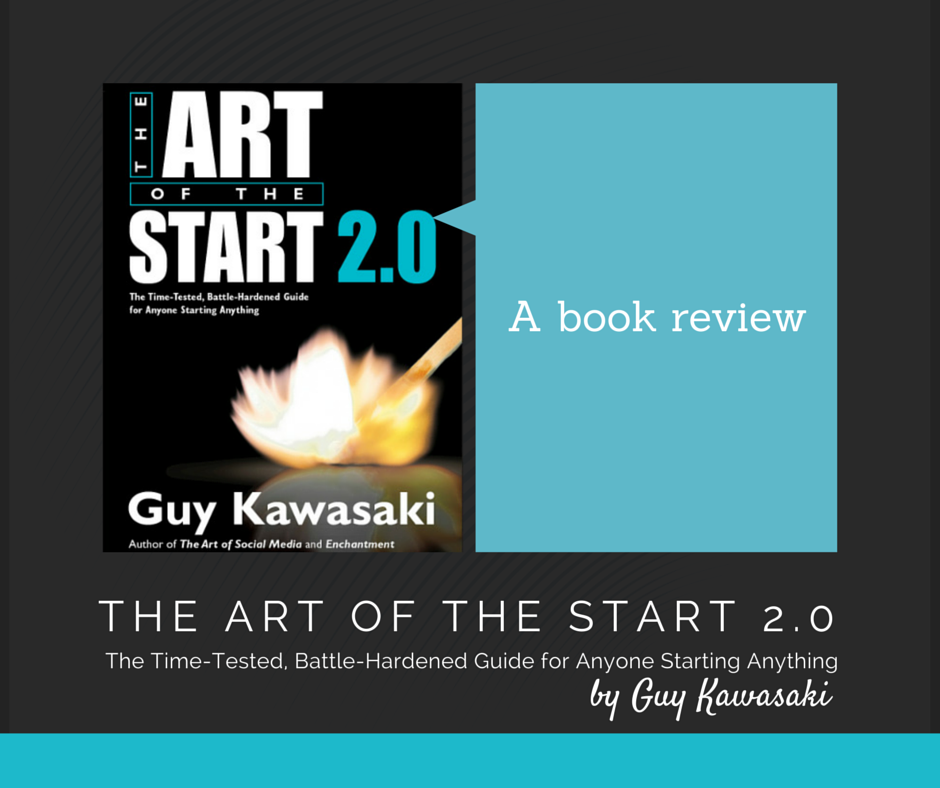
Book Review: The Art of the Start 2.0, by Guy Kawasaki

March 5, 2015 by Rosemary

Have you ever wished you could pick Guy Kawasaki’s brain?

Like, sit down with a pitcher of beer and just pepper him with questions until the pub closes or his head explodes?

This is your lucky day. Guy has done a “brain dump” in the form of an update to his 2004 book, The Art of the Start.

However, The Art of the Start 2.0 is not just a quickly busted-out update, it’s a complete overhaul. It covers everything you want to know about starting a new business, from idea to exit, written by someone who has literally been-there, done-that.

I would recommend it for anyone who is considering answering that little voice in their head, telling them to start something.
Art of the Start 2.0 book review

Guy Kawasaki was the first person I ever knew to hold the job title “Evangelist.” He has been on the giving and receiving end of pitches, and advised companies large and small. He’s seen the heights of the tech boom and the lows of the bubble burst.

He’s the person who will stand over your shoulder and remind you to spend more time on the product than on the furniture in your conference room.

The style of the book brings you right into Guy’s world. There are pithy stories, lessons-learned, exercises, and Q&A galore. It’s not the type of page-turner that you spend a weekend curled up with; it’s a manual that you dog-ear, highlight, and refer to over and over again.

Each chapter ends with recommended reading, so you can dive deeper into any subject as necessary.

“Customers don’t care if you want to destroy the competition. They want to know what benefits they derive from using your product. Also, evangelism is about what you do for your customers–not about what you want to become.” Guy Kawasaki

There is solid business advice in The Art of the Start 2.0, but by far my favorite bits were the hard-won little insider tips.

Remember to bring two thumb drives to your presentations, pick a company name with “verb potential,” and find your Morpheus (someone who will tell it like it is).

Some of the major topics covered include:

  • The Art of Starting Up
  • The Art of Launching
  • The Art of Leading
  • The Art of Bootstrapping
  • The Art of Fund-raising
  • The Art of Pitching
  • The Art of Building a Team
  • The Art of Evangelizing
  • The Art of Socializing
  • The Art of Rainmaking
  • The Art of Partnering
  • The Art of Enduring
  • The Art of Being a Mensch

In my own 20 years of business experience, I’ve been in many of the situations described in the book. It can be intimidating navigating conversations with potential investors, knowing when to hire more staff, and figuring out how to get the word out about your project.

With Guy’s advice in your arsenal, you’ll be ahead of the game.

Author’s Bio: Rosemary O’Neill is an insightful spirit who works for Social Strata — makers of the Hoop.la community platform. Check out the Social Strata blog. You can find Rosemary on Google+ and on Twitter as @rhogroupee

Disclosure: I was given a digital copy of the book for purposes of this review. My opinion is my own.

Filed Under: Business Book Tagged With: bc, book review, startup

Time to Automate Your Social Media?

March 4, 2015 by Thomas

social-media-100183509Social media has been proven to be an effective tool for performing a wide range of business tasks, from marketing to recruiting. As such, businesses around the world are adopting social media at a rapid rate.

If you have already joined the social media fray, you should know that you need to invest a substantial amount of time and effort in order to be successful on social media. One thing you can do to make your social media activities easier and less time-consuming is to use social media automation tools.

Here is a look at three great tools that you can use to automate your social media efforts.

Post Planner

If you want to promote your business and engage with consumers effectively on social media, you have to make a point to share interesting and helpful content regularly.

Post Planner can help you save time and effort by automating the publishing of content on your Facebook page.

This tool enables you to publish content based on a predetermined time schedule; target your content based on details such as age group, gender and education level; look for trending content and add it to your queue; crowd-source content from other people who use Post Planner; access a database with thousands of updates to find new ideas for updating your status; and upload bulk posts.

Additionally, it can perform simple analytics to show you the percentage of users who “liked”, clicked or commented on a certain post.

According to the article, “3 Great Tools to Automate Your Social Media“, Post Planner comes in four different versions, including the free Pro Planner and the paid Guru, Master and Agency plans.

Dlvr.it

When you have new content to share, you want to post it on all your social media channels. However, it can be time-consuming to do this if you have many posts to share on a regular basis.

Dlvr.it is a tool that you can use to deliver content to multiple social media networks.

All you need to do is specify the source and destination of the content. Whenever you create a new post, Dlvr.it will send out your updates automatically.

Currently, this social media automation tool supports Facebook, Twitter, LinkedIn, Google+, Delicious and App.net.

Social Oomph

Evergreen content is content that will not be outdated.

As your social media following grows, you will have fans or followers who have never seen some of your previously posted content. So, when you post content that is evergreen, you should continue to share it in the future.

Social Oomph features a queue reservoir that allows you to add content that you want to re-share to a queue, and you can specify how often the content should be shared.

Also, you can create variations of a post, so that you will not send out identical posts when you re-share content. Social Oomph can also help you find the right people to follow and monitor your social media activities.

Social media automation tools are becoming more advanced and useful.

If you do not have enough time to manage your social media activities, you should try using one of these tools.

Photo credit: Image courtesy of ddpavumba at FreeDigitalPhotos.net

About the Author: John McMalcolm is a freelance writer who writes on a wide range of subjects, from social media marketing to Cloud computing.

Filed Under: Marketing /Sales / Social Media Tagged With: bc, brand, business, networking, social-media

How To Keep Your People Engaged When Making Changes

March 3, 2015 by Lindsey Tolino

By Lindsey Tolino

When I was in middle school, my best friend moved to another school district. She came to me and explained that she was moving. She said she couldn’t do anything about it and would miss me. I was sad and didn’t like it, but part of me understood because she came to me and explained the situation.

hand writing on chalkboard

Sometimes you have to change things in your business. It can be scary because you don’t want to lose loyal customers or disgruntle employees. Your customers and employees have grown to expect your business to run a certain way and you may fear changing it.

I would have been very disillusioned if I showed up to school one day and my best friend was gone because she moved. I would have been hurt because I thought our relationship meant more to her than that. I would have been angry that she didn’t care or respect me enough to tell me ahead of time.

As humans, we may feel disrespected, disillusioned and angry if someone changes something that we’ve grown to expect, without telling us ahead of time or explaining why.

This is essential to remember when making changes in your business. You don’t want to disgruntle your employees or isolate your customers by executing decisions without communicating with them. Your employees and customers hopefully feel a sense of ownership in the business. If you simply change something without communicating with them, they may become annoyed, frustrated and less invested.

Change is difficult for most people. If you talk about it ahead of time, it gives people time to process and prepare for it. Furthermore, if you discuss the reasons for the change, people are likely to be more understanding, even if they don’t like the change itself.

I grew fond of a counter-service restaurant over the past year. Without warning or explanation, many menu items increased in price by at least a quarter. The restaurant had become wildly popular, so it didn’t seem like the price increase was necessitated because of low sales. As a customer, I felt like they were trying to squeeze every last cent out of me. This may not have been true. But since they didn’t explain the increase, it seemed like it came out of greed.

If the business had simply explained the reason for the increase, my loyalty may have been strengthened rather than shaken.

Unfortunately, even if you let people know your reasons ahead of time, the changes may still isolate customers or upset employees. But discussing it will minimize the discomfort and create a smoother transition. Maybe some of them have even been hoping for the changes you’re making.

If you have changes coming, discuss it with your team and make sure they know the reasons. Talk to your customers. Let them know it’s coming and why.

It shows you respect and care for them. If you share your reasoning, it may even deepen their trust in you.

Don’t drop changes on people. Show them how much you care by discussing it with them ahead of time.

Author’s Bio: Lindsey Tolino is an intentional creative who helps make businesses better. She serves business owners with her words at ToBusinessOwners.com. Follow her on Twitter @LindseyTolino or connect with her on Google+.
Image info: Royalty-free image by Death To the Stock Photo. (deathtothestockphoto.com)

Filed Under: Strategy/Analysis Tagged With: bc, managing change, strategy

6 Non-Obvious Entrepreneur and Founder Resources

February 26, 2015 by Rosemary

This blog was recently listed by the folks at GetVOIP as one of the “35 best entrepreneur blogs.” We appreciate the recognition, and it got me thinking about other lists of resources that might be out there for us “doers.”

It’s always good to refresh your toolkit, so I came up with six somewhat non-obvious resources for information, inspiration, and support related to entrepreneurship.

entrepreneur with laptop dog
  1. Startup Stash directory/
  2. 7 Great educational resources for entrepreneurs, from Upstart
  3. Kauffman Founders’ School video series/
  4. Quora, Startup Founders & Entrepreneurs category
  5. Pinterest “Entrepreneurship” category
  6. Top 25 Business Podcasts for Entrepreneurs

Have you found any useful new resources to help you in your entrepreneurial journey? Please share!

Author’s Bio: Rosemary O’Neill is an insightful spirit who works for Social Strata — makers of the Hoop.la community platform. Check out the Social Strata blog. You can find Rosemary on Google+ and on Twitter as @rhogroupee

Filed Under: Personal Development Tagged With: bc, business, entrepreneurship, founder

Cook Up More Revenue with Consumer Text Marketing

February 25, 2015 by Thomas

couple-enjoying-dinner-at-a-restaurant-100234263If you’re a restaurant, fast-food establishment or local eatery owner, you know that getting customers through the door is a constant focus of your business.

Even when business is good, there are always those quieter times of day when it can be hard to get enough patrons into those seats.

Using mass texts is one way your eatery can draw in more customers, get people excited about your food, and entice them with special offers and exclusive deals.

So just how can you use text marketing to increase your eatery’s revenue? And what are some examples of restaurants that are already doing just that?

Text Marketing Gets Customers’ Attention

As the article “Mass Consumer Texts Driving Up Sales At Restaurants” points out, using text marketing means you can reach a large number of potential customers in your immediate vicinity.

A text message has a personal feel. Unlike an online ad or billboard, a text message arrives directly in front of each customer, inviting them to open and read it, and grabbing their full attention for a few minutes.

Text marketing gives you the chance to start a personal interaction with each customer, putting your restaurant and food at the forefront of their mind, and ensuring they’ll think of you when it’s time to grab lunch or dinner.

Text Marketing Gives Them a Reason to do Business

The beauty of text marketing is that you can use it to entice your customers to eat with you. Text marketing is the perfect vehicle for sending them delicious offers, such as buy one get one free deals, or money off coupons.

If you particularly want to increase revenue at a quieter time of the day or week, you can use text marketing to send out time limited offers for those periods, encouraging people to come and eat with you at that time.

In addition, why not consider sending out weekly specials, daily discount coupons, text-to-win sweepstakes, or even conducting surveys to find out what your customers think of your restaurant, what works and what doesn’t.

Eateries Finding Success with Text Marketing

Several big-name eateries have already seen success with text marketing:

  • McDonald’s used a text-based sweepstakes competition with a wide range of prizes. 1.5 million customers joined in, showing that text marketing can be very effective indeed;
  • Chuck E. Cheese used text message marketing to encourage customers to join their email list – not only did it become the most successful method for getting customers on the list, but customers who joined via text were more likely to open the emails than any other customers;
  • UK pizza place Papa John’s sent out text offers for cut-price pizzas to customers on their text list, and saw a 33% jump in revenue for the duration of the offer;
  • Dunkin’ Donuts asked their customers to join their mobile marketing list, and got a fantastic response, with stores in the Boston area seeing 21% more customers walk through their doors;
  • Taco Bell branched out into using mobile marketing to connect with their customers, offering a free drink to those who opted in to their mobile marketing list. As a result, they garnered 13000 subscribers.

Text marketing is an immediate way to reach many customers quickly and easily, and it’s frequently more cost effective than other forms of direct marketing.

By reaching your customers when they’re out and about you can encourage them to stop off at your establishment and take advantage of your special offers.

Photo credit: Image courtesy of stockimages at FreeDigitalPhotos.net

About the Author: Tristan Anwyn writes on a wide variety of topics, including social media, SEO, restaurant businesses and SMS marketing.

Filed Under: Marketing /Sales / Social Media Tagged With: bc, brand, consumers, marketing, restaurants

7 Death Traps to Avoid When Starting an E-Commerce Business

February 24, 2015 by Guest Author

By Simon Horton

The Web offers endless possibilities to businesses. You sure are aware that the Internet has changed the dynamics of buyer-seller relationship forever. The lure of the Web is very difficult for an entrepreneur to resist and you are already planning your e-commerce blockbuster.

There is more happy news for you. The holiday season has brought in bumper sales for retail sellers. Cyber Monday saw sales totaling $2.68 billion with almost 21% of that sales coming from mobile devices like smartphones and tablets.

The weekend after Thanksgiving raked in more than $2 billion in online sales. Online sales in the US for the months of November and December combined are expected to surpass $89 billion, an increase of 16% over 2013.

The Internet obviously is the place to be for businesses. Amazon shipped approximately 426 items per second on Cyber Monday, with sales totaling in excess of 37 million items.

But finding your place under the sun in an unforgiving online marketplace is not easy. With super-hot competition breathing down your neck it becomes increasingly important for you to be at the right place at the right time to land the sale.

Success is very hard to find in an over-crowded global marketplace. Here are a few things you need to keep in mind to avoid a potential disaster for your online business.

1) Think Style over Substance

Once you have decided to take the leap and start selling online, is time to work out a clear strategy.

Do not spend hours creating the most attractive, interactive, responsive and stylish website. Not only are you required to put in endless hours, but you also end up spending quite a lot of money.

Dive into the potential customer base you are targeting. If you are selling kids’ garden accessories, make sure you know where to find your customers. Parenting blogs, forums and self-help groups offer much potential.

So do schools and kindergartens. With increasing stress being laid in schools on teaching children to eat healthy and natural, on how to source food from their kitchen gardens, and in general encouraging them to spend more time outdoors, your products do have potential to sell.

Go where your potential customers are more likely to find you and try to engage them constructively.

2) Neglect Content

Your website need not pay big bucks to bloggers to write for you. Spare some time to share valuable, informative, engaging and interesting content with your online visitors.

Blogging would not take up more than a few hours every week. Once you get the hang of it you will be easily able to post two fleshed out posts every week. And that’s all that is required in the early stages of your business.

Do reply to all comments and suggestions, and ensure you do not neglect any visitor to your blog.

3) Not Stay Social

Social media holds much sway over the online marketplace. This is where your potential customers meet and share ideas, opinions and latest gossip. You need to be familiar with popular platforms like Facebook, Twitter and Google+.

Once you have succeeded in building up considerable traffic to your site, you will be able to leverage social media to increase your visibility to a much vaster audience.

If you ignore social media sites very soon you will be left behind in the race with your competition getting there first and building up a dialog with the prospective customers.

4) Not Gauge the Practical Aspects

Your business is not all about your brilliant idea and yourself. You will need the help and support of plenty of others to actually get your business up and going.

Vendors, suppliers, shippers, customers and employees are all stakeholders you need to work with to ensure the success of your online venture. You need to measure how much all of this is going to cost you financially. How long can you sustain the nuts and bolts of your venture if the revenue takes time rolling in?

Amazon would not have been the success it is if it had shipped stuff late and broken all through its formative years. You will have to sweat to win your customers trust and most importantly their familiarity with you.

You have to honestly and thoroughly assess all of this before you set up your online store. Do you have all the necessary ancillaries in place for your business to flourish and run well?

5) Do Not Have a Customer-Centric Site

This is one of the biggest mistakes that could really mar the customer experience.

An online business site should be a delightful experience for any guest, not just for those who have painfully created an account. Do not make it mandatory for visitors to register to complete sale. Ensure the visitor faces as few hurdles as possible.

Quality, high-resolution images should be provided along with comprehensive product descriptions. There should be no room for doubt in your prospective customer’s mind as to what he is paying for.

You should also clearly specify the price of the product and the shipping options available. All modes of shipping do not cost the same. US Postal Service offers several benefits for small businesses that you can pass on to customers. Be clear to your customers about the choices available to them..

You should also clearly define your return policies and provide all info regarding customer support for all available channels including phone, e-mail and instant chat.

6) The Checkout Process Is Tedious

Tedious checkout processes can really depress your sales. Help your customer complete the payment in a single click. Follow the industry standard for entering credit card information and make the flow as intuitive and responsive as possible.

When you shop at Amazon or eBay the breezy checkout process makes shopping a pleasant experience.

A long and tortuous order placement process can make your customer abandon the shopping cart and find a better place to shop at.

7) Limited Payment Options

71% of e-transactions are made with cards. But a whopping 29% are using non-card methods which include PayPal and e-wallets. Go for payment methods that are favored by your target audience.

Lack of preferred payment options will deter your prospective customers from completing the transaction.

Ensure you allow payments without having to create an account and do not redirect people to other sites. SSL and PCI badges add to the credibility of your website. Customers value the padlock icon and the https URL prefix that shows you are using a secure payment gateway.

The path to online marketing success is waylaid with potential deathtraps. Avoid these mistakes and your venture is sure to succeed and win customer loyalty.

Author’s Bio: Simon Horton is the Founder of ShopIntegrator.com, a Hosted Shopping Cart Store Add-In. His years of experience has helped him setting up this platform. Feel free to reach him out on Google+.

Filed Under: Marketing /Sales / Social Media Tagged With: bc, e-commerce, marketing, sales

  • « Previous Page
  • 1
  • …
  • 6
  • 7
  • 8
  • 9
  • 10
  • …
  • 959
  • Next Page »

Recently Updated Posts

Is Your Brand Fan Friendly?

How to Improve Your Freelancing Productivity

How to Leverage Live Streaming for Content Marketing

10 Key Customer Experience Design Factors to Consider

How to Use a Lead Generation Item on Facebook

How to Become a Better Storyteller


From Liz Strauss & GeniusShared Press

  • What IS an SOB?!
  • SOB A-Z Directory
  • Letting Liz Be

© 2025 ME Strauss & GeniusShared