Successful Blog

  • Home
  • Community
  • About
  • Author Guidelines
  • Liz’s Book
  • Stay Tuned

Using Foreign Languages to Drive Traffic to Your Blog

January 13, 2012 by Guest Author

By Adria Saracino

cooltext443809602_strategy

Connecting Globally

One of the single greatest aspects of the Internet is the ability to connect with people from all over the world. Social media and blogging have quickly created an environment conducive to erasing the distance between people. Now more than ever, information can quickly spread within a matter of seconds.

This global market is great news for website owners, as it means there is opportunity for more people to visit your site. However, you may not be capturing as many of those visitors as you think.

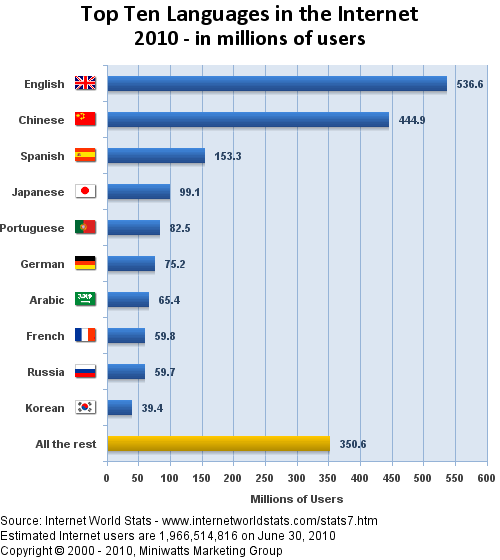
This graph shows that only one fourth of all Internet users are English speakers. Since ¾ of Internet users are not native English speakers, disregarding this audience on your website could mean a missed opportunity for more traffic.

So how do you make sure to capture non-English users? Cater to their native language.

For quick results, using programs like Google Translate (http://translate.google.com/translate_tools?hl=en) to translate your site content will give your international readers—who may have come to your site via English search terms—the option to view your content in a much friendlier environment. This shows cultural sensitivity, and as a result could encourage brand loyalty.

However, note that using free automatic translating services tend to produce very literal translations, which is often free of colloquialisms and common slang. Such literal translations oftentimes come off as poor grammar, so if your translations are faulty it could turn off potential foreign visitors.

Thus, more traditional methods of language learning (http://www.pimsleurapproach.com/) and translating your own content is probably the best way to ensure your site is suited for an international audience. Investing in programs like pimsleur French (http://www.pimsleurapproach.com/learn-french/) and pimsleur German (http://www.pimsleurapproach.com/learn-german/) are great for learning the fundamentals of the common languages you are hoping to optimize for. Whichever route you decide to take, make sure your site content is carefully edited for accuracy.

There are other benefits to catering to an international audience besides showing cultural understanding and sensitivity. Translating your site to popular languages also optimizes your site for international search engine results, since onsite factors are a major indicator of how well you will rank in search engines. This should give you a unique advantage over many of your domestic competitors who otherwise might not optimize for the often overlooked foreign web community.

As translation software improves and the web advances, translating your site should get easier. Until then, invest the time and resources needed to get your web properties optimized and into the search results of foreign visitors before your competition.

____
Author’s Bio:
Adria Saracino is the Head of Outreach at Distilled, a creative internet marketing agency in Seattle. When she’s not connecting with interesting people on the web, you can find her talking about style at her personal fashion blog. Follow her on twitter @adriasaracino to stay in touch.

Thanks, Adria!
_____

Be irresistible!
–ME “Liz” Strauss
Work with Liz on your business!!

Buy the Insider’s Guide to Online Conversation.

Filed Under: Marketing /Sales / Social Media, Successful Blog Tagged With: bc, Blogging-in-a-Foreign-Language, foreign language, internet traffic, LinkedIn

Blogging in a Foreign Language?

July 19, 2007 by Liz

Beyond Metaphors and Analogies

What’s Your Metaphor?

You might remember back to the Metaphor Project. About that same time Jan Circular Communication, one of the winners of Lorelles’s Book, and I began a dialogue about writing the fact that English is not his first language. I wondered whether he would be interested in writing a blog post about the experience. He agreed with enthusiasm. His blog post came in days.

In a lovely circle of communication, I’m pleased to say that as I put jan’s post up now while he’s running a virtual interview with Lorelle and me on his is blog.

Why On Earth Would You be Blogging in a Foreign Language?

Guest Writer: Jan

As everyone else does, I want somewhere to belong, but my community should not be defined by where I am or by which language is my mother tongue. Since community is about commonality we have to have something in common, but it should be what interests us not geography or language. Communities are (in my opinion) built through communication where language shouldn’t play the main part.

If the community is inviting and including, language will play practically no part as long as we make ourselves understood. However it is a fact that you get what you give, so working on your communication skills, including your language skills, will not only benefit others, but also yourself.

With my native language I only would reach a fraction of the world population. My native language is only spoken in one country and practically unknown outside its borders. Even adding in languages with similarities, my own language it is simply not the best basis for gaining a readership and building community, since the number of blogs would be a whole lot less. It wouldstill be possible to build
a position within that language, but I would be left with the feeling that there was an immense audience out there that could have been mine.

Although you could claim that getting started blogging in itself is like learning a new language, there’s no reason to limit your learning to this aspect. I’m optimistic enough to believe I can learn in at least three areas through my blog: the format, the content and the language.

I started blogging because I wanted to relearn things I learned during my education, but rarely use. I practically lost English because I didn’t use it. I decided to include it in my learning endeavor. So the language and content will mostly be relearning while the blogging will be actual learning.

What I have found so far is reaching out in a foreign language enriches my experiences. I guess you could say that the conversations from which you learn the least are those with yourself — almost as bad are those with people like yourself. Only if you go beyond that will you really add to your learn exponentially more. Besides communicating with people from other countries, not to mention continents, is fascinating.

If you want to interact with your local community you simply go out the door and participate in the activities, but if you want to interact with other cultures around the world blogging is surely the next best thing to actually going there. Besides does one not exclude the other. A number of bloggers travel to come together just as a number of people blog when traveling.

Thankfully is writing in English more a challenge than a struggle for me. Had it been a struggle it would be about trying to string sentences together, finding the right words and making myself understood. The
challenge, on the other hand, consists of bringing in more elements, being more precise and generally taking advantage of the opportunities that English offers to those who seek them. If it was a struggle I would probably have thought twice about it, but since I like challenges I didn’t need to think long before deciding.

If you are unsure whether your language foundation will hold up, I would recommend that you begin reading and commenting on blogs in the language you are considering. This will give you practice and introduce you to what could be possibly be your future blogging community.

Remember that the basic language skills isn’t the goal, but just another stepping stone. Hence I certainly have to keep working on my writing skills as will you. Even if you try adding to your vocabulary, using metaphors, analogies etc. and being as precisely as possible. We probably never learn to write like someone writing in their native language. The fact that we will never reach perfection should never be a reason for giving up though. After all, how many things is it really possible to be perfect at? What counts is the effort you put into it and believe me people recognize effort when they see it. Since you probably will not see your own mistakes there really isn’t any reason to get obsessed with them.

To sum up I think there are compelling reasons to blog in a foreign language. You will learn that language better; you will expand your horizon; and you will get to know people who you would otherwise never know. In order for it to work does it require a little more than the basic language skills, a willingness to continuously work on making it better and first of all a strong desire to reach out.

Jan

____________

Jan Suggested

In the process of putting this together, Jan asked at the beginning if I would edit and send back the article before I posted it. That’s exactly what happened. With his return email, he suggested I might add some end notes about the edits that I made. So here they are.
The edits I made were for clarity or differences in verb construction.

  • Those for language usage. These are mostly to verb forms. The verb construct that is most often a problem is that in which you use “would I” (a form for only questions in English) instead of “I would”. Most English sentences are subject then verb.
  • Deletion of phrases. These are edits for readability, fluency. and a more powerful message. The phrase “not to speak about” became the more common usage “not to mention.”
  • I also broke paragraphs to adjust what is more “print text writing” to “online writing.” Shorter paragraphs on more-focused main ideas work better on the web.

Thanks, Jan, for a great look into a special kind of blogging!

–ME “Liz” Strauss

Filed Under: Successful Blog, Writing Tagged With: bc, Blogging-in-a-Foreign-Language, Circular-Communication

Recently Updated Posts

Is Your Brand Fan Friendly?

How to Improve Your Freelancing Productivity

How to Leverage Live Streaming for Content Marketing

10 Key Customer Experience Design Factors to Consider

How to Use a Lead Generation Item on Facebook

How to Become a Better Storyteller


From Liz Strauss & GeniusShared Press

  • What IS an SOB?!
  • SOB A-Z Directory
  • Letting Liz Be

© 2025 ME Strauss & GeniusShared