Successful Blog

  • Home
  • Community
  • About
  • Author Guidelines
  • Liz’s Book
  • Stay Tuned

How to Think Like a Millionaire and Be What You Want to Be

November 20, 2007 by Liz

Congratulations! You’ve Won!

insideout logo

How would do if you won lots of money?
Most folks who win the lottery don’t do so well. The headlines shout out their stories.

    8 lottery winners who lost their millions

    Britain’s biggest lottery winner says jackpot ruined her life

    Lottery winners often make bad financial choices

    Lottery Winner Loses $114 Million In Four Years . . .

Most lottery winners are bankrupt in 5 years. Why is that?

Millionaire Thinking

Google the search string think like a millionaire [without quotation marks], and you’ll find that exact phrase still shows up on page 35 of the search results. Obviously, the idea that millionaires think differently is accepted wisdom.

Suppose your goal is to retire a millionaire. What would it take to get yourself there?

Becoming a millionaire takes the same passion, focus, drive, and vision as any job goal you might set.

Whether you aspire to be the headmaster of the school where you teach, the top research biologist, or an Olympic gymnast, without incredible luck, you just won’t get there, unless you . . .

  • a. believe it’s possible.
  • b. decide that nothing will stop you.

World Chess Champion Garry Kasparov didn’t get to be the best by thinking that he would never be at that level. Nicole Kidman didn’t become an A-List Actress and the highest paid public speaker in history by waiting for chances to come to her. Ian Fleming wasn’t dreaming about who’d play James Bond when he wrote the first book in the series.

All three of them knew where they were going and they got there.

“If you want to achieve something you have never had before, you must become someone you’ve never been before.” –Jill Koenig in her book, How to Become a Millionaire.

Let’s follow her thinking a little further.

“I am not talking about ‘fake it ’til you make it.’ I am talking about redirecting your thoughts, energy and actions into the type of person who would absolutely manifest that Goal.”

So what does Jill say that she did? You can find it her article with the same name as her book, How to Become a Millionaire.
This author who has become a millionaire and an expert in the field of strategic goal setting lays the path in plain language. To become a millionaire, she paid attention to millionaires whom she admired, using their actions as models. The path Jill Koenig took is set out plainly. You could do and so could I.

7 Traits Millionaires Have in Common

  1. Millionaires rise early, show up, and keep their promises. Hard work doesn’t scare them.
  2. Millionaires invest time in motivational activities and personal development.
  3. Millionaires keep a regular routine — one they know keeps on their “best game.”
  4. Millionaires keep their heads and hearts point toward their destiny.
  5. Millionaires see opportunity, not obstacles.
  6. Millionaires know how to say “no,” to a negative influence.
  7. Millionaires are people other folks want to do business with, or they could never have become millionaires.

Go ahead, replace the word millionaire with any goal or role you might long for. Those traits define peak performance and people we like to work with.

Any peak performer owns his or her goal. Don’t just wish. As Ghandi said, “Be the change.” Make your goal your identity. Once you do, people around you will start to agree and the support will move you toward where you’re going.

Be a millionaire or be something even better. If you are willing to become your goal, you’ll get there. You’re the only one who can talk you out of it.

It’s a matter of being willing to win.

Can you think like a millionaire?

–ME “Liz” Strauss
Work with Liz!!
Filed Under: Inside-Out Thinking, Successful Blog Tagged With: bc, Inside-Out Thinking, Perfect Virtual Manager, The Big Idea

25 Days to Organize a Blogger’s Life in Time for Holiday Fun

November 19, 2007 by Liz

Problems, People, Paper, and Plans

insideout logo

I looked at the calendar this morning. Roughly 6 weeks stand between me and the end of the year. I’m not much for New Year’s Resolutions, but I love the feeling of new beginnings when everything is cleaned up, put away, and ready to rock. On the other hand, I don’t like to make work, especially at holiday time. So this morning, I’m putting together a plan that I’m calling . . .

25 Days to Organize My Life in Time for Holiday Fun

At this time of the year, conflicting goals can intrude on the most uncluttered life. They can stress and overwhelm the calmest soul. Chaos like mine is already out of control.

This year, with that in mind, I’m organizing my life to avoid possible nuclear meltdown. I’ll do something each day to wrap things up so that I totally enjoy the end of the year fun.

I plan to clean up my live AND catch up with my friends as we make the season merry and bright.

I. Problems and Solutions

Day 1: Get help with common problems. I’m going to quit trying to figure out everything on my own. It silly for me to invest time digging up basic answers, when Simple Help has probably already figured most of them out. Simplehelp.net is a site that is both interactive and re-active; if you can’t find the solution to your problem, you can request content and the tutorial will be created for you. If I let other folks share what they know, I can save my time for the problems so unique to my situation that only I have the experience and detail to solve them efficiently. I have a couple that need attending to right away.

Day 2: Ask for help with my blog, too. I’m going to let more people know that I welcome guest posts on my blog. Though my blog can’t offer revenue it doesn’t earn, it’s got visibility and an intelligent, cool audience that’s priceless. AjaxNinja suggested seek out guest writers and I’m doing it today . . .

This is an invitation. . . . If you can submit an appropriate post by Friday morning, I sure could use your help. I’ll be in the UK Dec 1-9, 2007, and I’m not sure I’ll be able to blog while I’m gone. You’ll find my email address and topic ideas on the Guest Writer page.

II. Thousands and 150 Important People

Days 3-8: Update one of my “networks” each day from this group of sites:
MyBlogLog,
StumbleUpon,
Digg,
Facebook,
LinkedIn,
and Propeller.
When I find folks who have common interests, add them to my contacts.

Day 9-14: Review other “social networks” I belong to: Xing, Ning, Spock, Zude, Rapleaf, 8apps, Pownce, BlueChip, Zaadz, and Doostang. Decide which I should stay with and which I will resign from.

Day 15-17: Use MyLifeBrand or social url to incorporate the remaining Social Networks into one global platform. Make this a 15-30 minute part of each day moving forward. Place that block during a time that my mind needs a break from other kinds of work.

Day 19-20: Sort and group my email address book. Email is my most natural social network. Delete entries for folks I don’t recognize or haven’t corresponded with in less than 6 months. Email folks on the 6-month drop list that I want to keep current. Check my email settings. Delete old emails I no longer need need.

Day 21-22: Go through the contacts in my phone in much the same way. Delete those I don’t know and calling those I’ve not spoken to but want to keep on as a contact and part of my life.

III. Paper and Plans

Day 23-24: Clean off my desk and clean out my paper files. Maybe I’d better start doing a little bit of this one every day from day 1 . . . hmmmm.

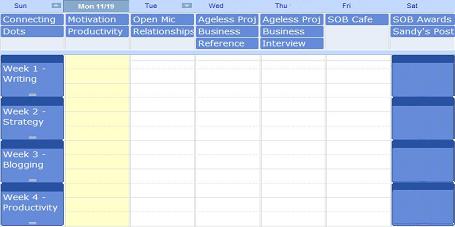
Day 25:Develop an Editorial Calendar for next month using the form below. Allow for spur-of-the-moment ideas and variations.

Editorial Calendar

Then sit back with a nice glass of my favorite beverage and listen to my favorite tunes. . . .

How would your 25 day plan to organize for some fun work out differently?

–ME “Liz” Strauss
Work with Liz!!

Filed Under: Inside-Out Thinking, Successful Blog Tagged With: bc, Inside-Out Thinking, Productivity, social-networking, The Big Idea

Seriously: Do New Thoughts and New Taglines Find Us?

November 3, 2007 by Liz

It Started with an Unsearchable Thought

insideout logo

It started with a blog post. Somehow in writing it, I had a new thought.

Seems a good reason NOT to be a thought leader . . . new thoughts aren’t searchable.

That thought caught a conversation about how our thoughts might connect us.

In the comment box, Alina Popescu said

Hi Liz! New thoughts are not searchable because they don’t need to [be]. They have their own little strategy to finding their way to people. I did not use a search to get to your blog. However, I got here and ceased to be a stranger 🙂 So who cares if you can’t search them? Most of us find new thoughts or are provoked to think exactly when they most need it.

Via trackback, Billy Smith said

It is about discovering, not being discovered « The Organic Leadership Blog

Last night on the telephone, I asked Lorelle VanFossen what she thought. We discussed what we thought about thoughts finding us in the universe. She talked about the “Great Cosmic Muffin,” and she said

You have to write about this in the way only Liz can. It’s important. Don’t leave that thought behind. Send out a new one. Show them how.

It’s hard to say, “no,” to Lorelle.

Do Thoughts Find Us? I Mean Really

cartwheel nebula

I know that, in the past year, I was thinking some thoughts that weren’t the best. What they brought weren’t the best folks or events.

With every knock, I lost a bit of who I am.

I started listening to EVERYONE, but myself.

Each new problem child outdistanced the last.

I can list unhappy endings one by one.
Yeah, it’s a list, and the list gets progressively — exponentially — more detrimental.

If I constantly flinch, isn’t inevitable that I’ll get hit? Why is that?

Are my thoughts on my sleeve? Do they somehow transmit? I have trouble believing that 1, 2, 3, 4 — small, medium, large, extra large — could be all a coincidence. It just doesn’t seem that coincidence is that organized.

Even more.

When I decided that I’d had enough, when I said, “I’m taking this ‘kick me’ sign off. No more. It’s the end of this rotten stuff,” within hours new things, good things, things I love, started happening. Is that coincidence too?

I think not.

Go ahead, believe whatever your heart will let you.

If right now, I send out this thought on a Saturday, when most folks are out and not reading blogs, will it find you before it normally would?

When I answered Alina’s comment up above, I wrote this descriptive phrase in the comment box.

New thoughts on a mission to find new thinkers.

Alina wrote this comment in response.

Liz, that sounds like a pretty good slogan.

Does it mean that a new tagline came to find me and my blog?

Liz's Signature

Filed Under: Inside-Out Thinking, Marketing /Sales / Social Media, Successful Blog Tagged With: bc, Inside-Out Thinking, The Big Idea

To Write a Review Folks Find Useful — Don’t Stick to the Facts

October 9, 2007 by Liz

Reviewers Who Think

insideout logo

Have ever read a review and still wondered whether you’d like the product? Do you know any reviewer who you rely on because he or she has the opposite opinions of you? Sometimes a reviewer who thinks differently than we do is more valuable than one who doesn’t say what he or she thinks at all.

I’ve been reading a passel of product reviews all weekend. Now I remember why I don’t read reviews. In an effort to be unbiased, reviewers seem to be too distant, too flat — they give the facts. The facts aren’t enough.

Don’t Stick to the Facts

When you blog the facts only, anyone could write basically the same review. The differences will be in the writing only. When you blog the facts only people tend to read to the minute detail to make sure your facts are exactly right . . . and that they’re all there. Too many facts can be either distracting or boring. Would the VW Beetle have been a hit based only on the facts? What about McDonalds? the iPod?

If you want to write a product review that folks find useful, don’t stick to the facts.

  • Facts don’t tell me if I will love my future mate.
  • Facts don’t tell the story of history.
  • Facts are only a part of the whole picture.

Write your experience too.

The Two Key Reasons to Write Your Experience

Here are the 2 key reasons why you should write a review with both the facts AND your experience.

  1. When you add your experience, readers get to see you. They know you used the product. It’s your voice and your credibility.
  2. When readers hear talk about using the product, they can picture themselves. It doesn’t matter whether they agree with how you found it, If you explain what made you think as you do — they’ll decide for themselves.

Any customer needs more than facts to decide whether to buy any product. Sure the facts are important, but looking only at the facts doesn’t tell what it’s like to use it.

When you add your experience, people are more likely to remember both the product and you. A great review can save a reader a great deal of time and money.

Don’t be shy. Tell me what you think.

— ME “Liz” Strauss
Work with Liz!! page in the sidebar. Call her now!

Related
To follow the entire series: Liz Strauss’ Inside-Out Thinking to Building a Solid Business, see the Successful Series Page.

Filed Under: Blog Basics, Inside-Out Thinking, Successful Blog Tagged With: bc, Blogs, business, Inside-Out Thinking, product-reviews

25 Things that People — Our Key Customers — Really Want

September 25, 2007 by Liz

SIMPLE SALE SERIES

Everyone Has Customers

insideout logo

I’ve been thinking a lot about customers lately. We all have them. Some are traditional sorts. They come to our businesses and pay us for products or services. Some are a little less conventional — they come in a customer role for things that don’t cost. Blog readers, first graders, park users are customers like those. Other customers don’t seem like customers at all, but really they are . . . mothers, fathers, sons, daughters all rely on our services like customers.

So it seems that knowing what customers want is more than a good idea. With that many customers everywhere we look, knowing what keeps them on a happy note would seem more like survival. Don’t you think?

25 Things that People — Our Key Customers — Really Want

Whether we have a business or we are just in the business of living, it’s good to know what will help us deliver a smile on the faces of the folks we care most about.

This list works for every kind of customer I’ve been able to think up. (Don’t go getting kinky on me.)

  1. People want help solving a problem.
  2. People want folks to notice them.
  3. People want to be heard when they offer their thoughts.
  4. People want to feel smart.
  5. People want to be a part of things.
  6. People want to be generous and for you to be generous too.
  7. People want give and be good things and want you to give and be good things too.
  8. People want to not worry . . . about time, money, health, injury, or other danger.
  9. People want to know that you’ll be the same person or better than the last time they saw you.
  10. People want to be entertained.
  11. People want to be informed.
  12. People want to learn.
  13. People want to know you don’t say bad things about them.
  14. People want to know they aren’t a number or a metric.
  15. People want good cake not just icing on a bad one.
  16. People do want the truth. They just don’t want it delivered with a sledgehammer.
  17. People want to believe in something without someone picking on them for it.
  18. People don’t want innovation. They want things that make life more livable.
  19. People want things and experiences that make their fill their time more meaningfully.
  20. People want to be understood.
  21. People want their questions answered even when the answer is “I don’t know.”
  22. People want the right to make mistakes without losing every time they do.
  23. People want to make their own choices.
  24. People want to know that you value their differences.
  25. People want to know that you know they are people.

People aren’t hard to understand. We all were born one of them. The trick is to keep in mind that folks around us — even folks we don’t know –are people too. They have their own thoughts and desires in the same way we have ours. We can meet with them where we agree — 25 points up there give us plenty to start with.

In our lives and in our businesses, people are our only customers for our actions and behaviors. If we make it about THEM, everyone will be just a little bit nicer. Lose track of that and they’ll remind us.

What things do the people in your life want? Are you a product of your environment? Could you be a better one?

–ME “Liz” Strauss
Work with Liz!!

Related
To follow the entire series: Liz Strauss’ Inside-Out Thinking to Building a Solid Business, see the Successful Series Page.

Filed Under: Inside-Out Thinking, Marketing /Sales / Social Media, Successful Blog Tagged With: bc, Inside-Out Thinking, relationships

7 Secrets to a Fiercely, Loyal Community of Readers

September 19, 2007 by Liz

SIMPLE SALES SERIES

Reading Is My Life

insideout logo

We all learned to read and kept on reading. If we didn’t, we wouldn’t be here. I went on to learn about readers and literacy — how folks interact with text and ideas became my field.

Knowing about reading is a tricky thing. People think that because they can read they must know how it all works. Just underneath the surface are secrets they don’t realize . . . Why would they, unless readers have been their customers for years?

I’m going to share those secrets with you.

The 7 Secrets to a Fiercely, Loyal Community of Readers

Ever been to a great restaurant or club where the mood is right; the service is grand; and every offering is spectacular? When the whole experience comes together in just the right measure, we leave a place already thinking about when we’re going to go back.

Written information, when it’s presented well, has the same effect. It’s a great fit that’s so satisfying, we’re thinking about the experience as a whole and the feeling that we came away with.

These secrets have been researched with every age group from pre-school to graduate school and every reading level from pre-literate to way over my head. But I know you’ll know they work, not because I said so, but because when you read them they will totally make sense.

  1. Be interesting. Be entertaining. Be silly. Be informative. Be controversial. Be anything but preachy or boring. Contrary to popular belief, you CAN tell. You DO know. Take the time to look. If you don’t, you’re lost before you start.
  2. Be simple. Put away the big vocabulary words and the long sentences. Only use that incredible word once in an entire piece. Elegance is understated. Impact is quiet. Take away all of the words you can without losing meaning. Extra words get between your message and me.
  3. Be positive. Know what you’re saying and show me how to get to a positive end. No one wants a problems without a solution. No one wants to live every day reading about doom. Think about how you invest your time with friends . . . do the downers really get more than the ones who help make your world better?
  4. Be trustworthy and respectful. Be who you say you are. Deliver on your tagline. Make sure your headlines tell the story of what you write. Answer comments. Most of all, know what you don’t know and invite your readers to share what they do.
  5. Be consistent. Let folks know what to expect of and from you . . . and in like manner, what you expect of and from them. Every relationship is based on an exchange. Readers and writers exchange the same way. It’s okay if folks don’t like one of your features, if you are consistent about how you label things or when you offer them, you make it easy for folks to get to the content they appreciate.
  6. Be readable. Make sure that every word you write is readable without distraction in every browser that your readers use. Configure your content to serve readers. Some folks get confused and try to do it the other way around.
  7. Be generous and satisfying. Care passionately about what you write. Care even more about the folks who come to read it. Know that readers want to like you and what you write, just as diners want to like the chef and the food in a great restaurant. Let us look smart. Let us help. Let us feel important, connected, and a part of what you’re doing. In other words, make readers the stars.

Readers and a writer work have a relationship like diners and a chef. Only part of that relationship is what is served up from the menu, the rest is the experience. Every successful chef . . . writer . . . first grade teacher knows that.

That’s how we’ve been getting folks to come back for years.

Got more to add to the list? I’m thinking you do.

–ME “Liz” Strauss
Is your business stuck? Check out the Start-up Strategy Package. Work with Liz!!

Related
To follow the entire series: Liz Strauss’ Inside-Out Thinking to Building a Solid Business, see the Successful Series Page.

Filed Under: Community, Inside-Out Thinking, Successful Blog Tagged With: bc, building-readership, getting-customers, Inside-Out Thinking, Liz-Strauss

  • « Previous Page
  • 1
  • …
  • 3
  • 4
  • 5
  • 6
  • 7
  • …
  • 9
  • Next Page »

Recently Updated Posts

Is Your Brand Fan Friendly?

How to Improve Your Freelancing Productivity

How to Leverage Live Streaming for Content Marketing

10 Key Customer Experience Design Factors to Consider

How to Use a Lead Generation Item on Facebook

How to Become a Better Storyteller


From Liz Strauss & GeniusShared Press

  • What IS an SOB?!
  • SOB A-Z Directory
  • Letting Liz Be

© 2025 ME Strauss & GeniusShared