
Successful Blog

  • Home
  • Community
  • About
  • Author Guidelines
  • Liz’s Book
  • Stay Tuned

Company Meetings Cutting in on Productivity?

January 11, 2012 by Thomas

Company meetings serve a wide array of purposes. That being said, can too many meetings be a bad thing?

Having worked at several companies now over a 23-year period, I have seen a variety of approaches to this subject.

Some companies have had a normal approach to in-house meetings, some have had too few meetings, while others have gone overboard and seem to be meeting on an almost hourly basis, whether through onsite meetings or teleconferencing.

I’ve always tended to believe that falling somewhere in the middle of the above-mentioned descriptions is best.

On the one hand, it is important for your team to know what one another are doing; without occasional meetings that is hard to achieve. On the other hand, meeting too often always leads me to wonder how any work is getting done. Too many meetings can lead to micromanaging and a feeling among employees that their every move is being scripted and watched.

If you’re not sure how often your company employees should be meeting to talk strategy, keep these things in mind:

  • What are you trying to accomplish with the meetings in the first place? – Are they held to share strategies, ideas, ask questions of where projects are going? If the answer is yes to any of those things, then by all means meet. If the answer is no to one or more of those things, then you need to rethink why you’re getting staff together;
  • Where does real productivity rank in your company? – While meetings can certainly be productive, they also pull employees away from the tasks they were hired to do in the first place. If you’re team is having to get together on a daily basis to meet even for half an hour, think about the loss of actual productivity time that half hour means to you and your business. I once worked for a company that required its writing team to meet on a daily basis. In lots of the meetings, we repeated what we said the previous day as far as updating our status on projects. In the meantime, I and some others sat there and thought about the wasted time going by when we could have been producing another article, conducting interviews, reaching out to new clients on the phone etc.;
  • Are we getting the same message over and over again? – Another risk factor with having too many meetings is that you will turn off some of your brighter employees. Going over the same message over and over again begins to lead to some tuning out both the message and the messenger. Let’s be honest, some company folks like to hear themselves talk. While that may be great for them, those listening are sitting there thinking about all the real work they could be getting done while listening to something they heard just a week ago. Constructive meetings are one thing, sitting there listening to lectures over and over again are another;
  • Are we stifling openness among employees? – If you’re having too many meetings, you may not even know it. In most offices, employees are not going to raise their hands when polled to respond yes if the company is meeting too often. For most employees, such a move in their minds would rock the boat, painting them as an uncaring employee. In reality, a good office culture is one where openness and the ability to speak one’s mind should be promoted. Without the ability to speak one’s mind in a professional and courteous manner, you are fostering a dictatorship at work, where one and only one voice is heard. Be bold and ask your entire team if they feel the company meets too often. If the answer is yes, take the time to think about how less meeting time can translate into more production time.


At the end of the day, each company and its management must decide what is in its best interests.

In my 20+ years of employment nationwide, I have yet to see the perfect meeting environment.

In the meantime, I’m going to meet with myself and see if I can come up with some solutions for this issue.

Photo credit: Markdenham.com


Dave Thomas, who covers topics such as starting a small business, writes extensively for Business.com, an online resource destination for businesses of all sizes to research, find, and compare the products and services they need to run their businesses.

Filed Under: Business Life Tagged With: bc, company meetings, employees, teleconferencing

Hierarchy of Influence: Matching Your Actions to Expected Reactions

January 10, 2012 by Liz

Redux: I wrote this post in Feb. 2011. Based on recent conversation, it seems even more relevant now and so I choose to pick it up, add some clarity and publish a newer version this week.

Not Every Attempt Gets the Expected Outcome

cooltext443794242_influence

When our son was barely five years old, he was a shy child who lived by his own timetable. He had his own ways of doing things. If you wanted his attention, your best bet was to make eye contact and simply explain what you what you had to say.

It was during that year, that his grandparents came to visit us in Austin. Together as a family, we planned several outings to enjoy the city and our favorite restaurants. One evening, the whole group was getting ready to go dinner and our son was still playing — not getting ready. This circumstance stressed out three of four adults in his company. Suddenly one, then two, then all three of them were using loud firm voices to tell a child, half their size, to “Get upstairs to change in to clean clothes, immediately!!”

The child froze like a deer in the headlights.

The mom in me responded with like to like. In firm and loud voice, I said, “Who are you to gang up on a little kid like that? Get away from here!”

The three adults moved into the kitchen and spoke quietly to each other.
I took the little boy by the hand. “I said let’s go upstairs and find what you’ll wear to dinner.”

When we came downstairs ready to go to dinner, I walked into the kitchen and apologized for my outburst. In return I got three calm apologies that also said I was right to intervene on the child’s behalf.

Not every attempt at influence gets the outcome we’re going for.

Which Actions Achieve the Outcomes You Seek?

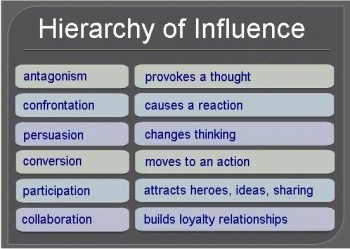
If we can agree that influence is some word or deed that changes behavior. Then plenty of influence occurred in the story I just related. I suspect that had I been privy to the whole scene in the kitchen I would have found that that single story included examples of confrontation, persuasion, conversion, participation, and collaboration. The only thing missing in this family scene would be true antagonism. Six different approaches to influence which lead to entirely different outcomes.

I’ve been reading about, thinking about, and talking to people about influence for months, because influence and trust are integral understanding to loyalty relationships. Let’s take a look at six of the usual forms of influence and the outcomes that result from them.

  1. Antagonism – provokes thought Your values are everything I believe is wrong with the world. You can’t stomach anything that I stand for. We are not competitors. We are enemies at war. Your words and actions might provoke thoughts and deeds, but what I’m thinking is how wrong you are, how to thwart you, or if I have no power, how to hide my true thoughts and feelings. An order from an enemy can influence a behavior but won’t change my thinking.
  2. Confrontation – causes a reaction You say it’s black. I know it’s white. I respond in some way — I fight back. I run away. I consciously ignore you. My response will probably change based who is more powerful. You might overpower me. I might stop responding, but it’s unlikely that you will actually change my thinking. Confrontation leads people to build a defense, to strengthen their own arguments.
  3. Persuasion – changes thinking You look at me and think about how what you want might benefit me. Rather than telling me, you show me how easy, fast, or meaningful it is go along with you. You’ve changed my about what you’re doing. I now see your actions from a new point of view.
  4. Conversion – moves to an action Your invitation to action is so convincing and beneficial to my own goals that I do what you ask. You’ve influenced my behavior to meet your goal. You have won my trust and commitment to an action. It’s not certain I’ll stay converted.
  5. Participation – attracts heroes, ideas, and sharing You reach out with conversation. We find that we are intrigued by the same ideas, believe in the same values, and share the same goals. Your investment in the relationship builds my trust and return investment. You invite me to join you in something you’re building. My limited participation raises my investment, gives me a feeling of partial ownership, and moves me to talk about you, your goals, and what we’re doing together.
  6. Collaboration – builds loyalty relationships We develop a working relationship in which you rely on my viewpoint. We share ideas and align our goals to build something together that we can’t build alone. You believe in my value to your project. I believe in the value of what you’re building. You have gained my loyalty and commitment. I feel a partnership that leads me to protect and evangelize the joint venture. I bring my friends to help.
Strauss_Hierarchy_of_Influence
Strauss Hierarchy of Influence

Not every campaign or customer situation will need to move to collaboration. But understanding each level will help us manage expectations allowing us to move naturally and predictably from confrontation to persuasion, so that we don’t expect the loyalty of collaboration from a momentary conversion.

Could be useful when looking to connect with that special valentine too.

How might you use the hierarchy to change the way you manage your business, your event, your community, and your new business initiatives?

–ME “Liz” Strauss
Work with Liz on your business!!

Buy the Insider’s Guide to Online Conversation.

Filed Under: Community, Marketing /Sales / Social Media, Successful Blog Tagged With: bc, influence, LinkedIn, relationships

Ideas & Infographics: So You Thought Your Mobile Habits Were Harmless?

January 9, 2012 by Guest Author

by Mihaela Lica

cooltext443809602_strategy

Getting Smart about Smart Devices

These days, if you are not heavily heeled with smart devices and wired into the social web, your business is probably suffering. This is no big secret. However, the habits and devices you use may have adverse affects on you that are seldom publicized. Does your neck ache? Ever get blurry vision? Read on.

Have you ever thought about just how your body is positioned while using your iPad or other smart device. Probably not, that is unless your eyeballs get so red from bad positioning your friends think you have a hangover. The infographic below reflects on how smartphone or device use can mimic the improper wearing of eyeglasses.

[Click the image to see the isolated infograph and again to see it full size.]

[Created by Mezzmer Eyeglasses]

The advances in mobile technologies and the ever increasing adaptation of them by us poses not only huge benefits, but sometimes very bad consequences. Smart devices, like any tool designed to accelerate or enhance our abilities, should be used properly.

If you are a habitual smartphone or pad user, maybe you should consider refining your habits? Or, maybe a pain in the neck is your cup of tea?

—-

Author’s Bio:

Mihaela “Mig” Lica founded Pamil Visions in 2005 where she uses her hard won journalistic, SEO and public relations skills toward helping small companies navigate the digital realm with influence and success.

You can find Mig on Twitter as @PamilVisions

Thanks, Mig! Thank you also to Mezzmer.com!

–ME “Liz” Strauss
Work with Liz on your business!!

Buy the Insider’s Guide to Online Conversation.

Filed Under: Business Life, Successful Blog Tagged With: bc, Infographic, LinkedIn, mobile habits, smart devices

Be Effortlessly Cool in Your Red Shoes and Own Your Own Life

January 9, 2012 by Liz

The Red Shoe Tragedy

cooltext443794242_influence

The rules, values, and ideas we learned growing up served us in those situations and settings. Some of those rules, values and ideas are universal to humanity, but others were built from the goals people who . Yet we often keep living by those rules long after we’ve left the group, society, or culture from which they came. We still use rules from grade school peer groups to define ourselves and make decisions as adults. The values, rules, and ideas imprint deeper and last longer than the channels for which they were developed to build, serve, and protect.

In my high school, it was a social and a fashion faux pas to EVER wear red shoes. Yet my friends who went to a Chicago high school had never heard of that “law.” It was stunning and amazing that these attractive, fun, funny, intelligent kids could live so effortlessly cool wearing red shoes whenever they wanted. It took outright clear thinking on my part to choose to set aside that rule — The tragedy was that it didn’t occur to me to stop following the red shoe rules until long after high school, long after it was even a remotely useful rule.

In every group, society, and culture that we belong, we use rules, values, and ideas to identify ourselves as members of the group, align our goals and define our roles. We use those rules, values, and ideas to attract like-minded thinkers and to channel our energy in the useful directions. But no single set of rules, values and ideas carries over completely to the next universe of people.

In increments we’ve learned to look outside us — to our parents, teachers, friends, bosses — for answers for the keys to navigate those elusive rules, values, and ideas that define good behavior and outline the clearest path to our success. What meet instead is other people who have also learned to look outside themselves.

The rules, values and ideas we collect over time grow and gather. Each one we add comes from someone else. We keep adding in more to those we’ve picked up and combine them in our own ways to make our own sense. The rules, values and ideas don’t leave our minds when we move on with our lives.

Rules, values, and ideas are like people in the way that few will fit us well-enough to earn the place of a life-long friend.

Who built the rules, values, and ideas that fuel the decisions you make?
If you haven’t named the values, rules, and ideas that are your friends for life, fair chance the answer is: not you.

Every new teacher, location, clan, situation, culture, corporation, church, organization, school, or troop offers new rules, ideas, and values slightly different from the last. Yet no person, group, or association has to live one moment of your life.

Think about that.

It’s your life.
No one has walked a mile in your shoes.
No one knows what you wish in the middle of the night.

Choose your values.
Make your rules.
Have your own ideas.
Be effortlessly cool in your red shoes.
Be your own unique value proposition.
Live your own life.

Are you ready to move the useless rules out of your head and get to a new sort of productive?

Be irresistible.
–ME “Liz” Strauss
Work with Liz on your business!!

Buy the Insider’s Guide to Online Conversation.

Filed Under: Motivation, Personal Branding, Successful Blog Tagged With: bc, LinkedIn, personal-identity, rules

Thanks to Week 325 SOBs

January 7, 2012 by Liz

muddy teal strip A

Successful and Outstanding Bloggers

Let me introduce the bloggers
who have earned this official badge of achievement,

Purple SOB Button Original SOB Button Red SOB Button Purple and Blue SOB Button
and the right to call themselves
Successful Blog SOBs.

I invite them to take a badge home to display on their blogs.

muddy teal strip A

They take the conversation to their readers,
contribute great ideas, challenge us, make us better, and make our businesses stronger.

I thank all of our SOBs for thinking what we say is worth passing on.
Good conversation shared can only improve the blogging community.

Should anyone question this SOB button’s validity, send him or her to me. Thie award carries a “Liz said so” guarantee, is endorsed by Kings of the Hemispheres, Martin and Michael, and is backed by my brothers, Angelo and Pasquale.

deep purple strip

Want to become an SOB?

If you’re an SO-Wanna-B, you can see the whole list of SOBs and learn how to be one by visiting the SOB Hall of Fame– A-Z Directory . Click the link or visit the What IS an SOB?! page in the sidebar.

–ME “Liz” Strauss

Filed Under: SOB Business, Successful Blog Tagged With: bc, blog-promotion, SOB-Directory, SOB-Hall-of-Fame, Successful and Outstanding Blogs

Learn to Use Video to Help Your Clients “See the Real Me” During #Sobcon Chat on January 19th, 2012 w/ @erlmedia

January 6, 2012 by SOBCon Authors

Finding the “right” business professional can be challenging and often frustrating. When was the last time you were handed a list of names by an insurance company and told to randomly pick a doctor? [Read more…]

Filed Under: SOBCon Site Posts Tagged With: bc, sobcon chat

  • « Previous Page
  • 1
  • …
  • 250
  • 251
  • 252
  • 253
  • 254
  • …
  • 1050
  • Next Page »

Recently Updated Posts

The Creator’s Edge: How Bloggers and Influencers Can Master Dropshipping

Is Your Brand Fan Friendly?

How to Improve Your Freelancing Productivity

How to Leverage Live Streaming for Content Marketing

10 Key Customer Experience Design Factors to Consider

How to Use a Lead Generation Item on Facebook


From Liz Strauss & GeniusShared Press

  • What IS an SOB?!
  • SOB A-Z Directory
  • Letting Liz Be

© 2025 ME Strauss & GeniusShared