Successful Blog

  • Home
  • Community
  • About
  • Author Guidelines
  • Liz’s Book
  • Stay Tuned

Effective Logo Design that Reaches Your Target Audience

September 30, 2011 by Guest Author

Guest Post
by Christopher Wallace

The Best Logo for the Best Customers

In today’s fast-paced, competitive environment, getting your business noticed is not only a top priority but also a critical one. The marketplace is getting more crowded all the time and every business is in competition for the most precious commodity out there—customer attention. And when you think about it, what better way can there be to get that attention than an effective logo?

Next time you see the Golden Arches or the Playboy Bunny, notice how these images instantly convey messages about their brands that a thousand well-written words could never come close to matching. What about your favorite sports team? Try watching a game without seeing the team logo. You can’t. Instead, count how many times you see that logo displayed—on the players’ uniforms, in the stadium, on the programs—just about everywhere. Are logos important? You bet they are!

So what makes an effective logo? People have their opinions. Some favor simplicity, while others insist that pizzazz is king. Some think letters, numbers, and symbols are all you should see. Others favor pictures and drawings. Some insist on including the business name, while others prefer to let the audience figure things out for themselves. Which of these is the right approach?

Well, the plain fact is that there is no one-size-fits-all answer. It all depends on your business and the demographic you are targeting. A dynamic, eye-catching, attention-grabbing, and memorable logo can do wonders for your business. But it can also be useless if it doesn’t attract the customers you are trying to reach. Here are some common things to remember when trying to find the right logo for your business:

  1. Make it adaptable. Think about all the places your logo will need to be displayed—and then make sure the logo is designed in a way that makes it stand out in every setting. A few things you should consider: Does the logo still look good when you shrink it down? Will it retain its appeal when the colors are removed and it appears in greyscale or black and white? Can it stand out against the backgrounds of the different places where it will be showcased?
  2. Make it original. You may have the best-looking logo on the planet. But if somebody else thought of it first, then it’s not really yours at all. Before you go with it, do some research! Is there already a logo out there that looks a lot like yours? If so, you run two risks: (1) the possibility of a lawsuit; and (2) the likelihood of confusion between your brand and the other one. Before settling on something, do some checking online. One good resource to use is Tineye. Another is Google images.
  3. Make it timeless. Avoid saddling your logo with trendy images that will soon be out of date. An ideal logo should be able to withstand the test of time. If you have to change your logo every couple of years, then your brand will never have a chance to cement itself in people’s minds. Ask yourself this: how many logos do you see today that include images of bell bottom pants or cassette tapes? Remember that today’s trendy craze is usually tomorrow’s old news.
  4. Make it relevant. You know what your business does. But that doesn’t mean that others know. Your logo needs to communicate your product or service. You want it to become your calling card for brand recognition and loyalty. If customers look at your logo and scratch their heads because they can’t figure out what you sell or what you do, you will very quickly be forgotten. Make sure there is a recognizable tie-in relating your logo to your business.
  5. Make it meaningful to the right people. The important thing here is to completely understand your target audience. This means understanding not only your target demographic (i.e., gender, age group, household income range, marital status, etc.) but also what makes them tick. You want to understand how your target audience approaches life, what traits they exhibit, and what their attitudes are. Are they risk-takers? Do they like to spend money? Are they tech-savvy? Only after you know answers to questions like these will you be able to design a logo that reflects both their profile and their feelings.

In today’s business climate, a sharp and distinctive logo is a must. It will make your business stand out but it can also do a lot more. It can inspire trust, create brand loyalty, and generate instant recognition of your business. But it will only do these things if it is designed with a lot of care and forethought. That logo may look like just a little piece of art but in reality it can make a huge difference to your bottom line.

————————————

Christopher Wallace, Vice President of Sales and Marketing for Amsterdam Printing, has more than 20 years experience in sales and marketing. At Amsterdam, a leading provider of personalized pens , promotional pens , and other personalized items such as imprinted apparel and customized calendars, Christopher is focused on providing quality marketing materials to small, mid-size, and large businesses.

Thank you, Christoper! Your list is thought provoking! Great timing for this. 🙂

–ME “Liz” Strauss
Work with Liz on your business!!
Buy the Insider’s Guide to Online Conversation.

Filed Under: Design, Successful Blog Tagged With: bc, business, LinkedIn, logo design

Why Working From Home May Not Work For You

September 29, 2011 by Guest Author

A Guest Post by
Rachel Carlson

cooltext443809602_strategy

Work Sweet Work?

Ah, the dream of working from home. So many perks – not having to get up early, no commute, no annoying co-workers, eating from your own fridge, break whenever you want, keep an eye on your kids – you don’t even have to get dressed if you don’t want to. Unless you’re one of the “lucky” people who actually have this privilege (between 2.8 and 44.4 million people in the U.S. work from home depending on who you ask), you’re probably reading this from a cubicle and dreaming of “freedom.” But hold on – working from home isn’t always what it’s cracked up to be. I’ve been working from home for several years now, and I can tell you that it’s definitely not for everyone. Let’s start with the biggest hurdle…

Distractions

People who work from home don’t have a traditional boss looking over their shoulder. A freelance writer, for example, probably doesn’t have any boss at all. A medical biller probably has a boss, but the boss isn’t physically in the room, checking to see if work is being completed. This sounds great at first, but it really leads to a pressing question: do you have the motivation and focus to accomplish what you need to do? Remember that you’re on your computer – will you really write that report, or will you spend three hours watching YouTube videos? Even if you think you’re motivated, other little things can add up – by the time you’ve checked your email, looked at your social networks, poured a cup of coffee, taken the dog out, searched for your keys, made a trip to the grocery store, and taken the dog out again, you suddenly realize you’ve lost two hours.

So, be honest with yourself – some people need a standard work environment to get things done. To help you decide if this applies to you, ask yourself these questions:

  • How did you function in school when you had a big assignment? Did you wait until the last second to do it? Did you spend hours on a small assignment because you’d write one sentence and then go out and do other things?
  • Do you have a space in your house/apartment that you can devote solely to work? Or will you be trying to work three feet away from that tempting XBox?
  • How will your pets distract you?
  • How much time do you spend on social networks? Do you automatically open Facebook whenever you open your browser?

Of course, these things can be overcome. In the past, I checked my email constantly while trying to get things done. But creating a schedule, logging out of email and social networks, creating a designated workspace, and setting goals for each day has helped immensely. Just be sure you’re absolutely ready to take the plunge.

Hidden Costs

Cutting out the cost of a commute can be a huge financial relief, but working from home will cause you to spend more money on certain things:

  • Food – You’ll need to keep your refrigerator stocked more than usual if you don’t want to be running out for food all the time.
  • Internet – Obviously, you’ll need an internet connection. But having a clear wireless internet connection will help preserve your sanity. Being tied down to one spot while working from home is not only unhealthy, but it can also prevent you from working in other areas to be less distracted. (Sometimes I go out to my living room couch or the kitchen table if I’m having trouble focusing.)
  • Bills – You’ll be using more electricity, water, and heat/air conditioning when you work from home. It’s likely you’ll also have higher phone bills depending on how much you’ll be required to talk to others.
  • Equipment – Setting up a home office can get expensive. You’ll need to get a comfortable chair, a decent desk, and possibly some extra shelving. Also, your life will revolve around your computer. If something breaks down, you’ll need to shell out the money to fix it immediately. (Just the costs of printer ink can add up.)
  • Time – This is intangible, but if you’re unmotivated and suffering from distraction, you can end up working some very long hours to get work accomplished.

Of course, some companies will pay for some of these expenses. But if you’re freelancing, you’re on your own. So, if you’re considering working from home, be sure to weigh these costs against your current situation – and write off what you can at tax time.

Physical and Mental Health

As mentioned earlier, it’s dangerous to just sit around all day. Your current job might at least require you to move to other areas of the office now and then – maybe some stairs are even involved. Chances are, however, that you’ll be moving a lot less when you start working from home. Maybe this won’t bother you, but if you’re health-conscious, you’ll definitely want to consider this aspect of the job.

Finally, think about this statement: when you’re at home, you’re at work. This still weighs on my mind sometimes. While many office workers take their work home, it can still be nice to go to a physically different and comforting place at the end of the day. “Work-from-homers” have much less separation. If you tend to worry a lot about deadlines, or if unfinished work really bothers you, working from home might not be for you. You may find yourself constantly thinking, “I should be working right now.” So, be sure you can seriously separate work from your personal life – even if they both occur in the same place.

—-
Author’s Bio:
Rachel Carlson is a writer and student that works from home. While she spends a lot of her time writing, she also helps different companies like Clear Wireless with gaining exposure through various blogs and websites. She has recently started a new Twitter account and is finally going to give it a real shot. She can be followed at @carlson_rachel.

Thanks, Rachel. It takes a clear mind and focus to get out a blog post about distractions. Great job! 🙂

–ME “Liz” Strauss
Work with Liz on your business!!

Buy the Insider’s Guide to Online Conversation.

Filed Under: Business Life, Successful Blog, Writing Tagged With: bc, LinkedIn, Rachel Carlson, Work at home

Imagining a Cutting Edge Online College Course for Blog Writing

September 23, 2011 by Guest Author

Guest Post
by Riley Kissel

Imagine the Best

Blogs are in no short supply these days. The World Wide Web is packed with them and you could spend your entire lifetime going through the annals of amateur online journals, posts, articles, and musings that exist and continue to be published every day.

Unfortunately the majority of blogs are mediocre; there are a few solid initial posts when the energy was there, and then they fizzle out into oblivion. Personally, there’s nothing more depressing than reading an awesome blog entry then seeing that the author hasn’t updated their site since early 2007. If they aren’t given up on, then the blog itself typically falls flat. The subjects aren’t interesting, the ideas aren’t insightful, and the writing itself is poor or poorly edited.

It’s bad. But blogs are incredibly popular. In order to cut down on all this content clutter throughout the Blogosphere, there should be a cutting-edge academic way to teach people how to blog properly. If it were up to me, places like online college courses would develop solid courses aimed at teaching students how to be a state-of-the-art blog writer.

Think about it. There’s a reason we have English majors, Journalism majors, and countless other college programs geared toward educating students in the art of a language or particular writing style. It’s the reason that’s been driving the entirety of education since the dawn of time: we want to streamline eagerness into better performance. Knowledge and the opportunity to perfect yourself are what classes are all about.

So what I’m saying is that since blog writing has become such an immensely popular subset of the written word, our universities need to start offering focused, accredited courses that teach students how to be better bloggers. Assuming half of every one of such a classroom’s students would be bloggers or aspiring bloggers, this would be enormously beneficial in improving the quality of blogs.

Hopefully, traditional universities would embrace such a program. But in the meantime, I see online colleges as the likely place where we could see new blogger classes being introduced as course options. Consider it a sort of beta phase. I don’t doubt for a minute that such a course wouldn’t be immensely popular with current generations of students.

Imagine what such a class could be like:

*Students could be taught on ways to stay inspired when the amount of ideas start to run flat.

*Classes could impose a daily blog entry, so students could get adjusted to churning out content on a daily basis.

*The basics of good writing can be reiterated, but with particular attention paid toward the need for blog writing to vivid, to-the-point, and insightful.

*The nature Blogging itself – with a capital B. Blog writing classes can present to students the (what I believe to be correct) idea that the blog is it’s own separate entity apart from journalism, diary-keeping, and so forth.

Once upon time every established art form had to break away from former foundations. Sculpture broke away from carving, film broke away from photography, and now the blog is breaking away into it’s own definition. This will include new rules, new concepts, and new beliefs when it comes to judging quality. These rules, concepts, and beliefs are all being worked out as we speak, and could finally be presented to writers in a digestible fashion if blog writing were taught within an academic setting.

I’m completely confident in the idea that one day universities will start offering blog courses to students. My only hope is that it will be implemented sooner rather than later. There’s a whole lot of clutter in need of getting cleaned up when it comes to blogs.

I want to see a day when the average blogger is confident, creative, and consistent. While offering college courses for blog writing won’t eradicate the enormous amount of junk out there on the Blogosphere, it’ll certainly help to make blog writers more creative, consistent, and confident.

What would you like to see in a course for bloggers?

————————————

Riley Kissel is a freelance writer who covers many industries with style. You can find out more about him at RileyKissel.com

Thanks, Riley, for new insights on a critical topic.

–ME “Liz” Strauss
Work with Liz on your business!!

Buy the Insider’s Guide to Online Conversation.

Filed Under: Motivation, Successful Blog Tagged With: bc, blogging education, Linkedon

Balancing Work and Life to Stay Healthy Working at Home

September 22, 2011 by Guest Author

A Guest Post by
Rachel Carlson

cooltext443809602_strategy

When you first start working from home, you probably know all of the basic rules. Try not to work in the same room where you sleep; don’t work a 9 to 5 shift. But you also have to remember that your daily commute is no longer there. When you work from home, you might spend the entire day sitting in the same spot, without even the minimal exercise you used to get strolling to the water cooler to catch up on office gossip.

Balancing Work and Life to Stay Healthy Working at Home

Working from home requires a great deal of discipline, and staying healthy is just as important as any other aspect of being a productive “work from homer.” Balancing work and life is much more difficult when you work from home, but it’s not impossible by any means. You probably know that alance doesn’t look like this …

But it still takes only a small effort every day to keep you healthy, lean, and productive.

Take Frequent Breaks

It’s an unfortunate fact that sitting is actually killing us. According to an infographic called “Sitting is Killing You”, the adverse health effects of sitting for any amount of time are numerous:

  • Electrical activity in your legs stops.
  • Your calorie burning drops to about one every minute.
  • After about two hours, your good cholesterol drops by 20%.

While it might not be possible to start working on a treadmill, you can certainly lessen the adverse health effects of sitting by getting up and taking a break every 30 to 60 minutes. I normally wait to clean, do laundry, and do the dishes until my normal work day. Then, I have something mildly physical to get up and do every hour or so.

Set a Time for Exercise Every Day

One of the great ways you can save time and stay healthy when working from home is to use your normal lunch period for exercise, and eat while doing some light work (like writing emails or doing research for an article). But joining a gym can mean a time intensive commute in the middle of the day, and that’s what you were trying to avoid by working from home in the first place. Instead, consider checking reviews of elliptical machines to see if there’s a machine that fits both your space and your budget.

Some people like putting the exercise machine right in the space they use for their office – which can work for some people as long as it’s not too distracting during the day. If you’ve never been the exercising type, try taking a short walk during your lunch to get blood flowing back to your legs, and keep a lifestyle more similar to your old office commute. Try sticking to this walking plan for at least a month before investing in a machine. While paying several hundred dollars for an exercise machine might seem exciting, it’s best to make sure that you’ll stick to the exercise plan before making the investment.

Exercise Helps More Than Your Waistline

A study performed by the American Psychological Association found that increased physical activity in people ages 15 to 71 had a direct correlation to improved focus and cognitive function. Based on this study, exercising makes it easier to focus in a distracting environment, multi-task, and focus on a single task for a longer period of time. This same study also found that exercising helped lower the risk of dementia in older participants, even if they didn’t start exercising until later in their life. In effect, exercise slows the aging of the brain, helping you work just as many hours at 50 as you did at 25.

You don’t need to set aside three hours of intense exercise every day to stay healthy when working from home. Instead, it takes a small, consistent effort to stay healthy and focused. If you have a dog, walking it every day is perfect for the type of exercise you need. If you live in a well populated area, you can even walk to a lunch spot (rather than taking the car) to get a bit of exercise during your lunch hour. And, of course, simply cleaning the house during break periods throughout the day is much better than doing nothing.

Plan Your Meals and Eat Healthy Foods

It might sound like a no-brainer, but it’s very easy to just grab a quick snack when you work from home. Nobody is around to ask if all you’re having for lunch is a bag of potato chips and a candy bar, and it seems to be the best strategy when you have a tight deadline to meet. However, unhealthy snacking is one of the biggest threats to people that work from home – because it’s so easy to do.

Really focus on what you eat for lunch every day. While it might seem like a good idea to grab a snack bar and keep working through lunch, this can be harmful to your body in several ways:

  • By supplying you with empty, sugary calories.
  • By keeping you sedentary for yet another hour of the day.

There’s nothing wrong with taking an hour to make a healthy lunch during the day. In fact, if you can’t spare an hour to get up, stretch, and enjoy a healthy meal, you might need to reevaluate your productivity and finds ways that you might be wasting time during the day.

While not being able to slide into your favorite jeans anymore is a fairly obvious sign that your work from home lifestyle might need a bit of tweaking, the more subtle signs can often be just as dangerous. Staring at a computer screen for hours every day, sitting in the same chair, and drinking caffeinated, sugary drinks are all activities that increase your chances for heart disease, diabetes, and a host of other adverse health conditions. But simply eating a healthier lunch, taking frequent breaks (at least once an hour), and resting your eyes by looking away from the computer screen once every 20 minutes are all it takes to offset the ill health effects of working from home, and properly balance work and life.

—-
Author’s Bio:
Rachel Carlson is a writer and student that works from home. While she spends a lot of her time writing, she also helps different companies like Clear Wireless with gaining exposure through various blogs and websites. She has recently started a new Twitter account and is finally going to give it a real shot. She can be followed at @carlson_rachel.

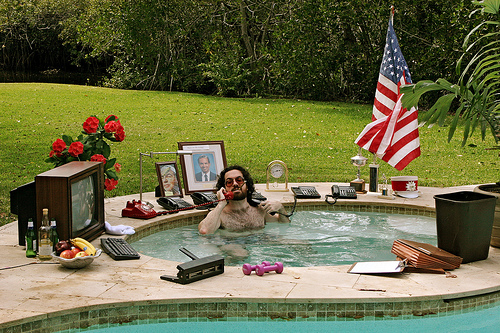
Thanks, Rachel. I think that guy in the picture used to work for me.

–ME “Liz” Strauss
Work with Liz on your business!!

Buy the Insider’s Guide to Online Conversation.

Filed Under: Business Life, Successful Blog Tagged With: balance, bc, LinkedIn, working from home

Beach Notes: The Gathering

September 18, 2011 by Guest Author

by Guest Writers Suzie Cheel and Des Walsh

It is Swell Sculpture Festival time at Currumbin and as we drove down the street this sculpture stood out for me. When we viewed it close up we found it was the piece that had been acquired by the Gold Coast Council and will have a home somewhere on the coast in some public place.

I liked the name The Gathering and that the artist Col Henry started that he was exploring the ideal of community and it’s importance to a sense of well-being and connection. That’s one of the benefits we get on a daily basis from our participation in Social Media.
.

Suzie Cheel & Des Walsh

Filed Under: Motivation, Successful Blog Tagged With: bc, Beach Notes, Des Walsh, Susie Cheel

Let Your Human Out: Build Connections With Your Small Business Marketing

September 16, 2011 by Guest Author

A Guest Post by
Stacey Acevero

Online marketing is really based on relationships, but living in a virtual world
where people can talk to one another, buy from one another and follow one another
without ever having to make a face-to-face connection can de-humanize the
marketing process.

If your marketing efforts aren’t generating the results you hoped for, try these 3
ways you can come out from behind your corporate cage and strengthen the bond
between you and your consumers.

1. Introduce the faces behind your brand.

Imbed video of conversational interviews with your management and staff
in online press releases, on your website and on your social channels. You
can also provide photos and profiles of the employees who will be the official
tweeters and bloggers for your company.

A study by The Next Web found that Facebook updates with photos receive
300 percent more engagement. Capture that increased engagement by
having your employees post on your Facebook page, tweet, like, comment

and communicate through LinkedIn using their corporate photos and
profiles.

2. Highlight corporate events on your Facebook page

Give followers an opportunity to see the best in your employees by uploading
videos of corporate philanthropic events. For example, members of your
staff might volunteer at a 5K run for the American Heart Association. Have
them all wear company shirts and showcase their presence at the event.

You can also invite employees to submit videos of their personal
philanthropic projects. Establish a monthly employee volunteer spotlight
column to introduce people in your company who are making a difference in
their community.

3. Respond to ALL comments

Businesses big and small are learning that the effect of a negative comment
can be hugely destructive. In fact, a recent study by InsideView found a
negative review on YouTube, Facebook or Twitter can cost a company 30
customers.

So it makes sense that companies respond quickly to negative comments.
This is where a human touch can ease ruffled feathers. Your reaction should
be personal and compassionate. Sometimes providing a sense of humor
can diffuse situations as well – invest time and training for the person who
will be the face of your brand in the midst of criticism on your social media
platforms.

However, it’s almost worse to receive a positive comment via your social
media channels and not respond. If someone has gone to the trouble to
say something good about your brand, thank them and then engage them
further. They may be open to letting you retweet, share and incorporate
their feedback into your press releases, website or email marketing.

Businesses and buyers are two intelligent species that can live in harmony together.
It takes a commitment to creating relationships and a willingness to continue
conversations.

Add a human touch to your online marketing strategies and your business will move up the evolutionary chain.

—-
Author’s Bio: Stacey Acevero is Social Media Manager for Vocus/PRWeb. Public Relations, SEO, marketing, small business and social media nerd. U.S. Air Force auxiliary 2nd Lieutenant and Mission Scanner. Organizer and sponsor of charity events. You can find Stacey on Twitter as @sacevero

–ME “Liz” Strauss
Work with Liz on your business!!

Buy the Insider’s Guide to Online Conversation.

Filed Under: Business Life, Marketing /Sales / Social Media, Successful Blog Tagged With: bc, LinkedIn, Marketing /Sales / Social Media, small business, Stacey Acevero

  • « Previous Page
  • 1
  • …
  • 46
  • 47
  • 48
  • 49
  • 50
  • …
  • 109
  • Next Page »

Recently Updated Posts

Is Your Brand Fan Friendly?

How to Improve Your Freelancing Productivity

How to Leverage Live Streaming for Content Marketing

10 Key Customer Experience Design Factors to Consider

How to Use a Lead Generation Item on Facebook

How to Become a Better Storyteller


From Liz Strauss & GeniusShared Press

  • What IS an SOB?!
  • SOB A-Z Directory
  • Letting Liz Be

© 2025 ME Strauss & GeniusShared