Successful Blog

  • Home
  • Community
  • About
  • Author Guidelines
  • Liz’s Book
  • Stay Tuned

How Technology is Powering Success

July 4, 2014 by Rosemary

By Teddy Hunt

The year was 1994. Katie Couric, Bryant Gumbel, and their guest sat around a quaint coffee table between NBC’s “Today” segments and pondered the pronunciation of the “@” symbol. “That little mark,” he said. “With the ‘a’ and then the ring around it. Couric said she thought it was ‘about.'” He went on to ask, “What is the Internet, anyway? Do you write to it, like mail?”

Just two decades ago, this was the reality, even among some of the most successful, high-profile people in our society. Now, the Internet and other forms of technology have become ingrained in our culture, and for good reason. Businesses and the people who run them depend on technology for success in many ways. 

technology to print on potato chip

Improving Efficiency

In today’s economy, a business has to squeeze out every ounce of productivity to remain competitive and successful, and technology provides us with many avenues to accomplish just that.

Efficiency serves as technology’s over-arching theme; it encompasses everything we’ve come to love and expect of the wonderful little gadgets we depend on. We can retrieve and share data in an instant, swipe a magical piece of plastic in exchange for goods and services, and tasks that we once performed by hand are now being streamlined by technology, void of human error.

Expanding Knowledge

Have you ever stopped to consider the sheer volume of information available to you on the Internet? Why not use that to your advantage? Except for encyclopedia salesmen, just about every other business person is reaping the benefits of unlimited amounts of knowledge with just the click of a button.

Internet searching brings you everything from interview dos and don’ts, to market trends, to tips on how to start your first business, all without ever having to leave your home. Even if you do leave your home, that same information is available to you on a smartphone or tablet. Technology is constantly reshaping the nature of knowledge, giving us the potential to be smarter and more efficient than ever before.

Instantaneous Communication

We’ve come a long way since the first mobile phone call in 1973. Communication on the go has become a necessity in the business world. Email and smartphones have changed the way we communicate with our peers and our customers by providing us with a variety of instantaneous connections. We can run our offices from the road if we have to, or instantly respond to customer inquiries after hours. No matter how personal you believe old-fashioned snail mail to be, the reality is that technology has taken over communication. Putting pen to paper puts you a step behind the competition. 

Promoting Open Mindedness 

As technology evolves, a successful person must learn to adapt. New developments keep us on our toes because we understand the importance of being up to speed when it comes to new technologies that could better our businesses.
This translates very well to being adaptive in general. All too often, we dig our heels in and resist change because our way of doing things works. Eventually, we must accept that it’s possible for something else to come along that works better. As technology grows, we should be willing to follow suit. 

Shrinking the World

Consider this scenario: A journalist on location in an unknown Middle Eastern village witnesses the beginnings of what could turn out to be a breaking news story. She pulls out her trusty 4G smartphone, snaps a few high resolution photos, and uses the phone to type a brief news blurb about what just took place. She can instantly upload all of that information to her news site. 

Technology eliminates boundaries. We can use it to manipulate the business world and in our professions in ways we couldn’t before. It brings everything to our fingertips so that we may, in turn, deliver it to someone else. 
Technology continues to redefine our culture as it grows. We should all be willing to use it to learn and become better at what we do because, without it, we would truly be in the dark.

Author’s Bio: Teddy Hunt is a freelance content writer with a focus on technology. When not behind a computer, Teddy spends the majority of his free time outdoors and resides in Tampa, Florida.

Photo Credit: JD Hancock via Compfight cc
Filed Under: Successful Blog, Tech/Stats, Trends Tagged With: bc, future, Productivity, technology

Book Review: Executive Presence by Sylvia Ann Hewlett

July 3, 2014 by Rosemary

When I first entered the workforce, my version of executive presence was a navy blue skirt suit. I struggled to be taken seriously as a writer in an office full of engineers. (That was also at a time when IBM required female employees to wear pantyhose.)

It took me years to realize that the suit alone wasn’t going to do it.

In our casual, work-from-the-couch, wear-pajamas business environment, it’s more important than ever to work on the elusive quality of executive presence.

Skills like gravitas, clear communication, a polished appearance, and authenticity are increasingly rare, but are required for building a successful business. Our own Molly Cantrell-Craig wrote earlier this year about Indiana Jones and his leadership style (you don’t need to carry a bullwhip).

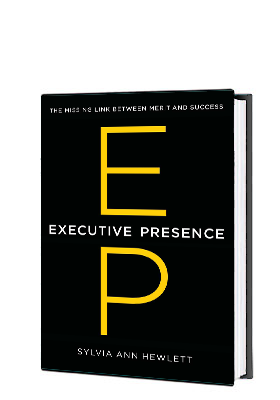
Executive Presence book

In Executive Presence, author Sylvia Ann Hewlett dares to puncture the balloon of puffed up “personal branding” that is often a lazy way to fake presence. She knows what she’s talking about. She is an internationally recognized expert on workplace power and influence who began her career as an insecure, sheltered Welsh girl breaking into the elite echelons at Cambridge University.

There’s a Grand Canyon-like chasm between choosing a color scheme for your wardrobe and having the cojones to tell your boss that she has just suggested something unethical.

The book is full of true stories and practical advice from men and women who have forged a path of leadership as business owners and as management.

How to Increase Your Executive Presence (A Sampling)

  • Tackle the hard things yourself. Don’t hide in your office and expect colleagues to take care of the tough tasks.
  • Become known as the calm in the eye of the storm. When everyone else is panicking, be the person who holds it together and makes decisions.
  • Surround yourself with people who are better than you are. Have the guts to admit what you’re not good at, and hire people who are strong in your areas of weakness.
  • Overprepare for everything. Be ready to contribute and speak up.
  • Get rid of communication crutches, both verbal tics (like saying um or uh) and physical crutches like avoiding eye contact.
  • When it comes to your appearance, focus on being appropriate to the situation/audience.
  • Your work attire should be your armor, making you feel invincible, not insecure. If you don’t feel right, that’s a signal from your inner voice.
  • If you need help in developing presence, consider connecting with a mentor or sponsor, someone you admire who already has presence.

Executive Presence is a handy little book for anyone who is new to the workforce, re-entering the workforce, or who wants to build a personal brand that makes an impact. It would be an outstanding graduation gift.

Do you feel that people respond to you as a leader when you’re making new connections?

Author’s Bio: Rosemary O’Neill is an insightful spirit who works for social strata — a top ten company to work for on the Internet . Check out the Social Strata blog. You can find Rosemary on Google+ and on Twitter as @rhogroupee

Filed Under: Business Book, Leadership, Personal Branding, Successful Blog Tagged With: bc, book review, leadership, presence

Do You Do Contract Work? Pay Attention To This Painful Lesson Learned

July 1, 2014 by Rosemary

By Lisa Jenkins

What This Is and Isn’t

It’s not a mea culpa.

It’s an object lesson I’m sharing so you don’t ever have to learn it for yourself.

here comes the rain again

The Backstory

Now, I either charge full fees for what I do or charge nothing for what I do – either way, the client gets my best effort.

Since becoming self-employed and contracting my services, I’ve had to rearrange how I give back to the global community. I don’t have the kind of time I had in the past.

Where I used to do things like work with a food bank to collect donations of canned goods that I built into a giant salmon sculpture in the mall in order to spur more donations, I now donate my service to organizations that match who I am as a person.

There’s no cookie cutter – if it’s a fit for me, I’m happy to help.

So last week, when a valued colleague shot me a message asking if I knew anyone who would be interested in a short term project that involved hashtag tracking for a non-profit, I offered to donate my services.

It was simple. Track and analyze a two-week history for a single hashtag across three social media platforms. A walk in the park, right? I told the client I’d be in touch on Tuesday.

It became apparent that the tools I use weren’t equal to managing what turned out to be a massive amount of historical data. Massive. I hit the thresholds of data collection before the first day was out. I requested upgrade quotes.

I should’ve let the client know but ever the optimist, I trusted that quotes from my vendors would arrive. Until today. I’ve still heard nothing and time is up. I can’t deliver what I promised.

If I hadn’t counted on vendors to respond and deliver, I would’ve contacted the client and had them make arrangements with someone else. I need those upgrades to do the job I took on.

If the client hadn’t counted on me to deliver, they wouldn’t have publicized the anticipated release of the data. They need that data to close their campaign.

I am professionally mortified. I’ve owned up but that doesn’t fix anything; apologizing never mended a broken plate. The client is left in the lurch. And it’s my fault.

The Lesson

Never count on having something you need from a third party until you have what you need in hand.

As I type, it seems like I should’ve known this before now. Maybe I’m naive or maybe I’ve just been lucky up to now. The point is, I don’t want you to have to learn this lesson for yourself. So I’ve shared it.

In the interest of making life easier for fellow colleagues and their clients, feel free to share your own hard-learned lesson in comments.

Author’s Bio: Lisa D. Jenkins is a Public Relations professional specializing in Social and Digital Communications for businesses. She has over a decade of experience and work most often with destination organizations or businesses in the travel and tourism industry in the Pacific Northwest. Connect with her on Google+

Image courtesy of Wikimedia Commons

Filed Under: Personal Development, Successful Blog Tagged With: bc, consulting, lessons-learned

How To Finish What You Start

June 27, 2014 by Rosemary

By Gary Dek

How many times have you started writing a story or article only to stop halfway through and not finish it? If your answer is at least one, then you are like a lot of writers out there who spend their time beginning a piece of work, only to lose motivation and not finish what was started. I know I have at least a dozen half-written posts saved in the “Draft” folder of WordPress.

Creative inspiration is not the problem; staying productive and finishing what you start is. Fortunately, that can be fixed with a few strategies and conscious steps. The following steps will give you some tools to help you learn how to accomplish the task and make a habit of finishing projects before moving on to new ones.

finishing

Resist Embarking On New Endeavors

One reason why writers never finish anything is because they are constantly starting new projects before they have completed the previous ones. I like to call this “Work ADD” because I enjoy the adventure and challenge of working on new projects.

A couple years ago, I would start a new website every couple of months. I would literally design and develop a website then write and edit unique content over the course of one weekend. While you may think I “finished” the project, the most crucial part of starting any blog/site is promotion. I just didn’t do any of that, and that rendered my efforts a waste of time.

Restrain yourself from this compulsion and stay focused. When you come up with a fresh idea, jot down a few notes for reference and come back to it when you are ready to fully explore the opportunity. A few bullet points should help to jog your memory when the time comes.

Take Stock of Your Current Projects

It is time to review what on-going projects you have and determine if any of them are actually worth finishing. Maybe that editorial you started a year ago isn’t relevant anymore. Make a list of the ones you really want to keep, prioritize them in order of importance and work on them one at a time, checking off each as you go.

Don’t worry about how long it takes; after all, you’ve already invested the time to start and that’s a sunk cost. You might as well finish the project and recoup a portion of your invested time, assuming there is still value in its completion.

No matter how important that memoir seemed ten years ago, it might not have the same importance today. It may be time to let it go.

How To Assess Incomplete Projects

Divide your projects into three folders:

  • Projects that evoke enthusiasm and fit with your current goals.
  • Projects that you need to move on from, even if you are unsure.
  • Projects that you are not actively inspired to finish now, but that you might want to revisit another time.

This doesn’t mean pile everything into categories 1 and 3. Be objective and honest with yourself. It will definitely help unclutter your mind, goals, and work area.

Pick A Project and Stick With It

Take a look at the folder containing the projects you are excited about right now. Pick one of them and do not look at another until it is done. Whether it’s a blog, freelance gig, eBook, or another obligation, this project is going to be your primary focus.

So, how do you choose which item on your to-do list deserves all your energy?

Do you start with the:

  • simplest project: If you have a short story you are working on, you might want to finish it before you work on that novel.
  • longest-running project: If you’ve been working on a blog for 5 years and it has the most loyal following, do you keep up the momentum?
  • project you’re most invested in: If you are already a professional writer and the work you have left unfinished is guaranteed to bring in some much needed cash, it provides a better return on investment to satisfy your existing client obligations.

Have A Clear Vision of What The Finished Product Should Look Like

This may seem like a no-brainer, but you would be surprised how many writers or online entrepreneurs dive into a project without any idea of where they are going with it. We are all guilty of this kind of “we’ll see what happens” kind of thinking, but ultimately, without a destination, your journey will take you nowhere.

Instead, make a list of what you think constitutes a finished product. For example, if you are writing a blog post, there are specific points you need to hit before you can say it is complete. This might mean:

  • your article has a start, middle and end.
  • your article is at least 1,000 words and proofread.
  • you’ve gotten feedback from your editor, revised the post, and it is now ready for publication.

In your personal or professional life, pinpointing clear goals can ensure every little step you take brings you closer to achieving them.

Set Your Goals

You know how some people keep a “bucket list” of things they would like to do before they die? Well, you should keep a similar kind of list that consists of your business goals. For example, starting a blog could be one small goal because it’s easy – it can be achieved in an afternoon. The real goal should be to attract 10,000 visitors a month to that blog within the first year.

However, don’t set yourself up for defeat by outlining impossible goals. Deciding that you want to sell your first blog for a million dollars after a year is not realistic, especially if you are a new blogger.

Create a list of milestones with deadlines to keep yourself accountable, such as:

  • writing a page a day for a month
  • completing a detailed outline for your short story
  • writing a short screenplay
  • getting 10 posts completed before launching your blog

Pick 5 to 10 goals and put them on your calendar. Keep the list somewhere you will see it daily for inspiration.

Stay Motivated

Regardless of whether you use a free blogging site to write for therapeutic reasons, with the hopes of becoming a published author, or simply because freelance writing pays the bills and offers the flexibility to be with your kids during the day, you need to learn how to keep the momentum going and stay motivated long enough to actually bring your great ideas to fruition. Hopefully these steps will help you learn how to finish what you start.

What’s your top priority right now?

Author’s Bio: Author Bio: Gary Dek is the blogger behind StartABlog123.com and Gajizmo.com. He offers small businesses and entrepreneurs SEO advice ranging from keyword density research to recovering from Panda/Penguin updates to promoting their blogs and growing traffic.

Photo Credit: JefferyTurner via Compfight cc

Filed Under: Productivity, Successful Blog, Writing Tagged With: bc, goals, Productivity, Writing

How to Release Your Inner Bruce Lee

June 26, 2014 by Rosemary

By Guest Columnist Martin Stellar

The young monk was sweating profusely. He was hurting and out of breath. He was spent.
In front of him stood a barrel full of kidney beans.

Beyond that was the cliff, and in the distance the rice paddies.
His master sat a little ways away to his side, meditating in the shade of a bamboo cove.

He could hear the shouts of “Katsu!” drift up across the rice fields. And the cracking sounds too, each time one of the older and more advanced monks broke bamboo in two with their fists or their shins.

He looked at the beans and he loathed them.

rice paddy

For the last three hours, he’d been jabbing his outstretched hands into them, as hard and as fast as he could.

A bucket full, 50 liters of dry kidney beans.

In. Out. Down. Up. Left. Right. Left. Right.

At first it’s not so bad: The beans are smooth and slide to make space.

But after ten minutes it starts to hurt.

After 30 minutes, you want to stop.
After 45 minutes, you want to cry.

After an hour, your hand feels like a building fell on it, and everything from your fingertips to your neck feels like Dr. Frankenstein just stitched it together last night.

He looked at the beans, then at the fields. He looked at his master, placidly meditating, his eyes closed.

He hurt. He wanted to cry, to topple the barrel and throw it off the cliff. In fact, he wanted to go home, or jump off the cliff, or perhaps throw his master off instead. He wanted to quit, any which way he could.

“Katsu!” it sounded across the valley. “Crack!”

He looked at the beans again, and breathed slow deep breaths. He still hurt, but not as much, not if he concentrated on his breath.

He raised his hand, paused, and jammed his fingers into the beans again. Left. Right. Left. Right.

His master opened an eye, and quietly smiled to himself.
This kiddo was going to turn out very strong indeed.

I always wondered how people manage to get so strong that they can break stone or wood with their hands. You see the videos of Shao-lin monks, and you wonder if that stuff is real.

Kick a thin tree in two with your shin? How…

Turns out, each time they ram their hand into the beans, or practice-kick against a sapling, they create micro-fractures, hairline splits, in the bone.

When that heals, just like any scar tissue, the new bone material is stronger than the actual bone.

Do that for a decade, and your bones do indeed become as hard as rock. It’s simple biology.

Now, I don’t expect you’re on the path to becoming a Kung-fu master.

But if you’re in business in any way – if you’re in life, actually – you are only ever going to get results, of any kind, if you can muster the guts just like the monk in my story did.

Saying ‘a quitter never wins’ is a nice quip, but it’s not very useful.

It’s not about quitting – you can’t quit. There’s no quitting life.

You can quit one activity, get rid of one burden, or avoid one challenge – but the moment you turn your back, life will present you with exactly the same challenge you avoided, just in a different way.

Life’s a bitch in that sense. Or, you could say life is a blessing, in that it never fails to show you what you need to learn or overcome next.

“Does this hurt, is it difficult, does it make you want to scream? Ah… That means, my friend, that you can push through, find the key, and make that difficult thing a stepping stone, something you can use to grow and get stronger.”

And then life simply asks you to choose: Slam the beans again – or walk away?

I’ve never trained for Kung-fu. My bones aren’t rock-hard. My best punch involves fruit, wine and liquor.

But I’ve had my own path, training, setbacks and hard knocks.

And over the years, I’ve learned that ‘giving up’ isn’t an issue.

It’s not about quitting or giving up: it’s to do with the battles you choose.

And sometimes, it’s good practice to step back – not to quit, but to say “I’m not fighting this battle today – I’m going to train first and get stronger first. THEN I’ll show you”.

Just like that little monk, who realised that the real battle wasn’t against the beans, but against his own mind.

You have more strength in you than you can possibly imagine.

The only reason you’re not living your strength fully, bringing it all out onto the playing field, is that it takes time and persistence to get strong.

Breathe. Relax. Life is very, VERY playful – naughty and a bit mean too, sometimes. But life is always there to help you, to show you ways to grow and get stronger.

Life and the world aren’t out to hurt you – it’s only there to teach you.

Punch the beans.
If it starts to hurt too much: put ice on it.

There’s no shame in losing a battle so you can regroup and recover your strength.

The beans will be there waiting for you tomorrow.

If you keep it up long enough, you’ll be stronger than beans, bamboo, wood, stone.

If you allow life to teach you, you’ll become stronger than life.

Now if you’ll excuse me, I’ve got some of my own bean-punching to do.

Author’s Bio: Martin Stellar is an email marketing specialist with a knack for building relationships. Former monk, former copywriter, once-upon-a-tailor; these days he’s on a mission to inspire and motivate. Each day he writes articles like these and sends them to his private list – and if you’d also like to receive them, please register at http://martinstellar.com.

Photo Credit: ♥siebe © via Compfight cc

Filed Under: Leadership, Motivation, Successful Blog Tagged With: bc, inspiration, Motivation

5 Resources To Help You Pitch Like a Pro

June 24, 2014 by Rosemary

On the AMC series The Pitch (watched by advertising nerds like me), the pitching team strides into the conference room with a steely confidence that’s equal parts John Wayne and Kanye West. They are super prepared, they’ve done their research, and they have shiny boards prepared by the design team.

Most of the time, you will not have any of these items when you get the chance to pitch. When you’re starting your own business, you need to take advantage of inexpensive tools that will help you “spread your ideas,” in the words of Nancy Duarte.

Pitch with Purpose and Structure

#1 Nancy Duarte’s TEDxEast talk about structure

This little 16 minute video will change the way you think, every time you talk. Although on the surface, it seems to be about making speeches, it’s really about storytelling. A pitch is a story.

#2 Duct Tape Selling by John Jantsch

You can’t tell a story without another person listening. There’s no pitch without a “pitchee.” And John Jantsch is someone who truly understands that successful marketing and sales is all about relationships. Read this excellent book, and arm yourself with the power of becoming a perceptive listener. Sounds counterintuitive, but it’s not. A crucial aspect of the successful pitch is the ability to listen first.

Pitch from Anywhere

#3 Join.me

Join.me has a free and premium service that allows you to easily share your screen (with audio) with anyone, anywhere. Share your personal URL or a special code, and the other person simply has to click the link. Audio can be done via Internet or via a call-in number (and they do have International numbers available). It’s well worth paying for the premium service, as you can then record sessions, make notes directly on the screen, and change presenters on the fly.

#4 Pinstriped

Have you ever been in the middle of a pitch or presentation when your IM pops up with a random message from your colleague? Or you need to browse past your Grumpy Cat photo collection to get to that image you need to pull in, in front of your prospect? Pinstripe is the elegant little solution to this problem. After you install it, you can present a clean, controlled desktop behind your deck or screenshare. You can even put up a logo/branded image instead of the clutter you usually have on your desktop. Pinstriped is in free beta right now.

Know Who You’re Pitching To

#5 Nimble

I’ve spent a lot of time researching CRM platforms, and Nimble has consistently impressed me. Its “secret sauce” is the 360 degree view of each contact’s social streams, pulled into one interface. If you’re about to meet with someone, you can easily pull up their profile and see what they’ve published recently. If you integrate your email account, you can also have a consolidated viewpoint of all past communications with that person. There is a free personal option, as well as premium business accounts, well worth the investment.

Pitching is an art form that requires practice and discipline. Surround yourself with tools and resources that will help you become a pro and close the deal.

What’s your favorite resource for pitching clients?

Author’s Bio: Rosemary O’Neill is an insightful spirit who works for social strata — a top ten company to work for on the Internet . Check out the Social Strata blog. You can find Rosemary on Google+ and on Twitter as @rhogroupee

Filed Under: Marketing /Sales / Social Media, Successful Blog Tagged With: bc, pitching, Selling, tools

  • « Previous Page
  • 1
  • …
  • 30
  • 31
  • 32
  • 33
  • 34
  • …
  • 84
  • Next Page »

Recently Updated Posts

Is Your Brand Fan Friendly?

How to Improve Your Freelancing Productivity

How to Leverage Live Streaming for Content Marketing

10 Key Customer Experience Design Factors to Consider

How to Use a Lead Generation Item on Facebook

How to Become a Better Storyteller


From Liz Strauss & GeniusShared Press

  • What IS an SOB?!
  • SOB A-Z Directory
  • Letting Liz Be

© 2025 ME Strauss & GeniusShared