Successful Blog

  • Home
  • Community
  • About
  • Author Guidelines
  • Liz’s Book
  • Stay Tuned

Book review: Joy, Inc., by Richard Sheridan

January 29, 2015 by Rosemary

Corporate joy? Is that an oxymoron?

It doesn’t have to be, according to Richard Sheridan. His company, Menlo Innovations, is devoted to “ending human suffering in the world as it relates to technology™.”

Sheridan’s book, Joy, Inc., (which was originally released in 2013), is a fascinating look inside his team’s “joy factory.”
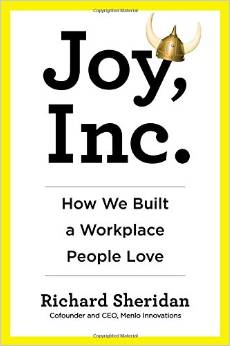
book cover Joy, Inc. by Richard Sheridan

The casual reader might be tempted to approach this book with some healthy skepticism. The title conjures up a mental image conjured of a bunch of forced-wacky Kool-Aid drinkers.

In reality, the book provides a detailed explanation of systems, methods, and daily processes that are intended to result in joy. Joy for the employees, for the clients, and for the lucky end-users of the software being created.

Learning and teaching are at the core of the Menlo system, where colleagues work in pairs and progress is quite visibly measured on the walls. Humans need to feel that they are making progress in order to be happy, and that need is systematized at Menlo.

Here are just some of the ways Sheridan and his crew build joy:

  • Avoid having “knowledge towers,” employees who are the sole repositories of certain information.
  • Eliminate bureaucracy, and unnecessary meetings wherever possible. Consider having a daily standup where only those with useful information to share speak.
  • Use what Sheridan calls “High-Speed Voice Technology.” Talk to each other, openly and frequently. Stop texting and emailing people who are in the same building. Build relationships, which build value.
  • One of the key elements of a joyful culture is having team members who trust one another enough to argue. Stop hiring people who all agree with each other.
  • Consider reverse show and tell. Rather than presenting your client with a progress report, ask the client to tell the team what is going on with the project.
  • Use physical artifacts for planning and task execution, so that everyone can immediately see progress and status.
  • Hire for joy and build that into the entire process. Look at the human, not the resume.
  • Whatever you’re making, build in the delight/joy for the end-user as well. Find a way to build links between your staff and whomever will be using the work product. Menlo has a special position called “high tech anthropologist,” which is the link between programmers and end-users.
  • Create an atmosphere free of fear. You can fail, you can experiment. Don’t get stuck on something just because you’ve already invested a lot of time in it.
  • Break important HR rules, etc., like having babies or dogs in the office, as long as it’s part of your authentic culture.
  • Share leadership, and be vulnerable. Share your vision and encourage new leaders.
  • Strive for clarity and discipline.
  • Incorporate flexibility as part of the culture, as much as possible. This makes it easier to start new initiatives.
  • Accountability is important, but only when everyone is accountable, top to bottom.
  • Employees need the “ability to go to work and get meaningful things done.” Values must be pervasive and visible in every aspect of the business, from the work space to contracts, to partner agreements.

Menlo is serious about transparency. The conclusion of the book punctures the idea that it is utopia. There are problems, as there always will be when humans are involved. The key difference is that here, problems are openly acknowledged and tackled as a team, not behind closed doors.

I’d strongly recommend this book to anyone who is considering building a business, and especially those who are already running a business. There are ideas galore, and even if you aren’t producing software, Sheridan challenges you to find the joy in your daily business.

Do you look at joy as a business value?

Disclosure: I was provided a digital review copy of this book. My opinion is from the heart.

Author’s Bio: Rosemary O’Neill is an insightful spirit who works for Social Strata — makers of the Hoop.la community platform. Check out the Social Strata blog. You can find Rosemary on Google+ and on Twitter as @rhogroupee

Filed Under: Business Book Tagged With: bc, book review, project management

Credit Reports Matter for Businesses and Consumers

January 28, 2015 by Thomas

credit-history-represents-debit-card-and-bankcard-100297005Whether you run a business or are just your everyday consumer, you more than likely know how important your credit history is, especially when it comes to meeting your financial needs.

For the small business owner, one’s credit score is very important in order to solidify yourself as being financially sound, most notably in the event you need to acquire a small business loan.

For the typical consumer, a solid credit score rings important when trying to get a new or used car loan, a loan to buy a home and much more.

With that in mind, do you truly know whether your credit report is thumbs up or thumbs down?

Obtaining a Loan or Credit Card

Typically the top reason you want a positive credit score is when it comes time to try and obtain a loan. The same holds true in looking for your first or an additional credit card.

Whether you get your information from CreditSesame.com or another such provider, your score will go a long ways in determining whether you get the funds you seek.

For starters, do you know where you stand when it comes to your credit score?

While the number range can fluctuate to a degree, the following scores mean:

  • 630 or below (Bad credit) – This range means you likely have missed some credit card payments, you have no credit card history, or you at some point filed for bankruptcy (personal reasons such as high medical bills and/or a small business that has gone under). One of the down sides to numbers in this range is that you will have to deal with larger interest rates and fees moving forward;
  • 630 to 689 (Average credit) – This range puts you in with millions of other Americans. While not the worst, your credit could be better if you did away with a sizable portion of bad debt hanging around. Numbers in this range can make it difficult to get a loan;
  • 690 to 719 (Good credit) – This range allows you to be eligible for a variety of different credit cards, with lenders also viewing you as a good risk in most cases;
  • 720 to 850 (Excellent credit) – This range is as good as it gets for consumers. Many will have the opportunity to receive cards that offer great rewards.

Check Your Report in Detail

When you get a copy of your credit report, make sure you go over it with a fine tooth comb.

Look for any inaccuracies, especially given today’s world of identity theft.

If you find something amiss, reach out immediately to the fraud departments of those you do business with and have your account placed under review, making sure no money can be withdrawn until the matter is cleared up. You should also have a security hold placed on your credit report.

Whether for personal or professional use (running a business etc.), your credit report and your history of handling credit will go a long way in determining your financial future.

Photo credit: Image courtesy of Stuart Miles at FreeDigitalPhotos.net

About the Author: Dave Thomas writes for a variety of websites on topics such as marketing and small business.

Filed Under: Business Life, Personal Development Tagged With: bc, credit cards, credit report, finance, identity theft

Simple Ways to Make Your E-Newsletter More User Friendly

January 27, 2015 by Rosemary

By Shaun Chatman

Your newsletter is an important way to get relevant information across to your customer base, clients, or readers. But all of these people will be viewing it on different devices. Use these tips to simplify your newsletter’s content and formatting, to enhance readability and keep your content user-friendly.

Format in a Single Column

You may be tempted to use fancy design work in your newsletter, but the best way to go is a simple format that puts all your information into a single column. Go for a column 500 to 600 pixels wide, and be sure to take into account special formatting for mobile devices. You won’t be able to keep formatting completely uniform over all devices, but you can take many steps to ensure that it doesn’t fall apart and become unreadable on certain devices. Simplicity is your best friend in these instances. Choose a few design elements (like text formatting and social media linking) that make the content easier to consume and then stick with those and ignore the impulse to go over the top.

Break Content into Headings

Your newsletter probably contains multiple points you want to communicate to your readers. Rather than writing it in the style of a letter with each paragraph flowing into the next, create a new heading every time you come to a new newsletter item. Make that heading obvious and separated from the rest of the content. By doing this, readers who are skimming through on a device with a smaller screen will know where to stop and start reading.

Use Images Sparingly

One or two interesting images will enhance the content of your newsletter, but overloading your newsletter with images is a surefire way to make it more difficult to read on multiple devices. Images, by default, require different formatting than text does, so no matter how careful you are, the more formatting you add to your newsletter, the more likely it is something will go wrong. Also, images take longer to load, especially on hand held devices like phones or tablets that may be connected to a 4G network rather than wi-fi.

Streamline Your Content

While skimming through paragraphs of content may be easy on a laptop screen, if someone is reading from his or her phone, it takes longer to scroll through a lot of text. Even with headings, keep your newsletter’s content relevant and brief. If you’re wondering about types of content apt for your newsletter, go for content that your readers can consume in bite-sized chunks. Tips and tricks for your customers, a short letter from the CEO of your company, or lists of significant blog posts or news articles are great places to start.

Remember, it’s not just about formatting. Good content also keeps your newsletter fresh and interesting for your readers. Each newsletter will look different, but by keeping it simple and following these tips, you’ll be well on your way to creating a newsletter that works on as many devices as possible.

Author’s Bio:Shaun Chatman is a seasoned writer featured on many authority blogs. Writing is his passion, and he spends most of his waking hours writing about everything from Tech to Education. He lives in Dunedin, Fl.

Filed Under: Content Tagged With: bc, Content, formatting, newsletter

Beach Notes: Starting the Day

January 24, 2015 by Guest Author

By Suzie Cheel and Des Walsh

Female lifeguard putting out the flags for the safety swim area at Kirra beach. Most lifeguards are male 🙂

female lifeguards putting out flags

Suzie Cheel & Des Walsh

Filed Under: Motivation Tagged With: bc, Beach Notes, inspiration

A spoonful of sugar for your next blog post

January 22, 2015 by Rosemary

In every job that must be done
There is an element of fun
You find the fun and snap!
The job’s a game

And ev’ry task you undertake
Becomes a piece of cake
A lark! A spree! It’s very clear to see that

A Spoonful of sugar helps the medicine go down
The medicine go down-wown
The medicine go down
Just a spoonful of sugar helps the medicine go down
In a most delightful way ~Walt Disney’s Mary Poppins

I’m not saying that your blog content is medicine, but if it’s useful information for your audience, there’s no harm in adding a bit of sugar to make it go down easily.

Ways to Enhance Your Blog Posts

View more lists from Rosemary O’Neill
Author’s Bio: Rosemary O’Neill is an insightful spirit who works for Social Strata — makers of the Hoop.la community platform. Check out the Social Strata blog. You can find Rosemary on Google+ and on Twitter as @rhogroupee

Filed Under: Content Tagged With: bc, blog content, blogging-tools

Is Starting a Small Business a Health Insurance Headache?

January 21, 2015 by Thomas


multi-ethnic-team-during-meeting-10066408If you’ve been thinking about turning your hobby into a small business or even buying an existing business, you may be hesitant after you start looking into the health insurance aspects of hiring employees.

Thanks to Obamacare, more small businesses are now required to provide health insurance plans.

That’s all well and good for owners who have the resources necessary to fund such plans, but it bodes ominous for startups that are bootstrapping their business.

In fact, the sole requirement for a health plan can deter new businesses from starting up in the first place.

Don’t worry.

Starting a small business doesn’t have to be a health insurance headache.

There are ways around the Obamacare mandate, just as there are ways to comply with the law in ways that won’t negatively impact your business finances.

Here are some effective ways to get your small business up and running – and keep it running – while dealing with health insurance requirements:

How to Get Around the Requirement

If you have zero funds available for a health insurance plan, yet still need employees to operate the day-to-day tasks of your business, hire independent contractors. Independent contractors are in business for themselves.

As such, they are responsible for their own taxes and health insurance.

They work for you on what’s called a “work for hire” basis. You assign them tasks based on their expertise and specialties, and they invoice you for work that is satisfactorily completed.

Independent contractors don’t technically work for you, and are not your employees. Thus, you are not liable to provide health insurance for them.

The management of your independent contractors needs to be systemized so that in itself doesn’t become an organizational headache.

If this is an avenue you’re interested in pursuing, consider hiring a project manager and investing in some kind of online collaborative software to ensure projects get done on time and under budget.

Keep in mind that if you want or expect your business to grow, eventually you’ll need to move to a traditional employee model.

At that time, you will need to implement a health insurance plan for them, and you’ll need to save in order to manage that scenario.

How to Work With the Requirement

The fact is, there are so many complicated requirements within the Obamacare mandate that it can be compared to the complexity of the overall tax law in general.

As the following article shows, a small business owner, will be hard pressed to research and understand the basic key health insurance terms, let alone come up with a health plan by themselves that satisfies the vast legal requirements.

Your best course of action is to outsource your health insurance plan management to a professional company that specializes in working with small businesses like yours.

Otherwise, the vast amount of your time and the time of your admin team will be spent trying to navigate the minefield of employee health insurance.

Whatever you spend on the health plan management company is tax deductible and the return on investment will prove substantial, even in the short term.

As a small business owner, how are you dealing with the new health insurance requirements?

Photo credit: Image courtesy of Ambro at FreeDigitalPhotos.net

About the Author: Kate Supino writes extensively about best business practices.

Filed Under: Business Life Tagged With: bc, employees, health insurance, Obamacare, small business

  • « Previous Page
  • 1
  • …
  • 9
  • 10
  • 11
  • 12
  • 13
  • …
  • 959
  • Next Page »

Recently Updated Posts

Is Your Brand Fan Friendly?

How to Improve Your Freelancing Productivity

How to Leverage Live Streaming for Content Marketing

10 Key Customer Experience Design Factors to Consider

How to Use a Lead Generation Item on Facebook

How to Become a Better Storyteller


From Liz Strauss & GeniusShared Press

  • What IS an SOB?!
  • SOB A-Z Directory
  • Letting Liz Be

© 2025 ME Strauss & GeniusShared