by Guest Writers Suzie Cheel and Des Walsh

Yesterday we were greeted at Rainbow Bay with this colorful assemblage.
Another one for our ephemeral art beach collection.
What have you got to boogie about?
Yesterday we were greeted at Rainbow Bay with this colorful assemblage.
Another one for our ephemeral art beach collection.
What have you got to boogie about?

Let me introduce the bloggers
who have earned this official badge of achievement,


I invite them to take a badge home to display on their blogs.






They take the conversation to their readers,
contribute great ideas, challenge us, make us better, and make our businesses stronger.
I thank all of our SOBs for thinking what we say is worth passing on.
Good conversation shared can only improve the blogging community.
Should anyone question this SOB button’s validity, send him or her to me. Thie award carries a “Liz said so” guarantee, is endorsed by Kings of the Hemispheres, Martin and Michael, and is backed by my brothers, Angelo and Pasquale.

If you’re an SO-Wanna-B, you can see the whole list of SOBs and learn how to be one by visiting the SOB Hall of Fame– A-Z Directory . Click the link or visit the What IS an SOB?! page in the sidebar.
–ME “Liz” Strauss
It’s great when your hometown stand behind you …
The Chicago Social Media Club is doing just that.
I’m thrilled to announce that again this year, Social Media Club Chicago has offered to host an Opening Party for SOBCon2010! Terry and I will be there as will many of the speakers, panelists, and out-of-town attendees. It will be like a super-tweetup with a great conversation and an after party to boot!
Come see the great views! Meet the great people! Get in the spirit of Chicago Social Media!
Here’s a look at the 2009 SOBCon and Social Media Club Chicago event video.
We won’t make any promises – yet – about who might show up. Let’s just say that this might very well be the most connected night of your life.
5:30 – 6:15 Check-in and Networking
6:15 – 7:15 Program
7:15 – 8:00 Socializing Networking
After party – in planning stages
Sign up now so that you don’t miss a minute of meeting anyone who might be there!
Thank you, Barbara, Jeff, Amy and all of SMCC for honoring us again!

When someone calls my company for the first time, thereâs a high probability that what triggered the phone call is a negative consumer-written review or blog posting that shows up first in search engine rankings for their business.
Usually, they want to know how we can make the negative review go away â right now. Itâs a shock when I say that the search engine âbots canât distinguish between a snarky teenager in Des Moines, a competitor in Dallas, and a thoughtful reviewer in Dubuque. The truth is that social media has given a voice to anyone who wants to attack your business, and there are people out there who seem to revel in attacking for any reason â or no reason at all.
Sometimes the negative complaints are valid, and sometimes theyâre not. So if youâre getting bashed in an online forum, the first rule is to respond to the negative consumer-generated review publicly, honestly, and as quickly as possible. Donât even think about creating an alias to respond to a negative online posting. You will get caught, and it will cause more damage to your reputation. Hereâs what I tell anyone who is wondering how to handle a negative online review:
a. Once you know the facts, offer to resolve any issues personally, via email or telephone. (This requires the company owner, or a senior manager.)
b. Continue the discussion offline if possible â then, once it is resolved, go back to the site where the negative review was posted, and post an honest explanation of what was done to rectify the issue.
c. If you canât identify the person, and you are not sure the complaint is valid, post your policy on the subject, and offer to resolve the issue.
Not long ago, after a speech to a business group, a man told me how he had put my advice to work. Itâs a perfect example of what I call the Zen way of handling this kind of issue.
âI wanted to tell you how I resolved a problem I was having with a really bad online review on Yelp about my business. Someone â I never did figure out who â posted a terrible review â and that was the first thing people saw when they did a Google search on our company name.
âSo I got my own Yelp account. I used my own name, and identified myself as the owner of the store. I basically said, âIâm saddened that you had a bad experience in my store. Iâve checked my records, and I canât find a transaction that sounds like this. Please call me at this number, so that I can resolve this issue immediately.â No one called, so a few weeks later I posted a second reply that said, âI havenât heard from you. Please call me. I want the chance to make you a happy customer.â
âI used my real name, our store name, and posted the store phone number. At the same time, when I would talk to a satisfied customer, Iâd say, âIâd appreciate it if youâd consider telling other people that you had a positive experience.â I even put a request for positive Yelp reviews onto the receipts we give to customers. That first terrible review is still out there â but now there are more positive reviews, and the search engines donât pick that bad review up first.â
One question that comes up often from frustrated small business owners is what to do if you find out about a negative comment that has âgone viralâ (when one original negative message has been picked up far and wide, and a small problem has spread all over the Internet). Again, the action you should take depends on whether or not the negatives are true.
Products break. Employees donât follow policy. Bad things happen to good companies â and they survive. The key to recovery is an honest response to the problem that explains what happened, and why it wonât happen again. If the problem isnât simple, or if it wasnât an isolated occurrence, consider hiring a crisis communication expert with specific online experience.
If itâs not true, politely request that the blog, forum, or site owner remove or retract the untrue information — or at least publish your response. Work with a search engine optimization (SEO) consultant to help you move positive information towards the top of search-engine rankings.
In very rare cases, business owners can seek legal help â libel laws do apply to online media. This is a last resort, and should be considered only in a very extreme case. First, itâs difficult and expensive because of the many steps required to identify the individual who posted the negative information.
More importantly, you can be sure that the minute a letter arrives from the lawyer, the news of âthe big bad companyâ coming after âthe poor citizen journalistâ will be spread far and wide, further damaging your reputation. I can think of very few occasions when legal action has helped resolve this kind of problem, but being married to an attorney, I leave this question open, and welcome any feedback from someone who has successfully used legal action in this kind of situation.
Becoming an active part of the conversation that is already taking place among your customers, employees, prospects, and competitors is the best way to prevent negative comments from taking over your online reputation. This is especially critical for professional service businesses, where the companyâs inventory and the companyâs reputation are one and the same.
Take advantage of the free tools available to monitor your companyâs online reputation. Start by signing up for Google and Yahoo email alerts using your company name, product name, and the names of key executives Yahoo Alerts and google alerts. Look at other tools like Ice Rocket, Monitor This, PubSub, and Blog Pulse.
While youâre figuring out where the conversation about your business and your competitors is taking place, establish a policy on how you are going to handle your part of the ongoing conversation. Who will speak for your company? How are you going to encourage satisfied customers and friends to speak positively about you?
Itâs no longer a question of whether or not social media is going to affect your business â it already is. So the only question is when are you going to take charge of your own online reputation?
—–
Shama Kabani is president of The Marketing Zen Group, and author of The Zen of Social Media Marketing, which hits store shelves this week. You’ll find her on Twitter as @Shama
Thanks, Shama! I find that the more we include folks in what we’re doing online from the start, the more we invite them to help us as we build our presence and our sites, the more we find they help us when those negative occasions crop up.
How do you handle negative remarks and comments when you find them online?
–ME “Liz” Strauss
Work with Liz on your business!!


Todd Hoskins chooses and uses tools and products that could belong in a small business toolkit. He’ll be checking out how useful they are to folks who would be their customers in a form that’s consistent and relevant.
Todd Hoskins
Although Twitter has worked hard to improve the user interface at twitter.com, it is worth the time to choose a client for your desktop and mobile use. Like Microsoft Outlook or Thunderbird seeks (and often fails) to improve email productivity, Twitter clients offer more tools and a better user experience.
The most popular desktop clients are TweetDeck, HootSuite, and Seesmic. Some of he most popular mobile clients include Tweetie (iPhone), Echofon (iPhone), Twidroid (Android), and UberTwitter (Blackberry). Increasingly, developers of desktop applications are making mobile apps as well and vice versa.
I currently use none of the above. For my small business purposes, I chose Brizzly for desktop and Twikini for my Windows Mobile device. I would prefer to avoid the topic of Windows Mobile 6 (and my wireless contract), so letâs look at desktop web applications.
Brizzly is a browser-based application, which means there is nothing to install. The app has a clean interface with inline maps, photos, and video. With embedded media, infinite scrolling, and auto refresh, my stream requires very little clicking. Itâs all there when I âdip inâ for a bit.
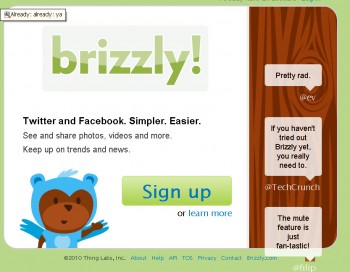
Importantly, applications like Brizzly allow you to handle multiple handles or accounts at once. This is where the difference of needs between applications for the enterprise and smaller businesses becomes most pronounced. An enterprise may need the ability to elevate, forward, share, or archive a tweet or conversation. There are fee-based applications for this. An individual user may be perfectly satisfied with twitter.com. For small businesses there are good free options in between.
I need to be able to find the relevant people and conversations and participate seamlessly without logging out and logging in of accounts. Saved searches, easily accessible bios, and a well-designed user experience are essential to me. Brizzly does this well.
Brizzly could improve with better management of contacts and followers (Seesmicâs latest version is impressive on this front). As customer service becomes more commonplace on Twitter for all sizes of companies, Brizzly may need to conservatively add CRM features. Letâs hope they stick with simplicity.
Summing Up â Is it worth it?
Enterprise Value: 1/5 â try CoTweet, PeopleBrowsr, or HootSuite
Entrepreneur Value: 4/5 â new iPhone application as well
Personal Value: 4/5 â also integrates with Facebook
—-
Thanks, Todd! You can find Todd on Twitter @ToddHoskins
Which clients do you use? What would it take you to try a new one?
–ME “Liz” Strauss
Work with Liz on your business!!
Iâm Teresa Morrow, Founder of Key Business Partners, LLC and I work with authors and writers by managing their online promotion. As part of my job I read a lot of books (and I love to read anyway!). I am here to offer a weekly post about one book author I am working with and one book I have put on my reading list. This week I will be highlighting ‘#DEATHtweet: A well lived life through 140 perspectives on death and its teachings’ by Tim Tosta and ‘Now, Discover Your Strengths by Marcus Buckingham and Donald O. Clifton, PhD. The books will cover topics such as social media (Facebook and Twitter), organization, career building, networking, writing, self development and inspiration.
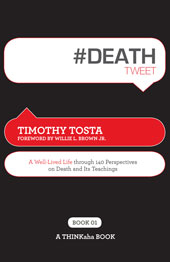
#DEATHtweet is written by Tim Tosta, an environmental lawyer, career coach, cancer survivor and hospice volunteer.
You may be wondering why would I bring up a book about death. Well, Tim sums it up nicely here:
“From my experiences with death, Iâve learned that it is actually possible to develop and maintain a thriving and even aggressive career, while fully experiencing all that life has to offer. #DEATHtweet and my seminars deal with these issues.â Tosta explains.
Here are few of the tweets from #Deathtweet to help understand what the book is about:
~Truly living your life is the best preparation for death.
~Underneath all of its noise and chatter, every life has its meaning. Look for your meaning. It may be great or humble.
~As you explore your life’s meaning an amazing thing happens- your life comes into balance.
~Death teaches you to live in profound change and to accept its inevitability.
~Observe your fear. Make it the subject of your curiosity. The more you inquire into it, the less
power it retains.
About the Author:
Timothy Tosta, a partner at Luce Forward, is recognized as one of Californiaâs leading land use and environmental attorneys. He also is a cancer survivor, a seasoned hospice volunteer, an evocative lecturer and writer. In 2007, Tim enrolled with New Ventures West and was certified as an Integral Coach in 2008. Tim is a graduate of Princeton University (A.B., 1971) and the University of California at Berkeley School of Law (J.D., 1974). Tim welcomes your inquiries about Coaching Counsel and its programs.
You can purchase a copy of #DEATHtweet online at ThinkAha books or Amazon.
This blog post is part of a virtual book tour by Key Business Partners and I have received a complimentary copy of #Deathtweet by the author.
Now I would like to highlight a book on my reading list–Now, Discover your Strengths.
A strength is defined as consistent near perfect performance in an activity.
In this book, it describes three revolutionary tools (to help discover our strengths) as follows:
1) The first revolutionary tool is understanding how to distinguish your natural talents from things you can learn.
2) The secondary revolutionary tool is a system to identify your dominant talents.
3) The third revolutionary tool is a common language to describe your talents.
I am ready to read more because this books does bring up some interesting points. What are those things you can learn to be good at over time and what are those traits (or strengths) you already have within you.
About the Author:
In a world where efficiency and competency rule the workplace, where do personal strengths fit in?
It’s a complex question, one that intrigued Cambridge-educated Marcus Buckingham so greatly, he set out to answer it by challenging years of social theory and utilizing his nearly two decades of research experience as a Sr. Researcher at The Gallup Organization to break through the preconceptions about achievement and get to the core of what drives success.
The result of his persistence, and arguably the definitive answer to the strengths question, can be found in Buckingham’s trio of best-selling books, First, Break All the Rules (coauthored with Curt Coffman, Simon & Schuster, 1999); Now, Discover Your Strengths (coauthored with Donald O. Clifton, The Free Press, 2001); and The One Thing You Need to Know (The Free Press, 2005), in which the author gives important insights to maximizing strengths, understanding the crucial differences between leadership and management, and fulfilling the quest for long-lasting personal success.
What would happen if men and women spent more than 75% of each day on the job using their strongest skills and engaged in their favorite tasks, basically doing exactly what they wanted to do?
According to Marcus Buckingham (who spent years interviewing thousands of employees at every career stage and who is widely considered one of the world’s leading authorities on employee productivity and the practices of leading and managing), companies that focus on cultivating employees’ strengths rather than simply improving their weaknesses stand to dramatically increase efficiency while allowing for maximum personal growth and success.
If such a theory sounds revolutionary, that’s because it is. Marcus Buckingham calls it the “strengths revolution.”
As he addresses more than 250,000 audiences around the globe each year, Buckingham touts this strengths revolution as the key to finding the most effective route to personal success — and the missing link to the efficiency, competency, and success for which many companies constantly strive.
To kick-start the strengths revolution, Buckingham and Gallup developed the StrengthsFinder exam, which identifies signature themes that help employees quantify their personal strengths in the workplace and at home. Since the StrengthsFinder debuted in 2001, more than 1 million people have discovered their strengths with this useful and important tool.
In his role as author, independent consultant and speaker, Marcus Buckingham has been the subject of in-depth profiles in The New York Times, Fortune, Fast Company, Harvard Business Review, USA Today and is routinely lauded by such corporations as Toyota, Coca-Cola, Master Foods, Wells Fargo, and Disney as an invaluable resource in informing, challenging, mentoring and inspiring people to find their strengths and obtain and sustain long-lasting personal success.
Marcus Buckingham holds a master’s degree in social and political science from Cambridge University and is a member of the Secretary of State’s Advisory Committee on Leadership and Management. He lives with his wife and two children in Los Angeles, CA.
*courtesy of Amazon.com
You can purchase a copy of Now, Discover your Strengths on Amazon.
Both of these books talk about life and living it with passion, dedication and using your time living your best life. I hope you enjoy and please let me know what you think about these books. I welcome your comments.