Successful Blog

  • Home
  • Community
  • About
  • Author Guidelines
  • Liz’s Book
  • Stay Tuned

3 Ways Leaders Demonstrate Commitment and Intentionally Build Community

September 28, 2010 by Liz

10-POINT PLAN: Negotiate a Commitment from Leadership

Inside the Business, Leaders Are the First Brand Ambassadors

You can’t move on the social web without hearing about building communities. Social media jobs are still filled with positions for community managers. It’s true that now, more than ever, having a loyal base of brand ambassadors is a key to visibility, trust, attention, reputation, position in the marketplace — all of which are critical to a solid, growing company.

The conversation and the new positions hardly mean anything if the people talking and hiring don’t deeply understand and invest in the people who are building, being, and branding that community.

It’s about people, people. Instead of thinking about the corporation as an amorphous entity, executives need to remember the individuals at the heart of every organization. Ok, so it’s not exactly an earth-shattering insight, but it’s a sign of how far we’ve drifted that people’s health, hopes, insights, and talents have come to be seen as mere grist for the grinding wheels of capitalism. –Helen Walters, It’s about People, People, Bloomsberg Business Week

On his blog, Doc Searls said this about how business is doing. It was part of an interview with Shel Israel.

In the original website version of Cluetrain, Chris Locke wrote, “we are not seats or eyeballs or end users or consumers and our reach exceeds your grasp. deal with it.”

Recognizing a situation and dealing with it, however are two different things. The “dealing” has barely begun.

Maybe there’s a reason that the best known experts at community building seem to come from solo practices and smaller firms where those self-same experts have been both the leadership and the hands-on people doing the community building.

Because the first and possibly most critical step “dealing with it” — establishing community over transaction” is to negotiate a commitment from leadership.

3 Ways Leaders Demonstrate Commitment and Intentionally Build Community

A conversation from a time in my publishing career.

Editor: “Do you ever want to be president of the company.”
ME: “No.”
Editor: “Why not?”
ME: “Because I don’t want everyone to be discussing what mood I’m in every morning.”

Whether it’s a dynasty, a corporation, a project team, or a two-person operation, the person who controls the finances and the paychecks gets a lot of attention and approval controls. With that power of position comes the responsibility to the health and vibrancy of the organization. That responsibility cannot be delegated, because everyone looks to that position to see which behaviors are modeled, supported, and rewarded.

The emperor sets the culture.

It also makes clear sense that to inspire fans, you have to be one. Know what you love bring it with to ignite the community fire.

Build the first fire under the folks who set the culture. Their behavior will telegraph and prove whether the community you’re offering has a chance to grow and thrive.

The Role of Leaders in Lighting the Fire

Whether we start a community initiative with a team, a department, a corporation, or a company of five — the role that the highest leader takes in the process will have a tangible effect on speed and depth with which a community forms. Leaders who demonstrate commitment and intentionally invest in building community offer living proof that the business believes is there for internal customers.

The people becoming a newly forming community want to know they’re investing in something real and lasting. Based on past promises and experiences, they will mete out and measure the depth of their own commitment by the commitment they see offered by loyal leadership. Leaders who show up — not to run the show — but ready to learn, participate, and work as colleagues and partners are irresistibly attractive. They add credibility, power, and meaning to the idea of community.

Leaders live values-based leadership by finding every opportunity to build a high-trust environment. Here are a few ways that leaders can help build an environment where community can take form, thrive and grow.

  1. Leaders announce their intention to participate. The most important sign that a new loyal community group relies upon is the public words and actions of the “guys” at the top. If we want loyal fans to invest in us, we have to invest in them. Leaders talk about their commitment to the community. They say it out loud and often. They also say how and why. They demonstrate that commitment by making specific promises about observable behaviors and keep them. A simple promise to refocus the role of leader to advocate for internal customers as heroes and one way of doing that is enough to start the community investing.
  2. Leaders come out of their office. An open door isn’t enough. The “open door” policy is a myth. An open door expects the less powerful to interrupt the work of leadership. Community grows where the people spend their time. Loyalty is a relationship built on communication, compassion, competency and consistency. Leaders who are committed to building a loyal community invite a two-way relationship. They demonstrate that commitment becoming friendly, familiar faces — ready to listen, help, and solve problems — in the places where people actually do the work. They see their role as service to the internal customers who help the company thrive.
  3. Leaders are learners and schedule time for it. They reach out to heroes in the business to gather ideas and information. They schedule time to learn more about what makes people good at what they do. They demonstrate their commitment by asking more questions than they have answers and by dedicating a consistent block of time on the calendar — 5 – 10 hours a month — learning from their internal customers what motivates them and how to help the community thrive.

Leaders who see the value of an internal community of loyal fans understand their role and responsibility in helping that community thrive. They make a great place to work and they let employees help define what that is. They establish systems that protect and manage the environment so that folks can work without worrying.

Leaders model and reward high-trust behaviors that bring out the best in others. They admit their own mistakes, speak with care, and share information because they value and respect the people who work with them. Even more they plan and provide opportunities every one in the community to grow, knowing that growing community members mean a growing community that thrives.

How to negotiate these points with leadership?

Be a leader and a fan yourself. Be willing to start small and prove how performance can rise when people are truly engaged in what they’re doing. And remind leadership of the 7 Reasons Why Investing in an Internal Community Makes Solid Business Sense that I wrote about last week.

What examples of great leadership promoting an internal community can you offer?

Related
To follow the entire series: Liz Strauss’ Inside-Out Thinking to Building a Solid Business, see the Successful Series Page.

–ME “Liz” Strauss

Filed Under: Community, management, Successful Blog Tagged With: bc, brand ambassadors, Community, LinkedIn, strategy 10-Point Plan

How Do You Influence Yourself?

September 27, 2010 by Liz

Why I Start SOBCon with the Litany Against Fear

sobcon-vmc

At SOBCon2010 this year, we had a top-notch agenda and a brilliant audience attending … and about 25 more people than before. The format was new one and the sponsors — intuit, Allstate, IZEA, and ReneNews were involved in the planning as never before. At SOBCon Colorado, we were facing an entirely new venue and most of the people attending were new to the event.

In both cases, we were set on delivering an irresistible experience that is SOBCon. Key and central to the central to the SOBCon experience is a high-trust environment. The more quickly we establish that, the more everyone would get from the entire experience. I thought about that long and hard. The question was …

How do we get an audience to let down their defenses when they’re in a room of strangers? How do we bring them into the room and let them know they don’t need a safety net? How do we establish that trust?

We do it many ways … Terry sings. I begin with the the Litany Against Fear.

Fear-Less and Influence Yourself First

In 1965, Frank Herbert wrote DUNE, the first in his acclaimed series of science fiction books. Early in the story the young, Paul Atredies was asked to hold his hand in box where he would feel excruciating nerve pain. If he removed his hand, he would die. He survived by reciting the Litany Against Fear.

dune_pain_box-2

I must not fear.
Fear is the mind-killer.
Fear is the little-death that brings total obliteration.
I will face my fear.
I will permit it to pass over me and through me.
And when it has gone past I will turn the inner eye to see its path.
Where the fear has gone there will be nothing.
Only I will remain –Dune, Frank Herbert, (Wikipedia)

When Paul removes his hand from the box is whole, but he is without fear … Fear- Less.

Trust cannot exist in the same space as fear.

I use the litany for many reasons.

  • to offer the idea that trust is a choice.
  • to suggest that if we can’t trust ourselves, how can we think we will trust each other?
  • and most important to influence myself …

  • to set aside my own fear publicly and be ready to trust myself.

Influence is a powerful stuff. What if we influence ourselves first?

How do you influence yourself?

–ME “Liz” Strauss
Work with Liz on your business!!

Buy the Insider’s Guide to Online Conversation.

I’m a proud affiliate of

third-tribe-marketing

Filed Under: Community, Marketing /Sales / Social Media, Successful Blog Tagged With: bc, influence, LinkedIn, Liz, sobcon

SOB Business Cafe 09-24-10

September 24, 2010 by Liz

SB Cafe

Welcome to the SOB Cafe

We offer the best in thinking — articles, books, podcasts, and videos about business online written by the Successful and Outstanding Bloggers of Successful Blog. Click on the titles to enjoy each selection.

The Specials this Week are

Social Media Explorer
“Who’s Jeff and why are we getting rid of the garage refrigerator?”

“Some guy from Craig’s List and it’s missing a couple shelves and the freezer doesn’t get cold enough.”

After a short discussion about how Jeff wasn’t from Craig’s List and hearing her explanation of which device will now keep our cookout beer cold, I learned she still had seven outstanding items left on the website. I was relieved neither of my children were among them, but what that meant was Nancy’s cell phone didn’t stop ringing the rest of the day.

The Difference Between Craig’s List & Social Media.

Spin Sucks
Last night I participated in #SBT10 chat (or Start Blogging Today), as a guest, with moderators Danny Brown, Grant Griffiths, and John Haydon. Never have I so violently been reminded about how unethical, demanding, and just plain old wrong some professionals are in our industry. The first few questions I received were along the lines of, “As bloggers, how do we pitch PR firms so they pay attention to us?”

PR Pros: Stop Treating Bloggers Like Second-Class Media

TRIB Local by Karen Putz
“I think Facebook is a huge waste of time,” a relative remarked recently. “I really don’t want anyone knowing what I’m up to and I don’t see the point in Facebook.”

I personally think my relative is missing out on some great stuff, because both Facebook and Twitter have enriched my life in different ways.

Adventures with Facebook and Twitter

Marketing Profs
Nearly eight in 10 of the nation’s smallest companies (79%) say marketing is a major success factor for their business and nearly one-half (46%) of such firms, or microbusinesses, say they are using some type of social media for marketing, according to a survey from Vistaprint.

Social Media Use Growing Among Microbusinesses

Chris L. Jordan
When we remove ourselves from our safe zones, we force ourselves into an enhanced state of decision making.

Let’s Get Uncomfortable

Related ala carte selections include

Business Opportunities Weblog

The Most Powerful Colors In Biz

Sit back. Enjoy your read. Nachos and drinks will be right over. Stay as long as you like. No tips required. Comments appreciated.

–ME “Liz” Strauss

Buy the Insider’s Guide to Online Conversation.

I’m a proud affiliate of

third-tribe-marketing

Filed Under: SOB Business, Successful Blog Tagged With: bc, Great Finds, LinkedIn, small business

Steve’s Shorts: #Commentz on Facebook Fatigue, Moms, Influencers and a Dreamweaver Screen

September 24, 2010 by Liz

We Interrupt Regular Blogging for Steve’s Shorts

Take a simple few minutes where a guy who is brilliant makes an observation about the social web that you might have already be thinking. This interruption brought to you by the evil conspiracy that is Steve Plunkett and Liz Strauss.

by Steve Plunkett.

cooltext467743303

A few facts Mr. Plunkett finds interesting …

  • Facebook customer satisfaction is in the bottom 5% of all private sector along w/ IRS tax e-filing, airlines and cable companies. (Source)
  • More than 60% of moms said they would provide info about themselves to a trusted brand if it meant more personalized content. (Source)
  • The 5 “most valuable” types of online influencers are: Megaphone, Open Book, Social Butterfly, Business First, and Enthusiast. (Source)
  • According to Morgan Stanley, within 5 years global internet consumption on mobile devices will surpass the same activity on PCs.
  • — From StevePlunkett, Dallas SEO Blog, via PRSarahEvans

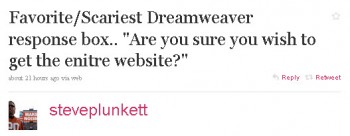
A Short Look at … What’s Next?

dreamweaver

Hope you enjoyed these moments with Steve’s Shorts.

steve_plunkett

M/C/C’s Director, Search, Steve Plunkett, is responsible for all aspects of search engine optimization (SEO) and Internet user behavior. Plunkett’s competitive personality makes him a perfect fit in the competitive world of SEO. As a child and a gamer, he worked hard ensuring that it was his initials at the top of every arcade game unit in his neighborhood. Today, he uses SEO to ensure his clients appear at the top of the search engine results –and offers an array of optimization services that are scoring big for those clients.

Buy the Insider’s Guide to Online Conversation.

Successful-Blog is a proud affiliate of

third-tribe-marketing

Filed Under: Successful Blog, Tech/Stats Tagged With: bc, LinkedIn, SEO, Steve Plunkett

Man, This is all screwed up…

September 23, 2010 by patty

by Patty Azzarello

cooltext466496263_leadership
this-is-screwed-up1

As a leader how do you deal with with negative energy?

Leading in rough times

This has come up a lot lately, so I wanted to talk more about this point I often mention as one of my top Leadership Values:

It is never the wrong idea to be positive and to lead.

When I say this I do not mean you should bury the problems and pretend everything is OK. Quite the opposite.

Face reality.

I mean jump in with both feet, acknowledge how ugly it is, and personally help find a way out of it.

When it gets bad…

OK, so they said there would be no layoffs, and now they are laying people off. They are treating people like crap. They don’t care. People are pissed off. Now there is even more pressure on schedules and cost cutting. My boss has checked out. No one has my back. I am getting blamed for things that are not my fault. My organization is likely to be shut down, so why should I care. Nothing I do matters.
What will you do next?

Winston Churchill once said,
“If you are going through hell, keep going!”.

You have a choice: Jump on all the crap with an equally negative attitude, or face it head on as leader who intends to make a positive difference for the business and the people.

Why do people choose to be negative?


It’s funny.

It is a wonderful comedic platform to go on about how messed up everything is and how stupid all the managers are, and how no one gives a damn about the employees.

It’s cool.

Being cynical and subversive is way more cool than being the boy-scout, showing that you are aligned with the lame corporate way of doing business.

You look smart.

If you can use a lot of details and data about why everything is screwed up, and dive into endless root-cause analysis, and catalog all the blame at a very granular level, some people will think you are really smart.

It’s easy.

Being negative and generating lots of data and commentary absolves you of having to do any work to fix anything.

But…

Being Negative is Toxic

It doesn’t help.

Nothing moves forward or gets better. This type of negativity draws people in because it a source of energy, and camaraderie in the absence of positive leadership. It becomes the way things are. And then it defines the future.
What does it look like to be positive and to lead?

Acknowledge the bad.

This is a really crappy time. I’m disappointed too. What do you think?.

Invite some discussion.

Let people tell you how this is impacting them. But then close that discussion off and make it clear you are planning to go forward. Ask for their help.

You have my commitment and support to create a new plan of attack. We can’t keep doing things the same way because it is killing us, but we need to move forward. Let’s focus on one thing that we can do well and start doing it right now. Or, at a minimum, let’s focus on how we can build our career capital for the future.

Life is long

If you choose negative path, or if you choose to checkout, or broadcast how screwed up everything is, in reality it might not make a big difference in that moment. So what are you hurting? You are having some laughs.

Sometimes there is no way practical way forward. Your organization could be being dismantled, outsourced or eliminated entirely. So who cares, right? What’s the big deal if I check out? It doesn’t matter anyway..

I have faced this many times at the helm of an organization who was being acquired or laid off… it might not seem like anything we do matters right now because this is all going away.

What you do now matters to YOU

Just remember that even though it might not matter in the current business situation, all of those people around you will eventually move on to other jobs in other places.

They will remember how you acted NOW.

Will they remember someone taking cheap shots at everyone and everything and checking out? or will they remember someone who stepped up tried to find a way to help?

If you can’t help the business, help the people.

People need you to be positive and to lead. It is never the wrong choice.

If it’s too bad, get out

If it’s really bad, get out. But while you are on your way, it is still the right choice to be positive and help others — if for no other reason, because it’s better for you.

You can build a hugely positive reputation for leadership in tough times.
People are always watching. It always matters.

How have you dealt with negative energy as a leader?

It’s so important (and at times really difficult) to stay positive. How do you it? Please share in the comment box!

—–
Patty Azzarello works with executives where leadership and business challenges meet. She has held leadership roles in General Management, Marketing, Software Product Development and Sales, and has been successful in running large and small businesses. She writes at The Azzarello Group Blog. You’ll find her on Twitter as @PattyAzzarello

I’m a proud affiliate of

third-tribe-marketing

Filed Under: Business Life, management, Successful Blog, Writing Tagged With: bc, LinkedIn, Patty Azzarello

Cataloguing Creativity: How Do You Organize Your Ideas?

September 22, 2010 by Guest Author


cooltext455576688_blogging

—-

Are you a collector?  Do you see something on television or while you’re out shopping and just have to have it?  Perhaps this scenario sounds familiar: You pick things up, here and there, and over the years you;ve acquired quite a collection.  Then, one day, you’re inspired to use one of those handy-dandy items and you can’t find it anywhere!

I am not a collector.  That isn’t to say that I don’t have a collection.  Through the generosity of various relatives, I have stacks of cookbooks, fancy kitchen tools, and  various odds and ends.  These items are carried in by the truckload by the helpful relatives and deposited in my house, where I am left to stash them away for future use.  And stash them away I do, here, there, and everywhere.

Days pass, sometimes weeks or months.  Suddenly, I’m inspired.  Where’s that Super Doodle Noodle Maker Aunt Bonita gave me?   Where in the world did I store it away?    I want to make Super Doodle noodles and my Super Doodle Noodle Maker is nowhere to be found!

Do you catalogue your creativity?

What’s the point?  Most of us collect blogging ideas as we go through life.  Our great, creative ideas for our blogs  can get lost in the hodgepodge of daily life if we don’t develop some way to catalogue them.   Finding a way to organize those ideas is a essential to having them when we need them.

There are many ways to keep track of those great ideas.  One tool that has helped me is a small notebook.  I carry it around in my purse and when I hear or see something that I think I could use later, I jot it down. Sometimes, the little notebook isn’t on hand, so I grab a piece of paper and write it down there.  So, now I have a small stack of papers and notebooks that I keep beside my chair, on hand for when I need to find that great concept from the past.

A little notebook is a start but it certainly isn’t going to keep things organized for future reference.  To keep things on track, I divide my concepts into categories for quick reference.  Ultimately though, something more will be needed.  Ideally, a file drawer organized alphabetically and divided by category would work best.  Being able to access information quickly and accurately when needed is an absolute necessity when you need to recall that one great idea or when inspiration runs out and you need to pull from your catalogue of creativity.  If my kitchen were as organized as my blogging ideas it would be a cinch to find my Super Doodle Noodle Maker when I need it!

How do you keep your ideas for blogging organized?  Let us know what works for you.  

Jael Strong writes for TheWriteBloggers, a professional blogging service which builds clients’ authority status and net visibility.  She has written both fiction and non-fiction pieces for print and online publications.  She regularly blogs at Freelance Writing Mamas .

Thanks, Jael

–ME “Liz” Strauss
Work with Liz on your business!!

Buy the Insider’s Guide to Online Conversation.

I’m a proud affiliate of

third-tribe-marketing

Filed Under: Successful Blog, Writing Tagged With: bc, blogging, LinkedIn

  • « Previous Page
  • 1
  • …
  • 100
  • 101
  • 102
  • 103
  • 104
  • …
  • 190
  • Next Page »

Recently Updated Posts

Is Your Brand Fan Friendly?

How to Improve Your Freelancing Productivity

How to Leverage Live Streaming for Content Marketing

10 Key Customer Experience Design Factors to Consider

How to Use a Lead Generation Item on Facebook

How to Become a Better Storyteller


From Liz Strauss & GeniusShared Press

  • What IS an SOB?!
  • SOB A-Z Directory
  • Letting Liz Be

© 2025 ME Strauss & GeniusShared