Successful Blog

  • Home
  • Community
  • About
  • Author Guidelines
  • Liz’s Book
  • Stay Tuned

Don’t Own the Problem. Own the Solution.

September 10, 2012 by Liz

If You Argue FOR Your Problems …

cooltext443794242_influence

At least twice a week, I have a conversation with a person or a team about a problem they’ve discovered with their business. Soon as I can I start asking questions about what makes the problem a problem and how we might unravel that knot to get things moving smoothly again.

What’s interesting is that most folks first want to convince me how terrible, awful, horribly huge and unsolvable the problem is. They want to dig deep into the details and issue and vent the emotions they’ve carried while the problem was tying itself up.

If you argue for your problems, they’ll be yours.

Do You Argue FOR Your Problems?

Don’t confuse identifying the problem with communicating how you feel about the problem. The two are just not the same thing. In the same vein, focusing on the cause of the problem is rarely a solution.

  • If he hadn’t … but he did.
  • If they had just … but they didn’t.
  • If this was built this boat right … but it wasn’t and if we keep talking about it, we’re ALL going to drown. We need a way to keep from sinking or a way to get to the shore.

Talking about how we feel about the problem and its cause, doesn’t do much to change the situation NOW. In fact, staying focused on those points is arguing to keep the problem a problem.

Some problems do better if we solve them first and discuss how to avoid them later.
Some problems – like a dropped glass spilling liquid all over the floor — may be just be an accident and not discussion at all
Some problems — like a detour — aren’t problems at all simply a shift in what we were expecting to occur.

Change Your Mind

The way we see a problem is what keeps is a problem. Stop seeing an obstacle. Look for the opportunity.
Inside every situation that seems to be a problem is a chance to learn a new way of doing things. Along with that comes a challenge to show our courage, grace, flexibility, competence, and confidence when faced with the need to find new solutions.

Truth is if we give up the payoff in dissecting the problem we’ll move more quickly to solution.
Let’s just agree that we have one and get on with solving it. We can address the problem after we’ve achieved the solution. We’ll save urgent time and be more rational then anyway.

Don’t Own the Problem, Own the Solution.

New solutions are what lead to innovation.
Necessity (problems to solve) is the mother and father that gives birth to revelation.
Keeping our eyes on each other and our hearts on open communication can bring us to a solution that was better than what we ever thought we wanted.

And being the one who can positively identify opportunity when the situation has been shaken raises influence and gains esteem from the folks who are stuck and frozen. Being able to keep the focus on the direction that moves us forward is a trait of a leader. It’s irresistible to be ready to keep winning when the day is raining.

Don’t own the problem.
Own the quest to find the solution.
Don’t argue for convincing folks how bad it is that it happened.
Argue for how good it is that we’ve got an opportunity to make something great happen.
Don’t parse apart the people and the pieces to find what was broken.
Do all our can to make things whole and moving things whole again.
That’s winning.
And winning is irresistible.

How do you catch yourself when you’re arguing for the problem?

Be irresistible.
–ME “Liz” Strauss

Buy the Insider’s Guide to Online Conversation.

Filed Under: management, Motivation, Successful Blog Tagged With: argue for the problem, bc, business problem solving, LinkedIn, own the problem own the solution, small business, solutions lead to innovation

Beach Notes: Beach Dali?

September 9, 2012 by Guest Author

by Guest Writers Suzie Cheel and Des Walsh

We were greeted with this beach artwork as we stepped onto the beach today and it reminded us of a Dali painting. The magic of nature and imagination in action

How have you changed your view recently?

– Suzie Cheel

Suzie Cheel & Des Walsh

Filed Under: Motivation, Successful Blog Tagged With: bc, Beach Notes, Des Walsh, LinkedIn, Suzie Cheel

5 Common Affiliate Marketing Struggles and How to Overcome Them

September 7, 2012 by Liz

by
Stefan V.

cooltext443809602_strategy

Affiliate Marketing Has Its Struggles

While product owners often have successful sales strategies in place like using armies of affiliate to sell for them, affiliate marketers themselves often reap little, if any, rewards. Why? There are many main issues that affiliate marketers struggle with while trying to promote their affiliate products and land sales. Several main issues are listed below, in no particular order of preference. Then after the list of issues, discover how to overcome them quickly and easily.

5 Common Affiliate Marketing Struggles

Here are five common affiliate marketing struggles.

  1. Lack of tech skills for Internet marketing can cause many an affiliate marketer to stumble. Many affiliate marketers lack much needed tech skills in today’s web-based world. They struggle with setting up leads capture pages, aka squeeze pages, setting up autoresponders, blogs, social media channels and other Internet marketing methods.
  2. Affiliate commissions can be very small and can take months to reach the marketer, long after promotional expenses are used for all the hard work of generating leads, clicks and sales.
  3. Communication can break down. Language barriers can be a problem. Consider the Tower of Babel and it doesn’t take much to imagine how difficult it is to really get a point across in another language that you wish to market in.
    And too many affiliates try to market something that they have either never purchased and even used before. They are trying to sell something that are not experienced with. A fine example is an affiliate who is new to working from home, yet wants to promote a get-rich-fast, work-from home scheme. If the affiliate has made it work, yes, by all means he should promote it. However, if the affiliate has never even earned any money from it, it’s not wise for him to promote the program until financial results are solid.
  4. Know what you are trying to market, who your target audience is and what you are trying to get them to do (i.e. you need sales experience, too). Go back to #2 above where the affiliate marketer needs to thoroughly understand the product in order to discuss its features and benefits. Focusing on a dynamic two-step offer of a main feature and benefit plus a call to action at the end of each marketing piece is key with affiliate marketing promotions. The more specific the content and call to action, the better. In other words if you want someone to click and subscribe to your online form, tell them to do just that – and tell them why they should (i.e. tell them what’s in it for them.)
  5. Support from the product owner / main seller is important. Too many affiliate marketers are left in the dark with regards to product support and affiliate marketing tools. All too often an affiliate marketer may get a coded link and a banner or other 1-time marketing piece, and that’s it. Then they are left on their own to figure out the best ways to market the product, how to make their own banners, squeeze pages and so on, to attract leads, clicks, and sales.

How to Overcome Them

If you want to overcome these struggles, keep these 7 points in mind.

  1. focus on what you know
  2. only market products you’ve used and understand well
  3. start with something that will be highly attractive to your audience
  4. choose a product that easy to communicate to readers in any language
  5. have a clear call to action
  6. put your offer where people can find it easily
  7. let that first affiliate product start earning before you try a second one

Keep your eyes on offering value to your audience and making it easy to buy from you and you’ll find your affiliate experience goes more smoothly.

Author’s Bio:

Stefan V. is in Germany a financial expert and he combines the power of his knowledge into the online marketing business. He has done some trial and error until he found the best products, informations, strategies and monetizations. Be in touch and find more here Seven Figure Society

Buy the Insider’s Guide to Online Conversation.

Filed Under: Marketing /Sales / Social Media, Successful Blog Tagged With: affiliate marketers, affliliate marketing, bc, LinkedIn, Work at home

Energize! Act like a startup

September 6, 2012 by Rosemary

by
Rosemary O’Neill

Energize! Act like a startup

You don’t have to work in a high-ceilinged loft in San Francisco to take advantage of startup wisdom. The energy, passion, and fast pace of startup culture has a lot to offer almost any business.

It’s not all about the perks

We did have a foosball table in the early days of our company, but what we discovered is that everyone appreciates less tangible perks. A collegial atmosphere, where everyone is respected for their ideas, is much more important than Aeron chairs.

Lessons you can take from startup culture

  • Go all in. Sleep under your desk if you have to.
  • Appreciate your colleagues.
  • Don’t build any internal silos; everyone pitches in.
  • Maintain your hunger for the mission; gather true believers around you.
  • Get all excited over every new customer.
  • Take advantage of guerrilla (free) PR and marketing opportunities.

Even if you’ve been in business for a long time, you can incorporate some of the ideas that make startups successful. But you don’t have to eat Ramen noodles.

What can you do this week to inject some startup energy and passion into your business?

Author’s Bio: Rosemary O’Neill is an insightful spirit who works for social strata — a top ten company to work for on the Internet . Check out the Social Strata blog. You can find Rosemary on Google+ and on Twitter as @rhogroupee

Thank you, Rosemary!

You’re irresistible!

ME “Liz” Strauss

Buy the Insider’s Guide to Online Conversation.

Filed Under: management, Motivation, Successful Blog Tagged With: bc, LinkedIn, small business, startup culture, startup energy, startup pace, startup wisdom

Calculating ROI and Tracking Sales on Your Advertising Brochures

September 5, 2012 by Guest Author

by Tara Hornor

Making an Investment in Marketing

Are you spending money on advertising brochures for your business? If so, it is important that you begin calculating the return on investment (ROI) to find out how much your business is benefiting from them. This also helps you prioritize your marketing efforts as you’re going to want to focus your marketing dollars where they have the greatest effect.

The sole purpose of making an initial investment in a marketing method such as advertising brochures is to end up making more than that original investment. Your goal is to spread the word about your business, gain new customers, and ultimately make more money.

Calculating ROI on Your Advertising Brochures

If you have never before attempted to calculate your ROI, don’t be intimidated. By following a few fairly simple mathematical equations (nothing a small business owner can’t handle) and gathering the right information, you can become a master whiz at knowing your profits for brochures, postcards, or any other print marketing material.

Calculations

The calculation for ROI is simple: (Profit – Cost) / Cost.

So let’s apply that to a sample project. You have the following costs:

$1,000 – designing the brochures
$1,000 – 10,000 brochures
$3,000 – mailing the brochures
$5,000 – total cost

After mailing out your brochures, you start to get orders. After a few weeks you step back and calculate that your total sales for the brochure campaign were $15,000. Here’s how you would plug this data into the ROI calculation:

($15,000 – $5,000) / $5,000 = $2

So you have two dollars as the result of the calculation. What are you supposed to do with this information? The result of this calculation tells you that for every $1 you invest, you get $2 back. That’s an excellent return on investment!

Simple, right? As long as you know how to determine which of your sales actually came about as a result of your advertising brochures.

Tips on Keeping Track of ROI

Most business owners appreciate the simplicity of ROI, as it is easy to calculate. But tracking actual profits that come explicitly from a campaign can be tough. When you create advertising brochures, you should have a specific advertising campaign in place. Since you will need to find out how many sales actually came from that specific campaign, make sure you use specific methods for tracking your campaign numbers.

Some of the techniques used for tracking a specific campaign include:

  • QR codes that customers scan. The code leads them to a specific landing page built specifically for your campaign.
  • Special phone number that is only associated with that campaign.
  • Coupon codes associated with that specific campaign.

The fact is that you probably have several marketing methods going on at any given moment for a single campaign from social media to emails to brochures. Be sure to isolate, as best you can, which is providing your profits so you can track properly. Therefore, if all of your marketing efforts are for advertising your latest product line – running shoes, let’s say – then be sure that your email leads to a different landing page than your brochures do.

As a business owner, you do not want to waste your money or your time, which is why you need to calculate ROI and track progress of the campaign on a regular basis. Once you do this, you can get a better insight into what consumers like and do not like. You will be able to figure out which brochures are working and which ones are not worth the initial investment at all.

Author’s Bio:
Tara Hornor writes about marketing, advertising, branding, web and graphic design, and desktop publishing for PrintPlace.com a company that offers online printing for print marketing media. Find her on Twitter as @TaraHornor .

Filed Under: Successful Blog Tagged With: bc, calculating ROI, LinkedIn, return on investment, small business, tracking campaign sales, tracking coupon codes, tracking QR codes

4 Keys to Video Marketing and a Free Guide to Mastering It

September 4, 2012 by Guest Author

by
Adria Saracino

cooltext443809602_strategy

4 Keys to Online Video Marketing

Blogging is one of the fastest and easiest ways to get your content and ideas out to readers, but content sharing is changing quickly as video is becoming more and more popular. YouTube is the largest search engine after Google, with over 800 million unique visitors per month. With the popularity of video skyrocketing, the future of blogging will gradually move towards video content.

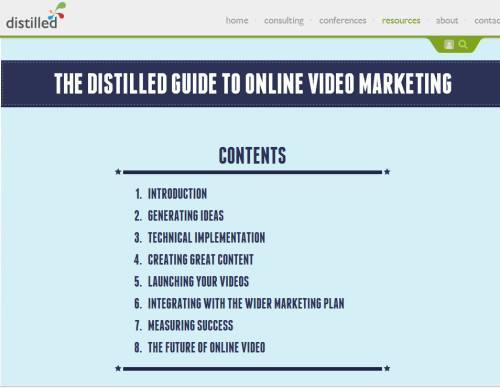
If you want your blog to remain relevant with your readers, it’s important you know how to use video on your blog effectively. Distilled has designed a video marketing guide that can help you understand and utilize video more successfully in your blog or business.

Let’s go through 4 keys for succeeding in video marketing.

Establishing Personality

Using video will establish your personality, style, and voice as a blogger much fast than traditional, static content will. If your blog depends on your personality or style, you should consider using video, so your readers and potential readers can establish a “relationship” with you quicker. With text content, it might take readers several articles to get to know your personality, but by using video small mannerisms, tone of voice, and body language can be picked up on instantly.

By establishing a relationship with your readers on a more personal level, you establish trust and loyalty. If your readers think they know you better, they are more likely to remain regulars to your blog.

Stand Out

Not many bloggers are dabbling in video yet, and choosing to do so will differentiate you from other blogs. Readers are always looking for new, fresh ideas and video is one way to give it to them. If you are blogging in a specific niche, using video can give you a unique and successful position. Even if there are other blogs in your niche that are using video, few people know how to use video effectively, and integrate it into their blog site well.

In our video marketing guide we cover how to ensure your video content is placed well on your site, and how to build a great internal linking structure, so that any links built into your video will provide value to your domain as a whole.

Mobile Devices

Using video on your website or blog is also going to help you attract mobile device users, because video is much easier to view on a phone or tablet than text. With so many people using mobile devices, and gathering information on the go, you need to make sure that you’re meeting your readers where they are.

Understanding When to Use Video

One snippet from Distilled’s guide explains well why video is not always the answer, “While video can be an extremely valuable asset for businesses with an online presence, it’s not always going to be the best form for every kind of content and every type of business. The skill to creating great video is in working out when and where to use it, focusing on identifying and filling content gaps rather than form gaps.”

While video is immensely helpful to blogs, it’s important not to use video just for the sake of video. Your video content should have a clear, identifiable purpose, which works well with video format. This guide covers types of content that works well with video, and how to put that content through a creative process to build the most successful video for your message.

Your Free Guide to Mastering Online Video Marketing

You can easily enhance your blog and stay relevant to your readers by using video, but video is only effective if it is done well. For more information on how to utilize video successfully, click on the downloadable PDF below, and check out Distilled’s website for more resources and information.

distilledguide
Author’s Bio:
Adria Saracino is the Head of Outreach at Distilled. When not consulting on promotion and content strategy, you can find her writing about style on her fashion blog, The Emerald Closet.

Filed Under: Marketing /Sales / Social Media Tagged With: bc, content sharing, LinkedIn, online video marketing, small business, using video blogging, video-marketing

  • « Previous Page
  • 1
  • …
  • 13
  • 14
  • 15
  • 16
  • 17
  • …
  • 190
  • Next Page »

Recently Updated Posts

The Creator’s Edge: How Bloggers and Influencers Can Master Dropshipping

Is Your Brand Fan Friendly?

How to Improve Your Freelancing Productivity

How to Leverage Live Streaming for Content Marketing

10 Key Customer Experience Design Factors to Consider

How to Use a Lead Generation Item on Facebook


From Liz Strauss & GeniusShared Press

  • What IS an SOB?!
  • SOB A-Z Directory
  • Letting Liz Be

© 2025 ME Strauss & GeniusShared