Successful Blog

  • Home
  • Community
  • About
  • Author Guidelines
  • Liz’s Book
  • Stay Tuned

The Book List: 42 Rules for your New Leadership Role and The Little Book of Leadership

May 4, 2011 by teresa

The Book List: a weekly series by Teresa Morrow

I’m Teresa Morrow, Founder of Key Business Partners, LLC and I work with authors & writers to help them with their online book promotion and marketing. As part of my job I read a lot of books (I love to read anyway!).

The books in The Book List series will cover a range of topics such as social media, product development, marketing, blogging, business, leadership, organization, career building, finance, networking, writing, self development, and inspiration.

’42 Rules for your New Leadership Role’ by Pam Fox Rollin
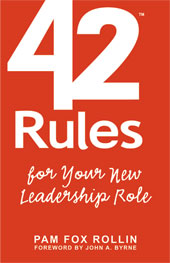
42rules-your-leadership-role-mid

“Pam gives us that rare gem of a book—the perfect blend of proven tactics solidly grounded in the latest research. 42 Rules for Your New Leadership Role offers smart, busy leaders the proven mindsets and
practical to-do’s to make their strongest start as they rise in the leadership ranks. She also provides great tips on leading change across your organization. Refer back to the book often, and take every
chance to hear Pam speak about leadership.”
Sharon L. Richmond, Director, Change Leadership Center of Excellence, Cisco Systems

“Pam and I met 10 years ago when we started our coaching company. Since inception Pam has been one of our most effective and loved coaches. Her clients love her because of how she helps them reach
the heights they were capable of. 42 Rules for Your New Leadership Role represents the best of what she has learned over the years. Buy this book, and expect it to change your life!”
Scott Blanchard, Executive Vice President, The Ken Blanchard Companies

Book Excerpt

Now that you’re stepping up to a new leadership role, you’re far less likely to receive useful guidance than earlier in your career. This holds true whether you are in your first manager role or an experienced leader joining top executive ranks. I find this problem is especially acute for new Directors and VPs. You’ve been hired at these levels for your track record, so people assume you know what to do.

However, just because you were successful in your last role doing or managing marketing, accounting, engineering, or whatever you did, doesn’t mean you know how to make a strong start at your next job.

One-quarter of senior executives promoted from within fail in the first 18 months; one-third of outside hires fail. Many flame-outs can be traced to missteps during their first quarter. More importantly, for the 60–75 percent of leaders who survive into the second year, their effectiveness and trajectory are powerfully affected by choices made as they start.

If you’re like the technology leaders, marketing executives, and top teams I coach, you might notice how easy it is to become so caught up in fighting fires that you forget to shut off the gas. Or, you suspect you’re lousy at certain aspects of leadership, so you ignore them and hope they won’t bite you. Or, maybe you never learned the rules in the first place! Leadership is an apprenticeship craft. With the trend toward more “flat” organizations, your boss may be stretched so thin that he/she can barely advocate for your team, let alone mentor you. Welcome to your new leadership role—you have a bigger job, in a tough climate, with very little support!

I wrote 42 Rules for Your New Leadership Role to fill that gap.

Based on two decades of coaching senior leaders, helping executive teams craft strategy, and guiding Stanford MBAs, I describe a proven set of approaches to teach you what you’ve yet to learn, remind you of what you already know, and inspire you to become the best leader you can be in this job…and your next…and your next.

As you read this book, take what I say as a starting point for your own good thinking. Adjust what you find here to serve your team’s needs, the market conditions, the cultural context, your goals, and your personal leadership approach.

The intense learning curve and unfamiliar environments of a new job make it difficult for your brain to consider options and make decisions as well as you usually do. When brains are overloaded, people tend to rely on what they’ve done before, even when that didn’t work very well or is out of place in the new context. Ironically, this tunnel vision and rigidity is especially true of leaders who have experienced success—people like you who have been promoted or recruited for a new role.

So use this book to prompt what you want to do at each phase of your start. Ask yourself what from this material will be useful to you in the week ahead. See what results you’re getting, and come back to this process at the end of the week. Consider the rules, make up your own mind, act, observe, and reflect. Repeat. Succeed.

About Pam*:

Pam Fox Rollin coaches executives to succeed at the next level. She specializes in helping functional leaders who are taking on broader roles with greater strategic opportunity and management responsibility. Pam is also known for expert work with assessments (personality, leadership, 360s) and for designing and facilitating unusually productive leadership offsites. Her company, IdeaShape Coaching & Consulting, advances leaders and teams at top and emerging Silicon Valley and Bay Area companies in biotech, technology, and consumer products. Before founding IdeaShape in 1999, Pam consulted with Bain & Company and Accenture; her MBA is from Stanford, where she often serves as a Guest Fellow, helping top MBA candidates develop their leadership skills.

You can order a copy of ’42 Rules for your Next Leadership Role’ online at Amazon. *this information came from Amazon.

Next, I would like to introduce you to a book on the business book list on Amazon: ‘ The Little Book of Leadership: The 12.5 Strengths of Responsible, Reliable, Remarkable Leaders That Create Results, Rewards, and Resilience’ by Jeffrey Gitomer.

‘The Little Book of Leadership by Jeffrey Gitomer

This book came out recently on the new releases (business) list on Amazon. You can also check out my recent blog post on this blog about his book, Social Boom.

The Little Book of Leadership: The 12.5 Strengths of Responsible, Reliable, Remarkable Leaders That Create Results, Rewards, and Resilience (Hardcover)
“As with Gitomer’s other books, this one is packed with bite-size gems that are worth living by, and learning from… this time on leadership. One of the core tenets he starts with is discussing how leadership must be earned (and how to get there), by one’s actions and not just conferred respect via position. He makes you look inside yourself to see where you’re providing authentic, likable leadership in a way that hits home.

Like his other books, all of which I’ve read at least a few times (thanks for the ribbon in these, too, a nice touch to keep ’em from getting dog-eared), this one makes you think about how others perceive you. And how to build a personal leadership philosophy, backed by actions, attitudes, belief and effective communications with others, that really makes sense.

Above all else, I like this book because it models how to develop personal responsibility for providing leadership (which in a way we all need to study, to be leaders of our families, in communities, as entrepreneurs, as well as formal managers and execs), and the checklist of activities and “things to keep in mind when leading others” that can make a big difference.

On a last note, I will say I’m very glad Gitomer’s gone beyond just sales training to correctly teach and show us all about how to develop a winning attitude, how to communicate and brand/position ourselves effectively, how to lead successfully and live a life worth living. He’s always been a great role model — thanks Jeffrey for all you’ve done for us. It’s sincerely appreciated. And much-needed in these dark times… you’re a beacon. Thanks.”
Kenneth Calhoun – Amazon Reviewer

About the Book
A new and impactful book on leadership from the perspective of leaders

What makes a leader relevant? It’s not their place of employment, job title, experience, or status in life?it’s their resilience. The true measure of any leader is his or her ability to react based on past experience and gut feelings, respond in real time to current circumstances, and then to recover quickly and move on with new lessons learned. The Little Book of Leadership combines classic style with the latest innovations to challenges the reader to self-evaluate every facet of their leadership, coaching, and communication abilities in order to better formulate what actions can be taken to improve their natural skills. Ideas and answers are provided for every challenge.

* Chapters include information about the 12.5 leadership strengths: From insights to legacy and every element in between. Morale, Attitude, Resilience, Opportunity, Guts, Measurement, Coach, Celebration, Next-level, and Lost Secret of Leadership
* Foreword by Dr. Paul “Doc” Hersey, creator of Situational Leadership
* Other books by Gitomer: The Sales Bible: The Ultimate Sales Resource, Revised Edition, also by Wiley, The Little Red Book of Selling (Bard Press) The Little Gold Book of YES! Attitude (Pearson)

Whereas other books rely on theory or philosophy, The Little Book of Leadership takes leadership into the real world of business, providing proven methods for becoming a successful leader.

About Jeffrey*:
AUTHOR. Jeffrey Gitomer is the author of The New York Times best sellers The Sales Bible, The Little Red Book of Selling, The Little Black Book of Connections, and The Little Gold Book of YES! Attitude. All of his books have been number one best sellers on Amazon.com, including Customer Satisfaction is Worthless, Customer Loyalty is Priceless, The Patterson Principles of Selling, The Little Red Book of Sales Answers, The Little Green Book of Getting Your Way, The Little Platinum Book of Cha-Ching!, and The Little Teal Book of Trust. Jeffrey’s books have appeared on best-seller lists more than 750 times and have sold millions of copies worldwide.
*courtesy of book website and/or Amazon

You can purchase a copy of ‘The Little Book of Leadership’ at Amazon.

Filed Under: Business Book, Business Life, Successful Blog Tagged With: 42 Rules for your Next Leadership Role, bc, Jeffrey Gitomer, leadership books, Pam Fox Rollin

Defining Greatness: Delicious Chocolate Lollipops

May 4, 2011 by Guest Author

By Jael Strong

Greatness is associated with unusual power and intensity. When something is “great,” it conveys excellence and brilliance; it is truly impressive.  So, is your blog great?

We must face reality. The vast majority of blogs fall short of greatness. Mediocrity seems the aim for many. But isn’t this to be expected? With millions of blogs in existence, and more being added each day, can we expect a flood of greatness? No, of course not. But don’t we want to be listed among the greats? Sure, who doesn’t?

So, what are the ingredients for greatness? I wanted to come up with something witty, but all I can muster is Delicious Chocolate Lollipops, commonly known as Design, Content, and Loyalty.

Delicious design

Blogs should be inviting, accessible, and navigable. Great blogs appeal to the eye. A trademark image and a catchy slogan can go a long way. Readers can easily remember these things, making it that much easier to find you again when they get a hankering for a good read.

Hand-in-hand with this is the concept of simplicity. A cluttered blog is just asking for readers to click away. I hate it when I go to a site and I am inundated with a plethora of useless links and advertisements. It’s like going to the mall around on Black Friday; I feel like I’m being pushed and shoved, and it takes forever to get what I came for.

A well-organized blog will not deluge its readers with nonsense. Rather, it should be like sitting down to eat a decadent dessert made especially for the reader.

Smooth chocolaty content, please

Appealing to the eye is good. Appealing to the mind is great. Once a reader is attracted to a particular blog, the writer should deliver with some great content. An excellent idea delivered poorly is like promising a moist chocolate cake, but bringing a piece of crusty, dried-out, cake-from-a-box instead.

How are you delivering your concepts? Do you try to be original? Are you checking for distracting grammatical errors? Do you mix in some humor? Most importantly, is your content relevant and up-to-date, providing something that readers are really looking for?

The loyalty lollipop

Loyalty is like a lollipop, you love it and you carry it with you wherever you go. A great blog is a blog people will think about even when they aren’t in front of their computers. They’ll recommend it to friends and colleagues, and look forward to being engaged by it again.

How do we build this loyalty? Bloggers have come up with some great tools for this. Of course, we should always encourage comments. Another tool is allowing guest bloggers to write for you. Sponsor contests and allow short humorous submissions that you will in turn publish on your site. Welcome feedback. Make your blog an open room where readers feel like they are part of the process.

Of course, loyalty is not one sided. You must be loyal to your readers as well. If you sponsor contests, allow submissions, or welcome guest posts and comments, keep up with time lines and respond to your readers. Also, keep a schedule that your readers can recognize. In other words, don’t take two months off without writing and then expect a warm reception on your return.

By combining quality design and content with reader loyalty we can all aspire to greatness and rise above the average. Talk to us, what tools for greatness do you utilize?

cooltext455576688_blogging

—-
Jael Strong writes for TheWriteBloggers, a professional blogging service which builds clients’ authority status and net visibility. She has written both fiction and non-fiction pieces for print and online publications. She regularly blogs at Freelance Writing Mamas.

Thanks, Jael

–ME “Liz” Strauss
Work with Liz on your business!!

Filed Under: Successful Blog Tagged With: bc

A Checklist for Building a Solid Partner Relationship

May 3, 2011 by Liz

Moving With New Tools to New Relationships

cooltext443809437_relationships

The past few years bloggers and brands have worked together to move messages through communities and across the Internet. It was a natural transition for a broadcast-based system to move some of their marketing and advertising from print publishers to online audiences.

In many cases, what has occurred is that brands have chosen to use the new tools with an outdated view to how reaching customers work. Though the brands have given this new relationship a new name – blogger outreach – that implies relationship, the goal behind the outreach is often still product mentions in the form of blog posts and eyeballs looking at them.

It may be easier on the short term to hire a blog post or offer something free in hopes of getting bloggers to write about it than to develop a relationship, but as more big and little brands bombard big and little blogs with pitches and product samples, the less attention any brand can get.

And it always was true that …

Old thinking and old methods aren’t the best use of new tools in a new cultural mix. The best brands — businesses big and small — are already making the move from outreach and focus groups to partnerships. The best business bloggers are taking the initiative to build relationships like that too.

A Checklist for Building a Solid Partner Relationship

Great brands, savvy small businesses, and the best business bloggers know the best business relationships are a partnership in which both sides align goals and work together on a shared mission not a single campaign or opportunity. Here’s a checklist for building a solid partner relationship that can do that.

  1. Check for similar team size and bias toward action. What you’re looking for is a similar time-goal orientation. If your business can turn on a dime and needs one person to make a decision, you’ll be at a disadvantage working with a business that is highly driven by several step processes. The business with the most approval stages always wins control.
  2. Check for shared values and like standards. What you want to determine is that you and your partner agree on what makes great work and great service to each other, the business, and the customers. These intangibles can’t be described in a contract. They have to be discussed deliberately. Do that.
  3. Check that you have the same vision and mission in view. What’s important to determine here is that your mission critical goals for the work are truly aligned, that you see the same ending outcome, and that you’re sharing the same kind of risk. Find out before the work starts if your views don’t match — you don’t want to find out later that you were building a partnership and the other team thought of you as a channel of distribution.
  4. Check that you agree on roles, process, and vocabulary. What you want is concreteness of the “how” the partnership will work. This conversation will bring you to who owns which part and what responsibilities go with that.
  5. Check that you have clear boundaries and realize differences in your time-goal orientation. What you want to bring up here is the idea of “scope creep.” How will you alert each other when the relationship needs re-balancing? What will be the communication methods for changes to the plan, the process, or resource and budgetary needs?
  6. Check that you have discussed how you will share the risk and share the benefits. What is important here is a conversation about how the vision will play out, what will be required from both teams to secure the win, and how the rewards will be shared when you bring it in.

This checklist is a conversation that stands outside the making of a deal memo or a contract. It’s a relationship meeting of the minds. The accuracy of the conversation needs to be tested after you’ve gone through the checklist. You can do that easily by following these two rules.

  • Take one small unit of work through the process to verify your thinking about the roles and the scope of the work. At each step of that prototype, keep what worked and revise what didn’t.
  • Throughout the relationship, review the results quickly, constantly, consistently and adjust to keep improving the process and the relationship. As you build trust, sleek down the checkpoints to let each partner do their work without unnecessary interruption.

Sound like a lot? It’s really not. If you think about it, it’s two meetings and keeping your head, heart, and vision in the partnership. They say a good partner can divide grief and multiply success. I can tell you that this process can bring you a lot closer to ensuring that.

How do you build a solid partner relationships?

–ME “Liz” Strauss
Work with Liz on your business!!

Buy the Insider’s Guide to Online Conversation.

I’m a proud affiliate of

third-tribe-marketing

__________

Filed Under: Checklists, Successful Blog Tagged With: bc, LinkedIn, parternships, process, relationships

Reinventing Is Futile – Connect to the Brilliance in You

May 2, 2011 by Liz

cooltext443809558_authenticity

Reinventing ourselves.

What are we thinking when we say that? Is the plan to pull apart our DNA and restring it? Shall we just set aside those skills and talents we came with? Genetics doesn’t work like that. Our DNA is coded with four letters A, C, T, and G. The order in which they’re set not only differentiates us from other species, but also from each other, except our identical twin.

We can’t just toss aside the A, C, T, and G to reach in a box of letter beads to recode a new set of letters we like better. We can’t really even rearrange our current code with any sense of surety.

554987_alphabet_beads

Add to that the wealth of experience that has brought us from the moment we gave our first cry and opened our eyes to this moment in time. That experience has moved, molded, and made us into unique beings. We can’t relive our experiences either.

Our genetics and our experience are the foundation of who we are. They have burned the pathways in our brains that move and manage information. They have set the personal comfort zones that we find in the human experience. If we try to deny those foundations, to become something other, we end up a bad facsimile. We can’t replace bits of our being the way an inventor might change out a set of wheels for skis.

Reinvention is futile.
I can’t reinvent myself into you.
You can’t reinvent yourself into me.

But you can reconnect to the best that you are.
And I can reconnect to the best that I am.

0300724-nix-rottenegg-nebula-star2

People and stars are made of the same stuff. And as every star is shines with its own brilliance, so do we. When we reconnect to that we know deep in our genes and our experience, we become a richly alive, unique human being.

Even the smallest star shines with it’s own brilliant light. And we are like the stars. No one brings what you are. No one can replace you. No one can shine as you.

What’s irresistible is the brilliance you are.
Reinventing yourself is futile. Connecting to your brilliance is powerfully fruitful.
The world will be just that much brighter when you do.

Be irresistible.

–ME “Liz” Strauss
Work with Liz on your business!!

Buy the Insider’s Guide to Online Conversation.

I’m a proud affiliate of

third-tribe-marketing

Filed Under: Motivation, Successful Blog Tagged With: authenticity, bc, LinkedIn, personal-identity, reinvention

Thanks to Week 288 SOBs

April 30, 2011 by Liz

muddy teal strip A

Successful and Outstanding Bloggers

Let me introduce the bloggers
who have earned this official badge of achievement,

Purple SOB Button Original SOB Button Red SOB Button Purple and Blue SOB Button
and the right to call themselves
Successful Blog SOBs.

I invite them to take a badge home to display on their blogs.

muddy teal strip A

the-dreaming-cafe
feverbee
hvm-solutions-blog
planet-pookie
the-wallace-effect

They take the conversation to their readers,
contribute great ideas, challenge us, make us better, and make our businesses stronger.

I thank all of our SOBs for thinking what we say is worth passing on.
Good conversation shared can only improve the blogging community.

Should anyone question this SOB button’s validity, send him or her to me. Thie award carries a “Liz said so” guarantee, is endorsed by Kings of the Hemispheres, Martin and Michael, and is backed by my brothers, Angelo and Pasquale.

deep purple strip

Want to become an SOB?

If you’re an SO-Wanna-B, you can see the whole list of SOBs and learn how to be one by visiting the SOB Hall of Fame– A-Z Directory . Click the link or visit the What IS an SOB?! page in the sidebar.

–ME “Liz” Strauss

Filed Under: SOB Business, Successful Blog Tagged With: bc, blog-promotion, SOB-Directory, SOB-Hall-of-Fame, Successful and Outstanding Blogs

Rhythmic Marketing Strategies for Businesses with Seasonal Demand

April 29, 2011 by Guest Author

A Guest Post By Isabella York

cooltext443809602_strategy

In this day and age of uncertain times, more and more people are looking for a point of stability in their lives with regard to income. These fervent searches have proved fruitful in the form of capitalizing on certain skills or native products, turning them into moneymaking ventures that last years or, unfortunately, fizzle and fade into obscurity. In an effort to stay fresh and original, personal business ventures have taken on different forms, one of which being the seasonal business.

A seasonal business can be rewarding for those who have the ingenuity and drive to see it through, even with its numerous pitfalls that can lead to its downfall. Amazingly productive only during a certain time of the year, seasonal businesses quickly lose their profit-generating capabilities during a period called the off-season. Unfortunately, off-season periods for a seasonal business can encompass most of the year leaving a very small margin for the moneymaking process.

In order to combat the dreaded period of slow income, seasonal business owners have to continuously innovate and market their products and services. This entails constant promotion and the use of a number of techniques that will help turn a profit when times are tough. It also calls for strategic planning and timely intervention, knowing when to push a sale and when to hold off or where to allocate funds to produce the greatest amount of positive change.

When it comes to marketing, no rules are set in stone, especially so with seasonal businesses, much of it is touch and go. By taking initiative and combining personal strategies with these tried and true methods, seasonal business owners can definitely last longer than the dismal projection most others set for them:

  1. Thorough Analysis and Planning

    Make sure to take a look at the calendar at the beginning of every fiscal year. Take note of important occasions and events and try to see how your products or services can be incorporated. Give yourself a trial period and map out your initial progress through a specific time period. Analyze trends and apply this knowledge to your sales approach. Try not to restrict yourself to the limits of your seasonal business but go beyond and see how you can move further. A good example would be modifying summer pool covers to fit the demands of the season. Another instance would entail offering tropical themed Christmas trees that could serve as summer time decor.

  2. Innovative Advertisement

    It is a known fact that customers are attracted to seasonal products and will generate a lot of income during the peak season. To this effect, seasonal business owners would do well to advertise their products far and wide. Reach as many people as possible through the latest communication avenues and create a system of feedback that allows you to talk directly with your customers. Study the latest advertisement techniques and use them to the optimum effect.

  3. Excellent Customer Service

    Establish an excellent database of loyal customers. By doing so, you generate a stable source of income even during the off-season. Create updated surveys every sale period and get customer responses personally to build rapport. The web with its wide array of tools is an effective way to generate and manage surveys. You can also draw on customer ideas to generate new advertisement and marketing schemes. Consumers can have great ideas too.

  4. Off-Season Strategizing

    Marketing practices need not be confined to peak-season. In fact, business experts claim that the most effort a seasonal business owner must exert is during the period of low income. However, an important point is not to exhaust one’s income and to prioritize what needs the most attention. For example, either do an advertising campaign or push for store renovations and product updates. Never take on too many projects as this may tip the fragile balance of peak season income and off-season demands.

  5. Diversified Approach

    Branch out in terms of market groups. Never restrict your campaigns and services to one market as this also limits the amount of money you can make. See about reaching different people from different countries. Try to go global and tap into the different seasonal strategies of business owners from other countries. Not only do you build a wider customer base but you are also opening yourself up to potentially useful knowledge you would never know otherwise.

Be willing to take in one step further. Look beyond the strategies presented here and see how you can build and improve on them. The consumer market is vast and constantly changing, requiring you to stay on your toes and keep the ball rolling with regard to coming up with new and more attractive marketing schemes. The most important thing in business, seasonal or otherwise is to take the first step. It’s all about initiative. With constant innovation and attention-to-detail you can start and maintain a successful seasonal business.

_____________
Isabella York has been in the business world her entire life. Having seen business cycles ebb and flow, she knows a thing or two about developing strategies for changing demands, however her job with a purveyor of Artificial Christmas Trees (http://www.balsamhill.com/Artificial-Christmas-Trees-s/1.htm) and Christmas Trees (http://www.balsamhill.com/) has catapulted this skill set to a new level.

Thanks, Isabella, for your insight into something we don’t talk about enough!

–ME “Liz” Strauss
Work with Liz on your business!!

Buy the Insider’s Guide to Online Conversation.

Filed Under: Marketing /Sales / Social Media, Successful Blog Tagged With: bc, LinkedIn, seaonal markets, Strategy/Analysis

  • « Previous Page
  • 1
  • …
  • 296
  • 297
  • 298
  • 299
  • 300
  • …
  • 1050
  • Next Page »

Recently Updated Posts

The Creator’s Edge: How Bloggers and Influencers Can Master Dropshipping

Is Your Brand Fan Friendly?

How to Improve Your Freelancing Productivity

How to Leverage Live Streaming for Content Marketing

10 Key Customer Experience Design Factors to Consider

How to Use a Lead Generation Item on Facebook


From Liz Strauss & GeniusShared Press

  • What IS an SOB?!
  • SOB A-Z Directory
  • Letting Liz Be

© 2025 ME Strauss & GeniusShared