Successful Blog

  • Home
  • Community
  • About
  • Author Guidelines
  • Liz’s Book
  • Stay Tuned

Social Media Book List: A few Amazon Business Best Sellers

August 18, 2010 by teresa

A Weekly Series by Teresa Morrow

I’m Teresa Morrow, Founder of Key Business Partners, LLC and I work with authors to help manage their online book promotion. As part of my job I read a lot of books (I love to read anyway!).

This week I will be highlighting 3 books on the Amazon best seller category in business and investing;‘Strengths Finder 2.0’ by Tom Rath and ‘The 7 Habits of Highly Effective People’ by Stephen R. Covey. The books I discuss will cover a range of topics such as social media, marketing, blogging, business, organization, career building, networking, writing, self development and inspiration.

‘Strengths Finder 2.0’
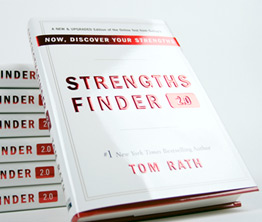
Strengths Finder by Tom Rath

“Hide not your talents. They for use were made. What’s a sundial in the shade?”
— Benjamin Franklin

This is a book on my reading list that I have not had the pleasure to read yet however, I agree wholeheartedly with the focus of Tom Rath’s book, StrengthFinder 2.0. If your strengths are hidden and not fully brought to the forefront, it is like you are being put in the shade and not brought to the light. When your strengths are displayed and actively seen, you are happier, and more productive in your work and relationships.

About the Book:

Do you have the opportunity to do what you do best every day?

Chances are, you don’t. All too often, our natural talents go untapped. From the cradle to the cubicle, we devote more time to fixing our shortcomings than to developing our strengths.

To help people uncover their talents, Gallup introduced the first version of its online assessment, StrengthsFinder, in 2001 which ignited a global conversation and helped millions to discover their top five talents.

In its latest national bestseller, StrengthsFinder 2.0, Gallup unveils the new and improved version of its popular assessment, language of 34 themes, and much more (see below for details). While you can read this book in one sitting, you’ll use it as a reference for decades.

Loaded with hundreds of strategies for applying your strengths, this new book and accompanying website will change the way you look at yourself — and the world around you — forever.

About the Author:

Tom Rath is a leading business thinker and one of the bestselling authors of the last decade. His first book, How Full Is Your Bucket?, was a #1 New York Times bestseller. Rath’s book, StrengthsFinder 2.0, is a long-running #1 Wall Street Journal bestseller. His most recent New York Times bestsellers are Strengths Based Leadership, published in 2009, and Wellbeing: The Five Essential Elements, published in 2010. Rath’s books have sold millions of copies and have made more than 100 appearances on The Wall Street Journal bestseller list.

Rath currently leads Gallup’s workplace consulting business. In this role, he guides the organization’s practices and research on employee engagement, selection, strengths-based development, leadership, and wellbeing.

Rath also serves on the board of VHL.org, an organization dedicated to cancer research and patient support. He earned degrees from the University of Michigan and the University of Pennsylvania. Tom and his wife, Ashley, and their daughter, Harper, live in Washington, D.C.

You can purchase a copy of ‘Strengths Finder 2.0’ online at ThinkAha Books or Amazon or on the Gallup website.

‘The 7 Habits of Highly Effective People’ by Stephen R. Covey
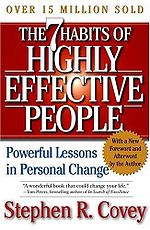
The 7 Habits of Highly Effective People

Another book to highlight on my reading list–‘The 7 Habits of Highly Effective People’.

I have read this book but it has been quite a few years so it is time to revisit this book and its lessons.

When I worked in corporate, I was lucky enough to be sent to a Franklin Covey seminar where I was given a copy of this book and a Covey business planner. And the reason why this book still remains on the best sellers list on Amazon is (I believe) because it holds solid advice for entrepreneurs, business owners, leaders and managers.

The 7 Habits of Highly Effective People are:

1 – Be Proactive
Teresa Tidbit – So true! It doesn’t help you when things are wrong or off to sit down and not do anything. Begin to put in motion those things you wish and want to happen. Think about how you can make things happen.

2. Begin with the end in mind
Teresa Tidbit – When I read this it reminded me of something my daughter did a few summers ago while swimming in the pool. She was trying to see if she could swim to the other side without having to take a breath in between. The first couple of times she had to stop and lift her head up before she reached the edge. She paused and took a couple of deep breathes and she went again. This time she did it and as she stopped to catch her breath, she said, “Mom, you know how I did it? I just keep thinking about the edge of the pool on the other side and kept going.”

3. Put First Things First
Teresa Tidbit – This is about becoming organized. When you don’t know where things are that you need, you spend more time trying to find it, then doing the work. Find what organizational tools work for you and use them.

4. Think Win/Win
Teresa Tidbit – This habit hits the mark around what social media, blogging, and relationship building is all about today. As you are building your community, network or “tribe”, you want to create win/win relationships.

5. Seek first to understand, then to be understood
Teresa Tidbit – Another great habit—especially regarding networking. When you go into a new relationship or connection, you want to start with being a listener not the talker. You want to be the giver, not the taker.

6. Synergize
Teresa Tidbit -This is about the levels of communication, another key to creating a solid business and personal life. You may not always agree or get along with your colleagues, friends or even your clients, but finding the synergy in the communication will help your relationships go much smoother.

7. Sharpen the Saw
Teresa Tidbit – Commit, Learn and Do. And this is in different aspects of your life—-mental, physical and spiritual. Take the time to do things that sharpen your mind, body and spirit. You may think these things aren’t important, however, when you don’t take the time, you will see how it affects your life.

About the book:

In The 7 Habits of Highly Effective People, author Stephen R Covey presents a holistic, integrated, principle-centered approach for solving personal and professional problems. With penetrating insights and pointed anecdotes, Covey reveals a step-by-step pathway for living with fairness, integrity, honesty, and human dignity–principles that give us the security to adapt to change and the wisdom and power to take advantage of the opportunities that change creates. *from back cover

About Stephen R. Covey:
Stephen R. Covey is a renowned authority on leadership, a family expert, teacher, organizational consultant, and vice chairman of FranklinCovey Co. The author of several acclaimed books, he has also received numerous honors and awards, including being named one of Time magazine’s twenty-five most influential Americans. Covey lives with his wife, Sandra, and their family in the Rocky Mountains of Utah.

You can purchase a copy of ‘Amazon.

I truly hope you will check out these books and please comment and let me know your thoughts on them. *I have not received either of these books from the authors. These reviews and opinions are mine and I have not been compensated for the reviews.


Filed Under: Business Book, Business Life, Successful Blog Tagged With: bc, Stephen Covey books, Tom Rath books

Book Yourself into the Book Yourself Solid Webinar

August 18, 2010 by Liz

I love this! Check it out…

It’s hard to believe that any individual I’ve helped focus a business hasn’t heard me say, “Get Michael Port’s book, Book Yourself Solid.” I keep it on the stand by my bed. It’s a timeless book that delivers on the title by explaining in clear easy steps how to build a solid practice through focus on and care for the people you serve.

So it was pretty darn exciting to me when I spoke on the phone with Michael Port this week and he said that he has created a quick, easy, and inexpensive way for you to get all the richness of his experience in a 2-day webinar in September.

I’m not kidding. This is something very cool. It is not online marketing or get rich quick. It’s systematic and professional business building that sticks.

If you know my blog at all in 5 years, I’ve rarely taken on an affiliate relationship.

However, I want to support this program, because it’s the right information at the right time by the right teacher at a price that is way less than I would have expected. (In fact, I so believe in it, I didn’t even ask him what the affiliate relationship is.)

Check it out. See for yourself.
https://michael.infusionsoft.com/go/2day/lstrauss/

Michael’s marketing advice is the best around. He’s also a generous human being who “gets” the value of relationships.

Bottom line: he delivers what he promises.

–ME “Liz” Strauss
Work with Liz on your business!!

Buy the Insider’s Guide to Online Conversation.

I’m a proud affiliate of

third-tribe-marketing

Filed Under: Marketing /Sales / Social Media, Trends Tagged With: bc, Book Yourself Solid, inkedIn, Michael Port

Miss Our Colorado Webinar? Watch and Hear it Here

August 17, 2010 by SOBCon Authors

Thanks to all who participated in our August 16th “SOBCon Colorado Preview Webinar”!

It was a great conversation about our fantastic speakers, the Colorado event, and the essence of SOBCon.

If you missed it, here is the Replay:

Watch and Listen to the August 16th Colorado Webinar.

Filed Under: Uncategorized Tagged With: bc

The Crucial Differences in Reach, Outreach, and Reaching Out

August 17, 2010 by Liz

Reach?

cooltext443809437_relationships

Changes, variations, mutations, and interpretations have arisen around business “reach.”

Marketing, I think, can be divided into two eras.

The first, the biggest, the baddest and the most impressive was the era in which marketers were able to reach the unreachable. Ads could be used to interrupt people who weren’t intending to hear from you. PR could be used to get a story to show up on Oprah or in the paper, reaching people who weren’t seeking you out.

Sure, there were exceptions to this model (the Yellow Pages and the classifieds, for example), but generally speaking, the biggest wins for a marketer happened in this arena.

We’re watching it die. — Seth’s Blog, Reaching the Unreachable, May 03, 2007

Reach, as in Circulation

In the world of getting a message out to many people, the word reach has traditional meant “circulation,” how many unique people will receive the message we send out. That number has never been truly quantifiable because …

Basically reach is about broadcasting.

  • Consumption of the message is not guaranteed. We all know about TV and TIVO, and newspapers people don’t buy but read … but perhaps a more interesting example is SETI has been broadcasting active Intersellar messages since the early 1970s. No one knows if any have yet been received, decoded, or understood.

    How do you know anyone is listening?

  • Communication is uncertain. We can’t measure whether the message sent is the one received unless we check. The audience may consume a message other than the intended message. The words carry different meaning in different cultures and for different individuals. Voice, tone, word choice all work together within the context of the receiver’s experience and emotional relationship to the message content. A great example is the effect of the Motrin ad on the Motrin Moms.

    How do you know the audience received the message that you sent?

  • Response is unclear. Once the data requires testing samples, the very act of surveying flattens our understanding of the human response. We lose the singularities that add deeper meaning to what moves individuals to act as they do. The trending line graph that shows your message is having an effect doesn’t explain why that’s so. The particularities and individual responses have been leveled out.

    How do you know for certain that you can repeat the same response?

Reach is NOT the number of people who actually are exposed to and actually consume the message, but rather the number who have the OPPORTUNITY to see or hear the message. It might be described as absolute number (1,284,793 million) Twitters, a metaphor (the population of the state of California) or a portion of demographic (74% of the male population between 18-24).

Whether the reach was effective might be a function of time spent with the message or times exposed to the message.

Reach goes broad and far, but establishes minimal relationship between the sender and individual receivers who can inform the process. Relying solely on reach / circulation will always be shooting in the dark.

It’s naive to confuse the act of reaching to actually touching an unknown someone’s mind and heart.

Blogger Outreach to Spread a Message

In the place where Marketing and PR cross the social media, the term, blogger outreach has come to mean identifying bloggers who reach the same audience you do with your products and enlisting (or pitching) them to talk or blog about your products and services to their communities. Done well blogger outreach has the power of moving a message from one trusted friend who knows many to a group of trusting friends who may tell even more. Done less well it can be someone who is simply broadcasting in a new way.

To my mind, blogger outreach is the art of asking people to evangelize to their networks for you. It’s crucial that such things include three things for the message to come through whole, authentic, and as intended.

  • To ensure the message is consumed, the blogger-brand match has to be true and lasting. An authentic message spreads more quickly and more deeply though trust agents who have a mutual commitment to the brand and its values. Campaigns and contests that go quickly don’t really seal the connection between the audience and the brand. It’s easy for a gift meant as a ‘thank you,” to be turned in to an expectation if it’s delivered in the wrong place, at the wrong time, in the wrong way.
    Unsophisticated bloggers with no P&L experience can find the attention heady, competitive, and begin to over-value their input. The act of outreach has to be a relationship — an example of your message in action — not a single date meant to get your message out.

    How do you identify the right partnerships in your “grassroots” blogger outreach efforts? How do you invest in bloggers as partners rather than as channels of distribution?

  • Every outreach interaction has to underscore the credibility of the message. Bloggers are experts at the needs of their communities. Great bloggers have earned their reputation and influence by being filters and standards of visible authenticity. Those bloggers can extend and enhance the power of your message.

    The right bloggers understand the businesses that are a good match for them and their readers in product, service, and philosophy. Tap into their expertise, rather than just a blog post, and you’ll have lasting value and a relationship.

    How do you demonstrate your message by the way you bring partners into your brand?

  • Authentic, relevant experiences inspire messages that communities want to share. Many companies simply hand a product to a blogger and ask for a review. It takes more creative time to develop an experience and a community that connects people around a product, however, those memorable experiences show people how products and services naturally fit into their lives. The time invested in putting things where people need them and use them is appreciated. The Tweet to Drive program that GM is doing in Chicago has fabulous potential for doing just that.

    How do you use all of your creative resources to make your outreach experiences most relevant and authentic?

Leaders are learners who let people participate in building things no one of us could build alone. Don’t just reach out, but bring bloggers into your brand if you want them to understand, own, and protect your message, to stand up for your intentions. Then when a message gets misinterpreted Actively investing time online and off listening to each other and sharing expertise and you will give them reason and opportunity to own, protect, defend what you build.

Reach Out and Touch Someone …

The power of connecting people to people is not a new thing. In 1979, AT&T needed to soften it’s image as a possible monopoly and reconnect with it’s customers in a more human way, Ken, D’Ambrosio, Marshall McLuhan, and N.W. Ayer all contributed to what became the famous “Reach Out and Touch Someone” media campaign. Reach out and touch someone …

Though the AT&T commercial is still broadcast and still the idea of reaching out to touch someone is a great example of what a traditional campaign in as part of an integrated marketing effort might look like today. It shows people connecting because of the experience a product allows.

Reaching out to connect is the goal.

  • Clear messages reach out to connect minds, hearts, and lives. A great message connects minds, touches hearts, and has meaning in people’s lives. It’s about what moves them; not about how we want them to move. Build a message like that and folks will join you.
  • Clear messages get consumed and passed on when they are about the audience. We can grow our businesses by understanding that it has now become easier than ever before to connect. We can to reach out to find great minds who have been where we’re going and invite them to participate in what we’re doing in new and exciting ways that benefit us both.
  • Clear messages reach out to connect through outstanding behavior and satisfying, meaningful experiences — in ones, some, and masses. True relationship one-on-one may not be scalable, but experience, behaviors and values are. We can reach out person by person and throug every action can demonstrate the values we respect to offer outstanding experiences. We can set a standard for what and our customers can count on and expect from us. We can do that in stores, on the phone, via email, in meetings, at trade shows, in all online venues, in every visit off line too.

When we know we’re about growing their business, we listen, use their language, and choose the right tools to meet their goals. Reaching out becomes connecting to their need in a way that lowers the risk and shares the benefits. We raise the goal to something bigger than we could alone.

The crucial differences in reach, outreach, and reaching out are the differences in how well we communicate what we do and how deeply we demonstrate that we do it.

Do you have reach, do outreach, or do you reach out? Do do you all three?

–ME “Liz” Strauss
Work with Liz on your business!!

Buy the Insider’s Guide to Online Conversation.

I’m a proud affiliate of

third-tribe-marketing

Filed Under: Marketing /Sales / Social Media, Successful Blog Tagged With: bc, LinkedIn, outreach, reach

Do You Know Your Limits? Are You Reaching Customers or Confusing Them?

August 16, 2010 by Liz

Are You Thinking Brick and Mortar, but Working Online?

cooltext443809437_relationships

The first was supposed to be a short phone call with a client about how to get visibility for his book. The second was supposed to be the initial meeting on how to launch a new product.

The question that caused the chaos was simple really …

What group of customers do you want to reach first?

Neither guy wanted to commit. Both were sure that they were meant to sell to everyone.

The problem isn’t who might buy your product, but the visibility, strength, and power of your reach.

Once upon a time, when a store had a location, that a target market was gated by geography. An answer such as

I want to reach every small business.

really meant every small business in a certain in a limited geography. It was too expensive to think much wider than that.

The Advantages of a Location Limited Community

Before the Internet, geographical communities often served as niche markets. Thus the famous mantra, “Location, Location, Location” became important. Location meant traffic and visibility. We could saturate a market simply because it was limited and then go find another market to saturate. Huge companies such as Wal-mart started out just that way.

  • Limited geography meant limited competition. People could only walk or drive so far to get to the product or service they wanted.
  • Limited geography meant limited reach. The local community shared certain values and only grew so large. Our values had to be their values for us to succeed.
  • Limited geography meant visibility and familiarity. When we were the only pizza bar in the neighborhood, the only marketing firm on our street, or the only leadership coach in our neighborhood, location we were a lot easier to see.

We could say that everyone was our customer because everyone was limited to everyone in a certain area. Customers got to know us because we were there every day in the same community.

Do You Know Your Limits? Are You Reaching Customers or Confusing Them?

953139_roadsign_confusion

Now that we’re online and offline, location is no longer geographic. We need to limit our communities in other ways to get that same visibility, traffic, and saturation before we try to conquer a second community.

Now we have to define our limits so that our customers can see us above the competition in a global playing field.

  • Limit your playing field. You’ll have a clearer picture of what you need to know and how to reach the people you want to reach. Choose service professionals, corporations, or b2b companies.
  • Focus on that specific community or group as your market to raise your visibility and establish your expertise.
  • By picking a limited community, you can be everywhere they are. You can can concentrate on them, their needs and how they change with the context of each new environment. You can the knowledge of intimacy, nuance and depth of experince.

Try to reach everyone and the result will be confusion. Lawyers and People who run Day Care Centers just don’t have the same needs. Even small business owners in different industries recognize when we’re being generic with them. We’re all looking for solutions that meet our needs not “sort of” answers that might fit a problem “somewhat like” what we’re facing.

The focus of a smaller niche makes it easier to know, understand, and serve the people who love what we do well. Reach out for the customers who will help your business thrive, not the ones who will take any answer and leave any time.

Having a relationship requires limiting and focusing attention.

Do you know your limits? How do your ideal customers know you’re here for them?

–ME “Liz” Strauss
Work with Liz on your business!!

Buy the Insider’s Guide to Online Conversation.

I’m a proud affiliate of

third-tribe-marketing

Filed Under: Marketing /Sales / Social Media, Successful Blog Tagged With: bc, LinkedIn, Location limits, relationships

Beach Notes: Sand Castles and Thinking Differently

August 15, 2010 by Guest Author

As we walk on the beach in the early mornings, there are often sand castles remaining from some families’ activities the previous day.

In several years of walking on this beach we had not previously seen any sand castles built on the rocks at the end of the beach.

Someone was thinking differently.

And these sand castles probably lasted longer.

sandcastles900

Suzie Cheel & Des Walsh

Filed Under: Successful Blog Tagged With: bc, Beach Notes, Des Walsh, Suzie Cheel

  • « Previous Page
  • 1
  • …
  • 346
  • 347
  • 348
  • 349
  • 350
  • …
  • 1050
  • Next Page »

Recently Updated Posts

The Creator’s Edge: How Bloggers and Influencers Can Master Dropshipping

Is Your Brand Fan Friendly?

How to Improve Your Freelancing Productivity

How to Leverage Live Streaming for Content Marketing

10 Key Customer Experience Design Factors to Consider

How to Use a Lead Generation Item on Facebook


From Liz Strauss & GeniusShared Press

  • What IS an SOB?!
  • SOB A-Z Directory
  • Letting Liz Be

© 2025 ME Strauss & GeniusShared