Successful Blog

  • Home
  • Community
  • About
  • Author Guidelines
  • Liz’s Book
  • Stay Tuned

Quotes that work (and don’t work)

February 6, 2015 by Rosemary

By Mickie Kennedy

A solid quote can round out a press release or blog post in ways nothing else can. Not only can it encapsulate what you’ve been trying to say throughout the whole of your content, but if the quote is from the right source it can also add an air of authority to the piece. Not only this, but a well-placed quote from the right source can put a face on what may have otherwise been very dry material, and make the reader take notice.

But just throwing in a random quote from your CEO won’t work. You have to be very careful with the quotes you use in your press releases for several reasons. Here are a few examples to give you an idea of what to do and what not to do.

Press interview with microphone

The Boring Quote

Ugh! This is absolutely the worst thing you can do. If your quote is dull, uninteresting, or otherwise pointless, it’s dead before it’s even left the ground. This is the textbook example of just inserting a quote simply for the sake of doing it:

“Our new Apple Corer 5000 will certainly core your apples, so you should probably buy one,” says President Bob Yawnsville.

This quote says nothing, essentially – it’s just there for filler. If the person reading your release doesn’t stop reading right then and there, you’re lucky. What’s more, the statement is just a thinly disguised plea for a sale. It’s not even a pitch. At least a pitch can be interesting.

If you’re going to put a quote in, make it worth the reader’s time.

“The Apple Corer 5000 uses brand-new coring technology invented in a lab deep inside the Earth’s core while our scientists listened to metalcore. At Apple Town Inc. we fully embrace the word ‘core’ in all its uses, and we transfer this thinking to each and every corer we release,” says President Ted McCool.

This quote does two things: it adds new information describing the mentality of the company, and it also gives a behind-the-scenes look at what goes into the products. It’s not just slapped in there.

Bottom line: quotes should add their own unique angle and perspective to your content. Here’s a trick. Read your piece with the quote, and then read it without the quote. Have you lost any information, any interesting context? If not, then it’s time to get a new quote.

Controversial or Standout Quotes

Not to overstate it, but quotes have to be in your press release for a reason. This also goes for the actual content – if the material in the quote is there just for the heck of it, you’re better off leaving it out. This goes doubly so for anything controversial or something you know will stand out.

For example, let’s say that apple corer business has a rival that’s been known to invest in overseas interests. They could call the rival out by attacking them for not investing in American interests with something like:

“We’re extremely proud to be an all-American company, keeping our production and profits tied to American interests rather than shipping jobs and money overseas — unlike some other coring businesses I know,” says CEO Jan Appleton.

See how that comes off as a little snarky? Even though it may sound a little snarky, going after your rivals is perfectly fine, and it certainly draws attention. Use caution and common sense, though. Going on the offensive for the sake of a few more eyeballs is going to do nothing but hurt you in the long run. Make sure you have a leg to stand on and some ground to defend before launching an all-out assault.

The same goes for outright controversial quotes, like using current events to make your point. Something like:

“The latest ebola outbreak only plays up the global need for higher apple consumption” says CEO Barb Corringstone. “If people were getting their fair share of phytonutrients and vitamin D from apples, the world would be a safer, healthier place.”

Is this really necessary? Does it add anything or are you just trying to stir up a hornet’s nest? This can truly backfire on you if you’re not careful. Remember Barilla Pasta CEO Guido Barilla’s homophobic comments on Italian radio? That sure did earn Barilla quite a bit of attention – but for a company that (a.) is famous for its penne and not its politics, and (b.) had previously expressed no opinion on matters more controversial than the proper diameter of campanelle, the attention wound up seriously injuring the company. So use your head.

As with every quote, make sure you’re putting it in your content for a good reason, as readers can detect when you’re being disingenuous. Bottom line: quotes should add their own unique angle and perspective to your content.

Here’s another trick. Read your piece with the quote, and then read it without the quote. Are you needlessly going to rankle the wrong people for the wrong reasons? If so, strongly reconsider replacing your quote.

Do you often use quotes in your press releases?

Author’s Bio: Mickie Kennedy is author of the PR Fuel blog and President of eReleases Press Release Distribution.

Filed Under: Writing Tagged With: bc, PR, press release, public relations

Four steps to your best day ever

February 5, 2015 by Rosemary

“Make 2015 your best year ever!”

All of the confetti has landed on the ground. January is in the rear view mirror, and if you aren’t paying attention, the first week of February is almost done.

confetti on the ground

Did you have big planning sessions the week before New Years? Did you set up your new calendar, your new systems, new routines?

Many of us do that, and by the first week of February, some of it has begun to crumble already.

But let’s not sit around being depressed. Let’s switch our thinking up a bit.

What if we applied the “best year ever” thought process to a single day?

What if we decided to wake up tomorrow and focus on making it a success?

Here are some typical planning steps for an “annual planning” session:

  1. Set aside time to dream and visualize.
  2. Decide what you intend to do and why you intend to do it.
  3. Break the goal down into manageable steps with a timeframe.
  4. Take action immediately.

That looks a lot like a perfect day, doesn’t it? Let’s re-frame:

  1. Use your first 30 minutes to visualize the day and let creative juices flow, without external interruption.
  2. Decide what you intend to accomplish that day, and think about why you intend to do it.
  3. Choose which steps you want to advance on that day, and schedule them in.
  4. Take action immediately.

It’s still necessary to do the annual and quarterly planning. However, those longer-term plans are much more likely to happen if you get in the habit of a daily refocus.

Don’t forget to include all aspects of your day in the plan.

When you set your intentions for the day, you should incorporate your afternoon run, your manicure, your visit with a sick friend alongside the business luncheon, the copywriting, and the pitch meeting.

How do you make sure that your days are moving you toward a successful year?

Author’s Bio: Rosemary O’Neill is an insightful spirit who works for social strata — a top ten company to work for on the Internet . Check out the Social Strata blog. You can find Rosemary on Google+ and on Twitter as @rhogroupee

Photo Credit: AndrewButl3r via Compfight cc

Filed Under: Productivity Tagged With: bc, goals, planning, Productivity

Make It Your Business to Know Google Chrome Extensions

February 4, 2015 by Thomas

software-development-diagram-100101781You might be surprised to find out how some of the newest Google Chrome extensions can help your business run more efficiently or improve productivity to increase the bottom line.

You must select the ones that have the best benefits for your company and know how to use them properly.

With that in mind, check out:

Smartsheet

This app allows you to manage projects and work with team members.

It looks similar to a spreadsheet, which makes it easier for anyone to learn. You can set deadlines and even choose the priority level of each project. You can even create assignments within assignments.

One of the big benefits with this extension is that it allows you to attach documents, videos and other files so that everyone can have access.

You can also check your calendar and timeline to see how each project fits into your overall schedule and what is coming due when.

Business Hangouts

For those familiar with Hangouts will appreciate this app.

It includes special features just for businesses, such as the ability to manage who is attending your meetings and send out invites and reminders.

Another benefit that will be important to many businesses is the fact that you can include people who are not part of Google Plus. When you install it on Chrome, it only takes a click to set up a meeting.

Evernote

Listed as one of the top extensions in the article, 7 Killer Google Chrome Extensions for Your Business, Evernote is well-known but not everyone is taking advantage of its features.

For those who are always on the go and accessing information on multiple devices, Evernote lets you keep all of your notes in one place where you can retrieve them from anywhere.

It has been compared to the paper Post-It notes, but it actually does a lot more. You can even search for your notes and place everything together for fast access.

Wave Accounting

You can manage your own finances with this app.

It runs right in your browser and is ideal for small businesses. You have the option of entering expenses manually or allowing the process to work automatically. It also allows you to create invoices for your customers and even send them straight from your computer. You can even accept credit cards for payment.

Like many other complex and expensive software programs, Wave Accounting allows you to create reports and balance sheets so you can manage the financial aspect of your business.

Each of these apps works with Google Chrome and can provide a significant benefit for your business.

By using one or more of them, you can organize your time, documents and work flow so that you can keep your company on track. By automating as many processes as you can and using quick and easy apps to manage certain aspects of your organization, you can spend more time on other tasks.

These apps also allow you to function like any other business no matter how small your company is.

Photo credit: Image courtesy of Stuart Miles at FreeDigitalPhotos.net

About the Author: Joyce Morse is an author who writes on a variety of topics, including business and technology.

Filed Under: Tools Tagged With: apps, bc, business, employees, Google Chrome, technology

Why You Should Want Better For Your Customers Than They Want For Themselves

February 3, 2015 by Lindsey Tolino

By Lindsey Tolino

Do your kids want pizza for every meal but you want better for them? I don’t have kids but I have been one long enough to know that they don’t always want what’s best for themselves. If we’re being honest, we’re like children in this too. We want things that may not be best for ourselves.

Sad Pizza

A little over a year ago, I was working at a bakery-cafe and a customer asked if the baked goods had trans fat in them. As a fairly fanatical trans-fat-hater, I was sad to say I wasn’t sure, so I pulled out the book of ingredients. I was astounded to read almost every single pastry was loaded with the stuff.

I was especially surprised since this bakery-cafe appealed to health-conscious, higher-educated consumers. The bakery-cafe fronted like it esteemed customer health, while it was sneaking cheap, artificial, poisonous fats into the fairly expensive baked goods. The customer that had inquired was viscerally upset.

The image of the bakery-cafe was shattered for me that day. I thought that they wanted what was best for their customers. Turns out, they wanted what was best for their bottom line. That day I thought about how a great business cares about what’s best for their customers, not necessarily about what their customers want.

The customer that inquired was the only one who ever asked me about it. People assumed or at least weren’t questioning to know. But that didn’t change the fact that the cafe should have wanted what is best for them. They could have used butter or another natural fat and still made it taste as good. Instead, they exalted their bottom line above what was best for their customers.

Businesses are responsible for what they know. If they know that something isn’t good for their customers, they should want better for them.

I go to Planet Fitness. I like a lot of things about it. But the thing I haven’t been able to comprehend is the monthly free pizza and bagels they give to customers. I think that Planet Fitness may have done a target market study and found that their customers like bagels and pizza (who doesn’t really?).

But I’m bothered by it, because they should want better for their customers. Though it’s a no judgement zone (which I totally can get behind), that doesn’t mean I want my gym to spur on my unhealthy behavior. Pizza and bagels may be what the customers want, but Planet Fitness should want better for their customers. Instead of investing in monthly junk food, it makes more missional sense for them to encourage healthy eating. People are there to get in shape and it’s confusing to have your gym seemingly sabotaging your goals.

I love businesses that I can trust. When my dad was in auction school, he taught me the phrase Caveat emptor, which means “let the buyer beware.” As a customer, I am generally suspicious of every business. I can’t trust them until they prove it to me.

I learned to trust my mom when I was little, after I hurt myself jumping on the bed when she told me not to. I discovered she had my best interests in mind, even when I didn’t. Similarly, I learn a business can be trusted when I discover that they want better for me than I want for myself. When I discover this, I naturally trust, support and praise a business.

When I find that a business implies that it’s for my health, but then hides trans fat in my baked goods, it has the opposite effect. Trust is broken. My interactions with the business becomes transactional and about what each party can get out of it. I am forever suspicious.

The way to gain customer trust is to want better for your customers than they want for themselves.

Customer trust is vital to the health of your business. Your mom wouldn’t give you pizza for every meal just because you wanted it. My mom didn’t want me to jump on the bed because I could get hurt. Don’t give your customers what they want, give them better than they want. A truly great business owner is looking for what is best for their customers before they even request it.

Image info: Royalty-free image from http://www.freeimages.com/photo/1196126.

Author’s Bio: Lindsey Tolino is an intentional creative who helps make businesses better. She serves business owners with her words at ToBusinessOwners.com. Follow her on Twitter @LindseyTolino or connect with her on Google+.

Filed Under: Marketing Tagged With: bc

Put the Boiler Back in Your Boilerplate

January 30, 2015 by Rosemary

By Mickie Kennedy

Think back to the last time you wrote a press release.

I bet you spent hours dreaming up the concept, digging up the right quote, and crafting that perfectly pointed inverted pyramid. You probably had a colleague or two proofread it before lovingly releasing it out into the world over the wire.

Now think about the last time you wrote the boilerplate that goes at the end of your press release. How long did you spend on it? Did you have a friend proofread it?

I’m willing to bet you didn’t. And I’m not blaming you. I’m guilty of the same sin. And I have a challenge for the PR pros out there. It’s time to put the “boiler” back in boilerplate.

steam engine

Where has all the steam gone?

The term boiler conjures up intense heat, sweat, clanging metal and honest hard work. It’s a powerful image. So why are our current boilerplates so wimpy?

I blame it on our current all-encompassing focus on content. In today’s increasingly digital world, the challenge is to get as much content out there as we can. We want to build credibility, get found through search engines, and best of all, see our carefully written words in print or on our favorite news website.

But it pays to remember that well-written boilerplate can facilitate all of that. Put yourself in the shoes of an editor. Say you receive a similar press release from two t-shirt companies. Apparently they have both noticed a sharp uptick in consumer’s buying t-shirts based around the 80’s television series Diff’rent Strokes. A trend has been spotted! But which company would you trust, just based on their boilerplate:

“Novel-Tees has been selling novelty t-shirts on the web since 1999. Visit us at novelteesz.comm.”

“Arty-Tees provides the most comprehensive collection of 1980’s nostalgia t-shirts on the web. Arty-Tees’ collection of over 60,000 designs includes limited edition signed t-shirts as well as hard-to-find designs straight out of the MTV heyday. Awards include a “T-Shirty” for innovative original t-shirt design, and stars as diverse as rocker Keith O’Keef and ingénue Marylin Maryland have been spotted in our swag. Backdate your look at arty-tees.commm.”

Arty-Tees is the hands-down winner. Here’s why:

  • It’s comprehensive – By the time you finish reading the Arty-Tees boilerplate, you really have a sense of the company and what they do.
  • It’s specific – it mentions exactly what the company sells, who they sell to and why you should also buy from Arty-Tees.
  • It’s repetitive – Will you forget that Arty-Tees sells t-shirts? Doubtful, because the boilerplate makes repeated mention of the company name and the product they specialize in.

Best of all, your boilerplate is the only place in your press release where it’s allowed, and even expected, for you to promote your company. So don’t waste this smoking hot opportunity!

How much time do you spend writing company boilerplate? Has this post inspired you to pump up your boilerplate? Let us have a look in the comments!

Photo Credit: midcheshireman via Compfight cc
Author’s Bio: Mickie Kennedy, author of the PR Fuel blog and founder of eReleases.

Filed Under: Marketing /Sales / Social Media Tagged With: bc, press-releases, public relations

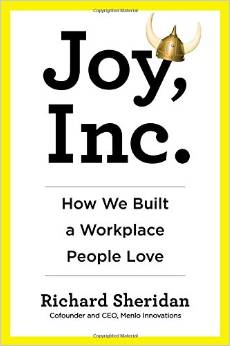
Book review: Joy, Inc., by Richard Sheridan

January 29, 2015 by Rosemary

Corporate joy? Is that an oxymoron?

It doesn’t have to be, according to Richard Sheridan. His company, Menlo Innovations, is devoted to “ending human suffering in the world as it relates to technology™.”

Sheridan’s book, Joy, Inc., (which was originally released in 2013), is a fascinating look inside his team’s “joy factory.”

book cover Joy, Inc. by Richard Sheridan

The casual reader might be tempted to approach this book with some healthy skepticism. The title conjures up a mental image conjured of a bunch of forced-wacky Kool-Aid drinkers.

In reality, the book provides a detailed explanation of systems, methods, and daily processes that are intended to result in joy. Joy for the employees, for the clients, and for the lucky end-users of the software being created.

Learning and teaching are at the core of the Menlo system, where colleagues work in pairs and progress is quite visibly measured on the walls. Humans need to feel that they are making progress in order to be happy, and that need is systematized at Menlo.

Here are just some of the ways Sheridan and his crew build joy:

  • Avoid having “knowledge towers,” employees who are the sole repositories of certain information.
  • Eliminate bureaucracy, and unnecessary meetings wherever possible. Consider having a daily standup where only those with useful information to share speak.
  • Use what Sheridan calls “High-Speed Voice Technology.” Talk to each other, openly and frequently. Stop texting and emailing people who are in the same building. Build relationships, which build value.
  • One of the key elements of a joyful culture is having team members who trust one another enough to argue. Stop hiring people who all agree with each other.
  • Consider reverse show and tell. Rather than presenting your client with a progress report, ask the client to tell the team what is going on with the project.
  • Use physical artifacts for planning and task execution, so that everyone can immediately see progress and status.
  • Hire for joy and build that into the entire process. Look at the human, not the resume.
  • Whatever you’re making, build in the delight/joy for the end-user as well. Find a way to build links between your staff and whomever will be using the work product. Menlo has a special position called “high tech anthropologist,” which is the link between programmers and end-users.
  • Create an atmosphere free of fear. You can fail, you can experiment. Don’t get stuck on something just because you’ve already invested a lot of time in it.
  • Break important HR rules, etc., like having babies or dogs in the office, as long as it’s part of your authentic culture.
  • Share leadership, and be vulnerable. Share your vision and encourage new leaders.
  • Strive for clarity and discipline.
  • Incorporate flexibility as part of the culture, as much as possible. This makes it easier to start new initiatives.
  • Accountability is important, but only when everyone is accountable, top to bottom.
  • Employees need the “ability to go to work and get meaningful things done.” Values must be pervasive and visible in every aspect of the business, from the work space to contracts, to partner agreements.

Menlo is serious about transparency. The conclusion of the book punctures the idea that it is utopia. There are problems, as there always will be when humans are involved. The key difference is that here, problems are openly acknowledged and tackled as a team, not behind closed doors.

I’d strongly recommend this book to anyone who is considering building a business, and especially those who are already running a business. There are ideas galore, and even if you aren’t producing software, Sheridan challenges you to find the joy in your daily business.

Do you look at joy as a business value?

Disclosure: I was provided a digital review copy of this book. My opinion is from the heart.

Author’s Bio: Rosemary O’Neill is an insightful spirit who works for Social Strata — makers of the Hoop.la community platform. Check out the Social Strata blog. You can find Rosemary on Google+ and on Twitter as @rhogroupee

Filed Under: Business Book Tagged With: bc, book review, project management

  • « Previous Page
  • 1
  • …
  • 91
  • 92
  • 93
  • 94
  • 95
  • …
  • 1050
  • Next Page »

Recently Updated Posts

The Creator’s Edge: How Bloggers and Influencers Can Master Dropshipping

Is Your Brand Fan Friendly?

How to Improve Your Freelancing Productivity

How to Leverage Live Streaming for Content Marketing

10 Key Customer Experience Design Factors to Consider

How to Use a Lead Generation Item on Facebook


From Liz Strauss & GeniusShared Press

  • What IS an SOB?!
  • SOB A-Z Directory
  • Letting Liz Be

© 2025 ME Strauss & GeniusShared