Successful Blog

  • Home
  • Community
  • About
  • Author Guidelines
  • Liz’s Book
  • Stay Tuned

Twitter Traction – How to Ask and Who to Ask

November 13, 2012 by Guest Author

by
Tommy Walker

cooltext443809602_strategy

Big Taboo about Asking on Social Media

So apparently there’s this big taboo about asking for things on social media.

On one side, there’s a camp that says you should never ask for anything EVER.

You should provide high quality content, engage in the community, tweet, share links, comment (you know the deal). and you should always so amazing that if you’re patient, people to come to you.

Then on the other side, you’ve got the camp that says, “why wait?” they use autofollow tools, DM everyone without regard, send mass emails to bought lists… There’s a name for these people – But I’m guessing the editor probably won’t let me use it ;-P

The Middle Ground

I’ve recently discovered a middle ground that was surprisingly simple, and returned results that were pretty shocking to me.

Just ask via private message.

I know right? Who would have thought?

For years, I’ve operated with this fear that if I sent any kind of request through a Twitter DM or Facebook message, I would be instantly labeled a spammer and my online career would crumble in seconds.

But it turns out, with a little finesse & a personal tone, you can use private forms of social media and people will take action.

Twitter Traction – How to Ask and Who to Ask

In this article, I’ll show you an example of how I’ve used private messages en masse that resulted in one of the most commented articles on my blog. Granted, you can’t spend comments, but those comments lead to guest post opportunities, mentions on other blogs and was the topic of conversation on a podcast. And more positive exposure never hurts, right?

The Caveat

You do have to provide value in your work. The person you’re asking should actually be getting something out of it. If it’s not advice, a good chuckle will do.

Whatever you do, do not waste people’s time. Send only that which you’re proud of and are willing to read 20 times in a row yourself. And be selective about who you ask and how frequently.

It also helps if your work already gets some traction on it’s own. It doesn’t have to be crazy, but it’s nice if people you don’t know are finding you without you having to push.

On to the rules.

Presentation — How to Ask

The presentation of your private message is all that that you have to signal to the receiver that you’re sending something useful. Get this wrong, you look spammer. Get it right, and you’re acting as a filter sharing something that’s worth their time. It’s a fine line, but I’ll show you what’s worked for me.

Step 1 – Appear legit. It’s very simple, add the person’s name. Crazy I know. But when you think about it, that’s something a lot of Auto DM programs DON’T do, so taking the extra step really counts. Plus, when you see your own name it’s an instant hook to your attention.

Step 2 – Find some unique angle that will pique their interest. For example, Let’s say I wanted to drive conversation to an article I wrote about online manipulation .

This particular angle is controversy.
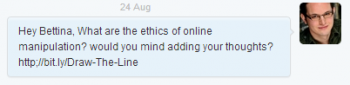
You might also use empathy,

humor,
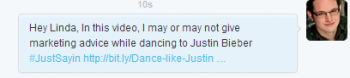
drama.
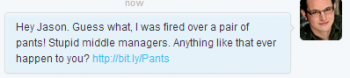
Really, you could use any number of angles, just make sure it’s compelling.

You may have noticed that most of these use questions and all of them have a customized link.

When I combine all the elements; the first name, the interesting angle, the question and the link; I’m trying to invoke the need to respond and click the link. The custom link just adds a little extra emphasis to the work the lines.

The first time I tested this, I DMed 34 people and 27 of them responded in the comments.

Now, like I said comments don’t add to my bottom line.

But they did lead to a guest post, a mention on a podcast and someone dedicated a whole blog post to talking about the tactic ().

All of this earns impressions of my brand, and brings links back to my site, improving my overall trust factor.

Comments may not do anything for my bottom line immediately, but when playing the long game, all of these things matter.

Segmentation – Who to Ask

So, one of the major reasons why any of this personal asking stuff works is because you’re being selective about who to ask in the first place.

First, they have to be active on the platform. Seems simple enough, but looking at every single profile to determine activity is time consuming, and will most likely be the first thing anyone using this tactic will overlook – I know I did. But, spending the time now saves you from wasting time sending to people who aren’t active.

Second, they have to have some level of familiarity with you.

You might think, “well they’re connected to me, so doesn’t that qualify?” And I have to ask how many people are you connected to on social media with no idea who they are or what they’re about. This is pretty much true for most social media platforms; except Twitter.

On Twitter, you can bend the rules a little. Here’s how.

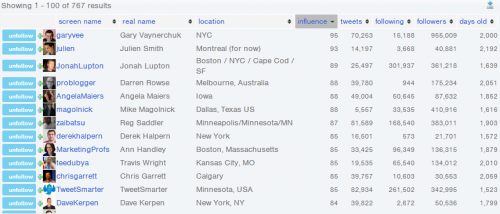
First- Go to FollowerWonk.com and click on the “compare users” tab

Second-Type in your twitter handle, and the handle of another author who covers a similar subject matter, or writes similarly to the article you’re trying to promote.

Then check out the “followers of both” link.

NOTE: DO NOT SEND DM’S TO EVERYONE HERE!!!!!

All you want to do is find people who wouldn’t be made too uncomfortable if you were to send them a Dm.

Even though Liz and I have some pretty influential people following both of us, I know I don’t have a relationship with them the same way she does, and wouldn’t want to risk making a fool of myself with really influential people.

However, if I sorted the influence list to show more “normal” people, I could find active twitter users that followed both of us who might also be more accessible

Again “ANYONE WITH A HEARTBEAT” IS NOT A GOOD CANDIDATE.

It’s important to make sure they’re active, but it’s critical that you check out their feed to qualify whether or not you should send them a DM. If they only tweet about macrame and you’re promoting an article about boating, it’s not a good fit.

If it’s somebody you don’t tweet with much, acknowledge that in your dm …

Hey Caylie. I know we don’t talk much but [Insert Hook Here] http://bit.ly/Successful-Dm

This adds an extra level of human to what would otherwise be a fairly robotic process.

And, If you’re wondering how you could get some “in common” followers, here is a great article to get you started with followerwonk(but check followerwonk first, most people I tell about this technique are pleasantly surprised.)

A Word Of Warning

Obviously this CAN backfire if you go overboard with it.

I would not recommend DMing all of your followers for every single piece of content you put your name on.

I would also give a people a healthy period of time in between when you ask for something.

I would ALSO make sure you go out of your way to do something even NICER for them, without being asked.

And I would be sure to thank them privately for when they do contribute.

The reason this method works, and what separates it from being total spam, is that it provides a filter for useful content in an otherwise flooded environment.

If you get selfish and forget that it’s about filtering good content to the right people – well, I’ll let you imagine what happens next.

So, I’m curious, have you ever tried direct asking before? If so what happened? If you haven’t, what’s the stupidest DM you’ve ever gotten that was clearly sent out by a robot. I’m certain we can get some pretty hilarious stories out of this one.

Oh, and if you know anyone who could benefit from this article,(or want to totally light it on fire) test this method out and let’s see how it works 😉

Author’s Bio:

Tommy Walker is the host of “Inside The Mind” a show that fuses online marketing strategy with internet generation humor. Currently, he is conducting a crowdfunding experiment for Season 2, which proposes to do no less than flip the world of online marketing on it’s head. You can find him @Tommyismyname

Thank you for adding to the conversation!

Buy the Insider’s Guide to Online Conversation.

Filed Under: Marketing /Sales / Social Media, Strategy/Analysis, Successful Blog Tagged With: bc, calling people to action, how to ask, LinkedIn, small business, Twitter traction, who to ask

Beach Notes: Stage of Flight

November 11, 2012 by Guest Author

by Guest Writers Suzie Cheel and Des Walsh

This was quite amazing to see a flock of seagulls in various stages of flight at Fingal Beach. Some just sitting, some preparing to take of, some in flight and some coming to land.

What stage of flight are you in?

– Suzie Cheel

Suzie Cheel & Des Walsh

Filed Under: Motivation, Successful Blog Tagged With: bc, Beach Notes, Des Walsh, LinkedIn, Suzie Cheel

How to Prioritize Your Time When Working at Home

November 7, 2012 by Guest Author

by
Deb Bixler

Keeping on Track is Keeping on the Money

When you have a work at home business, it’s great to be your own boss. It can also be a nightmare to manage your own time. When you can’t fire yourself, it’s hard to actually motivate yourself to get anything done. However, time is money, and when you can’t get yourself to keep on a time schedule, you are doing little more than wasting your time. Put these quick tips into place to keep you on track and help you prioritize your time when it comes to your business at home.

How to Prioritize Your Time When Working at Home

First of all, do the hard tasks first. When you prioritize your tasks in order of importance and skill, you are less likely to procrastinate before you get anything done. Do the things first that have a deadline, are hard to accomplish, or are just plain boring before you move on to the more fun aspects of your work at home business, like marketing, designing, or making phone calls.

If you have to, put yourself on a time schedule. Working at home we often do not work a set schedule as if we had a job. When you actually write a business schedule you may find that you go to work more regularly. Many people treat themselves as if they are an employee in a classic job, and make themselves work from a set time to a clock out time in order to stay on track. Many work from home business owners actually even put aside time for a lunch break. When you have a hard time keeping track of your time, it may be best for you to treat your job as if you are in a traditional office setting, even if you are your own boss and your job is merely your living room.

Finally, keep track of the hours you work. You’d be surprised how much you are actually not working in a work week when you see your hard work in hours. When you keep track of your work hours, whether you delegate yourself to a time schedule or not, you can see how much, or how little, you are actually working, and it may be just the motivation you need to help you get moving.

Many people will say the hardest part about having a work at home business is finding the energy and motivation to physically start the day. When you put a little discipline in your schedule and keep track of your efforts, you just may find yourself putting more time into your business, and making more money at the same time.

Author’s Bio:
Deb Bixler retired from the corporate world using the proven business systems that made her a success working for others by incorporated them into her home business. In only 9 months Deb replaced her full time income with the sales and commissions from her home party plan business. Find her on Twitter at: http://www.Twitter.com/debbixler

Thank you for adding to the conversation!

Buy the Insider’s Guide to Online Conversation.

Filed Under: Successful Blog Tagged With: bc, LinkedIn, Productivity, small business, time-managment

7 Email Marketing Strategies to Build Your Subscriber List

November 6, 2012 by Guest Author

by
Steven Taylor

cooltext443809602_strategy

7 Email Marketing Strategies to Build Your Subscriber List

Email newsletters are one of the cheapest and easiest ways to stay in contact with your readers and customers, but like any other marketing technique, they must be used in the right way to grow. Here seven ways to grow your subscriber list.
1. Offer something for free – It’s an amazing phenomenon – consumers generally will subscribe to anything for a “free” gift. Write an ebook about you industry and offer it to your new subscribers for free. Promote your ebook on your blog or website sidebar, encouraging your new and old readers to sign up for exclusive access. You’ll be able to capture email addresses to build your subscriber list while positioning yourself as an expert in your niche or industry. If your ebook is valuable enough to subscribers, they will be more likely to come back to your blog.
2. Offer exclusive content – This one is a great way to encourage return readers of an already active blog or business website community. If your readers love what you write, offer additional “bonus” content on a regular basis through your email subscriber list. Another idea is to offer quarterly bonus tips or tutorials for users who sign up for your subscriber list.

3. Offer a discount – In the same way customers will sign up for anything to get something free, they will sign up for an e-newsletter for a discount. Promote an offer – a small discount or free product at signup – and watch your subscriber list grow.
4. Make it easy – Subscribers don’t want to jump through hoops to get your content. The more difficult it is to subscribe, the less likely people are to sign up. Luckily, there are some free email newsletter services that make it simple. Mail Chimp offers an e-newsletter service that lets you add an easy-to-use form that you can place on your sidebar. Place this close to the top of your page so it’s one of the first things your visitors see when they stop by your blog. To make it even more clear, create a big, bold image that says “subscribe” that leads to the form.

5. Ask for referrals – Sometimes the best way to get something is to ask! Your subscribers might not think about forwarding your newsletter to their friends and colleagues unless you mention it. As an aside in your content (for instance, in the sidebar with a cool, eye-catching graphic) write “If you loved it, share it!” or something similar that asks for a referral in a casual way. Also, make sure you have share buttons visible for email, Twitter and Facebook. Create an HTML version with a subscription box visible so your newsletter content can be spread more easily through social media.

6. Offer point-of-sale opt-in – If you own a small business or an online business, offering point-of-sale opt-in is a simple and very effective way to build your subscriber list. This doesn’t have to be advanced – if you have a brick-and-mortar store, ask for a name and email if your customer is interested. If you have an online store, ask if your buyer would like to subscribe as they are checking out. Bloggers can even join in with the point-of-sale technique: at the end of a blog post, ask your readers if they’d like to join your list.

7. Don’t abuse your list – Your customers are giving you their personal information in exchange for your content, so make sure you don’t take advantage of it! Keep your enewsletters to a reasonable amount, and send our your newsletters in regular intervals and at a predictable time. Readers are generally overwhelmed with email, so your content has to be short, valuable and infrequent. Write short, catchy subjects so your readers know exactly what they will be getting, and never use “bait and switch” measures to get them to open. Offer what you say you’ll be offering.

Which of these 7 Email marketing strategies would work best for your business?

Author’s Bio:
Steven Taylor has been writing about technology and small business solutions for nearly a decade. When he’s not writing, you can find him reviewing Time Warner Business Class Internet services. View their website for more information about Steven’s work.

Thank you for adding to the conversation!

Buy the Insider’s Guide to Online Conversation.

Filed Under: Marketing /Sales / Social Media, Successful Blog Tagged With: bc, email marketing strategies, LinkedIn, small business

3 Ways Successful Women Entrepreneurs Apply Work Ethic

November 2, 2012 by Guest Author

by
Katie Donnelly

cooltext443809602_strategy

Women Entrepreneurs and Work Ethic

There’s a lot we can learn from successful women entrepreneurs. Although there are many routes toward becoming a successful business woman and supporting workplace diversity, one thing all top entrepreneurs have in common: a tireless work ethic. As Margaret Thatcher once said, “I do not know anyone who has got to the top without hard work. That is the recipe. It will not always get you to the top, but should get you pretty near.”

3 Ways Successful Women Entrepreneurs Apply Work Ethic

Here are 3 lessons we can all learn from successful woman entrepreneurs who know how to apply a strong work ethic to achieve their goals.

Take initiative and follow through.

A 2011 Zenger Folkman study that surveyed 7,280 leaders across a wide range of successful organizations found that women excel in many leadership categories, outperforming men much of the time. In fact, the two categories in which women outscored men most dramatically were taking initiative and driving for results. It should come as no surprise that taking initiative pays off. Women entrepreneurs do not wait around for a lucky break to come to them. They identify opportunities, take initiative and follow through to achieve their goals.

Do whatever it takes.

To make it to the top, you will have to put in long hours. Yahoo CEO Marissa Mayer used to put in 130-hour workweeks at Google, including regular all-nighters in which she slept under her desk. She managed to avoid burnout by being invested in — and keeping a positive attitude toward — her work. As she told Joseph Walker, “I don’t really believe in burnout. A lot of people work really hard for decades and decades, like Winston Churchill and Einstein . . . Burnout is about resentment. It’s about knowing what matters to you so much that if you don’t get it that you’re resentful.”

In addition to putting in long hours, sometimes entrepreneurs have to be willing to do work that no one else wants to do. Especially when you are first starting out, you will probably have to put in some grunt work before you can move up.

Practice self-development.

Finally, always be willing to practice self-development: women who are always looking for ways to improve have an advantage in business. The Zenger Folkman study also found that women were more likely than men to seek out personal and professional development. Katy Cowan, who runs the PR agency Boomerang and founded the online community Creative Boom, identifies a “willingness to learn” as one of the “top ten traits of successful, creative businesswomen.” She writes:

You cannot rest on your laurels when you run your own business. The creative industries are always changing, so you will constantly need to keep up and innovate. Successful female entrepreneurs know this and will work hard to learn and improve all the time. They’ll read books, go to workshops and be willing to learn from others.

There is no secret recipe to becoming a successful female entrepreneur. However, this combination of working hard, putting in the time and always being willing to learn something new has propelled plenty of women to the top.

Author’s Bio:
Katie Donnelly is a freelance writer in Philadelphia, who wrote this post on behalf of Navex Global, a leading provider in ethics and diversity training in the workplace.

Thank you for adding to the conversation!

Buy the Insider’s Guide to Online Conversation.

Filed Under: management, Motivation, Successful Blog Tagged With: bc, LinkedIn, small business

How Internet Business Changes with Video Chat

October 31, 2012 by Guest Author

by
Jason Phillips

cooltext443809602_strategy

What Offline Businesses Know

Small businesses have always been built on customer relationships. Strong relationships with your customers mean stronger stability for your business. Mom and pop stores on main street have lived off this truism for years and they continue to do so because so called brick and mortar businesses deal with customers in person every day. In many ways, customers are their business.

The Limits of Internet, Email, and Text

What internet businesses have forgotten, however, is that dealing with customers is their business too. That means that whatever Internet business you are in, dealing with customers is what you are all about.

Internet businesses, for all of their convenience and stocking capability, have always had been at a disadvantage from local brick and mortar businesses due to the lack of credible customer relationships. When a customer shops at a local business, they have the advantage of asking for a sales associate from behind the counter when they have a question or concern and a real person will show up and help them out. In addition, the customer and sales associate can build a solid relationship with each other over time. This means that if the customer is familiar with Jane because she was kind and helpful last week, he can come in the next week with his concern and ask for Jane again with a good reason to believe he will receive the same quality of service.

This kind of long term personal relationship model breaks down over the impersonal Internet.

Email and text chat have been the mainstay of customer support for most online businesses, but customers can’t connect to a user name the way they can connect to a face. For all the customer knows, a different representative could be using the same name each time and the customer would never know.

There is something about face to face communication that builds a connection between people that email and text can never do. While brick and mortar may have had the monopoly on this face to face personal touch to customer service in the past, video chat is quickly evening the playing field.

How Internet Business Changes with Video Chat

Have you ever noticed how a little baby will stare at your face for minutes on end while you hold them? This early staring at people’s faces is a developmental stage that is vital to all humans. This trains us to distinguish the thousands of different facial expressions and subtle emotions that are communicated through face to face communication. Text chat and email certainly can’t come close to this level of communication. And while voice communication provides the addition of voice inflection, it still comes nowhere close to the depth of communication achieved by face to face communication.

This is why video chat is vital to your online company’s customer service strategy.

The text based, impersonal and anonymous nature of the internet is changing under us with the advent of video chat. The internet is about to become a much warmer place because of the depth of communication now available between people.

The bottom line is that video chat is a great thing for your online business because it begins closing the gap between brick and mortar customer service and online customer service.

Make no mistake; this is going to be a challenge for some of us to get used to. After years of sitting, and maybe even hiding behind email and text, we are going to have to get back to the basics of good old person to person communication. We need to relearn good eye contact, good clear speaking and the elimination of all those “ums” and “ahs”.

Author’s Bio:
Jason Phillips shared this post. Jason is a freelance writer who enjoys the challenges of creativity and attention to detail. His articles on webcam chat are really appreciated by his readers. Jason always tries to provide unique and interesting content in his articles.

Thank you for adding to the conversation!

Buy the Insider’s Guide to Online Conversation.

Filed Under: Customer Think, Successful Blog Tagged With: bc, business video chat, customer-relationships, Internet business, LinkedIn, small business

  • « Previous Page
  • 1
  • …
  • 24
  • 25
  • 26
  • 27
  • 28
  • …
  • 109
  • Next Page »

Recently Updated Posts

Is Your Brand Fan Friendly?

How to Improve Your Freelancing Productivity

How to Leverage Live Streaming for Content Marketing

10 Key Customer Experience Design Factors to Consider

How to Use a Lead Generation Item on Facebook

How to Become a Better Storyteller


From Liz Strauss & GeniusShared Press

  • What IS an SOB?!
  • SOB A-Z Directory
  • Letting Liz Be

© 2025 ME Strauss & GeniusShared