Successful Blog

  • Home
  • Community
  • About
  • Author Guidelines
  • Liz’s Book
  • Stay Tuned

The How & Why of Adding to Other People’s Twitter Lists

December 12, 2013 by Rosemary

By Nick Kellet

Until now first person curation has been the name of the game when it comes to Twitter Lists.

Making lists on Twitter has been a solo task.

If anyone wanted to be suggest omissions to your lists it meant asking. Asking always causes friction. The need to ask stops people from acting.

No longer. Enter Listly. Friction free crowdsourced Twitter Lists.

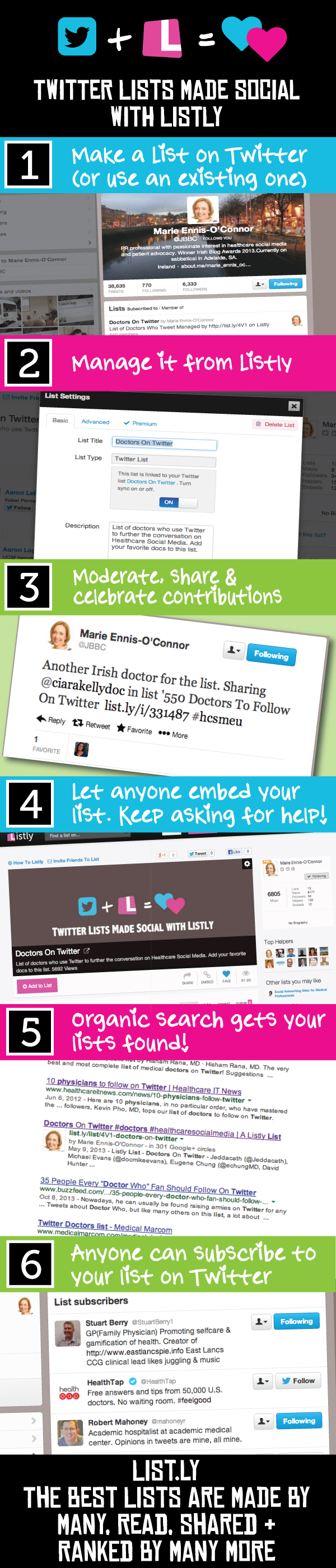
Now you can make a list on Twitter and manage it from Listly.

You get the best of both worlds:

  • Curate on Listly
  • Subscribe on Twitter

What that means is:

  • Anyone can add suggested omissions directly to the list
  • You can seed your lists from any number of other lists
  • Duplicates will be ignored.
  • You can auto accept suggestions or moderate suggestions via the Listly list queue
  • Items accepted to the list are added to your Twitter list (and the person added is notified via Twitter as normal)
  • Items removed from list or sent to the queue will be removed from your Twitter list.

People can get discovered for being on your list as you can embed the list on your blog (as can anyone).

If your blog is on WordPress (self-hosted), you can use the Listly plugin.

If not you can use the Javascript version, which works on just about every blogging platform except WordPress.com.

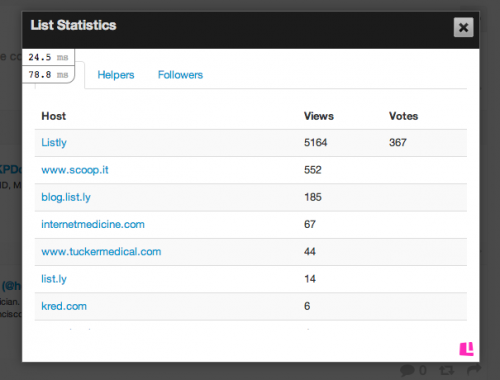
Here’e an example of a list of Doctors on Twitter – 600+ and growing fat – it’s been viewed 6k+ time and embedded on multiple blogs.

150+ people have helped to create this list.
List.ly list example

You can choose the layout you’d like to use to embed the list on your blog. Here’s a preview of this list in “Gallery” mode.

List.ly Example

Your Twitter lists become embeddable content that helps everyone on the list get found and in so doing, drives traffic to your blog.

As people can suggest omissions to your list over time your blog post will keep changing. People can also vote to change the ranking and order of the list. This keeps your content fresh in the eyes of search engines.

As your content evolves over time, new people will discover your lists and potentially share, vote and contribute. It’s a process that extends the lifecycle and value of your content.

With Listly, lists get better over time.

Here’s the workflow.

List.ly Twitter Infographic

Are you using Twitter Lists today?

Lists let you be more focused in the way you listen and engage. Lists are a segmentation tool. Smart marketing folk stay focused and segment their markets into targeted niches.

Segmenting on Twitter on your own is hard. It’s also a never ending task if you need to do all the work.

The Internet & The 1% Rule

Today we expect to be able to create, contribute or consume.

Regular Twitter Lists don’t follow this rule (no contribution) and that’s the issue Listly’s Twitter integration addresses.

Modern internet users expect to be able to participate.

Now, because anyone any can contribute Twitter Lists can follow the 1% rule

  • Create (1%)
  • Contribute (9%)
  • Consume (90%)

This means List become valuable resource where many people can help and consume what others have created. These lists get more valuable over time. People gravitate to trusted resources. Better lists get more subscribers.

These could be your lists.

You could be providing utility to your audience.

The real magic happens when you choose to collaborate and work with others.

Will you create resource for your local community?

Will you serve a global niche and help surface everyone in that niche?

This is how real communities form.

People connect around a passion.

Where will you begin?

Author’s Bio: Nick Kellet is Co-founder of Listly. Founder @Gifttrap & @AnswerSets. He creates & curates ideas, loves software & games, and is a master community builder. Connect with Nick on Google+ or LinkedIn.

Filed Under: Marketing /Sales / Social Media Tagged With: bc, curation, lists, Twitter

Site Crash: What’s Your Response Plan?

December 10, 2013 by Rosemary

By Michelle Rebecca

Website crashes can be detrimental to a company’s operation. If your host goes down, your software fails or your internet provider encounters a problem, it is your business that suffers. When these situations occur you are no longer able to conduct e-business or to monitor your site’s feedback.

In order to decrease the impact of site crashes it is important to have an emergency response plan. Below is a list of tips for helping your organization navigate a site malfunction.

Investigate the Issue

Once you have been alerted to an issue with your website, the first step is to look for yourself. While a customer or employee may have encountered a problem with your website, this issue could be related to their network connection or a number of other external causes.

Accessing your website and attempting to navigate the pages will determine whether or not this is an actual issue with the website or simply a problem on someone else’s end. For instance, if you were to check your site’s XML management page and find that it was down, then you would know you have an internal problem to manage.

Once you’ve established that there is a real problem, you need to find out exactly what the issue is. This issue may be related to your website’s host, a programming error or a network problem. Identifying the cause for the site crash will allow you to make a plan for contacting the necessary individuals and getting your site back up as soon as possible.

Programming Error

You can determine whether or not a site has a programming error by checking the status bar at the bottom of the page as suggested by Smashing Magazine. If this bar reads “loaded” or “done” then you can be sure that the issue is not related to the site’s software or server.

On the other hand, the terms “waiting” or “connecting” designate that the problem is in fact a programming error. Having identified this problem, you now know to alert your tech team in order to locate the error in the coding for your site.

Web Server Software

If programming is not an issue, then web server software may be the culprit. By logging onto your website’s server you can determine whether the server has run out of space, run out of memory or whether there is another situation of that nature.

Also, when you log in, many servers take you to a control panel that may indicate the problem for you. As for disk space and memory concerns, there are a series of commands you can utilize while logged into your server to view available space as noted in Smashing Magazine’s article.

Hard Disk Space

By inputing “admin@server$ df” in the command line of your server its disk space allocation will be displayed. This will display your site’s file systems and the percentage to which they are currently being used. If this percentage is 100 percent then you’ve found your issue and need to free up some space.

Memory

Considering the small likelihood that your server’s hard disk space is taken up, you should proceed to check the memory. Utilizing the “free” command will allow you to view how much memory is currently in use. From there you can determine whether a particular piece of software is slowing down your server and proceed to solve the issue accordingly.

Getting to the bottom of a website issue can be a time consuming and stressful situation. Use the aforementioned steps and tips to help identify website problems and to determine how to solve them.

Author’s Bio: Michelle is a blogger and freelancer with a passion for social media and blogging. She loves how social media connects people across the globe, and appreciates that blogging gives her the opportunity to voice her thoughts and share advice with an unlimited audience. Follow her on Twitter and Google+.

Filed Under: Blog Basics, Successful Blog, Tech/Stats Tagged With: bc, crash, server, technology

Marketing Your Blog in the Real World

December 6, 2013 by Rosemary

By Kelly Edwards

Blogging is not limited to cyberspace, and neither is promoting your blog to boost its recognition. In fact, marketing at events is an opportunity to access a whole range of readers and contributors that you might not have otherwise interacted with. But how do you assess if an event is worthwhile for your blog? Traveling to a networking event, paying for a ticket to a convention and even renting a stand to promote your blog are all factors that can make event marketing a more expensive choice, so how do you track if it’s the best choice to make?

Define Your Goals

While calculating the profit made from an event isn’t as simple as counting receipts for a blog, there are still ways you can attribute success to your event marketing. Tracking how many business cards you give out or flyers taken is a good start. You can also take a list of names interested in joining your mailing list (if you have one) or offer entry to a competition. These are all goals that you can measure throughout an event, however any positive effects in traffic or subscriptions may take a few days, perhaps even weeks to be felt.

Choosing the Right Event

Not every event is going to bring in the correct audience for your website. You may be tempted to attend a very large blogger event but will you be finding an audience that will actively want to engage with your blog? If you’re a niche site then it can be more effective to look into more specific blogging events, especially those in tune with your blog’s ethos. If you talk a lot about your local area then have a look into local tourism events which you could attend. If you post on a specific hobby or interest then look into events or exhibitions around these topics. This will lead you to a large group of attendees who are also a relevant part of your demographic.

Combining Real World and Online Marketing

Event marketing can still be supported by your online fans by promoting your attendance in advance. This can be on your own channel as well as outreach into other areas. If you’re attending a local event then would they appreciate some content on their website from upcoming attendees? Get in contact now and promote yourself and the event you’ll be spending time at. You can continue this after the event as well, offering posts on how you found the event and your experiences.

If you met people and exchanged business details then get in contact ASAP whilst you’re still fresh in their mind. You invested in networking and now it’s time to be proactive about all the new contacts you may have made.

Promoting at the Event

There are many ways you can promote your blog at an event and nothing is easier than wearing a branded t shirt. You can also give away branded goodies to those who show an interest in your subject of interest as well as cards and flyers. Ensure that your logo and brand colours are proudly on display and mesh with the blog itself to make the transition for the attendee as smooth as possible.

If you’re attending an exhibition or event with a stand then your promotional displays should be choreographed and also include the URL of your blog. A large and attractive banner will also grab more attention. If you’re promoting your blog at an event or exhibition that is traditionally more focused around sales or crafts then try to get a spot near a refreshment area so that attendees are more likely to slow down and look at your blog. Having an optimised mobile site will also mean that attendees that look up your blog on their phone will be able to quickly access your site.

Improving Your Approach

After your first event you will most likely realise where you can make improvements. Perhaps you were somewhat shy about approaching so many people so quickly. Perhaps you don’t feel as though you explained your blog succinctly enough and people lost interest. Perhaps you regret spending too much or not enough setting up an attractive exhibition for your blog. Whatever ideas enter your head for how you can improve next time, ensure you write them down now! You can also start mapping ways that you can approach these challenges and improve your marketing strategy.

Combining these elements will lead to excellent promotion of your blog at an event and hopefully some greater recognition for your brand.

Author’s Bio: Kelly Edwards writes about promotional display materials and helping businesses at http://www.marlerhaley.co.uk. You can find her on Twitter as @MarlerHaley.

Filed Under: Marketing /Sales / Social Media, Successful Blog Tagged With: bc, events, marketing

You’re Only A Stranger Once

December 5, 2013 by Rosemary

The tagline for this blog jumped off the site at me the other day.

Liz says, “you’re only a stranger once.”

You're only a stranger once

The first time you encounter someone, whether it’s online or offline, you have a lifetime of possibilities floating between you. There’s no messy experience to muddy the waters, no shared history. As strangers, you are just two molecules floating around.

Kaboom.

The molecules collide.

Now the possibilities start to develop.

Will you share a laugh in your first meeting? Will the other person say something that violates your personal code, and immediately cut off the possibilities? Will you decide to have a second experience together?

I recently had the great pleasure to welcome a new customer who arrived via a two year long, circuitous series of molecular collisions both in real life (at conferences) and online. And the most wonderful thing is that, when each of the encounters took place, neither one of us had an “endgame” or “agenda” in mind, other than being open to meeting new people.

If you’re open to the possibilities, then the happy accidents can happen. And they happen more frequently, the more you put yourself out there. Magically, the byproduct of this open intention is that you can become a “super-collider.”

The beautiful tagline at the top of this page means something. Whether it’s your first comment, your first submission of a guest post, your first time attending a SOBCon event, your first time reading this blog, you’re only a stranger once.

Everything after that is possibilities.

Author’s Bio: Rosemary O’Neill is an insightful spirit who works for social strata — a top ten company to work for on the Internet . Check out the Social Strata blog. You can find Rosemary on Google+ and on Twitter as @rhogroupee

Photo Credit: pshab via Compfight cc

Filed Under: Community, Motivation, Successful Blog Tagged With: bc, Community, connections, networking

Managing to Expectations: A Primer

December 3, 2013 by Rosemary

By Dipti Parmar

The best advice I received during my career in corporate America can be summed up in these four words; inspect what you expect. These four words that can provide focus for managing a business, a staff, a team, and even your children.

When it comes to business, the only metrics you should concern yourself with gathering are those that will help you make the right decisions. Most analytical software tends to emphasize metrics that might make you feel good about your business but do not really provide any useful guidance for making decisions.

For example, a report that reveals you have a total of 20,000 “hits” to your website may make you feel good, but the report tells you absolutely nothing about how you achieved those hits. In this sense, such statistics aren’t terribly useful.

You may have seen this in your business. You launch a new feature or product and a few days later sales and revenue are up. Everyone pats themselves on the back. The product guys think it is the result of the feature, the sales guy thinks it’s the new promotion and the customer service people think it’s the customer-friendly policies. The fact is, you don’t really know what caused the up-tick, but when sales and revenues drop back to baseline … no one wants to accept the blame!

Compare this to what I would describe as an actionable metric. For example, by adding a new feature to your website but allowing only every other customer to see it, you would be able to examine both sets of revenue streams a week later and make some meaningful conclusions. This metric is designed to allow you to ascertain the effectiveness of the new feature based on revenue differences. If the new feature increased sales, then you obviously want to implement that feature for all your customers. If you see that it didn’t move the needle for either group, you could scrap it. The important take-away here is that these types of metrics are actionable. It is data from which a conclusion can be readily made and acted upon.

How to Achieve Actionable Metrics:

Split tests—such as the one I described above, will allow you to take the right course of action on anything from minor copy tweaks to major product changes. These tests are widely known as A/B tests and you can get more information and background from this whitepaper titled “Controlled Experiments on the Web: Survey and Practical Guide” (PDF).

Per Customer Metrics—because people are metrics! Ordinary metrics can fog our focus on reality by diverting attention to unreal groups and pseudo concepts. It is significantly advantageous to examine data from a per customer or per segment perspective. Try focusing, for example, on the number of page views per new or repeat customer rather than just the total number of page views. Per customer data can indicate that you are increasing the level of engagement with your customer. Looking at aggregate data will not reveal this trend. There are several analytical packages that offer a business the ability to reduce aggregate data to per customer and/or per segment analyses. One is Google Analytics, which in combination with Google’s goal tracking feature will allow you to see which web referrers are driving the most conversions. Armed with this information, you can make decisions on which referrers are worth your time and money. This allows your business to maximize its return on investment.

Group analysis and funnel metrics—can be among the most useful metrics for forward decision making. For purposes of illustration, let’s say you have an e-commerce product with a few life-cycle events. These may include registering for the product, signing up for a free trial, using the product and, ultimately, buying the product. A simple report can be created to show these metrics for groups in a defined time period. For example, you might create a weekly report which shows what percentage of customers registering in that week went on to take each life-cycle step. If these numbers reflect no changes from group to group, then we have learned that nothing significant is happening. If one spikes up or tumbles down, then we have an unmistakable reason to investigate. Using funnel metrics to consolidate this data into a few useful numbers is easy to do manually, even if you have a large number of registrants. Simply break out the old fashioned index cards and record the number of customers registering each day. Then for each conversion (sale), make a tally mark on the index card corresponding to the date that customer registered (not the date they bought). Then on a weekly or monthly basis, you can compute conversion rates for the customers registering in that time period. Obviously, it is this number you want to focus on driving up!

What I have shared here today has been focused on the e-commerce business but the theme of managing to expectations is equally applicable to brick and mortar businesses. The idea of inspecting what you expect is applicable to all business enterprises, from invoice financing companies like CBAC Funding to the mom and pop dry cleaning store in your neighborhood.

If you expect to achieve a goal, measuring your progress is essential; otherwise, how will you know you reached it?

Author’s Bio: Dipti Parmar, a digital marketing wiz is associated with E2M Solutions. She’s been journeying through the world of digital marketing for 6 years and is a blogger and networker. She’s also a movie buff and loves taking long walks by the seashore. She is @dipTparmar on Twitter.

Filed Under: Business Life, Strategy/Analysis, Successful Blog Tagged With: A/B, Analytics, bc, testing

Savvy Blog Growth Tips for Small Businesses

December 3, 2013 by Rosemary

By Christopher McMurphy

The phrase “adapt or die” has proved true in the animal kingdom, and it has a place in the wild world of marketing as well. Monumental shifts in the advertising landscape since the advent of the Internet have only served to buttress this point. And while larger organizations often have the full weight of entire marketing departments at their disposal, it can be difficult for smaller operations to keep up with the trends. And failing to move with the times can spell certain death for any outfit.

But those small businesses that feel they lack the means to mount an effective online marketing campaign are sorely mistaken. Any organization, big or small, can utilize modern, proven methods to convert leads into customers and generate that attractive ROI. Here’s how.

Set a schedule

Those running an operation themselves may rightly feel they don’t have much time to commit to crafting and posting regular blog posts. That said, there’s no need for the frazzled business owner to overextend him or herself. Owners should commit to a preliminary schedule that involves making at least one post per week. Once a firm schedule has been set, owners can then focus on increasing the output over a period of time, such as to multiple blog posts per week.

Hire out

Some owners may simply be too busy to even commit to one or two posts per week, and that is understandable. However, that is no reason to forgo a blogging strategy entirely. Time-strapped owners can outsource their needs and hire writers from across the web. There are plenty of quality guest bloggers out there, all with the skill and expertise required to contribute authoritative, original blog posts on a variety of subjects.

Engage

In the world of blogging, the hard sell is anathema to success. The most successful bloggers reach large audiences by getting personal with their readers. When it comes to small businesses, owners are going to want to craft an overall theme to their blog posts (helpful DIY tips, Top-5 lists, etc., etc.) and engage while staying on message. Oftentimes owners find success in this manner by adding personal details and experiences within the content.

Offer help

The best (and most successful) blogs contain content that is of some use to the reader. The average web surfer is highly likely to bypass all blog posts that contain nothing more than sales pitches on their way to more helpful content. That means the blogger needs to be credible in the field in which they write about. An auto parts business, for example, should consider publishing posts on DIY auto repair, as this is of use to their target audience.

Be honest

One of the best ways small business owners can achieve success through blogging is by being honest. The most successful blogs around are transparent and forthcoming about what it is they represent. Fine print doesn’t translate in the blog world, so business owners should air on the side of prudence and gain trust through total honesty.

In the end, if there’s one thing that all small business owners and operators should take away from this article, it is the need for consistency. All the content in the world won’t matter much unless it is visible on a regular basis. That means being diligent in adhering to a firm blogging schedule is paramount for any successful content strategy.

Author’s Bio: Christopher McMurphy is a seasoned blogger and expert in the field of digital marketing. Among other things, he focuses on SEO, copywriting and social media.

Filed Under: Blog Basics, Checklists, Successful Blog, Writing Tagged With: bc, blogging, small business strategy

  • « Previous Page
  • 1
  • …
  • 43
  • 44
  • 45
  • 46
  • 47
  • …
  • 84
  • Next Page »

Recently Updated Posts

Is Your Brand Fan Friendly?

How to Improve Your Freelancing Productivity

How to Leverage Live Streaming for Content Marketing

10 Key Customer Experience Design Factors to Consider

How to Use a Lead Generation Item on Facebook

How to Become a Better Storyteller


From Liz Strauss & GeniusShared Press

  • What IS an SOB?!
  • SOB A-Z Directory
  • Letting Liz Be

© 2025 ME Strauss & GeniusShared