Successful Blog

  • Home
  • Community
  • About
  • Author Guidelines
  • Liz’s Book
  • Stay Tuned

Get Your Out-of-Whack Back in Whack Again!

August 2, 2010 by Liz

Whack Your Process Models Back Into Shape

cooltext443809602_strategy

As I remember the number is 10% change, but when I say that people say it’s probably more like 20%. I tried looking up the research and I couldn’t find it. But the actual percentage doesn’t matter … because the effect is clear when tell you the effect of the change.

If you change the personnel on your team by 10%, all of your process models fall apart.

Go ahead tell me, it’s really 20% (you know who you are). Like I said the number doesn’t matter. The change does.

Think about it.

1066753_there_may_be_trouble_ahead_2

If you’re used to working alone and you’ve added one person to the project, you’ve changed by more by 100%. If you’ve had three people on the team and one leaves, you’ve cut your team by 33.33%.

Things like this happen all of the time. We add new people. People move to new roles. People leave for other jobs in other places. Volunteers and others hide out in caves or disappear into open spaces.

Yet we keep working in the same order, thinking the process is the same process. Except now, the process is out of whack, broken, and discombobulated. This happens to entrepreneurs and huge corporate teams. Are you there?

Twelve Signs that Your Project or Process Is Out of Whack

Here are 12 signs that your project or process is woefully out of whack:

  1. The next step doesn’t seem clearly visible.
  2. No one knows who to invite to which meeting.
  3. Emails are flying like crazy, but don’t seem to be helping.
  4. The people to keep in the loop seems to shift from everyone. That advisor group you might rely on has become undefinable.
  5. Your work seems to have too many moving parts.
  6. Your project doesn’t have enough brains, hands, or eyes to get done right, well, and on time.
  7. Procrastination is looking like a good thing.
  8. Moving forward would be easy if you could pinpoint which way that might be.
  9. You might have lots of resources, but don’t know how to get them working.
  10. When someone asks, “How can I help?” Your answer is a blank stare.
  11. Success isn’t feeling like an option.
  12. You spend more time talking about how to get the work done, than actually working on the project.

Recognize any of that? Let’s that whack back into things.

Get That Out-of-Whack Back in Whack Again!

Execution and productivity are a natural result of great process. A great process model takes advantage of your skills and minimizes the time it takes move things.

Stop. Redefine your process. An hour or two getting the process model right will speed communication, trust, and the quality of work exponentially.

If all of your models are out of whack do this for one typical project, then adjust the model as you move forward.

Here are some questions to get to the right process model.

  • What will the finished work look like?
  • Who does the finished work depend on?
  • Who are the key people who belong on the communication and command team? How can we keep that to key people who inform others who work them?
  • Who’s accountable for what pieces when?
  • How will the work get passed from one stage / team to another?
  • In what ways can the process flex? In what ways must folks check in before changing the process?
  • What tools will be used to communicate changes, issues, news, and updates?
  • Who will update the status of the project and how will that be done?

Whether you’re a team of one or a team of 30, a process that is back in whack saves time in decision making, improves communication, saves resources, lowers costs, and stops details and fires from running / ruining projects. Your confidence and trust in your work will grow as the process model takes shape and folks around you will see the progress as competence, power, and expertise.

How will you firm up your process models?

–ME “Liz” Strauss
Work with Liz on your business!!

Buy the Insider’s Guide to Online Conversation.

I’m a proud affiliate of

third-tribe-marketing

Filed Under: Strategy/Analysis, Successful Blog Tagged With: bc

Who Won’t Let Your Business Fail?

July 20, 2010 by Liz

We Need Someone Outside the System We’re In

cooltext443809602_strategy

Some kids learn to ride a bike by just getting on one. They ride and fall down until the falling down part stops. Other kids have the luxury of someone who runs alongside the bike helping them balance as they ride. Those kids get fewer bruises and meet the sidewalk head on fewer times.

Launching a new idea, product, or service is a lot like riding a bike, or maybe more like trying to ride a horse after you already know how to ride a bike.

652124_44692591_cool_bike-2


We have a grand idea. It’s a good plan. We’ve think through the audience, how we’ll reach them, and how we’ll connect them to each other and our grand service, amazing product or outstanding event. …

Whether we work alone or on a highly competitive corporate team, the hardest part of our work is to get a balanced appraisal of our idea before we take off on the ride.

Why is that?

Each of us is inside a system — a network, a business, a circle of family and friends. Shouldn’t we be able to find help there? Maybe not, because …

  • some people who helped build the idea — participated in the thinking. They can see how we got where we’re going, but not necessarily what we’ve missed.
  • some people in our system often want to maintain the equilibrium of our relationships. Unless we’re about to ride off a cliff or over broken glass, they’ll let us try what we might even when they’re not sure they can see any way it will work.
  • some people in our system have already decided about us and our ideas. We know the people in our system who always say, “that’s brilliant,” “that won’t work,” “we’ll see.” “just go for it,” and “where do I fit in?” to every idea we have.

The problem is that we can’t see the holes in a plan that we’ve made. What we need is the feedback of a naive intelligent customer who doesn’t know how we got to our idea.

Who Won’t Let You Fail

What every system needs is someone outside the thinking to come in at the end to say “Why that?” Imagine a guiding angel (not a devil’s advocate) who is 100% for seeing you and your team succeed with the highest quality result.

The businesses who do more of this are the ones who come to market with renewed confidence. Recently, Dell did a great job of seeking out this kind of advice with their #DellCap initiative. (thanks Dell!) Old Spice has been listening in lots of new ways. SOBCon owes much to so many people: Britt Raybould, Kevin Ferrasci O’Malley, Geoff Livingston, Sheila Scarborough, Chris Brogan, Becky McCray, Jason Falls, Carol Roth, Jonathan Fields, Stephen Smith, Chris Cree, and too many others to name– who have told us their truth while we were working on ideas.

What we need is someone who won’t let us fail. Do you have someone who will

  • keep you and your team focused on your end goal and your passion
  • hold you accountable for your goals.
  • stays out of the thinking and developing in order to question your decisions without prior knowledge of how you got to them.
  • point out hidden assumptions and risks
  • make sure you’re not underestimating your abilities or setting the bar too low.
  • tell you when you’re building for yourself rather than the people you serve.
  • won’t let you fail or limit reach and will tell when you’re in danger of doing so.
  • keep your confidence and trust as you talk about what your worries are.

We can’t be inside the thinking and outside the thinking at the same time. Having someone outside your system who won’t let you fail is the best investment a business can make. A few hours a month to check in on what’s planned can save thousands in time and resources invested in the wrong things because no one noticed the hidden assumption in your plan.

The question isn’t whether the outside source is paid. It’s whether the source can tell you the hard truth gently. The right source would risk your relationship rather than let you fail.

Some folks have it in their DNA that they can’t stand to watch anything fail. Find a few of them and get them on your team. Make them heroes. Listen to what they say or they won’t stay around long. What better safety net can a business have than people who won’t let them fail?

What companies do you know who have found a way to listen to folks outside the system who won’t let them fail?

–ME “Liz” Strauss
Work with Liz on your business!!

Filed Under: Motivation, Strategy/Analysis, Successful Blog Tagged With: bc, Dellcap, LinkedIn, sobcon

Here’s How You Gain Customers As You Grow Your Product Line

July 19, 2010 by Liz

Be Visible, Be Focused

cooltext443809602_strategy

Mike and Larry (not their real names) had an idea. It was simple. When they came to me they had already figured out to enlist other folks by inviting them to be partners, experts, and heroes and their idea became a fabulous reality — a great first success. After their event, we talked about how to leverage their success into something longer and more lasting.

They had so many ideas! Their ideas were all over the place.

Whoa!

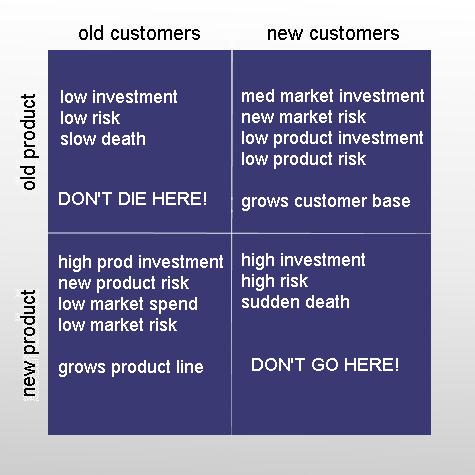
We stopped to take a strategic look at what was already at their door and where natural managed growth might go. We started with this model to guide the plan.

oldnewcustomer

  • [top left box] What is your core product / service? Who is in your core customer base? What was the form of your first success? Who are the customer you reached with your first success?

    Mike and Larry had developed an online webinar that had gained a huge following of fans — a core group of online small business folks, particularly pr and marketing people. We named them “old product” and “old customers” to remind us that we were focused on expanding both the product line and the customer base. Doing the same thing for the same people only leads to slow death

  • [top right box] How can you offer that same product to new customers? To extend the circle of people that attended the original webinar, Mike and Larry are offering it as an mp3 and a transcript. They may also use some as newsletter content and possibly later put it in a paid content subscription site.
  • [bottom left box] How can you keep serving the customers you reached with your first success? Mike and Larry have already started a second webinar series on a new question. They’re looking at new forms of the webinar, text versions of the same idea, a book, and offline events.
  • [bottom right box] How can you keep to solid path? Once we discussed how much bandwidth and risk it takes to veer away from a core audience and product niche, Mike and Larry agreed that the lower right box isn’t for them.

Ideas are good, but it’s hard to choose which will take you to the place you want to be, if you don’t know where you want to go. On the other hand, knowing where you’re going is irresistibly attractive.

All you need to get started is two questions: Who’s in your core audience and what is the first thing you will offer them?

I can’t wait to hear.

–ME “Liz” Strauss
Work with Liz on your business!!

Buy the Insider’s Guide to Online Conversation.

I’m a proud affiliate of

third-tribe-marketing

Filed Under: Marketing /Sales / Social Media, Strategy/Analysis, Successful Blog Tagged With: bc, LinkedIn, models, Strategy/Analysis

12 Outstanding Managers Share How They Delegate for Success

July 13, 2010 by Liz

Take Too Long to Teach Someone? How Long Will It Take if You Don’t?

cooltext443809602_strategy

Personal bandwidth who has enough?
Whether we work for a huge corporation or work for ourselves, learning to ask for help in positive, profitable ways is a learned skill. We all have to learn to delegate well or we can’t grow beyond what we can do by ourselves and do well. Without delegation skills, we’ll be stuck as builders, line item worker, mid-level of execution because we won’t be able to …

  • grow past what one person can do in day.
  • trust people who have skills we don’t.
  • move to higher level thinking by passing on what early learners can do.

With that thought in mind, I asked 12 outstanding managers (13 if you count me) this question …

How do you delegate responsibility to inspire the best performance from people you work with?

Here’s what they said.

Know the Outcome You Want

The key to be really clear on what you are looking in a position or on a specific project — and by that I mean, first with yourself. If you don’t have a clear idea in your own mind — if you instead have only a vague notion — it’s pretty difficult for anyone who works with you. And that’s a frustration for everyone. Do I sound like I’ve been there? Uh.. yeah! — Ann Handley

Work with and Trust the Right People

Simple as it sounds, sometimes we reach for the nearest person to help, rather than taking time to identify the person best suited for the work we have. Taking a moment to look at the skills required and match the person to the job can make a HUGE difference in the success of a job.

You are correct, not having enough time to get everything done is a top concern for most of us. I know it is for me. I think that the key is to recognize that you absolutely cannot do it all on your own. And the responsibilities will only increase, so it becomes a necessity to bring in an assistant or even a team to help with time-draining details. Spend time hiring the RIGHT people that can be reliable and trustworthy and then TRUST THEM TO DO IT. — Kelly Olexa

I make sure to delegate squarely in the sweet spot of the other individual’s skill set, which usually maps to one of my weaknesses. This gives the teammate the opportunity to take ownership and feel important (which, in fact, they are!) — Steve Woodruff

First, pick and work with great people, if you want the best performance. Second, never let an issue fester, when you could address with an open honest, if painful, communication. — Becky McCray

Set Clear Expectations

Often when we work with someone we respect, we “endow” that person with great traits. We unconsciously assume he or she will deliver things that we don’t mention when we “hand over” a task.

Clearly state the task to be done, set a clear goal and give feedback when the task is completed — Barry Moltz

I am a control freak, so it is not in my nature to delegate. It has to be a process of discussion and mutual trust, then I let go (as best as I can). This means agreeing time frame, ensuring the person I am delegating to knows EXACTLY what is expected of them, and talking through everything they need before they can get started. — Chris Garrett

First, I make sure I’m clear about what I’m delegating. In other words, I try to make clear the work I expect the person to complete and the decisions that they will be responsible for making.

Second, I try my hardest to trust. This is the only way to not be a micro-manager. Truth is, people have brains and ideas of their own…they might make choices that are different than what I would choose. When they do, I want to learn how why they did, so I ask their rationale. More often that not, it’s sound.

Combined, I believe that these two things allow me to get the best performance from the people I work with. — Scott Porad

Let People Know Why You’re Counting on Their Performance

To get great work, communicate how it important a project is and why it’s important. Let people know that you’re counting on them for their best. Nothing ruins performance more than thinking someone might come behind us to “redo” what we’ve just done.

I get the best results when I explain not only the tasks at hand but also the purpose. Understanding the reason why something needs to be done and the general purpose / objectives behind the work gives the person performing the work extra insight and inspiration to do their best. — Carol Roth

Rather than delegating responsibility I try to delegate “soul”. Always make sure the person knows “why” what I am doing and delegating is so important to me. It becomes an emotional bond rather than a functional responsibility. — Hank Wasiak

Be There After the Assignment

It’s a risk to delegate and forget a project. Often a check back will reveal something that we’ve not communicated well. Sometimes a question or an offer to “take a look” can empower someone to perform at even higher levels.

I work my best to create simple systems and empower those I work with by asking how I can serve them to get the job done better, easier, and faster. — Lewis Howes

Value Great Performance

Everyone likes to be paid well, but payment comes in many forms. Gratitude for great work, referrals, and citations add to the mix of what inspires people to want to do their best work for us.

Explain the task. Illustrate its importance. Communicate the benefit to them. Then make sure the benefit happens. Even if it’s just a “good job” you can’t forget the praise or next time they’ll forget to follow through. — Jason Falls

and Remember to Delegate Even When You Don’t Want to …

The point is that delegating today might mean that it will take you two days to teach someone how to do something, but two days from now they’ll know how … If you don’t delegate now, two days from now you’ll still be someone who has to go it alone.

I suck at actually IMPLEMENTING this, but I DO try to remember it as guidance….learned it from a smart guy on an Admiral’s staff….

“It’s not a question of ‘What must I do?’ It’s a question of ‘What must get done?’ Stuff has to get done, but that does not mean that I – personally – must do it.”

— Sheila Scarborough

Asking for help clearly with focus on the person and the work that needs doing can actually improve our performance and make our value greater. After all, who doesn’t know someone who does something better than we do?

Where might a little delegation raise your visiblity, your performance, and the amount of work you get done?

–ME “Liz” Strauss
Work with Liz on your business!!

Buy the Insider’s Guide to Online Conversation.

I’m a proud affiliate of

third-tribe-marketing

Filed Under: Business Life, Strategy/Analysis, Successful Blog Tagged With: bc, delegation, LinkedIn, project management

The Biggest B2B Marketing Mistake and What It Means to Social Media

June 22, 2010 by Liz

Are You Serving the Wrong Customer?

cooltext443809602_strategy

A hot topic on the web is whether social media can work for companies who work B2B. Of course it can. Social media tools are simply tools for connection. Like email and the telephone they don’t discriminate about connecting people who at businesses to people who run businesses from connecting people at businesses to people who are considered to be end users of the products we build.

A good part of my career I spent building products for a B2B2B kind of market. The textbooks we made were mandated by politicians, sold to schools, used by teachers and students. It was a complicated sales and marketing process filled with “adoption” scenarios, standards documents, and presentations.

In the early years, I did a lot of looking in the wrong direction. Are you doing that too?

The Biggest B2B Marketing Mistake

The biggest marketing mistake B2B businesses make is considering the business they sell to as their customer. It works in these ways:

  • I build something for Larry’s Business to sell to Larry’s customers. I listen to Larry and make Larry my customer.
  • Everything I build is for Larry’s approval.
  • Larry is the only one looking out for Larry’s customer. He’s left to do all of the thinking.

That worked for me until I got to be Larry. Then I realized I should have been looking at Larry’s customers. I would have been so much more valuable to him if I had been participating in evaluating what I was doing from the point of view of the people he served.

and What It Means to Social Media

So what does that mean to social media? How can social media work in a B2B world?

If we understand that our role in working with businesses who sell to other businesses is to help them grow their businesses, then we can use the tools that the Internet gives us to

  • uncover and discover information that better defines what those customers value — what irritates them, what is essential to them, and what they consider more important than lower prices.
  • connect our business clients build networks with people in other industries who want to solve similar problems
  • offer information, research, and case studies via webinars and seminar about the latest tools and processes for serving their customers
  • show them how to use the social web to see and serve the customers of the businesses they serve.

Social media tools and models work the same for B2B as they do for B2C if we realize that that B2B businesses want networks and information.

Network Solutions and Radian6 do B2B well.

What other great examples of B2B social media come to mind immediately?

–ME “Liz” Strauss
Work with Liz on your business!!

Buy the Insider’s Guide to Online Conversation.

I’m a proud affiliate of

third-tribe-marketing

Filed Under: Strategy/Analysis, Successful Blog Tagged With: B2B social media, bc, LinkedIn, Strategy/Analysis

The Preschool Teacher and the 3 Year Old: When Customers Misbehave!

June 7, 2010 by Liz

Not a Focus Group Kid

cooltext443809602_strategy

I’m a teacher. I love teachers. We’re all teachers in some way. So I can tell this story with friendship and compassion. Besides if you read on, you’ll see it’s not about teachers at all, but about companies and customers …

From the start we knew our son wasn’t going to be “focus group” material. He decided when to be born — and even then, the doctor had to go to extremes to convince him to join the world. (I was pretty sure he’d be driving a car out when he did.)

By 2, he could write, spell, and read, but he had no interest in conversation. He didn’t draw until he was 5. He preferred to examine the world through his own eyes and perfect his handwriting, like an athlete or a musician might — hours a day, practicing each movement until he perfected it and then practicing again. That same year, he developed an entire sign alphabet.

Let’s just say that in his preschool class, our son was a niche market. His preschool teacher, an upright authoritarian, was used to serving a one-size-fits-all market. She had her objectives, her goals, and her expectations. As you can imagine, theirs was not a relationship made in heaven.

At the first teacher-parent conference, Ms. Authority laid it all out for me exactly what my son was doing wrong. I heard a short litany of complaints about this young customer misbehaving.

Of course, the problems were all his.

  1. He doesn’t pay attention. “I work hard everyday planning magnificent lessons around fans and feathers,” she said. ” … so that he can learn the letter f,” she went on. “He ignores what we’re doing and walks over to the magnifying glass. He looks at wheels on toy trucks and spines on books.”
  2. He’s defiant. “When I tell him to sit in the time out chair, he defies me. He outright asks what will happen if he doesn’t sit there!”
  3. He’s got a hearing defect and could be deaf. “No matter how loud I talk, he doesn’t pay attention. You need to have him tested. I think he might be deaf.” (I’m not making this up.)

Except, I knew the problems weren’t problems at all. It was all I could do explain that to her. You see, this customer was ignoring her because she had nothing to offer.

  1. He already knew how to read, write and spell. Had she let him near the magnetic letters he would have written out words like “cough” and “pharmacy.”
  2. He’s curious and careful, not defiant. Had she gotten to know him, she would have found out that he can’t make a decision without knowing where it would lead.
  3. It wasn’t his hearing. Had she walked up behind him to whisper “chocolate cake,” she might have seen how well he listened to important words.

Instead, she was the center of her universe. She saw her customer through a filter of expectations. The data set said his behavior was not right and she filled in an explanation.

She had made the offer about HER … not about him.

487232_magnet_letters

With the right offer to the same customer — say a magnifying glass and a set of magnetic letters — she might have made a loyal fan who would be looking for what she was going to bring out next for him.

We do the same thing in business, we design something that we’re sure the perfect customers will love, but sometimes we forget to ask them what thrills them.

What do you advise when someone complains about customers misbehaving?

–ME “Liz” Strauss
Work with Liz on your business!!

Buy the Insider’s Guide to Online Conversation.

I’m a proud affiliate of

third-tribe-marketing

Filed Under: Marketing /Sales / Social Media, Strategy/Analysis, Successful Blog Tagged With: bc, customer-service, LinkedIn

  • « Previous Page
  • 1
  • …
  • 12
  • 13
  • 14
  • 15
  • 16
  • …
  • 48
  • Next Page »

Recently Updated Posts

Is Your Brand Fan Friendly?

How to Improve Your Freelancing Productivity

How to Leverage Live Streaming for Content Marketing

10 Key Customer Experience Design Factors to Consider

How to Use a Lead Generation Item on Facebook

How to Become a Better Storyteller


From Liz Strauss & GeniusShared Press

  • What IS an SOB?!
  • SOB A-Z Directory
  • Letting Liz Be

© 2025 ME Strauss & GeniusShared