
Successful Blog

  • Home
  • Community
  • About
  • Author Guidelines
  • Liz’s Book
  • Stay Tuned

How Much Can the Wrong Hire Cost You?

October 23, 2013 by Thomas

Hiring a new employee carries some risk.

The person you choose to hire may look and sound great during interview, but he or she may turn out to be a poor performer in the end. It is essential that you try to avoid making a wrong hire, because it can cost your company dearly.

According to The Harvard Business Review, about 80 percent of employee turnover results from poor hiring decisions. Here is a look at the potential costs of a bad hire.

Financial Loss

In a survey conducted by CareerBuilder, about 41 percent of companies estimated that a bad hiring decision cost them more than $25,000 and 25 percent said that it cost them more than $50,000.

The financial cost of replacing a bad employee can vary greatly depending on his or her position in your company.

The Labor Department estimates that the average cost of replacing a new hire is about one-third of his or her annual salary.

Some of the expenses that are involved include interview expenses, orientation and training, employment assessment, termination costs, potential legal expenses for wrongful dismissal, relocation and career transition. A large portion of the financial loss results from the need to repeat the hiring process to find a replacement.

Lower Productivity and Work Quality

Poor job performance is usually the main reason why a particular employee is considered a bad hire.

An employee who is not making enough effort to fulfill his or her job duties satisfactorily can have a significant negative impact on the overall productivity of your company.

If he or she is constantly failing to meet deadlines and delivering poor quality work that needs to be redone, it will take a longer time for your company to complete projects and possibly cause your workforce to become more disorganized.

Negative Work Environment

Hiring the wrong employee can also have an adverse effect on the morale and satisfaction levels of other employees.

Competent employees may be required to pick up additional work because of the incompetence of the new employee, and they may feel dissatisfied as a result of that.

If the new employee has an attitude problem, he or she can undermine teamwork and create an inharmonious work environment, which can in turn hinder your business performance.

Reputation Damage

Employees who deal directly with customers are the “face” of your business, and their attitudes and behaviors can affect your customers’ perception of your company.

If the new employee occupies a customer-facing position, he or she can jeopardize your relationship with your customers. Poor service and negative attitude can upset and frustrate customers, and cause them to lose loyalty. A bad employee can cause significant damage to your business reputation even if he or she is with your company for just a few months.

A good workforce is one of the key ingredients for business success.

As such, you have to take the necessary measures to ensure that you hire the right people for your company.

Photo credit: pinnacleplacement.com

About the Author: John McMalcolm is a freelance writer who writes on a wide range of subjects, from human resource management to online reputation management services.

Filed Under: Business Life Tagged With: bc, budgets, employees, Hiring, Interviews, work environment

How to Start Speaking at Corporate Events

October 22, 2013 by Rosemary

By Stephanie Lynch

When most people start thinking about speaking in front of hundreds, if not thousands of people, they often think of their worst nightmare. However, there are a handful of us out there that would love to speak in front of groups about a particular topic or issue.

If you have been wanting to share your advice for quite some time now, a great way to start is via corporate events.

These events are designed to talk to people who want to learn about what you have to say. While starting out may not pay much, you may find down the road that if you become good enough at it — it could lead to some great money, potentially leading to a full-time gig. So if you have been thinking about speaking and don’t know where to really start, here’s how you should get started:

#1 Start Online

The best place to start is the Internet. Try to find some blogs or even consider starting one up yourself. The key here is that you’re going to want to start building a following that appreciates your knowledge of the topic. Once people start finding about you, they will be more likely to attend your speaking event.

If you don’t know where to find these blogs or even start with building a website, there are countless ways to do so. For starters, creating a website today is easier than ever. Content management systems, such as WordPress, can make your website look like the professionals. Most web hosting companies will be more than happy to install this system for you. Once it’s installed, play around with the themes and learn how to post. If that sounds like something that is too challenging, you may want to become a contributor to a handful of popular websites on your topic. As long as you provide value, 99 percent of the owners out there will be happy to take you in.

#1A Creating a Website for Speaking

This one kind of goes with number one, but I will label it as “1A.” If you’re serious about speaking, it’s important that you create a page that explains what you can do.

Since most organizers or conferences are going to ask for a “resume,” this website that you build will be a great way to give them all the information that they need. On this website, be sure to include the following:

– Overview: Talk a bit about yourself.

– What topics can you talk about?

– Show some sample videos or speeches you had done in the past

– Have people brag about you

– If you’re going to charge, let them know how it’s done.

– And lastly, don’t forget the contact information. Make sure that they can contact you through various methods.

If you can’t build a website, consider investing money to have it done by someone else. This can potentially be a deal breaker for serious speaking gigs.

#2 Network

Ah, the word “network.” This is a word that we just can’t get away from when it comes to the corporate world. If you want to learn how to speak at events, it’s so important that you network with other professional speakers and event organizers. This can be done via social media outlets, blogs or better yet — in person at the events. Some of the best people that you can get to know are the actual professionals who run the events.

#3 Submit your Ideas

No matter what industry you’re in, there are going to be a handful of conferences every year throughout the world. If the conference is serious enough, they should have a website, and on this website, there should be a “speakers wanted” page. If they have something like this, be sure to take advantage. Like applying for a job, take your time and make sure that everything is perfect.

Speaking at corporate gigs and events will take time. You can’t expect to make tens of thousands the first time you do it. Since I can’t cram everything into one post, I wanted to leave you with these amazing books as well:

– Confessions of a Public Speaker by Scott Berkun

– Magic of Public Speaking by Andri Sedniev

– No Sweat Public Speaking by Fred E. Miller

Have you considered adding public speaking to your skill set?

Author’s Bio: Stephanie Lynch works for howmuchisit.org, a collection of cost helping guides. The next time you need to know what a surgery, professional service or something else costs in life, there’s a good chance it will be here.

Filed Under: Audience, management, Successful Blog Tagged With: bc, events, public speaking

How to take your Pinterest account to the next level

October 18, 2013 by Rosemary

By Charles Mburugu

Pinterest can be a great option for business owners who would like to promote their products and services. One of the most popular social media networks, it is not just for leisure time anymore.

Pinterest allows users to collect photos and videos and share them with others. These images are pinned on boards, which are categorized according to hobbies, interests and events. Here are some tips that will help you take your pinning to the next level.

1. Include hashtags, @reply and keywords

Pinterest users can use hashtags and keywords to look for specific items. In addition, they are informed whenever anyone replies to a pin. Therefore, make sure your pin descriptions have the relevant hashtags as well as keywords. This will increase the chances of your pin appearing in related searches. However, avoid having excess hashtags in your description since this could make it difficult to read. Replies enable your visitors to share their thoughts in the comments section of the pin.

2. Add a ‘Pin it’ bookmark to your browser

If you don’t have a ‘pin it’ bookmark, pinning anything from any site can be a long and frustrating process. The good news is that installing this bookmark on your browser is very simple. All you need to do is visit http://about.pinterest.com/goodies/ where you can download the ‘pin it’ button and then install it. Whenever you pin a web page, you will be able to see all the photos on it. You can then select the specific image you want to pin.

3. Be social

The main purpose of social networks is to enable users to share, comment and connect with others. Therefore, when using Pinterest, you need to engage with others by liking, commenting on or repinning what they have posted. By being social and helpful, you will attract the attention of other users and they are likely to return the favor.

4. Request that followers pin photos of themselves with your product

This can be a very effective strategy for connecting with your fans and finding out what they think about your products. Running a contest would be a great way of implementing this strategy. For instance, the person who pins the most creative photo could get a discount on their next purchase. Alternatively, you could choose the winner based on the number of likes or re-pins their photo gets. This will encourage participants to involve their friends in the contest, thus resulting in more exposure for your products. Always be sure to read the Pinterest business guidelines before starting a contest.

5. Pin directly on your blog

If you have a blog, Pinterest allows you to pin photos directly on it. Whenever you find anything interesting, you can add it to one of your future blog posts. Alternatively, you could write a whole blog post based on that photo. Adding photos to blog posts is very easy. All you need to do is click the ‘Embed’ button on the photo and copy the code which appears. You can choose to adjust the size of the photo before pinning it on your blog.

6. Pin videos

Besides photos, Pinterest also allows you to pin your favorite videos. This is a great feature for people who are selling all kinds of products. You can pin ‘How to’ lessons and ‘DIY’ tutorials that show how the product actually works. Ask some of your fans to pin videos of themselves using your product and taking about its benefits. You could also choose to pin videos which show how the product is actually created. Funny videos of all kinds can also be very effective in capturing the attention of your audience.

7. Test various captions

One of the best things about Pinterest is the captions feature. You can use this feature to add hashtags as well as keywords. As you use these captions, it will be important to monitor them on a regular basis. Find out which captions attract the highest number of likes, repins and comments. This will give you an idea of what kind of captions to use for your future pins.

8. Include a dollar sign for products

If you’re pinning an image of something you have for sale online, you can include the dollar sign in the description, and Pinterest will automatically put a price ribbon across the corner, and index your pin as an item for sale.

Author’s Bio: Charles Mburugu is a HubSpot-certified content writer/marketer for B2B, B2C and SaaS companies. He has worked with brands such as GetResponse, Neil Patel, Shopify, 99 Designs, Oberlo, Salesforce and Condor. Check out his portfolio and connect on LinkedIn.

Filed Under: Marketing /Sales / Social Media Tagged With: bc, images, pinterest, social-media

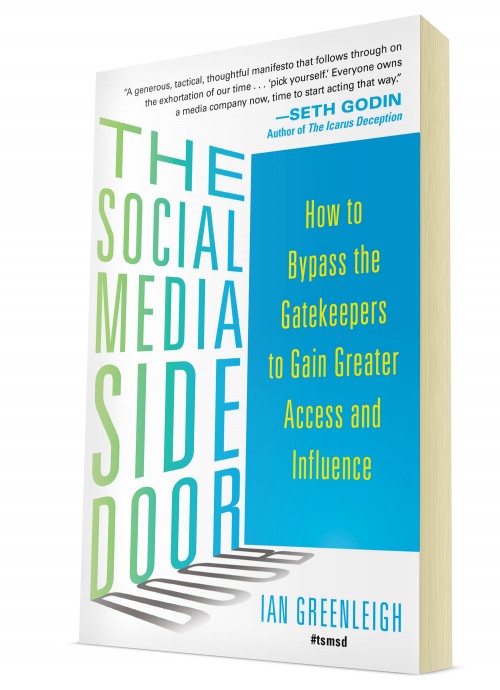
Q&A with Ian Greenleigh, author of The Social Media Side Door

October 17, 2013 by Rosemary

As a small business owner, I’m always hustling to make the most of limited resources. The techniques presented in Ian Greenleigh’s new book, The Social Media Side Door (McGraw Hill, October 2013), are designed to help us take advantage of the seismic shifts that have happened in recent years regarding access and influence.

Ian Greenleigh: The Social Media Side Door

Enjoy this Q&A with Ian, as he offers some great insights from the book.

1. What is the social media side door?

We’re living through an extraordinary time. Social media is decimating the human and technological gatekeepers that have historically prevented non-elites from accessing and influencing powerful people and institutions. The barriers are crumbling all around us, and so many people haven’t even noticed, or they’re simply not yet equipped to take advantage of these massive opportunities, what I call “social media side doors.”

2. How did you discover it?

I really struggled to get a decent job during the recession. I had just graduated with a degree in political science, even though it was a field I didn’t want to pursue. I was in sales, and I wasn’t very good at it. It was pretty bleak. None of the things our society teaches about getting great jobs were working. I thought I was bright, hardworking and creative, but I couldn’t find a way to convey that to the professional gatekeepers in recruiting.

I needed to try something radically different, so I scraped the bottom of my dwindling savings account to attempt something I had seen on a blog. I took out a Facebook ad, pointed it at a special “hire me” page on my blog, pointed the ad at decision-makers at the top companies in Austin, and saw the clicks roll in. Within a few weeks, I had a nice array of options for my next career step.

It wasn’t an anomaly. Once I started looking for them, I realized that social media side doors existed almost everywhere barriers seem to exist. I also realized that no one had written a guidebook to help people spot and take advantage of these new opportunities, so I decided to write it myself.

3. How can people find and open their own side doors in social media?

Realize that side doors often open gradually. For example, every time you leave a comment on a CEO’s blog, or tweet a piece of intelligent feedback to an influencer, you’re opening that side door up an inch or two more.

Think about the goals of the person whom you’re trying to reach, and reflect on how you can help them get there faster. You can do things like introduce them to other influential people via Twitter, interview them on your blog about a project they’re promoting, or help them find information they’re after.

Relationships are still the basis for almost all of the value created in social media. Social media makes it really easy to answer the question, “what has this person done for me lately?” As such, you’ll hear “yes” far more often when you’ve provided value before an ask, or in conjunction with it.

4. Why should we try to open these side doors sooner rather than later?

Imagine it’s the dawn of the 20th century, and you’re a salesperson, marketer or jobseeker. Telephones are expensive and rare, but somehow you’ve acquired one for free. There are no gatekeepers to screen the calls of the rich and powerful, and you can reach any of these fellow telephone owners simply by asking a switchboard operator to put you in touch. If you wait too long to take advantage of this situation, your competition will beat you to the punch, your approach will no longer be unique, and access now seems like more of a liability than an opportunity to those being accessed.

We’re not quite there yet with social media. We see rising adoption among powerful people, but the human and technological gatekeepers haven’t caught up yet. And innovation happens so rapidly, that the arrival of each new social network brings with it a new set of access and influence opportunities.

Author’s Bio: Ian Greenleigh is a social media and content strategist, and author of The Social Media Side Door: How to Bypass the Gatekeepers to Gain Greater Access and Influence. He helps companies turn data, ideas, and relationships into true thought leadership. His words and ideas have been featured in Harvard Business Review, Ad Age, Adweek, Digiday, Ragan, Seth Godin’s The Domino Project, and elsewhere. He writes and speaks on a wide range of topics, including changing consumer-brand relationships, the convergence of personal identities, and the radically shifting landscapes of access and influence. You can connect with Ian on Twitter: @be3d

Filed Under: Marketing /Sales / Social Media, Outside the Box, Successful Blog Tagged With: access, bc, influence, social-media

Is Bankruptcy Your Only Option?

October 16, 2013 by Thomas

Just more than 40,000 U.S. businesses declared bankruptcy in 2012.

That number is a staggering figure to be sure, but a sharp drop from the 2009 peak of 60,837 during the worst of the so-called Great Recession.

Although the economic climate has improved considerably since 2009, 40,000 business bankruptcies constitute a fairly ominous statistic, representing the dashed dreams of American entrepreneurs, both big and small.

Business Failures Inevitable

Whether the economy is robust or on its knees, businesses will continue to rise or fall depending on a wide variety of variables.

If you’re a small business owner whose debt load is swiftly becoming unsustainable, then you may find yourself facing the very real possibility of insolvency. Under the protection of the bankruptcy court, a business can be reorganized or its assets can be liquidated to satisfy creditors.

Although bankruptcy in theory holds out the promise of a “fresh start” for the owners of failed businesses, a business bankruptcy filing can severely damage the credit score of the business and its principals, making it difficult, if not impossible, to access financing at reasonable rates in the short-term future.

Bankruptcy = Hefty Legal Bills

Another adverse consequence of bankruptcy is the substantial legal bill incurred during the process of filing for protection under the bankruptcy code. And bankruptcy will not wipe out tax liabilities, which can continue to haunt the owners of failed businesses for years to come.

In the case of companies that seek to reorganize under the protection of the bankruptcy statutes, in so doing they cede control to a bankruptcy court judge or trustees who will have the final say in all company-related decisions during the reorganization process.

If as a business owner, you see signs that your company is in imminent danger of failure, what other options do you have besides bankruptcy?

Attorneys Lei Lei Wang Ekvall and Evan D. Smiley, authors of “Bankruptcy for Businesses,” a legal guide published by Entrepreneur Magazine, discuss two common alternatives to bankruptcy for businesses that find themselves in financial distress.

Negotiating a Workout

Under the first alternative — an out-of-court workout — the business owners seek to resolve their financial problems with creditors without relying on a court to preside over these negotiations.

Needless to say, the success of such negotiations hinges primarily on the willingness of your business’s creditors to engage in such talks. For this reason, it would probably be prudent to initiate such discussions before creditors have become intransigent because of prolonged failure to pay bills.

To effectively avoid bankruptcy, this financial workout should seek to win the cooperation of all creditors.

Should one or two major creditors refuse to join the talks, the business owner is likely to be forced to take the bankruptcy option. The business owner must also come up with a viable plan that ensures creditors they will eventually be repaid if they agree to cooperate.

This first alternative to bankruptcy presupposes that the business’s owners believe they can regain their footing and resuscitate their business if creditors allow them to set up a less arduous debt repayment schedule.

In other cases, business owners may fully realize that their company is beyond the point of salvage but still wish to avoid recourse to federal bankruptcy court.

Second Alternative

Assignment for benefit of creditors, the second alternative to bankruptcy advanced by Wang Ekvall and Smiley, is designed for cases in which liquidation appears to be the only course of action left for a failing business. Although such assignments require court intervention, they are overseen by state courts and not the federal bankruptcy court.

Under an assignment, the faltering business selects an assignee — an appointment sometimes subject to creditor approval — who then oversees the liquidation of the failing business’s assets, subject to state laws covering such procedures.

If the liquidation produces sufficient cash to reimburse all creditors and cover the assignee’s fees, any leftover funds can be returned to the business’s owners or shareholders.

In the event you have filed for bankruptcy tied to your small business, what was the outcome? Have you been able to get back on your feet with a new business venture?

Photo credit: thelaw.tv

About the Author: Jay Fremont is a freelance author who has written extensively about personal finance, corporate strategy, business education, and career degrees in business.

Filed Under: Business Life Tagged With: bankruptcy, bc, creditors, liquidation, small business

Manage Your Milennial New Hires With Loose Reins

October 15, 2013 by Rosemary

By Barry Welford

A large proportion of the people you will be recruiting will come from those born since 1980. These are often called Generation Y and the younger of them are known as Generation Z or Millennials. Likely they will be technologically savvy and will be well informed on the job market place and what it has to offer. What are they looking for in working in your company, and what do you need to have them achieve for success?

There is much online help for this significant recruiting challenge and there are even webinars that can set out effective strategies for recruiting Gen-Y.

The recruitment process can only be regarded as a success if both the candidates selected and the company achieve their goals through the contributions of these new hires.

Establishing A Loose Reins Culture

A company culture that is likely to resonate well with these new hires is what the Harvard Business Review calls the “Loose Reins” approach to management. Sometimes, the best management is little or no management at all. Sometimes, effective order and engaging experiences can be achieved with the most simple rules.

The article gives examples of how these principles are applied and gives the following summary of what it is all about:

The power of this kind of self-organization suggests that creativity and innovation might best be achieved not through rigid hierarchy and central controls, but from one or two simple but vital agreements. These agreements are often implicit, ones that everyone understands and is accountable for, yet that are left open to individual interpretation and variation. When we provide the right social context and then let things be, employees self-organize and produce better environment and better results than managers imposing control.

That sounds very appealing but clearly is somewhat revolutionary. Perhaps not everyone will be comfortable in this kind of environment. The recruiting and selection process clearly is critical in making candidate choices that will be successful for both parties.

Selecting Generation Y Candidates Who Can Accept Loose Reins

Before discussing the factors that will distinguish the most successful candidates for this Loose Reins culture, it is easier to define the characteristics of those who will not fit:

Individuals who

  • are black and white thinkers and do not see the shades of gray
  • insist on clearly defined detailed rules
  • are not self-starters
  • have difficulty in making decisions

The better candidates will be at the other end of the spectrum on these dimensions. In particular, they:

  • have an attitude of getting things done
  • can cope with ambiguity and devise practical rules that work
  • are innovative in finding novel solutions
  • will involve and work with other team members

Needless to say candidates will only be interviewed if they have the necessary job and technical skills to handle the position.

What These Candidates Will Demand

What may sometimes be overlooked is that it is even more critical for the candidate that the outcome should be successful. The company can move on fairly rapidly if a wrong decision has been made, but the individual will be faced with much more significant problems if the job is not working out. You can therefore expect that the best candidates will have their own requirements that must be met. In addition to the standard terms such as salary, vacation, hours of work and working conditions these might well include the following:

  • A realistic job description
  • A list of available resources and budgets
  • A clear statement on results to be achieved
  • Possible career opportunities based on success

The bottom line on all this is that the successful candidate and the company must have a shared vision on what is to be achieved and the plan to make it happen. Without this, there is a good chance that one or other or both will be severely disappointed.

Are you a “loose reins” manager?

Author’s Bio: Barry Welford writes for Next Day Flyers. He is a frequent blogger on business performance and Internet Marketing. You can follow him on Twitter at @bwelford.

Filed Under: Business Life, management, Successful Blog Tagged With: bc, Hiring, HR, management

  • « Previous Page
  • 1
  • …
  • 52
  • 53
  • 54
  • 55
  • 56
  • …
  • 959
  • Next Page »

Recently Updated Posts

Is Your Brand Fan Friendly?

How to Improve Your Freelancing Productivity

How to Leverage Live Streaming for Content Marketing

10 Key Customer Experience Design Factors to Consider

How to Use a Lead Generation Item on Facebook

How to Become a Better Storyteller


From Liz Strauss & GeniusShared Press

  • What IS an SOB?!
  • SOB A-Z Directory
  • Letting Liz Be

© 2025 ME Strauss & GeniusShared