Successful Blog

  • Home
  • Community
  • About
  • Author Guidelines
  • Liz’s Book
  • Stay Tuned

Three “Love You Loyal” Realities to Build a “Love You Loyal” Brand

April 12, 2010 by Liz

Anything Less Will Be Forgettable

cooltext443809558_authenticity

Brand, reputation, relationship the impression that people have of us and our business. We help shape and form it, but the image people take away isn’t in our control. Or is it? In some ways, what people decide about us has to do with experience we might never have been a part of. Some folks dislike all techies or all teachers. Some are biased against our age group and no actions will change that. Some are fiercely loyal to our competitor so much so that they cannot see us.

What does it take to get loyalty like that?

Three “Love You Loyal” Realities to “Love You Loyal” Brand

But with the folks who don’t know us and hold nothing against us. We have a chance to invite them into a passionate business relationship. To that well, we have to understand three critical “love you loyal” realities about you and your brand. You probably already know these intuitively, but you may not have put them all together in one place.

  1. A brand is how people think and feel about us … not what they say. People might remember what tell them or repeat what we want them to say. They might even agree with what we’ve taught them is our value base. If we invite them in, value them, ask them to contribute to it, they see the values in action, become part of what we’re building and want to protect it.
  2. People have expectations based on who they think and feel we are. People use our values to interpret our behaviors and our behaviors to interpret our values. If we share our intentions and how those intentions support our values, people make the connections that support us and help us see the unfavorable disconnects.
  3. The environment — especially other people — influences the thoughts and feelings people have about us. People feel a loyalty until someone tells a story that shakes their belief or their understanding. If we’re consistent with our shared values, state our intentions to keep them, and let folks contribute as vibrant growing part of improving on that, they’ll protect us against influences that might unravel the best of plans.

If we love our customers loyal, by knowing what we stand for and what we stand for is defined by valuing, serving, and protecting them, they will love us loyal back.

What’s one way you’ve seen a person or a company these three “love you loyal” realities into a web presence or a brand?

–ME “Liz” Strauss
Work with Liz on your business!!

Buy the ebook. Learn the art of online conversation.

Register Now!! for sobcon-vmc

Filed Under: Marketing /Sales / Social Media, Successful Blog Tagged With: authenticity, bc, LinkedIn, personal-branding

Beach Notes: Let’s Boogie

April 11, 2010 by Guest Author

by Guest Writers Suzie Cheel and Des Walsh

lets-boogie

Yesterday we were greeted at Rainbow Bay with this colorful assemblage.

Another one for our ephemeral art beach collection.

What have you got to boogie about?

Suzie Cheel & Des Walsh

Filed Under: Motivation, Successful Blog Tagged With: bc, Beach Notes, Des Walsh, LinkedIn, Suzie Cheel

Social Media Club Chicago Hosts SOBCon Opening Party

April 9, 2010 by SOBCon Authors

It’s great when your hometown stand behind you …

The Chicago Social Media Club is doing just that.

I’m thrilled to announce that again this year, Social Media Club Chicago has offered to host an Opening Party for SOBCon2010! Terry and I will be there as will many of the speakers, panelists, and out-of-town attendees. It will be like a super-tweetup with a great conversation and an after party to boot!

Come see the great views! Meet the great people! Get in the spirit of Chicago Social Media!

Here’s a look at the 2009 SOBCon and Social Media Club Chicago event video.

We won’t make any promises – yet – about who might show up. Let’s just say that this might very well be the most connected night of your life.

5:30 – 6:15 Check-in and Networking

6:15 – 7:15 Program

7:15 – 8:00 Socializing Networking

After party – in planning stages

Sign up now
so that you don’t miss a minute of meeting anyone who might be there!

Thank you, Barbara, Jeff, Amy and all of SMCC for honoring us again!

Filed Under: Announcements Tagged With: bc, Chicago Social Media Club, LinkedIn, sobcon

The Zen Way to Deal with Negative Commentary Online

April 9, 2010 by Guest Author

A Guest Post by Shama Kabani

cooltext443809437_relationships

When someone calls my company for the first time, there’s a high probability that what triggered the phone call is a negative consumer-written review or blog posting that shows up first in search engine rankings for their business.

Usually, they want to know how we can make the negative review go away – right now. It’s a shock when I say that the search engine ‘bots can’t distinguish between a snarky teenager in Des Moines, a competitor in Dallas, and a thoughtful reviewer in Dubuque. The truth is that social media has given a voice to anyone who wants to attack your business, and there are people out there who seem to revel in attacking for any reason – or no reason at all.

Sometimes the negative complaints are valid, and sometimes they’re not. So if you’re getting bashed in an online forum, the first rule is to respond to the negative consumer-generated review publicly, honestly, and as quickly as possible. Don’t even think about creating an alias to respond to a negative online posting. You will get caught, and it will cause more damage to your reputation. Here’s what I tell anyone who is wondering how to handle a negative online review:

  1. Check the facts. Is this person a customer? A former or current employee? A competitor spreading rumor?
  2. a. Once you know the facts, offer to resolve any issues personally, via email or telephone. (This requires the company owner, or a senior manager.)
    b. Continue the discussion offline if possible – then, once it is resolved, go back to the site where the negative review was posted, and post an honest explanation of what was done to rectify the issue.
    c. If you can’t identify the person, and you are not sure the complaint is valid, post your policy on the subject, and offer to resolve the issue.

  3. Follow your mother’s advice. Mind your manners, and if you can’t say something nice, don’t say anything at all. Online mudslinging never helps. If someone is posting personal slurs, be sure that YOU stay on the high road – don’t sink to their level.
  4. Rally the troops: encourage friends and satisfied customers or clients to post positive reviews.

Not long ago, after a speech to a business group, a man told me how he had put my advice to work. It’s a perfect example of what I call the Zen way of handling this kind of issue.

“I wanted to tell you how I resolved a problem I was having with a really bad online review on Yelp about my business. Someone – I never did figure out who – posted a terrible review – and that was the first thing people saw when they did a Google search on our company name.

“So I got my own Yelp account. I used my own name, and identified myself as the owner of the store. I basically said, ‘I’m saddened that you had a bad experience in my store. I’ve checked my records, and I can’t find a transaction that sounds like this. Please call me at this number, so that I can resolve this issue immediately.’ No one called, so a few weeks later I posted a second reply that said, ‘I haven’t heard from you. Please call me. I want the chance to make you a happy customer.’

“I used my real name, our store name, and posted the store phone number. At the same time, when I would talk to a satisfied customer, I’d say, ‘I’d appreciate it if you’d consider telling other people that you had a positive experience.’ I even put a request for positive Yelp reviews onto the receipts we give to customers. That first terrible review is still out there – but now there are more positive reviews, and the search engines don’t pick that bad review up first.”

One question that comes up often from frustrated small business owners is what to do if you find out about a negative comment that has “gone viral” (when one original negative message has been picked up far and wide, and a small problem has spread all over the Internet). Again, the action you should take depends on whether or not the negatives are true.

Products break. Employees don’t follow policy. Bad things happen to good companies – and they survive. The key to recovery is an honest response to the problem that explains what happened, and why it won’t happen again. If the problem isn’t simple, or if it wasn’t an isolated occurrence, consider hiring a crisis communication expert with specific online experience.

If it’s not true, politely request that the blog, forum, or site owner remove or retract the untrue information — or at least publish your response. Work with a search engine optimization (SEO) consultant to help you move positive information towards the top of search-engine rankings.

In very rare cases, business owners can seek legal help – libel laws do apply to online media. This is a last resort, and should be considered only in a very extreme case. First, it’s difficult and expensive because of the many steps required to identify the individual who posted the negative information.

More importantly, you can be sure that the minute a letter arrives from the lawyer, the news of “the big bad company” coming after “the poor citizen journalist” will be spread far and wide, further damaging your reputation. I can think of very few occasions when legal action has helped resolve this kind of problem, but being married to an attorney, I leave this question open, and welcome any feedback from someone who has successfully used legal action in this kind of situation.

Becoming an active part of the conversation that is already taking place among your customers, employees, prospects, and competitors is the best way to prevent negative comments from taking over your online reputation. This is especially critical for professional service businesses, where the company’s inventory and the company’s reputation are one and the same.

Take advantage of the free tools available to monitor your company’s online reputation. Start by signing up for Google and Yahoo email alerts using your company name, product name, and the names of key executives Yahoo Alerts and google alerts. Look at other tools like Ice Rocket, Monitor This, PubSub, and Blog Pulse.

While you’re figuring out where the conversation about your business and your competitors is taking place, establish a policy on how you are going to handle your part of the ongoing conversation. Who will speak for your company? How are you going to encourage satisfied customers and friends to speak positively about you?

It’s no longer a question of whether or not social media is going to affect your business – it already is. So the only question is when are you going to take charge of your own online reputation?

—–

Shama Kabani is president of The Marketing Zen Group, and author of The Zen of Social Media Marketing, which hits store shelves this week. You’ll find her on Twitter as @Shama

Thanks, Shama! I find that the more we include folks in what we’re doing online from the start, the more we invite them to help us as we build our presence and our sites, the more we find they help us when those negative occasions crop up.

How do you handle negative remarks and comments when you find them online?

–ME “Liz” Strauss
Work with Liz on your business!!

Buy the ebook. Learn the art of online conversation.

Register Now!! for sobcon-vmc

Filed Under: Marketing /Sales / Social Media, Successful Blog Tagged With: bc, LinkedIn, negative comments, Shama Kabani

Cool Biz Tools: Brizzly

April 8, 2010 by Liz

Todd Hoskins Reviews Tools for Small Business

cooltext451585442_tools

Todd Hoskins chooses and uses tools and products that could belong in a small business toolkit. He’ll be checking out how useful they are to folks who would be their customers in a form that’s consistent and relevant.

Pick Your Client, Any Client by

Todd Hoskins

Although Twitter has worked hard to improve the user interface at twitter.com, it is worth the time to choose a client for your desktop and mobile use. Like Microsoft Outlook or Thunderbird seeks (and often fails) to improve email productivity, Twitter clients offer more tools and a better user experience.

The most popular desktop clients are TweetDeck, HootSuite, and Seesmic. Some of he most popular mobile clients include Tweetie (iPhone), Echofon (iPhone), Twidroid (Android), and UberTwitter (Blackberry). Increasingly, developers of desktop applications are making mobile apps as well and vice versa.

I currently use none of the above. For my small business purposes, I chose Brizzly for desktop and Twikini for my Windows Mobile device. I would prefer to avoid the topic of Windows Mobile 6 (and my wireless contract), so let’s look at desktop web applications.

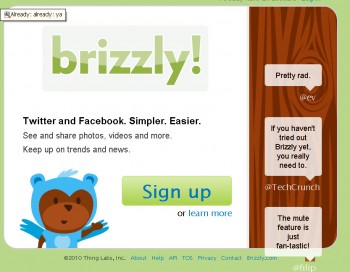
Brizzly is a browser-based application, which means there is nothing to install. The app has a clean interface with inline maps, photos, and video. With embedded media, infinite scrolling, and auto refresh, my stream requires very little clicking. It’s all there when I “dip in” for a bit.

brizzly

Importantly, applications like Brizzly allow you to handle multiple handles or accounts at once. This is where the difference of needs between applications for the enterprise and smaller businesses becomes most pronounced. An enterprise may need the ability to elevate, forward, share, or archive a tweet or conversation. There are fee-based applications for this. An individual user may be perfectly satisfied with twitter.com. For small businesses there are good free options in between.

I need to be able to find the relevant people and conversations and participate seamlessly without logging out and logging in of accounts. Saved searches, easily accessible bios, and a well-designed user experience are essential to me. Brizzly does this well.

Brizzly could improve with better management of contacts and followers (Seesmic’s latest version is impressive on this front). As customer service becomes more commonplace on Twitter for all sizes of companies, Brizzly may need to conservatively add CRM features. Let’s hope they stick with simplicity.

Summing Up – Is it worth it?

Enterprise Value: 1/5 – try CoTweet, PeopleBrowsr, or HootSuite

Entrepreneur Value: 4/5 – new iPhone application as well

Personal Value: 4/5 – also integrates with Facebook

—-
Thanks, Todd! You can find Todd on Twitter @ToddHoskins

Which clients do you use? What would it take you to try a new one?

–ME “Liz” Strauss
Work with Liz on your business!!

Buy the ebook. Learn the art of online conversation.

Register Now!! for sobcon-vmc

Filed Under: Successful Blog, Tools Tagged With: bc, Brizzly, LinkedIn, Todd Hoskins

7 Reasons Business First Should Establish Expertise in a Single Segment or Vertical

April 5, 2010 by Liz

cooltext443809602_strategy

It sure seems counter-intuitive. A bigger market may seem to have more customers, but it’s also easier to get lost in.

Just choosing a smaller domain, a vertical and defining it sets a small business apart from all of the other small businesses that are trying to serve every customer on the planet and not doing much to attract any.

Becoming an expert in a small domain makes it easier to say “We’re the ones for you.” The you might be daycare centers, boomers, auto buyers, foodies, books buyers, cool apps afficiandos or exotic pet trainers — any definable group that has a group identity, talks to each other, and wants what you offer. The payoff in a smaller segment is often faster, greater, and more meaningful, especially when you start with a segment you’ve worked in, are a part of, and know intimately.

After all any small business should know what expertise it offers and be able to judge how well it is doing. It needs to know when new information is worth investigating and be able to apply it as needed.

Even the biggest brands started in one vertical … with good sense.

amazon-logo
  1. It’s easier for anyone to attain true expertise in a smaller domain or segment. Learning a single domain and it’s traditional technical basis will free you up to be creative. Learning an entire industry won’t offer the time to for mastery that breeds true innovation.
  2. The rules and procotols are more easily mastered. You get to know the conditions and the players and their positions more quickly. As, a result, you fit in more quickly and gain status faster.
  3. A smaller field of knowledge focuses your effort, concentrates your learning. Being brilliant at one thing is more valuable than being good at many — especially if many are good at the same things. People place more value folks who understand their issues intimately.
  4. It’s the best way to get your game on and get to know your customers. Mastering a smaller domain allows you to hone your skills more finely, understand nuance, recognize finer opportunities, and develop offerings that more clearly fit customer needs.
  5. Being an expert in a smaller space raises ROI. You apply the same knowledge to similar situations rather than change gears with each new client. You’re able to find ways to connect client work and research to lower your investment. Relationships go deeper and partnerships are more likely — you might share in development for different uses.
  6. A smaller pond enhances your visibility. It’s easier to see the stars in a smaller universe. You can build a network quickly and that network will stay with you and help you grow into new segments.
  7. As you gain visibility, you can extend your expertise and reach by moving into other niches and verticals strategically. With slow moves to related fields, your expertise grows exponentially. You can take on larger territory with out problems of scalability.

With those thoughts, it makes sense to start with a vertical you already know. If you were trained as a teacher or a lawyer, you might want to start near education or a law, where you already have depth and credibility. You can always overlay your marketing or social media passion on the vertical you know.

Remember when Amazon was only books?

What vertical suits the small business expert in you?

–ME “Liz” Strauss
Work with Liz on your business!!

Buy the ebook. Learn the art of online conversation.

Register Now!! for sobcon-vmc

Filed Under: Marketing /Sales / Social Media, Strategy/Analysis, Successful Blog Tagged With: bc, expetise, LinkedIn, small business

  • « Previous Page
  • 1
  • …
  • 123
  • 124
  • 125
  • 126
  • 127
  • …
  • 190
  • Next Page »

Recently Updated Posts

Is Your Brand Fan Friendly?

How to Improve Your Freelancing Productivity

How to Leverage Live Streaming for Content Marketing

10 Key Customer Experience Design Factors to Consider

How to Use a Lead Generation Item on Facebook

How to Become a Better Storyteller


From Liz Strauss & GeniusShared Press

  • What IS an SOB?!
  • SOB A-Z Directory
  • Letting Liz Be

© 2025 ME Strauss & GeniusShared