Successful Blog

  • Home
  • Community
  • About
  • Author Guidelines
  • Liz’s Book
  • Stay Tuned

Have You Found a Way to Make Small Talk Work for You Yet?

December 12, 2011 by Liz

Could We Just Get On With It?

cooltext443809602_strategy

The holidays come with their obligations. The running, the gathering, and the inevitable holiday parties. The parties with friends and families can be true memory makers, filled with traditions and great reunions. The parties with coworkers and strangers can be a little intimidating, filled with small talk and expectations.

Small talk used to make me crazy. It was painful to listen to the ritual, empty conversation that didn’t go anywhere. It felt so inauthentic — people saying things and pretending to care about them. I’d try to participate but it was energy draining. “Could we just get on with it?!!” Small talk seemed such a time waster. How could so many people spend so much time getting no where, talking about the weather?

Everyone talks about the weather, but no one does anything. — Mark Twain

I admit I didn’t understand. As a result, I not only wasn’t good at it, but I was disruptive.

I’d try to add humor, switch it up a little, and every attempt would fall flat. People who small talk like their small talk a certain way.

My aversion to small talk made networking events and big company meetings excruciating. An introvert with a mile wide shy streak, I could sense a small talk conversation 60 seconds before it started. I practiced defensive networking. I’d walk around, smile, and hope someone as uncomfortable as I was would discover me. My fear of babble was getting in my way. Worse, I was probably telegraphing something like disdain.

My inability to small talk wasn’t working for me. It was time for a new view: If so many people found it useful, maybe there was something to it. Maybe I should pay attention, do some observing.

What I found out is that small talk comes in more than one flavor. The second flavor might be what has left many of us with a bad taste.

Don’t Let the Small Talk You Hate Ruin the Small Talk that Makes Relationships

The first thing I noticed when I started observing is that small talk has a pattern and purpose. You’ve probably noticed it too. Small talk is used to fill silences. What I didn’t catch for quite a while is that small talk comes in two forms — one that serves people who already know each other and another for people building relationships.

The Small Talk that Builds Relationships

Small talk is a space filler and a social lubricant. People use conversation to move together over time. It’s a social bonding ritual in which people define relationships, set boundaries, find similarities and differences. Small talk enables people to learn another’s social position, validate similar interests, and establish a platform for a continuing conversation … “Oh yeah, Jesse is my movie buddy. Love talking movies with him.”

When relationships are new, small talk is how people learn each other’s boundaries.The opening remark and it’s response follow the rules of a conversational dance. It really works so easily and doesn’t have to be insincere or shallow if you know these rules.

  1. Small talk starts with an agreeable statement or question. Start a conversation by noticing something, such as “Beautiful day, isn’t it?” or “That’s a stunning necklace!” Smile and make it easy to talk to you. A simple agreeable statement or question is a way small talkers of making a positive initial connection. If you don’t feel comfortable talking about the weather, or the food, or the latest techie gadget, comment on something about the other person. Share something you’ve noticed that you’re enjoying at that every moment
  2. The response to the first question or statement usually builds on the first question or statement. Respond with a little more than was asked for … “Yes, I live for the tulips on Michigan Avenue.” or “Thank you! It attracts amazing people. Are you always so great at noticing nice things?”
  3. Accept the invitation the opening agreeable statement or question offers you. Continue the conversation by sharing something, passing the conversation back, and listening to your new acquaintance. Offer only as much detail as fits your new relationship.

Starting the conversation is actually the easier way. Notice something worth commenting on in an agreeable way.

If you’re at that holiday party with strangers and coworkers, remember this to have more success in starting a conversation. Don’t approach two people talking, they’re probably having a deeper conversation. Look for a group of people standing together. Then look at their feet. The way we stand gives away how engaged we are. The person most open to a new conversation will be the one whose feet are pointing away from the conversation.

A little practice at the agreeable opening statement or question made my experience of small talk so much more refreshing. Now I find it’s a great way to open doors to new relationships with amazing people. I highly recommend it.

If Small Talk Is So Good, Why Does Everyone Hate It?

Small talk shows up in other situations. One in particular may be what has earned small talk it’s bad name. That would be the small talk that happens before someone, particularly someone in authority, uses to find a common ground and an even relationship right before he or she delivers bad news. I call that “the three things before the but.” You may have experienced it. For the naive or new to the experience, it’s a kind of being blindsided. To those who have previously experienced it, it’s still painful because once burned it’s easy to recognize what’s next. An example might be …

You’re a fabulous writer, a charming person, and very charismatic, but … you’re fired.

The worst part of this version of ritual, warmup conversation is that it doesn’t matter how true the “three things before the but” may be, the way that they’re used to deliver the hard news renders the three compliments unbelievable. The three compliments were pulled together to manipulate the tone and smoothly move the conversation. This conversational tactic destroys trust.

Have You Found a Way to Make Small Talk Work for You Yet?

People who say the “three things before the but” aren’t building relationships.
People who smile and talk about the weather while shaking hands and stealing your wristwatch aren’t building relationships.
People who smile big, talk about the weather, ask about your kids, but forget your name over and over aren’t building relationships.

They all may be using the art of talk as a social lubricant, but their using it to serve themselves not a relationship.

It’s not the small talk that’s the problem or the opportunity. It’s the motive that drives it.

Choose wisely and you’ll find that small talk can open a world of new relationships. Break the ice, invite others in, and sincere small talk can build you a network of amazing people.

Though I never think of it as small talk when I do it. I think of it as fun conversation.

Have you thought about small talk lately? Have you found a way to make it work for you?

Be irresistible.
–ME “Liz” Strauss
Work with Liz on your business!!

Buy the Insider’s Guide to Online Conversation.

I’ve spent a couple of days on Twitter. Actually too many to count. My first tweet was March 16, 2007 and


Filed Under: Marketing /Sales / Social Media, Successful Blog Tagged With: bc, communication, LinkedIn, networking, small talk

It’s All in How You See the Rain

December 9, 2011 by Liz

cooltext443860173_ive-been-thinking

about rain.
It rained as I was thinking about what to put here. It’s been raining a lot lately, but I don’t mind.
Rain reminds me of something I wrote a few years back …

After the rain has fallen there is a moment, just a glimpse of a second when all of the world stands perfectly silent, when everything seems to stop.

I hear my heart beat. Heartbeats are the sound of waiting water, collecting from raindrops no longer falling. They’re still in my mind with the thoughts that made them come raining down.

Now that I’m quiet and the air is clearer. I see the world again as it truly is — filled with delicate beauty and wonder. Nothing is wrong or right, in tune or out of sync. Nothing is upside down.

There is only what happens, like the rain. There is only what is.

The sun shines through the drops making a prism, a rainbow of color that wasn’t there only a moment ago.

Sometimes we put our own meaning on things that happen, even things like rain.
Rain is only rain. It’s not good or bad. We decide things like that sometimes because we want to, sometimes from habit.

The next time you have an automatic response to a situation, ask yourself, “Am I making the rain something bad?”

Liz's Signature

Like the Blog? Buy my eBook!

Filed Under: Motivation, Successful Blog Tagged With: bc, LinkedIn, Motivation/Inspiration, personal growth

Be Unshakeable

December 8, 2011 by Rosemary

A Guest Post by
Rosemary O’Neill

cooltext443809558_authenticity

Be unshakeable.

It’s a famous scene in the Saturday morning cartoons: a character goes flying off a cliff, starts flapping, and starts to enjoy flying. Another character holds up a sign saying, “you can’t fly,” and immediately the first character drops like a stone.

You can create valuable content
You can contribute big ideas
You can have fanatically devoted customers
You can give your unique perspective
You can start something exciting
You can change
You can enjoy what you’re doing
You can treat people with respect
You can be recognized for your work
You can write

You can fly.

And if someone comes along with a “you can’t fly” sign, just shoot it with an Acme Slingshot.
_____

Author’s Bio: Rosemary O’Neill is an insightful spirit who works for social strata — a top ten company to work on the Internet. Check out their blog. You can find her on Twitter as @rhogroupee

Filed Under: Business Life, Motivation, Successful Blog Tagged With: bc, focus, LinkedIn, Rosemary O'Neill

Ideas & Infographs: The Effects Your Small Business Can Have By Hiring Just One Person

December 8, 2011 by Guest Author

Guest Post
by Adria Saracino

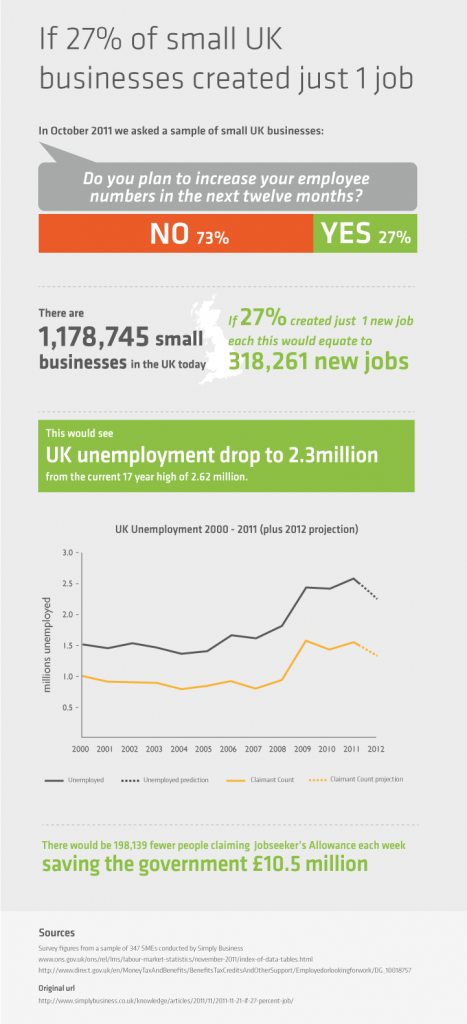
It is hard to imagine a small business hiring one person having any lasting effect on unemployment in the UK. After all, the rates are now at a 17-year high. However, new data suggests this is the case; that small businesses can in fact reduce unemployment.

Simply Business. a company that provides insurance for small businesses, conducted some marketing research after new unemployment data was released by the British government. Of the small businesses surveyed, 27% said they plan to hire at least one employee in the next twelve months. And all of the sudden, that “one person” quickly turns into over 300,00 new jobs across the market.

Simply Business created the following UK unemployment infographic to display the effect small business owners have on the economy.

Click this link to see the full-size infographic.

Jason Stockwood, CEO of Simply Business, said:

“The optimistic picture these small businesses paint is heartening in these tough times. When you consider that SMEs account for 99.9 per cent of the total enterprises in the UK and provide over 59 per cent of the jobs in the private sector their continued success and growth is key to our economic recovery.”

With such a large number of new employment, there would be an estimated decrease in over 190,000 people claiming Jobseeker’s Allowance, resulting in the government saving over £10,000,000 each week.

Are you the owner of a small business? And if so, do you plan on hiring anyone in the next twelve months? If so, you just might end up being part of a large decrease in unemployment rates.

————————————

Adria Saracino is the Head of Outreach at Distilled, a creative Internet marketing agency. When not connecting with interesting people on the web you can find her talking about style at her personal fashion blog. Follow her on twitter @adriasaracino to stay in touch.

Thanks, Adria!

–ME “Liz” Strauss
Work with Liz on your business!!

Buy the Insider’s Guide to Online Conversation.

Filed Under: Strategy/Analysis, Successful Blog Tagged With: bc, Hiring, LinkedIn, small business strategy

How to Make Your Surroundings Work for You

December 7, 2011 by Guest Author

Guest Post
by Rachel Carlson

When life gets busy, a good exercise routine can fall by the wayside. Fortunately, there are plenty of ways you can make physical activity a part of everyday life — sometimes without going to the gym! Read on to discover just a handful of ways you can make small adjustments to your day so that you never miss a workout again.

Find Exercise in Everyday Activities

Reviews of elliptical trainers suggest that they can be a great way to burn calories and get in shape, but they are not the only method for achieving physical fitness. Back in 2002, the New England Journal of Medicine published the results of a study which compared the fitness results of test subjects who only walked a bit extra every day to those who performed a set exercise program. The scientists discovered that the walkers got just as much benefit taking their exercise in small, manageable pieces as did the people who adhered to a schedule. Hence, it doesn’t matter if you exercise for one hour, or in fifteen minute increments. What really matters is the total amount of exercise you get.

Bryan Bordeaux, D.O., from Johns Hopkins University recommends taking a different approach to your everyday activities. He recommends using the stairs in your home as a means of exercise and also points out that things like yard work and house cleaning can actually burn a significant amount of calories. Bordeaux also suggests finding small opportunities for walking throughout the day. For instance, park farther away from your office and consider walking instead of driving to perform errands. You might also pass up the elevator in favor of taking the stairs. Any of these methods can get your heart rate up and burn calories.

Set Goals to Improve Fitness

Another important strategy for physical fitness is setting goals. The America On the Move Foundation cites goal-setting as being among the most important components of exercise. Begin by setting ultimate goals such as: Iíd like to lose twenty pounds or I’d like to put on ten pounds of muscle. To achieve them, you should also set incremental goals that will put you on the right track. You might decide to take 2,500 more steps every day and resolve to eat an apple as a morning snack instead of a Danish. Once you’re achieving these incremental goals on regularly, you can up the ante by adding another 500 steps every day, adding some light weight training, and having a salad with dinner every night. Achieving even these small goals will give you a sense of accomplishment and spur you on to the next level.

Keep Motivation Running High

Even with the best of intentions, we sometimes feel our motivation to be fit and active slipping away. Without realizing it, we begin to slide back into spending evenings on the couch with the television, without giving a thought to perhaps stretching or using a cardio machine while we watch.

The good news is that there are lots of strategies that can help you keep the importance of your fitness goals in mind. Certified fitness trainer Cindy Brotherston believes that people are motivated to exercise either through fear factors or positive motivations. Fear factors might relate to disease statistics, spending the balance of your life in debilitating health circumstances or finding yourself in danger of an early, preventable death. Positive motivation factors might include things like setting and achieving goals and using results of a workout program to help maintain inspiration. She also recommends taking a photograph of yourself before beginning an exercise program and then taking a further photograph several weeks in to see what kind of progress you’ve made. Noting any positive results can definitely supply you with any missing motivation.

Brotherson also recommends finding a reliable workout buddy who can give you external motivation to keep going with your fitness routine. When you know that someone else is counting on you to show up for a morning workout, it can definitely get you up out of bed and moving. Doing something you like can also help keep motivation high. Focus on fun-for-you sports like tennis, hiking at a nearby lake, or taking your dog for an extra long walk to keep moving toward your fitness goals.

Start Healthy Habits

Once you’ve resolved to live a healthier life, it’s important to begin in small increments. Cutting out every bad habit at once in a cold turkey fashion can actually be a good way to sabotage your efforts. Start by making a list of everything you’d like to either cut out or change. Your list might include things like walking to the store, eating four servings of fruits and vegetables every day, or giving up dessert three times a week. The list can be as long and detailed as you would like, but the important thing is to tackle one item at a time. Make each item on your list the focus of a week or perhaps even two. Once it begins to feel like a comfortable part of your routine, cut out something else or work on picking up a new healthy habit.

WebMD.com reports that changing even one factor for living a healthier life, like eating breakfast every morning, can significantly increase your ability to live a meaningful, active life. Involve your whole family in your healthful efforts by preparing a health-conscious dinner together on a Saturday night or spending Sunday on a long family bike ride. As a family, brainstorm for extra ways you can all get healthy and active together.

Make it Fun

Wellness expert Dr. Andrew Weil stresses the importance of making exercise fun in order to make it work for you. After all, when you enjoy your workouts, you’re more like to keep up with your routine. However, we all have a tendency to want to avoid certain exercises. Maybe you think developing upper body strength is no fun, for instance. Instead of avoiding weight training, try focusing on it instead. You have an opportunity to make significant progress and make this aspect of your workout a favorite by improving your performance.

When the routine starts to seem stale, change things up by adding a new twist. Purchase exercise bands, a new fitness DVD, or a exercise ball. Challenge yourself with a new class at the gym or resolve to change that one part of your body that you’ve always wished was different. Believe it or not, you are in charge and you can make a difference when it comes to your physical fitness.

————————————
Author’s Bio:
Rachel Carlson is a writer and student that works from home. While she spends a lot of her time writing, she also helps different companies like Clear Wireless with gaining exposure through various blogs and websites. She has recently started a new Twitter account and is finally going to give it a real shot. She can be followed at @carlson_rachel.

Thanks, Rachel!
–ME “Liz” Strauss
Work with Liz on your business!!

Buy the Insider’s Guide to Online Conversation.

Filed Under: Business Life, Successful Blog Tagged With: balance, bc, health, LinkedIn, working-at-home

How Images Can Make Your Blog Post Demand to Be Read

December 6, 2011 by Guest Author

How to blog series

A Guest Post by
Chris Lamphear

cooltext443809602_strategy

Successfully Working From a Home-based Office

Be Compelling. It’s one of the most important commandments for any successful blogger. But after you’ve written a post full of value for your reader, your job isn’t done. You have to figure out how to make your post jump off the page and demand to be read, otherwise all the work you’ve done writing the perfect post will be for naught.

I’ve been writing articles and promotional copy for more than twenty years and have learned that an attention-grabbing image is a must if you want to be read. I even started creating my own images and over time figured out the type of images that do the best job. Here’s what I’ve learned …

1. The image should communicate a concept.

Your reader wants to learn about a certain topic; that’s how he or she landed on your article. An accompanying image must clearly illustrate the same concept the reader is interested in. Don’t go with a pretty but generic picture. Ask yourself, “If I just stumbled here and didn’t know what this post was about, would this image tell me?” Make sure you pick a photo or illustration that clearly makes the very same points you’re writing about.

2. The image should be simple.

You have about one second to convince your reader to spend time with your article, and the less complex detail getting in the way of communicating your message, the better. The reader should not have to study the image to get to an “Aha!” moment and uncover your point. Think of the picture as a billboard shooting through your field of vision while you speed down a freeway. The most effective and powerful images are those that make an immediate impact. Be clear and you’ll get attention.

3. Intelligent use of vibrant color is candy for the eye.

Certain colors like red are flags that tell the reader the image is important and pull the eyes in. Stay away from drab, dull colors; instead look for primary and bright colors that jump off the page and say “look at this!” Here’s an example of an image of the word Goal with a target and arrow. Red is a color that tells the eyes “This is important,” and when the reader sees it and absorbs the message, determining this is in fact the subject he or she wants to learn about, you have succeeded.

4. Words in pictures tell a story.

Sometimes the best way to make your subject matter jump out and demand attention is to pick a picture that embeds that very word right inside it. Here’s an example: a two-way street sign with the words You Decide. Sometimes an image that incorporates a word or two can pull double duty, telling a reader what your post is all about more quickly than a wordless image can. In this sense, a word truly is worth a thousand pictures.

5. Relevant images = good SEO.

As a bonus, having images with titles and alt tags that support your subject could help you with SEO efforts. Communication is becoming more visual every day, and Google Image Search is being used by more and more people to quickly find the content they need. Be sure to include the appropriate image information in your code, such as title and alt description, and make sure you title the picture file something that matches your content.

I’ve decided to share my images with others like you to help you communicate your messages. Use one of my pictures in a post and see if it makes a difference! I’ll give you one in exchange for a link and credit. Just take a look at my royalty-free stock photo website and let me know what image you’d like to use. Click on the Contact Us page at www.theideadesk.com and tell me what you’d like to use. Good luck!

—-
Author’s Bio:
Chris Lamphear is author and owner of the ideadesk blog. where he writes about how to use design to boost the effectiveness of your communication, from winning new customers to growing relationships. Through the blog, I also offer free images from his site for royalty-free stock photos, theideadesk.com

Buy the Insider’s Guide to Online Conversation.

Filed Under: Audience, Blog Basics, Successful Blog Tagged With: bc, blogging, business-blogging, How-to-Blog, images, images on blogs, LinkedIn

  • « Previous Page
  • 1
  • …
  • 52
  • 53
  • 54
  • 55
  • 56
  • …
  • 190
  • Next Page »

Recently Updated Posts

The Creator’s Edge: How Bloggers and Influencers Can Master Dropshipping

Is Your Brand Fan Friendly?

How to Improve Your Freelancing Productivity

How to Leverage Live Streaming for Content Marketing

10 Key Customer Experience Design Factors to Consider

How to Use a Lead Generation Item on Facebook


From Liz Strauss & GeniusShared Press

  • What IS an SOB?!
  • SOB A-Z Directory
  • Letting Liz Be

© 2025 ME Strauss & GeniusShared