Successful Blog

  • Home
  • Community
  • About
  • Author Guidelines
  • Liz’s Book
  • Stay Tuned

Audience Is Everything – Do You Know Your Audience as Well as You Know Yourself?

May 31, 2011 by Liz

Content Isn’t Audience, But You Knew That

cooltext443809437_relationships

When I gave a keynote at the EdNet conference, where I met with many old and new friends in the business of publishing. I ended up in the most interesting conversation with one in particular, a man who was connected to me from years ago when publishing in print was my life. We got to talking about how publishers were facing the need to move from shelves of books to information that moved across the Internet.

He said, “I love books. I love seeing them stand on the shelves. I understand why everyone wants to keep making them. But I also see why we need to move our thoughts and ideas to PDFs.”

First I winced, then I smiled, then I laughed.

“What?” was what he said.

“You’re thinking of the paper web. A PDF is just a digital form of a paper document and almost as much of a pain. It’s not really part of the web. It’s a gated and separate location. I have to leave where I am to click over to where it is, wait for it to load, and then I’m stuck inside it. Switching back and forth takes for ever. It’s like asking me to go to the corner to buy a book.”

“Ah, I suppose I should be saying content.”

“Content on a blog or a website is easier to access. Yep that’s for sure, but content isn’t the end.”

I asked him to tilt his head to consider this question, “How many books sit on library and living room shelves that were chosen with great intentions then never read?”

If your goal is to sell books or to sell content, then keep your eye on them.
That will happen is that you’ll grow your sales and find ways to get more books in peoples hands and more visitors to your content.

But all of the thoughts that writers worried to express and the reams of ideas that could be changing the world may become good piled in the good intentions of book shelves and feed readers — parts of collections that never get read.

The book, the pdf, the website, the content isn’t the destination the audience is.

Know Your Audience as Well As You Know Yourself

An airplane traveling from New York to Chicago is off course 98% of the time. Still it gets there. Why? The pilot is always adjusting with his destination in mind. Do you listen to your best audience and tweak what you do to keep your content in their sweet spot?

The audience is your destination. If you’re writing for yourself, you’ll head in a different direction than if you’re writing for people learning what you know. It may sound obvious, but it’s still worth stating — if you don’t know where you’re going, you’re not going to get there. If you think you’re going everywhere or writing for everyone, you’ll end up nowhere.

Too often authors and bloggers don’t think through who their readers will be. As a result a blog post or a book title gets our attention but doesn’t keep us interested. Don’t write for the fad or the lastest content trend, write for the people who are exploring the idea behind it. Then when they change their direction, you can change yours with them because your relationship is with the audience not with the content.

Have you really thought through who your audience is? Here are some questions to help you do that. Take a shot at answering them all in one sentence.

  • Who am I writing for?
  • How are they like me and how are they not?
  • What do they care about?
  • What will get their interest and keep it to the very end?

Write down your audience profile. Revisit it often. Adjust it as your readership grows and you get to know them better.
Use it to guide what you choose to write.

Now that you’ve got a clear destination. Other decisions get a whole lot easier.

Do you look at what you offer from the audience view? How does that work for you?

–ME “Liz” Strauss
Work with Liz on your business!!

Buy the Insider’s Guide to Online Conversation.

Filed Under: Audience, Successful Blog Tagged With: audience, bc, Content, LinkedIn, relationships

What George S. Patton Said That’s Crucial to Your Business

May 30, 2011 by Guest Author

A Historically Relevant Guest Post
by Terry Crenshaw

cooltext443809437_relationships

Historically Relevant

Generally speaking, it’s probably fair to say that the principles of success possess a kind of across-the-board relevance, an applicability to most any endeavor you could mention; while the particular precepts of success may vary from one enterprise to the next, the universal concepts are basically the same. Maybe it’s for this reason the business world is one so pregnant with analogies. Sports metaphors come into play in the business world all the time, but even more prevalent might be military analogies – metaphors suggesting that the very traits that make for a successful general might also yield an effective business owner.

Loyalty

In that spirit, there’s a familiar quotation from General George S. Patton that’s worth mentioning in the context of business success. The war hero once famously said,

“There’s a great deal of talk about loyalty from the bottom to the top. Loyalty from the top down is even more necessary and is much less prevalent. One of the most frequently noted characteristics of great men who have remained great is loyalty to their subordinates.”

Loyalty – not from an employee to the company, but from the company itself to the employees. What a novel concept.

I can’t help but think of this principle as I consider the examples of businesses such as Whole Foods – a company that is consistently voted one of the Top 100 best places to work, and a company that performs well against its many competitors. There’s something to be said for Patton’s philosophy, and it seems like no big stretch to say that it’s applicable to companies like this; could the fact that it’s both a highly profitable business and a business that treats its employees well truly be a coincidence?

I doubt it. At any rate, the factors that could be at play here are numerous, and while they’re not particularly obscure or hard to deduce with the simple tools of common sense, they might warrant a brief repetition. For starters, there are some obvious financial considerations to be made here. We know that happy employees are more likely to stick it out with their jobs rather than go looking for employment elsewhere; less turnover means less time wasted on the recruiting and training of new employees. It means a more streamlined and efficient business in general, even.

And if you think that loyalty is the only military virtue that translates into a business setting, just consider these further examples – historically relevant business strategies that resonate even today.

Adaptability

For one, we could champion the virtue of adaptability. This is obviously a crucial military trait; a strategy must be altered to fit the nature of the enemy forces, and even the terrain on which the battle is being fought. In much the same way, a business has to adapt to the times, and to its competitors. We have seen airlines adapt to the changing demands of air travel – in particular, we’ve seen Southwest abandon the hub-and-spoke model, and they should at least be given credit for trying to change with the times. On the flipside, we’ve seen McDonald’s adapt to the changing needs of consumers, and to new economic realities; they’ve cashed in on the premium coffee and smoothie trends furthered by companies like Panera, but also ensured that these products are priced to meet the budgets of recession-affected diners.

Strategizing

We could go on. What about strategizing – the importance of long-term thinking about the future? Barnes and Noble did it with the introduction of their E-Reader, the Nook. They saw where technology and reading were headed and jumped on the bandwagon – leaving companies like Borders to flounder

Expansion

And what about expansion? The history of military conquest is one of empires gradually expanding their domain, in much the same way that Amazon steadily grew from a bookseller into a merchant of just about anything you could name.

These are all companies that have learned from the military – and more broadly, from history in general. And what they have to show us is that changing with the times – strategizing, planning, adapting – is important, but there’s also something to be said for time-honored principles. This fine line is tough to walk, but of course, we can always look to the past for sterling examples of how it is done.

What have you learned from history?

——

Terry Crenshaw covers economic trends in the United States and writes for www.peterorszagsite.com. Terry is especially interested in tracking the ideas of Peter Orszag and other economic experts as the economy attempts to recover from the recent recession.

Thanks, Terry, for the reminder that great thinking has always been what wins the day.

–ME “Liz” Strauss
Work with Liz on your business!!

Buy the Insider’s Guide to Online Conversation.

Filed Under: Strategy/Analysis, Successful Blog Tagged With: bc, LinkedIn, lont-term thinking, Strategy/Analysis, Terry Crenshaw

Unstick the Stories from the Past that Are Stuck in Your Head

May 27, 2011 by Liz

cooltext443809437_relationships

Any time we walk into a familiar situation, we have advantages of knowing how the situation works. We know the people, the place, and the usual routines that each brings to the “system” of what’s going on. That same advantage of knowing, that is also a disadvantage. It can sabotage us by leading our thinking down the wrong paths or leaving us blind to new behaviors unless they are striking different, unable to see that what we expect isn’t what’s going on.

That disadvantage of knowing a situation is one reason why we can’t check our own work. If we know the thinking that went into it, we can’t find the hidden assumptions or the parts that are missing. We already know why we did what we did. We already know why the people involved chose as they chose.

When we invite an intelligent outsider to table to look with “fresh eyes” and a “fresh mind,” that person won’t necessarily understand when he or she encounters the places where we skipped a step in laying out the logic.

It’s a simple case of you can’t know and NOT know at the same time.

The same is true when we meet up with family and friends. We fall back into roles and relationships so familiar that it can leave us blind. We walk in to the situation with hidden assumptions that make the situation familiar, but also keep folks tied to our definition of who they were, making harder for them to show us who they are now. We all have had the same thing happen to us as our parents or our siblings still see us as we were when we were 12 years old and can’t seem to see us as we are now.

If we want change the way people see us, it could work to try on that role of intelligent outsider.
When we meet up with friends this weekend, what would happen if we looked with “fresh eyes” and a “fresh mind” that offers them a fresh starting place — much like the fresh place a new friend of a friend gets to start a relationship with us?

Or as Barbara Kiviat said in such a memorable way . . .

When you hear a tune in your head, it’s tough to put yourself in the position of a person who doesn’t. —BARBARA KIVIAT, Time

What if we unstick the stories of our friends, family, and ourselves from the past that are stuck in our heads for just that short little while?
How might our relationships with friends, family, and ourselves change?

–ME “Liz” Strauss
Work with Liz on your business!!
Buy the Insider’s Guide to Online Conversation.

Filed Under: Community, Successful Blog Tagged With: bc, LinkedIn, relationships

Are You Seeing So Much That You’re Blind?

May 24, 2011 by Liz

Finding Your Own Leadership Path

Looking in the Right Direction

insideout logo

Last night, I shared a lovely phone call with Tim Sanders who had just arrived in Chicago after several flight delays and detours. Tim is an amazing traveler. I guess he would have to be a speaker so in demand as he is.

I used to travel like that it takes a certain mindset. To do it well, busy travelers also need to understand how to lower stress and keep our eyes on what’s important. The same is true of people who travel extensively and often.

Does that sound like you?

When I hung up the phone with Tim, I marveled at his energy and generous spirit. I got to thinking about how traveling used to affect me and what I learned that made me a better traveler and a far nicer person to work with.

Are You Seeing So Much That You’re Blind?

Working at a fast pace is much like traveling on too many airplanes. The information coming at as us fast and furious. We become machine-like in our effort to process. We see the details of what we need to navigate. The problem that I found was that I sometimes hyperfocused through to the important navigational and informational details that I was blind to the people in the picture. The people became just more data carriers to inform my goal.

That was a problem. It’s not human. We’re wired to be social not mechanical.

So the more I focused on the information, the more stressed and less social I became. With or without a real itinerary, traveling too fast made see so much I was blind to the people around me.

And when we lose sight of the people around us, they find a way to remind us that they are people not unfeeling data points. Such reminders usually aren’t fun or pretty.

So I learned how to pace my “traveling” with an appropriate amount of “space,” so that my eyes remained open to value the people I meet. Here’s what I do now regularly.

  • I look at the people I talk with.
  • I talk more about the people I’m going to see rather than the places I’m going.
  • I think of every detour, delay, and problem as a chance to meet someone and capture a new story.
  • I think of myself as a visitor in everyone else’s world.
  • I make it a point to sit silently for “recess” breaks 3 or 4 times a day — at my desk, on airplanes, in taxis.
  • DI look at the sky and trees, because it’s hard to feel overly important when I’m face-to-face with creation.

No major magic there. It’s doing what Tim calls feeding our brains, what I call keeping our heads wired to our hearts.

Either way the result is a powerful return on investing.

The more I see the people around me, the more they see good things coming out of me.

What do you do to make sure that you’re not seeing so much that you’re blind?

Be irresistible.

–ME “Liz” Strauss
Work with Liz on your business!!

Buy the Insider’s Guide to Online Conversation.

Related articles:
The Only One
Business, Blogs, and Niche-Brand Marketing

Filed Under: Marketing /Sales / Social Media, Motivation, Successful Blog Tagged With: bc, LinkedIn, relationships

When a Tire Goes Flat in Front of the Audience, Stop Driving

May 23, 2011 by Liz

This Isn’t Working

cooltext443809602_strategy

On a hot, spring day in May when I was teaching first grade, an acute classic migraine hit me smack between the eyes. I’d lived with the symptoms and studied the condition since I got the first one in grade school, I knew the causes and the effects of this cousin to epilepsy.

This nerve storm would be an award winner. The “aura” — the quiet before the migraine storm — came on with an intensity that signaled that the pain would be following on fast and furious. It also meant that I might lose the feeling my hands or start “wixing my merds,” which wouldn’t be good in this class of 36 six-year-olds who had my number.

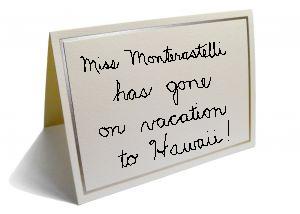
So while the kids were doing their math, I made a sign, set it on my desk, facing the class. It said I had gone on vacation.

gone_on_vacation_to_hawaii

Then I sat at my desk writing a letter to a friend about how the situation sucked.

A first-grader much like Carol Roth (@caroljsroth) came up to my desk to ask a question. I acted invisible and kept writing, as if we were on two different points in the time-space continuum.

She picked up the sign and read it to the class, “Miss Monterastelli has gone on vacation to Hawaii.” She put the sign back on the desk with some authority.

A voice from a Chris Brogan (@chrisbrogan sort of young man said, “Hey, that means we don’t have to do our work!”

Then a voice from a Amber Naslund (@AmberCadabra sort of young lady said, “Yeah but if we did that, when she gets back, she’d give us THAT look.”

So they went on with their work and I waited for my migraine medication to take effect so that I could get back to my class and back to our work.

When a Tire Goes Flat in Front of the Audience, Stop Driving

I was at presentation a while ago. The speaker was someone I’d looked forward to hearing. She not only knows her subject matter, but comes high recommended as someone who can keep an audience engaged.

As the presentation got rolling, it became apparent that she had built her presentation for a different audience. The slides were over-packed with information that didn’t apply to the people in the room. It also seemed that she had realized that too, because as she spoke her confidence waned.

She didn’t have the option of putting up a sign and building a new presentation, but she might have untangled the situation by stepping back and starting over just the same.

If only she’d stopped, stepped back, and said, “You know this is not working, let me try something else. I’m going to close my computer and start over with a few questions from you.”

The audience would have thought her a hero for saving them an hour of time wasted. The humanity and courage of setting aside her plan for them would have said volumes about her respect. What had gone haywire could have been a super win.

Instead, despite her own discomfort, the speaker chose to plow through to the end with the presentation that didn’t work.

When a tire goes flat, it’s a bad idea to keep driving. The same principle works here. If you know that what you’re doing isn’t working, stop, step back, and start over in a new way.

It’s not the plan that counts it’s the quality delivery to the audience.

Whether we’re telling, helping, or selling, sometimes we can misjudge where our heads are or what the audience needs. We can often feel it by the lack of feedback in the room. It never hurts to ask, if the group wants or needs to go another direction.
They’ll make you a hero for making it about them.

And about those first graders …

After about a half hour, I felt much better and took down the sign sign. Luckily I had been to Hawaii, because I was greeted with a long list of questions about what I’d done and seen while I was on vacation there.

Do you have a story about plowing on when you should have stopped or starting over and being glad you did?

–ME “Liz” Strauss
Work with Liz on your business!!

Buy the Insider’s Guide to Online Conversation.

Filed Under: Marketing /Sales / Social Media, Successful Blog Tagged With: bc, LinkedIn, starting over

4 Steps to Discovering How to Live on Purpose

May 20, 2011 by Guest Author

A Guest Post by Veronica Drake

cooltext443809558_authenticity

I am Veronica Drake…. mother, ex-wife, wife, victim, friend, arch enemy and survivor. I will show you how I came to realize there are really only four steps to finding your purpose. It only took me 18 plus years to figure it out. Most likely it will take you all of three minutes to decide if it means anything to you.

One cold November morning in 1996 I screamed at God and tried to give Him back His faulty product. I even had the balls to challenged Him to a standoff: “If you have any use for me, show up now or I’m outta here.”

I was sick and tired of living the life I was given. I was blaming the Creator. I had no idea if there even was a God. I figured what did I have to lose. As I was careening my car toward the abutment I came face to face with the details of the life I had created: friends I’d made, loves I’d lost, bridges I’d burned, battles I’d created, and mistakes I’d lived to regret. I realized all this in a split second. And, yes, like in the movies, something happened. It was as if something literally was taking my foot off the gas and applying it to the break. I truly had no control over what was happening. I remember feeling very warm and safe. Something very familiar had me.

t wasn’t long after that experience I got all Holy Rollerish. It didn’t take me long to realize that Holy Roller stuff wasn’t me. But, it did make me question WHO I WAS and WHY I WAS SPARED that day?

I decided to dive in and explore what was really going on with me. What I know about me is I have charisma, I’m very out-of-the-box, I am quick witted and people are drawn to me. Ummm, what was it the Creator wanted me to do with all of that; what Purpose could I possibly fill. There it was right in front of my face the entire time. I would be who I was naturally created to be. Still struggling to identify Purpose, I simply continued to live my life, a life I could be proud of, a life that served others no matter what title I wore.

Ironically, just as I settled into living, it became crystal clear to me. I am a teacher of Purpose. I was given the gift of connecting people to Purpose. Wow, that was powerful. Lil’ ole me using the gifts I was given to be naturally who I am.

It was an 18-year journey for me but luckily for you I condensed it all down to 4 easy steps!

My Four Steps for Finding a Purposeful Existence:

  1. Clarity. Be clear about who you are. Take an honest inventory of what you are bringing to life. List your successes and your natural abilities. Take the time to write it out and revisit it daily. Begin knowing that we are all inherently good and we were all created with natural gifts. If you are struggling to get started, remember our Creator put default settings in us and all we have to do is simply return to what we know; the Golden Rule, do unto others.
  2. Passion. Passion IS energy. It shows up mentally, physically, and spirituality. Embracing the passion and learning to focus it is really the core of finding Purpose. Passion pushes us to look for ways to continually improve what we do and how we do it. Be passionate about who you naturally are. Marrying passion with Purpose is the ultimate fulfillment in life.
  3. Acceptance. A big part of living on Purpose is acceptance. To live a simplified Purposeful life all you need to do is surrender to what is. When you have expectations you will always find yourself in chaos. Bring acceptance into your life and you will find how easy life really is. Acceptance isn’t about living with what is forever it merely means you allow it to be until it no longer is.
  4. Deciding. Nothing happens until YOU DECIDE. The law of inertia states that “A body in motion tends to remain in motion, a body at rest tends to remain at rest.” Will you stay stagnate or will you move? I have DECIDED to be a Spiritual Life Coach who empowers people to live life on Purpose. You?

Living life on purpose is living up to the reason that we’re here, making the most of our gifts.

Have you discovered how to live life on purpose yet?

——
Veronica Drake js an International Spiritual Life Coach who inspires clients to explore their spiritual self. Her site is Spiritual Coach Veronica Drake and she writes for people heeding the call of their inner guidance systems and who look to reconnect to their heart on her blog. Her Twitter name is RonnieDrake.

Thank you, Ronnie, for sharing the story of your passion, your purpose, and your life!

–ME “Liz” Strauss
Work with Liz on your business!!

Buy the Insider’s Guide to Online Conversation.

Filed Under: Motivation, Successful Blog Tagged With: bc, LinkedIn, living, management, personal-development

  • « Previous Page
  • 1
  • …
  • 73
  • 74
  • 75
  • 76
  • 77
  • …
  • 190
  • Next Page »

Recently Updated Posts

Is Your Brand Fan Friendly?

How to Improve Your Freelancing Productivity

How to Leverage Live Streaming for Content Marketing

10 Key Customer Experience Design Factors to Consider

How to Use a Lead Generation Item on Facebook

How to Become a Better Storyteller


From Liz Strauss & GeniusShared Press

  • What IS an SOB?!
  • SOB A-Z Directory
  • Letting Liz Be

© 2025 ME Strauss & GeniusShared