Successful Blog

  • Home
  • Community
  • About
  • Author Guidelines
  • Liz’s Book
  • Stay Tuned

Teams: How to Make Quality the Signal above the Time and Money Noise

December 28, 2010 by Liz

(Updated in 2020)

Photo by Marvin Meyer on Unsplash

10-Point Plan: Train Self-Managing Teams with an Outstanding Bias Toward Quality

Show Me in the Contract Where It Assures the Work Will Be Good

Spend enough time in business you hear the saying, “Fast, Quick, and Good, Can’t have all three!” or some version of it. In my business it was Quality, Schedule, Budget, Pick Two!”

I watched and wondered for years what made this algorithm work. Observation proves that without constant surveillance it consistently comes out the same.

Schedule and Budget win out over Quality.

Quality is hard to define, protect, and keep. It’s high touch, high concept, by it’s very nature qualitative and subject to discussion. Schedule and budget are right there, out loud, down on paper easy for everyone to measure and see.

In a business endeavor, every member of a team knows exactly how late, how much over budget some effort might be, but few can agree how much it has slipped on quality.

If we’re talking about products, it’s hard enough judge the quality gap — that’s the job of the product team.
But suppose we’re talking about quality leadership, quality thinking, quality communication, quality relationships, or living out a quality social media strategy?

How Do You Keep the Noise of Time and Money from Killing Quality?

Quality leadership does the quality thinking that forms the quality decisions. It’s quality communication that builds long-term quality relationships. That kind of quality is at the foundation of any team endeavor that succeeds. It’s also the at the core of any quality social media strategy.

Whether we’re talking to employees, customers, or volunteers, it’s important that we telegraph with every nuance of our brand that quality will always be the signal above the noise of time and money. Because quality is about them.

How do we build an outstanding bias toward quality into the fabric of our organization and our teams? Use the same steps we used to build a brand-values baseline and if you can, invite help from that same core team.

  • Start with the heroes and champions from the core team. Whenever change is the goal, look for the folks most predisposition to embrace the change and invite them first.
  • Put the problem before the change makers — about 12 people in three teams. When they have gathered first challenge the teams to define quality as a definition of thinking, leadership, communication, relationships, and process. Have them come to one definition for their team.
  • Ask that core group of change makers how to tackle the problem Ask them how to bring quality to be the highest signal above the noise on their team.
  • Listen and record their answers. Think of it as a list of possibilities, not necessarily a brainstorm, but more like an offer of possible tactics to try in their natural habitat.
  • Review the list and ask the group to sort it. Choose three categories. Possible categories might be leadership-based ideas, communication-based ideas and process-based ideas.
  • Ask each team to discuss one of the three lists they’ve made. Suggest that they discuss how well the idea might work over time with their coworkers, how it might need to be changed, and whether it needs outside input. Allow teams to add or remove ideas. Explain that they’re looking for one or more ideas that have merit — enough power and value that the team believes they could persuade others to put the idea into action.
  • Invite the teams back to the group to present the ideas that they believe have merit. Challenge the teams to persuade the rest of the room to take on their call to action.
  • Allow the listening teams to give their response and to offer their opinion on how easily they might be able to persuade others to join in to the proposed quality challenge. Work together to help reword and rework any that have value, but need a more powerful argument.
  • Decide on the most effective quality-enhancing changes that are most natural to the organization.
  • Build a strategy on how to introduce them to the larger group. Will it be peer-to-peer training? Will it be a meeting? Will it be a proof of concept that the small group tries and then demonstrates success?
  • Then, choose a way that everyone can measure the success of the attempt to change behavior to a more quality-based way of work. Set a date to meet again to report back, consider how things worked, and adjust the call to action or the process.

Research has proven we go where we look and we change what we measure. If we want our bias toward quality in thinking, leadership, communication, and relationships to grow, we have to look at, measure and talk about them in the same ways we do schedule and budget. If we want quality to be the signal above the noise, we have to invest our schedule and budget in making it so.

People look at what we do — not what we say — to know what we believe.

How do you prove to your employees, customers, and volunteers that quality is above the noise of time or money?

READ the Whole 10-Point Plan Series: On the Successful Series Page.

Be Irresistible.

–ME “Liz” Strauss

Filed Under: Content, Marketing /Sales / Social Media, Successful Blog Tagged With: 10-point plan, LinkedIn, quality, relationships, teams, trust

What Is the Most Crucial Element of Influence?

December 21, 2010 by Liz

The Outcomes We Achieve

cooltext443794242_influence

Every person has influence. What what we say, and how we act has an effect on how others think, feel, and behave. As a writer, an observer, and manager, I’ve watched and studied how people respond to what we do, what we say, and what they see.

As every parent and pet owner knows, sometimes the outcome we’re going for — a change in belief or behavior — isn’t the outcome we achieve. Our intent, our feelings toward an audience are only one side of the equation. How that audience interprets our words and deeds determines the change in belief or behavior that might result.

Our influence is highly affected by context.

  • The world view of the people we might influence. An individual’s emotional associations and beliefs can filter how people interpret our intentions, our words, and actions. A person who believes all learning must be their own experience will ignore a warning to avoid a dangerous part of town. A person who has only had bad experiences with people from our “group” may fight against any message we offer.
  • The value those people put on their relationship with us. Filters such as the halo effect and other cognitive biases, such as wishful thinking, can change how our message is processes and received.

We don’t control how other people think, what they feel, or how they interpret what they hear and see.

Though we may carefully consider and choose the most generous way to communicate and interact within those those contexts, the audience will choose their interpretation of that interaction. The same authentic, highly influential, collaborative message to one audience will be a disingenuous, controversial, alienating rebuff to another audience. We see that all of the time in the world of politics.

The most crucial element of influence is understanding what the audience and what the already believes. If we want to influence people, to move them to an important action, to change their core beliefs, we need to know the audience, listen to their world view, champion their cause, and honor their reality. Lasting influence is a trust relationship built through time and shared experience.

How do you champion the audience you want to reach?

–ME “Liz” Strauss
Work with Liz on your business!!

Buy the Insider’s Guide to Online Conversation.

I’m a proud affiliate of

third-tribe-marketing

Filed Under: Marketing /Sales / Social Media, Motivation, Successful Blog Tagged With: audience, bc, influence, LinkedIn, Marketing /Sales / Social Media, relationships

Tom Peters, the Chihuahua Story, and the Effect of Your Influence

December 20, 2010 by Liz

cooltext443794242_influence

Tom Peters, Influence Quote and the Retweet

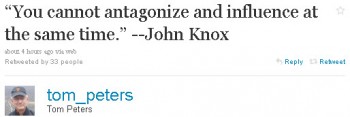
Recently on Twitter, author, speaker, professional agitator, and my personal hero, Tom Peters (@Tom_Peters) quoted John Knox with this tweet:

tom_peters

I retweeted it.

Three Wise Men Respond

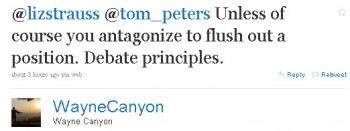
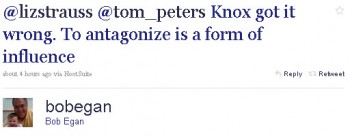
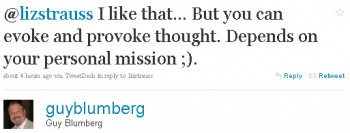
Three gentleman responded with interesting comments as you can see.

waynecanyon


bobegan

guyblumberg

That got me thinking about influence again and how the experts define it.

Wikipedia and What Is Influence?

I spent a few hours reviewing what I knew and researching more about influence, its definitions, and its synonyms to arrive at the most basic idea that connects them.

Influence is the power to change behavior or beliefs.

Wikipedia shares a wealth of information across domains on what influence is …

Sphere of influence (astrodynamics), the region around a celestial body in which it is the primary gravitational influence on orbiting objects
Sphere of influence (astronomy), a region around a black hole in which the gravity of the black hole dominates that of the host bulge
Social influence, in social psychology, influence in interpersonal relationships

In terms of social influence, they point to compliance, identification, and internalization. From what I see, the science of influence limits the change to be that which evokes a positive result.

Social influence occurs when an individual’s thoughts, feelings or actions are affected by other people. Social influence takes many forms and can be seen in conformity, socialization, peer pressure, obedience, leadership, persuasion, sales, and marketing.

Like the three who commented on my retweet, I agree, our words and acts have influence beyond what’s described here. Antagozing can influence beliefs or behaviors. Sometimes we influence without knowing it. Sometime our influence can bring about unexpected responses.

The Chihuahua and the Effect of Your Influence

We can set out to have influence or gain influence. We can see how our actions influence behaviors and belief systems. We can mislead ourselves into believing we have influenced in one direction, when in fact we have done no such thing. The intent of our influence does not guarantee the outcome.

Which leads me to the story of the chihuahua.

The Story of the Chihuahua

110319_chihuahua_5

A man renovated his house, tearing out the entire kitchen. Every fixture, appliance, and bit of the original room was removed. He started over with four walls, one window, and the door to the backyard. During the winter rebuilding the kitchen floor was down to the concrete foundation.

The man and his wife had a chihuahua and the one thing the man hated was taking the dog out to the backyard to pay its call to nature, especially in the winter. So the man covered a huge corner of the torn-up kitchen with a rubber mat and some newspaper; put a dog bowl there; and he allowed the nervous little pet to do his “duty” there.

When the spring came, the kitchen was finished complete with very expensive new hardwood flooring. It was no longer acceptable for the tiny dog to stay in the kitchen when nature was calling. The man made a plan to change the dog’s behavior.

Every time the dog messed the kitchen floor, the man would stick the chihuahua’s nose in the mess and then toss the dog out the back door or out the open kitchen window.

The chihuahua did change its behavior. After it “went” on the floor, it jumped out the window.

Sometimes we mistake, misinterpret, and totally miss on seeing our influence. The man changed the dog’s behavior, but it wasn’t the change the man had been going for. All of the predictable outcomes of our influence aren’t always obvious.

Silence doesn’t always mean agreement. Changed behavior doesn’t always mean a change in thinking. Sometimes we influence a change in behavior that goes in a direction other than we’re thinking.

No one is really without influence. we all have the power to move another person to change a belief or behavior. The most influential watch what how influence works in their own lives and learn from that. As my friend, Chris Brogan demonstrates exactly how he does that when he discusses ways we can improve our influence. It’s the quality of our thinking, the concern for the listener, and care in our delivery, that makes our influence move a thought or action in the direction we hope.

What examples of “chihuahua story influence” have you seen in business?

–ME “Liz” Strauss
Work with Liz on your business!!

Buy the Insider’s Guide to Online Conversation.

Successful-Blog is a proud affiliate of

third-tribe-marketing

Filed Under: Marketing /Sales / Social Media, Successful Blog Tagged With: bc, influence, LinkedIn, relationships, Strategy/Analysis

How to Be an Opportunity Magnet

December 13, 2010 by Liz

Do You Really Think You’ll Have More Time Later?

cooltext443809602_strategy

Where we’re working at home or working in an office, at this time of year, time is hard to find, hard to manage, and basically not there. What’s new about that?

Stop! Think for a moment. When do you remember having too much time on your hands?

Do it now!

Bet it’s been a while since you didn’t have plenty to do even if it was things you didn’t want to do. I’m guessing that finding time to do everything that you could, should, or might be doing to move ahead right now is one of the biggest problems you’ve ever had.

How to Be an Opportunity Magnet

Strategy is a realistic plan for taking advantage of how opportunity fits our unique situation and skills. Yet, opportunity can pass us by and keep on moving, if we don’t have time for it.

To be ready for the opportunities coming our way, we have to create space and time to handle them. Here’s a few ways to be ready when it does. Become an opportunity magnet.

  • Tell people where want to be giong. The more people you tell, the more people who can be passing along opportunities.
  • Know your focus. Not all opportunities are equal. Look for those that match your focus.
  • Know what you need to move you forward. Some opportunities will be in your line of focus, but they’ll be just more of what you’re doing. Look for chances to meet new people, gain new skills, and expand your expertise and experiences.
  • Stop again to ask questions. See every person as a chance for learning. They know about shorter ways to get to where you’re going. That makes them opportunities too.
  • Don’t do everything yourself. Enlist your network and friends to help you with those things you’re not so good at. Let them help you build what you’re building. They’ll know better how to refer you and how to help you find the opportunities you need.

One single NYTimes has more information than an average 18th century person learned in a lifetime. We’re not going to get away from the constant noise and time burden. But we can create a space where opportunity can squeeze and flourish … if we know how to recognize the right opportunities and develop the habits that will attract them.

What do you do to attract more opportunities to your life?

–ME “Liz” Strauss
Work with Liz on your business!!

Buy the Insider’s Guide to Online Conversation.

Successful-Blog is a proud affiliate of

third-tribe-marketing

Filed Under: Marketing /Sales / Social Media, Successful Blog Tagged With: bc, LinkedIn, relationships, Strategy/Analysis

Michael Jordan, The Old Spice Guy: Why Characters and Celebrities Can’t Humanize Your Brand

December 6, 2010 by Liz

A Celebrity Doesn’t Humanize a Brand

cooltext443809558_authenticity

I don’t watch TV much, but lately when I do this Hanes commercial with Michael Jordan keeps cropping up.

Does this commercial “humanize” Hanes? Of course not. It’s a traditional celebrity endorsement and if anything, it makes the celebrity look smart and the customer look informed, but not so socially adept. We may want to ibecome a bigger fan of Michael Jordan, but do we want to join a group of the guys who act like the guy talking to him?

Is the commercial really about making a relationship with Hanes or with the celebrity who wears Hanes? I say Hanes built a commercial about humanizing Michael Jordan, not Hanes.

The Old Spice Guy and Mr. Clean

Last year when the “Man Your Man Could Smell Like” Old Spice Campaign came out, everyone I knew passed on it on to someone else. We sat at lunch at SxSW sharing it on our iPhones because the clever copy and innovative camera work made it fun and worth talking about.

And then, the Old Spice Team at Wieden and Kennedy knocked our socks off when the Old Spice Man started answering comments with YouTube Videos.

But did the Old Spice Man humanize the brand? Again, I think not. What is the Old Spice Man? A celebrity work for hire? A human Mr. Clean? A character we can make a relationship with?

We’re still not making a relationship with Old Spice or the people who work for the brand.

Why Characters and Celebrities Don’t Humanize a Brand

Being human is about having humanity — a benevolent compassion for other members of the species. That’s a job that doesn’t stay on a TV screen, in a magazine, or on a website. It’s a relationship that goes both ways. It responds to questions, finds solutions, picks up the phone, answers the email, and celebrates great ideas.

As much as they add personality and glamour, even a sense of the way that people who run the brand want to relate with us, characters and celebrities can’t humanize a brand. They are cardboard cut outs of people not real people we can form a relationship with.

Here’s just a few things they don’t do.

  • They don’t listen and respond in meaningful human ways. They don’t ask us about our ideas, thoughts, wishes, needs, or the real ways we use their products. Surveys and questions are about them, not us. How do you like me? Isn’t a relationship building question.
  • They don’t act on our behalf. They don’t carry back our thoughts, ideas, and information to the people who make the products, do the marketing, and solve the problems when something isn’t working.
  • They don’t have true two-way conversations. They are paid or made to represent the brand in the same that packaging does — to underscore and represent an idea or a feeling in an outgoing direction.
  • They don’t build communities. Their work is not intended to help customers connect as people, but rather to connect customers to their products or the brand.

In other words, characters and celebrities don’t build relationships. They keep the brand conversation all about the brand. Humans who only talk about themselves, think about themselves, and work to promote themselves are considered lacking in humanity as well.

It takes real people who love their work and care about real customers, who work with real vendors, partners, and customers to reach real customer goals and solve real customer problems to humanize a brand.

Celebrities and characters don’t do that. People like @AmberCadabra @GeorgeSmithJr @ZenaWeist @vick08 @bsimi @connieburke and @LionelatDell do.

What brand do you know that’s done a great job at showing its humanity?

–ME “Liz” Strauss
Work with Liz on your business!!

Buy the Insider’s Guide to Online Conversation.

I’m a proud affiliate of

third-tribe-marketing

Filed Under: Marketing /Sales / Social Media, Successful Blog Tagged With: authenticity, bc, characters, humanization, LinkedIn, personal-branding, relationships

How to Be Ever Grateful for What You Have

November 25, 2010 by Liz

cooltext443809437_relationships

Thanksgiving. Families. Rooms filled with people. Old torn relationships and new relatives. Or worse. A diner and a meal alone with faded memories.

We can’t bring back or remake today into what once was.
We can’t get the folks we love to behave exactly as we might want.
We can’t orchestrate the world to turn slowly to our best thoughts.

But we can be grateful for what we’ve got.
Every day. No matter what. We can recognize and celebrate what we value most of all.

How to Be Ever Grateful for What You Have

When that clerk in the grocery shop snaps and cracks and can’t even look up to see the person that you are, think about the generous person might have seen. Smile anyway and say “Thank you.”

When that person at work treats you like an inconsequential robot, think about the value you add every day. Smile anyway and say “Thank you.”

When that family member takes over the center of the universe, think about how much nicer you can be when you’re able to see the view from the perimeter. Smile anyway and say “Thank you.”

When that person you misinterprets your good deeds, think about good feelings that came with the doing. Smile anyway and say “Thank you.”

When that gossip says things about you that aren’t true, talk to your friends who would never believe such things about you. Then smile anyway and say “Thank you.”

Thank you
for showing me I don’t get thrown by little things.
for helping me see who I am is not what you say about me.
for the opportunity to try a positive response to your negativity.

Thank you can be an invitation to set the table differently.

682321_the_table_is_set

But most importantly,
When the people who help you thrive show up,
smile every time and say thank you.
You’ll know them by the way
they consistently say and show they have faith in you,
by the hope and time they invest your dreams,
and by the endless love they provide to see you through.

Make every breath a smile and a thank you.
Say it out loud and show to proudly in every way you know how.

It’s a forever gratitude … a generosity that goes both ways.
Smile and say “thank you” out loud to recognize how rich your life is.
Every day.
———
Thank you to everyone who has changed my life.
My gratitude is huge and will always come back to you.

–ME “Liz” Strauss
Work with Liz on your business!!

Buy the Insider’s Guide to Online Conversation.

I’m a proud affiliate of

third-tribe-marketing

Filed Under: Blog Comments, Marketing /Sales / Social Media, Motivation, Successful Blog Tagged With: bc, gratitude, LinkedIn, relationships, thank-you

  • « Previous Page
  • 1
  • …
  • 5
  • 6
  • 7
  • 8
  • 9
  • …
  • 54
  • Next Page »

Recently Updated Posts

Is Your Brand Fan Friendly?

How to Improve Your Freelancing Productivity

How to Leverage Live Streaming for Content Marketing

10 Key Customer Experience Design Factors to Consider

How to Use a Lead Generation Item on Facebook

How to Become a Better Storyteller


From Liz Strauss & GeniusShared Press

  • What IS an SOB?!
  • SOB A-Z Directory
  • Letting Liz Be

© 2025 ME Strauss & GeniusShared