Successful Blog

  • Home
  • Community
  • About
  • Author Guidelines
  • Liz’s Book
  • Stay Tuned

Rhythmic Marketing Strategies for Businesses with Seasonal Demand

April 29, 2011 by Guest Author

A Guest Post By Isabella York

cooltext443809602_strategy

In this day and age of uncertain times, more and more people are looking for a point of stability in their lives with regard to income. These fervent searches have proved fruitful in the form of capitalizing on certain skills or native products, turning them into moneymaking ventures that last years or, unfortunately, fizzle and fade into obscurity. In an effort to stay fresh and original, personal business ventures have taken on different forms, one of which being the seasonal business.

A seasonal business can be rewarding for those who have the ingenuity and drive to see it through, even with its numerous pitfalls that can lead to its downfall. Amazingly productive only during a certain time of the year, seasonal businesses quickly lose their profit-generating capabilities during a period called the off-season. Unfortunately, off-season periods for a seasonal business can encompass most of the year leaving a very small margin for the moneymaking process.

In order to combat the dreaded period of slow income, seasonal business owners have to continuously innovate and market their products and services. This entails constant promotion and the use of a number of techniques that will help turn a profit when times are tough. It also calls for strategic planning and timely intervention, knowing when to push a sale and when to hold off or where to allocate funds to produce the greatest amount of positive change.

When it comes to marketing, no rules are set in stone, especially so with seasonal businesses, much of it is touch and go. By taking initiative and combining personal strategies with these tried and true methods, seasonal business owners can definitely last longer than the dismal projection most others set for them:

  1. Thorough Analysis and Planning

    Make sure to take a look at the calendar at the beginning of every fiscal year. Take note of important occasions and events and try to see how your products or services can be incorporated. Give yourself a trial period and map out your initial progress through a specific time period. Analyze trends and apply this knowledge to your sales approach. Try not to restrict yourself to the limits of your seasonal business but go beyond and see how you can move further. A good example would be modifying summer pool covers to fit the demands of the season. Another instance would entail offering tropical themed Christmas trees that could serve as summer time decor.

  2. Innovative Advertisement

    It is a known fact that customers are attracted to seasonal products and will generate a lot of income during the peak season. To this effect, seasonal business owners would do well to advertise their products far and wide. Reach as many people as possible through the latest communication avenues and create a system of feedback that allows you to talk directly with your customers. Study the latest advertisement techniques and use them to the optimum effect.

  3. Excellent Customer Service

    Establish an excellent database of loyal customers. By doing so, you generate a stable source of income even during the off-season. Create updated surveys every sale period and get customer responses personally to build rapport. The web with its wide array of tools is an effective way to generate and manage surveys. You can also draw on customer ideas to generate new advertisement and marketing schemes. Consumers can have great ideas too.

  4. Off-Season Strategizing

    Marketing practices need not be confined to peak-season. In fact, business experts claim that the most effort a seasonal business owner must exert is during the period of low income. However, an important point is not to exhaust one’s income and to prioritize what needs the most attention. For example, either do an advertising campaign or push for store renovations and product updates. Never take on too many projects as this may tip the fragile balance of peak season income and off-season demands.

  5. Diversified Approach

    Branch out in terms of market groups. Never restrict your campaigns and services to one market as this also limits the amount of money you can make. See about reaching different people from different countries. Try to go global and tap into the different seasonal strategies of business owners from other countries. Not only do you build a wider customer base but you are also opening yourself up to potentially useful knowledge you would never know otherwise.

Be willing to take in one step further. Look beyond the strategies presented here and see how you can build and improve on them. The consumer market is vast and constantly changing, requiring you to stay on your toes and keep the ball rolling with regard to coming up with new and more attractive marketing schemes. The most important thing in business, seasonal or otherwise is to take the first step. It’s all about initiative. With constant innovation and attention-to-detail you can start and maintain a successful seasonal business.

_____________
Isabella York has been in the business world her entire life. Having seen business cycles ebb and flow, she knows a thing or two about developing strategies for changing demands, however her job with a purveyor of Artificial Christmas Trees (http://www.balsamhill.com/Artificial-Christmas-Trees-s/1.htm) and Christmas Trees (http://www.balsamhill.com/) has catapulted this skill set to a new level.

Thanks, Isabella, for your insight into something we don’t talk about enough!

–ME “Liz” Strauss
Work with Liz on your business!!

Buy the Insider’s Guide to Online Conversation.

Filed Under: Marketing /Sales / Social Media, Successful Blog Tagged With: bc, LinkedIn, seaonal markets, Strategy/Analysis

What Do You Get from the Pizza Party at My Dad’s Saloon?

April 4, 2011 by Liz

At What Price?

insideout logo

Near the end of my freshman year in college, we found out that my boyfriend’s fraternity brother — a guy I knew — was getting married. What was amazing, interesting, exciting was that he was getting married in the town of about 20,000 people where I grew up. The wedding would take place on a Saturday that summer. They college kids I knew would be staying for the weekend to party and enjoy each other’s company right now the street from my dad’s saloon.

My dad was a quiet and generous man who had the wonderful idea that the sun rose and set on my head. He was for almost anything that could bring a smile to me. So when I asked if some of the college folks could come to his saloon that Sunday afternoon for pizza and conversation, his answer was a smile of we can’t have them leaving town hungry. His words were “how many and what time?”

And as it turned out that my estimate of 10-20 and 2 hours for a pizza reunion became something more like 40-60 and 5 hours of talking. Pizza and fried chicken, beer and soda and other beverages were non-stop for the entire time. The whole while, I got to introduce college friends to my dad as sort of held court and sort of worked the bar.

Near the end of the afternoon, I noticed one friend looking a little nervous.
I asked, “How might I help?”
He said, “I’d like to talk with your dad.”
“Easy!”

I introduced my friend to my dad. They shook hands.
Then my friend said, “I’d like to pay the bill. Could you tell me what we owe for all of this?”

My dad smiled and nodded. He washed a glass or two and set them on the bar. before he reached out for a small white pad of paper and a tiny orange pencil with no eraser. He began writing, figuring on the pad that was enveloped in his huge hands. He looked up and surveyed the room, then wrote something down. I bet he did that survey five or six times without saying a word, without even a question in his eyes or looking at me.

My nervous friend waited patiently with his wallet out.
I could tell he was wondering whether their would be room on his credit card.

About then, my dad stepped back held the white pad out about arm’s length as if he were doing the math in his head — which could well be. Then he stepped forward again, tore off the slip on paper on which he’d been figuring, and set it in front of my nervous friend.

dad-wave

My dad said, “I’ve been over this twice, and as far as I can figure this is what you owe — no tipping on Sunday.”

The piece of paper read ” $1.50″ — 40-60 people and 5 hours of beer and beverages — one dollar and 50 cents.

“Hope you don’t mind if I rounded it up. We don’t keep pennies in the register.”

I learned a lot watching that sale.

What do you take from this story? Do you see something worth remembering that I might not see?

Be irresistible … like my dad.
–ME “Liz” Strauss
Work with Liz on your business!!

Buy the Insider’s Guide to Online Conversation.

Successful-Blog is a proud affiliate of

third-tribe-marketing

Filed Under: Marketing /Sales / Social Media, Successful Blog Tagged With: bc, LinkedIn, relationships, Strategy/Analysis

The Riskiest Question We Ask When Introducing Our Business and a Much Better Approach

March 7, 2011 by Liz

People Ask It All of the Time

insideout logo

We meet on Twitter or on my blog. Perhaps you came up to talk after I spoke at a conference or a mutual friend said that we should meet and talk. We have a lot in common and a lot of expertise that supports each other. We both think the other is smart. So we decide to sit down to talk more.

Things are going great. So we begin to introduce ourselves and our businesses to each other.

I ask about what you’re doing. You tell me more. We’re getting somewhere that looks like we could find a way to build something together that might move our businesses forward. Then one of us asks what appears to be a simple question that people ask often and the other one starts to buy out.

The question — one that people ask all of the time — might surprise you because on the surface it sounds smart, other-centered, and on target. But, it’s not because of how it shifts the burden of thinking and how it changes my perception of who the person who asks it.

The question?

How can I help you?

What’s wrong with that?

When we ask How can I help you? here’s what happens. We throw the burden of thinking (and the evaluation of our fit) to the other person. The person we’re talking to has to stop to consider within their entire realm of possible jobs, tasks, and future dreams,…

  • where he or she might be able to use some help.
  • who we are, what our skills are, how they might fit the culture and brand of what he or she has planned.
  • whether he or she might be able to manage putting those two together in the context of what’s already going on.

That’s a huge amount of thinking, considering, and evaluating to answer even to someone we know really well. The risk is huge that the answer will be wrong — that the person answering will misjudge our skills (too high, too low) or not think of the perfect fit for what we have to offer. Inside that situation is also the risk that the person will be uncomfortable at being unable to give a quick answer and the chance that he or she will wonder why we already don’t know.

Why take those risks at all?

A Much Better Approach

For almost a year now, I’ve reserved the How can I help? solely for situations in which people are outlining specific problems that fall into my area of expertise. And even then I try to avoid it, reaching instead for Would it help your situation if I offered a way to … ? I find that opens the discussion to more concrete exploration of where my skills fit the person’s business goals.

And when it’s a conversation that’s with a new business acquaintance rather than leading with How can I help? which is really about me. I turn the conversation to them by asking

What are your goals for the next two quarters? What are you hoping to achieve to move your business forward?

Then I listen and as I listen I ask more questions about vision of those positive outcomes.

So, would that look like a new product? a growth in awareness? a larger community? a more functional website?

And I listen more until I can clearly see their goal, their vision. Then I can also see how I might use my skills to help them achieve it, how we might align our goals to build something together that benefits us both.

A leader is someone who wants to build something he or she can’t build alone.

Do you see how a new approach to introducing your business can help your business and their business grow?

–ME “Liz” Strauss
Work with Liz on your business!!

Buy the Insider’s Guide to Online Conversation.

Successful-Blog is a proud affiliate of

third-tribe-marketing

Filed Under: Marketing /Sales / Social Media, Successful Blog Tagged With: bc, business-relationships, LinkedIn, Strategy/Analysis

7 Steps Get the Best Leadership Thinking from Your Team

January 11, 2011 by Liz

10-Point Plan: Teaching Leaders to Think

“I Don’t Pay You Think” Doesn’t Work Anymore

cooltext443809602_strategy

For years we marketed one-size-fits-all solutions, it worked to grow the numbers higher and higher by allowing companies and corporations to focus on how to give us more for less. We had access to more products at lower prices because of it.

And in that one-size-fits-all environment, it’s fairly certain that at least once in your career you heard a manager say the famous words, “I don’t pay you to think.” In fact the system relied upon carefully controlled decisions … only a few people were allowed “to think.”

Rogue thinking upset the carefully constructed system of industrial production that made the whole thing work. Even customer conversations were perfected down to scripts so that no maverick thought could undermine the “perfected” process of handling relationships.

Except customers never did find those scripts the making of a perfect relationship and now as customers have ways of connecting with each other, they’re letting us know that they’re spending their attention, time, and money with companies and corporations who build one-of-a-kind things, offer customized and personalized service, and develop true and loyal relationships.

What 20th century company or corporation was designed to manage that?

7 Steps Get the Best Leadership Thinking from Your Team

It’s been decades of businesses that have preached the mantra “I don’t teach you to think.” Leadership reaches out to build together what can’t be build alone. Ironically, it gets stronger when everyone thinks.

How does a leader build a team that leaves behind black-and-white safety of scripted relationships to the gray decision making that actually serves customers and the company? Without the right environment, support, and commitment in place it’s likely to be a mess of good intentions that foul up things.

Here are 7 steps to building a thinking, influential leadership team.

  1. Trust your team. It goes without saying that if you picked the right team, they’ll do the right job. If after reflection, you find that trust isn’t going to come. It’s time to change your own thinking about the people you want on your team.
  2. Start with a small crew. A change in management style cannot be made via a toggle switch or a pendulum swing. Rather than announcing new “rules of behavior.” Enlist a small crew who has already shown they understand both customers and what drives the business.
  3. Agree on the definition of a good result. Strategy always begins with knowing where we want to go. Set a goal. Define what a successful completion of that goal would be.
  4. Let the crew plan how to get from here to success on that one thing. You’ve agreed on the outcome and you’ve chosen the right crew. Let them show you their most efficient process for achieving it. Let them work out the details without you.
  5. Review the plan by asking questions. Have a short meeting for the crew to show you what they’re going to do. Limit yourself to questions rather than advice. You now have the benefit of being outside the thinking and so you can test it for holes and hidden assumptions — something you couldn’t do when you were part of building the plan. You can learn from the new ideas they bring to it.
  6. Stay out of their way as they execute. Ask them to keep you apprised via status updates and meetings, but stay in question so that you can be tester of the thinking rather than the only thinker in the room. When people look to you for an answer, answer with, “You have more information, than I, what seems the most appropriate action to you? Why do you think so?”
  7. Celebrate Success and Value What You Learn Every status meeting take a moment to celebrate successes. Invite the crew to do the same with you. Also take time to highlight and value new things, surprises, and misfires that teach what not to do.

The days of “i don’t pay you to think” are thankfully long over. True leaders are people who don’t want to do all of the thinking. Leaders are people who want to build something innovative, elegant, and useful that they can’t build alone.

Care-filled thinking, well-thought action, and thoughtful response has become the gold standard of business growth, innovation, and loyalty relationships. When everyone is thinking, the customer and the company become a community and the business thrives. Thinking is the new ROI.

The way and the level at which we value our teams’ thinking is directly proportional to the value of the thinking they return.

How do you get the best thinking from your team?

–ME “Liz” Strauss
Work with Liz on your business!!

Buy the Insider’s Guide to Online Conversation.

Successful-Blog is a proud affiliate of

third-tribe-marketing

Filed Under: Community, Strategy/Analysis, Successful Blog Tagged With: bc, LinkedIn, management, Strategy/Analysis, teamwork

Retweet or Race to the Finish: 3 Steps to Influencing Action

December 27, 2010 by Liz

Not Just a Call, but Real Action

cooltext443794242_influence

You want people to retweet you?

Whatever the action, a retweet, a call to arms, or a race to the finish, enlisting a folks to move in the same direction to follow our passionate action requires that we follow some simple acts of our own. Consider these three steps and and the following equation the next time you want to influence people move to act on your behalf.

The three steps to influencing action are simple, but also harder than they look:

  1. Give people a big reason — important, urgent, and about teamwork — filled with meaning that is bigger than helping you do what you want..
  2. Show them how fulfilling the mission will benefit them and make them proud to have been a part.

    Request for RT = benefits for Requestor and the requestor’s people.
    RT http://mysite.me because we need 100 fans to help our school.

    Request for RT = benefits the Retweeter and many other people.
    RT http://kidzrd.com/ & Get a thank you from a kid who’s learning to read & a link in Reading Heroes List

    Which request would be more likely to move you to action?

  3. Make it easy to be a part. Whatever the action, hoard the hard labor, and offer the hero parts.

As with any quest in which we want to move people to action …

The rules are fueled by the spirit of leadership — the belief that we can build something important and urgent together that we can’t build alone. It’s our team on a relay race. It’s giving the reason that we want to run the race and are willing invest our best to go for the win.

679px-southern_12_stage-02_1988

The math is simple.
Meaningful reason + proud feeling of sharing = a message that goes wide.

It doesn’t take training in calculus to work through this equation. It takes a true sense of humanity and human relationships. Any caring person can get to that.

What do you find is crucial to moving people to action in what you do ?

–ME “Liz” Strauss
Work with Liz on your business!!

Buy the Insider’s Guide to Online Conversation.

Successful-Blog is a proud affiliate of

third-tribe-marketing

Filed Under: Marketing /Sales / Social Media, Successful Blog Tagged With: bc, LinkedIn, RT, Strategy/Analysis, Twitter

Tom Peters, the Chihuahua Story, and the Effect of Your Influence

December 20, 2010 by Liz

cooltext443794242_influence

Tom Peters, Influence Quote and the Retweet

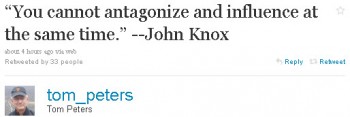
Recently on Twitter, author, speaker, professional agitator, and my personal hero, Tom Peters (@Tom_Peters) quoted John Knox with this tweet:

tom_peters

I retweeted it.

Three Wise Men Respond

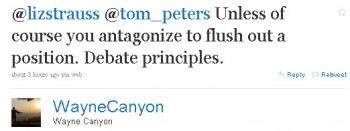
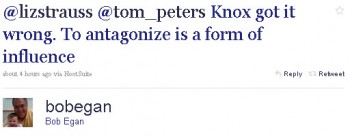
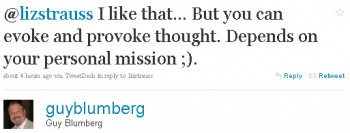
Three gentleman responded with interesting comments as you can see.

waynecanyon


bobegan

guyblumberg

That got me thinking about influence again and how the experts define it.

Wikipedia and What Is Influence?

I spent a few hours reviewing what I knew and researching more about influence, its definitions, and its synonyms to arrive at the most basic idea that connects them.

Influence is the power to change behavior or beliefs.

Wikipedia shares a wealth of information across domains on what influence is …

Sphere of influence (astrodynamics), the region around a celestial body in which it is the primary gravitational influence on orbiting objects
Sphere of influence (astronomy), a region around a black hole in which the gravity of the black hole dominates that of the host bulge
Social influence, in social psychology, influence in interpersonal relationships

In terms of social influence, they point to compliance, identification, and internalization. From what I see, the science of influence limits the change to be that which evokes a positive result.

Social influence occurs when an individual’s thoughts, feelings or actions are affected by other people. Social influence takes many forms and can be seen in conformity, socialization, peer pressure, obedience, leadership, persuasion, sales, and marketing.

Like the three who commented on my retweet, I agree, our words and acts have influence beyond what’s described here. Antagozing can influence beliefs or behaviors. Sometimes we influence without knowing it. Sometime our influence can bring about unexpected responses.

The Chihuahua and the Effect of Your Influence

We can set out to have influence or gain influence. We can see how our actions influence behaviors and belief systems. We can mislead ourselves into believing we have influenced in one direction, when in fact we have done no such thing. The intent of our influence does not guarantee the outcome.

Which leads me to the story of the chihuahua.

The Story of the Chihuahua

110319_chihuahua_5

A man renovated his house, tearing out the entire kitchen. Every fixture, appliance, and bit of the original room was removed. He started over with four walls, one window, and the door to the backyard. During the winter rebuilding the kitchen floor was down to the concrete foundation.

The man and his wife had a chihuahua and the one thing the man hated was taking the dog out to the backyard to pay its call to nature, especially in the winter. So the man covered a huge corner of the torn-up kitchen with a rubber mat and some newspaper; put a dog bowl there; and he allowed the nervous little pet to do his “duty” there.

When the spring came, the kitchen was finished complete with very expensive new hardwood flooring. It was no longer acceptable for the tiny dog to stay in the kitchen when nature was calling. The man made a plan to change the dog’s behavior.

Every time the dog messed the kitchen floor, the man would stick the chihuahua’s nose in the mess and then toss the dog out the back door or out the open kitchen window.

The chihuahua did change its behavior. After it “went” on the floor, it jumped out the window.

Sometimes we mistake, misinterpret, and totally miss on seeing our influence. The man changed the dog’s behavior, but it wasn’t the change the man had been going for. All of the predictable outcomes of our influence aren’t always obvious.

Silence doesn’t always mean agreement. Changed behavior doesn’t always mean a change in thinking. Sometimes we influence a change in behavior that goes in a direction other than we’re thinking.

No one is really without influence. we all have the power to move another person to change a belief or behavior. The most influential watch what how influence works in their own lives and learn from that. As my friend, Chris Brogan demonstrates exactly how he does that when he discusses ways we can improve our influence. It’s the quality of our thinking, the concern for the listener, and care in our delivery, that makes our influence move a thought or action in the direction we hope.

What examples of “chihuahua story influence” have you seen in business?

–ME “Liz” Strauss
Work with Liz on your business!!
Buy the Insider’s Guide to Online Conversation.

Successful-Blog is a proud affiliate of

third-tribe-marketing

Filed Under: Marketing /Sales / Social Media, Successful Blog Tagged With: bc, influence, LinkedIn, relationships, Strategy/Analysis

  • « Previous Page
  • 1
  • …
  • 5
  • 6
  • 7
  • 8
  • 9
  • …
  • 18
  • Next Page »

Recently Updated Posts

Is Your Brand Fan Friendly?

How to Improve Your Freelancing Productivity

How to Leverage Live Streaming for Content Marketing

10 Key Customer Experience Design Factors to Consider

How to Use a Lead Generation Item on Facebook

How to Become a Better Storyteller


From Liz Strauss & GeniusShared Press

  • What IS an SOB?!
  • SOB A-Z Directory
  • Letting Liz Be

© 2025 ME Strauss & GeniusShared