Successful Blog

  • Home
  • Community
  • About
  • Author Guidelines
  • Liz’s Book
  • Stay Tuned

Get Your Leadership ON … Before You Get Folks “on the Bus”

April 5, 2011 by Liz

10-Point Plan: Building a Team

Bringing Irresistible High Performers Into Your Brand

cooltext443794242_influence

Whether you’re a solopreneur in Ladd, Illinois or a C-suite executive at a Fortune 100 corporation, leadership — building a business — means you aren’t doing what you’re doing alone. It’s tried, true, and almost tired wisdom that getting the right folks on the bus is the first step in the process of building a great business. Every advocate of Jim Collins knows that you need the right team to take a business from good to great.

Seems simple. Enlist a great team and win.

Yet when the time comes to get other folks to board the bus, we can so get busy filling seats, much that we could consider about who joins us is left back on the curb long after the bus has already taken off.

In a strange way, we sometimes don’t let our leadership kick in fully until we see a team in front of us and at best that’s a little late. You see at the moment we need someone to help with our business, our brand, or our quest, we often get focused on the task we need with and lose sight of the person who will be doing the task.

Here’s how the process often works.

  • We have a job that needs doing. Someone has left the team or the business is growing and it’s time to add another someone to the group.
  • We determine the nature and scope of the tasks, the level of work, and the skills and time required to fill that gap.
  • We find an old job description. We edit that to construct a new one.
  • We share that new job notice with people who know great people and in places where appropriate candidates will see it and respond. Then we review submissions for experience and expertise.
  • We invite people to interview for the position and select the candidate we feel most likely to be qualified, committed to the work, and a good fit for the team.

Yet, a few months later we often find that we have a whiner, slacker, complainer, an under-performer, or a person who’s personality doesn’t fit the work or the people with whom that person regularly interacts. .

Somewhere between process and performance we’ve left a leadership gap.

Get Your Leadership On … Before You Build the Team

When I worked in publishing, I watched and worried over the variation in performance in freelancers and employees and from employee to employee. With some serious thinking and calculated tweaking, I found the process by which a person was enlisted could get the right people to stay with it to “get on the bus” and the bad fits to decide to pass on that opportunity. What it took was a willingness to go a little deeper – and to leave the “driver’s seat.”

It starts by shifting priorities from those of a boss or a manager to those of a leader building a team.

  • A great boss hires great employees who can get the work done.
  • A manager enlists great people who have the individual expertise and team skills to execute collaborative projects to successful outcome.
  • A leader attracts and chooses other great leaders who have the abilities, motivation, and complementary skills to become a team that can build something outstanding and lasting that no single member could build alone.

A leader spends more reflection on what’s missing and what’s needed to fill out the team — focusing strategically on a longer view and stronger growth rather than on the tactical response to a present need. A leader sets the standards higher. Leaders expand the thinking from not just what we need — someone to do a job — to what will attract true leaders who will grow with the company and even more than that fill in the gaps of the team.

With our leadership ON our priority becomes “all good people” to build the strongest team possible. And we apply that standard to every role that interacts with our team — employee, volunteer, vendor, partner, customer, friend. The key to “all good people” is to develop a process that attracts the kind of people we want and is such that the people who don’t want to be outstanding employees and volunteers just don’t come.

As I describe this leadership matrix, you’ll see how the process can do just that for you.

The Leadership Matrix for Choosing Outstanding Employees and Volunteers
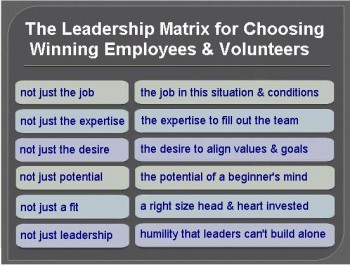
Strauss Leadership Matriix for Choosing Winning Employees and Volunteers

Here’s how the process changes when we have our leadership on before we build the team:

  • We have a job that needs doing. Someone has left the team or the business is growing and it’s time to add another someone to the group.
  • Not just the job. We analyze the situation, conditions, and opportunities. We look first at the people currently doing those tasks. We ask those people what they could be doing more of and should be doing less of in order to be bringing their best game to the business.
  • Not just the expertise. We look for the expertise to that’s missing from the team. Some of what the current team could be doing less of to perform higher are tasks that they’ve outgrown. Some of what they could be doing less of are skills that aren’t their strengths. If we build a job description to the team, rather to the immediate set of tasks, we’ll gain new skill sets that aren’t currently available. For example, if the team is great at people skills, but weak on data skills, we can look for someone who also brings that.
  • We share that new job notice with people who know great people and in places where appropriate candidates will see it and respond.
  • Not just the desire or potential. We build a short-answer values and potential survey rather than a submission form. Each question might allow only 100 words. The questions might be …
    • What led you to apply for this position?
    • How do your values align with the values of our business?
    • How do you see your contribution in helping the business grow?
    • What in your life or work experience proves to you that we’d be successful working together?
    • How would you describe the optimal working relationship we might have now and moving forward?
  • We invite people to interview for the position and select the candidate we feel most likely to be qualified, committed to the work, and a good fit for the team.
  • During the interview, we introduce the candidate to the business, to members of the team, and to the employee or volunteer who last joined the business.
  • Not just a fit. We ask the newest employee or volunteer to assign the candidate a small task. The task might be writing a blog post or a proposal for a new idea. The task is chosen to fit the skills needed by the team. The newest team member is asked to give the candidate this slightly ambiguous guidance.
    • This is not a test. It’s so that we have something of a project nature to talk about.
    • It’s not expected that it will be a final, executable idea.
    • When you (the candidate) are ready, please call to set up a meeting to discuss what you bring.
  • Not just leadership. The candidates who set up meetings show up with a project and ready to share their thinking. . The meetings allow you and the team to discuss how the candidate makes decisions and what he or she valued in developing the meeting project.

The task sorts the candidates with leadership qualities, initiative, and motivation. Those who set up a return date are the ones can deal with ambiguity and have the ego strength to bring their ideas with clients and colleagues with confidence. The people who don’t want to invest or risk in that way sort themselves out of the process.

The meeting itself allows everyone — candidate and the team — to try on the fit and by discussing “real work.” The team can see the candidate’s ability to trust in him- or herself, the work, and the group comes out. The candidate can experience how the team discusses ideas and relates to each other as a group.

I used this process for 18+ years and only once did a candidate make who set up the meeting turn out to be one who didn’t belong on the bus. All of the others were high-performers who fit the team.

How do you get your leadership ON before you build a team?

Be irresistible.

–ME “Liz” Strauss
Work with Liz on your business!!

Buy the Insider’s Guide to Online Conversation.

I’m a proud affiliate of

third-tribe-marketing

Filed Under: Community, Successful Blog Tagged With: bc, Hiring, LinkedIn, management, team-building

What Do You Get from the Pizza Party at My Dad’s Saloon?

April 4, 2011 by Liz

At What Price?

insideout logo

Near the end of my freshman year in college, we found out that my boyfriend’s fraternity brother — a guy I knew — was getting married. What was amazing, interesting, exciting was that he was getting married in the town of about 20,000 people where I grew up. The wedding would take place on a Saturday that summer. They college kids I knew would be staying for the weekend to party and enjoy each other’s company right now the street from my dad’s saloon.

My dad was a quiet and generous man who had the wonderful idea that the sun rose and set on my head. He was for almost anything that could bring a smile to me. So when I asked if some of the college folks could come to his saloon that Sunday afternoon for pizza and conversation, his answer was a smile of we can’t have them leaving town hungry. His words were “how many and what time?”

And as it turned out that my estimate of 10-20 and 2 hours for a pizza reunion became something more like 40-60 and 5 hours of talking. Pizza and fried chicken, beer and soda and other beverages were non-stop for the entire time. The whole while, I got to introduce college friends to my dad as sort of held court and sort of worked the bar.

Near the end of the afternoon, I noticed one friend looking a little nervous.
I asked, “How might I help?”
He said, “I’d like to talk with your dad.”
“Easy!”

I introduced my friend to my dad. They shook hands.
Then my friend said, “I’d like to pay the bill. Could you tell me what we owe for all of this?”

My dad smiled and nodded. He washed a glass or two and set them on the bar. before he reached out for a small white pad of paper and a tiny orange pencil with no eraser. He began writing, figuring on the pad that was enveloped in his huge hands. He looked up and surveyed the room, then wrote something down. I bet he did that survey five or six times without saying a word, without even a question in his eyes or looking at me.

My nervous friend waited patiently with his wallet out.
I could tell he was wondering whether their would be room on his credit card.

About then, my dad stepped back held the white pad out about arm’s length as if he were doing the math in his head — which could well be. Then he stepped forward again, tore off the slip on paper on which he’d been figuring, and set it in front of my nervous friend.

dad-wave

My dad said, “I’ve been over this twice, and as far as I can figure this is what you owe — no tipping on Sunday.”

The piece of paper read ” $1.50″ — 40-60 people and 5 hours of beer and beverages — one dollar and 50 cents.

“Hope you don’t mind if I rounded it up. We don’t keep pennies in the register.”

I learned a lot watching that sale.

What do you take from this story? Do you see something worth remembering that I might not see?

Be irresistible … like my dad.
–ME “Liz” Strauss
Work with Liz on your business!!

Buy the Insider’s Guide to Online Conversation.

Successful-Blog is a proud affiliate of

third-tribe-marketing

Filed Under: Marketing /Sales / Social Media, Successful Blog Tagged With: bc, LinkedIn, relationships, Strategy/Analysis

Beach Notes: Do You See It?

April 3, 2011 by Guest Author

by Guest Writers Suzie Cheel and Des Walsh

silver-lining

Look for the silver lining.
In the sky, in life, in business,
you can’t see it if you don’t look.

Suzie Cheel & Des Walsh

Filed Under: Motivation, Successful Blog Tagged With: bc, Beach Notes, Des Walsh, LinkedIn, Suzie Cheel

Thanks to Week 284 SOBs

April 2, 2011 by Liz

muddy teal strip A

Successful and Outstanding Bloggers

Let me introduce the bloggers
who have earned this official badge of achievement,

Purple SOB Button Original SOB Button Red SOB Button Purple and Blue SOB Button
and the right to call themselves
Successful Blog SOBs.

I invite them to take a badge home to display on their blogs.

muddy teal strip A

b2cy
blue-gurus
get-in-front-communications
leadership-for-good
parallel-interactive-communications

They take the conversation to their readers,
contribute great ideas, challenge us, make us better, and make our businesses stronger.

I thank all of our SOBs for thinking what we say is worth passing on.
Good conversation shared can only improve the blogging community.

Should anyone question this SOB button’s validity, send him or her to me. Thie award carries a “Liz said so” guarantee, is endorsed by Kings of the Hemispheres, Martin and Michael, and is backed by my brothers, Angelo and Pasquale.

deep purple strip

Want to become an SOB?

If you’re an SO-Wanna-B, you can see the whole list of SOBs and learn how to be one by visiting the SOB Hall of Fame– A-Z Directory . Click the link or visit the What IS an SOB?! page in the sidebar.

–ME “Liz” Strauss

Filed Under: SOB Business, Successful Blog Tagged With: bc, blog-promotion, SOB-Directory, SOB-Hall-of-Fame, Successful and Outstanding Blogs

Too Forgiving? You Aren’t Doing Your Staff or Yourself a Favor

April 1, 2011 by Guest Author

A Guest Post by
Rahil Muzafar

cooltext451585442_tools

Clarity Can Be Kind

Not very long ago, I used to work in an advertising agency, as the supervisor of a team of content and copywriters. We were a small advertising firm that catered to even smaller businesses. My department was responsible for writing copy for both online and offline ads, churning out blog posts for our corporate blog, and occasionally writing press releases. The overall workload was quite manageable and the procedure fairly simple … products and clients’ requirements were allocated to different writers, they’d write a copy and forward it to me. I’d take a look, make necessary changes and send the work to the concerned department. Being the supervisor, I was in charge of proofreading before the content was finalized and processed.

Now, some writers I had were quite a misfit (and I am trying to be polite when I say “misfit”). Some of them were not even recruited as the writers; instead they had been drafted from other departments because they had demonstrated a good comprehension of English grammar. That wasn’t my decision of course, because for me, English comprehension comes at the very end of the list of requisites for the job of copywriting. Common sense and creativity is what I’d like to see in a writer by default, since neither common sense nor the creativity can be taught, oh and good research skills are a plus.

Anyway, going back to our story …

the copy these writers produced mostly ended up as some desperate attempts to be creative, and the worse part is, these attempts fell flat nine times out of ten. The copy hardly made any sense and most were far off the mark.

I never told them in clear words that what they should be looking for another career because creative writing is beyond their ken. But because I didn’t have much to do (and also because I couldn’t think of a polite way to show them the door) I would rewrite their entire work in the name of reviewing. Note that I m not trying to brag about my instant copywriting skills, the thing is that most of our clients were small sized businesses operating in the local market, so they were not looking for the extraordinary, therefore it was pretty easy for me to transform the wayward into something of quality.

Occasionally, I’d call one of the writers to say he or she had failed to write anything sensible, following the information with a motivational speech encouraging the writer to pull out all stops to improve. I wanted to give them some time to learn (even though my acumen kept telling me that they didn’t have the “thing” needed for this job).

Months went by, and it turned out that I was right, none showed any considerable improvement, the nonsense-ness in their written pieces was as obvious as the first day, and there was hardly an instance when I didn’t follow reading their copies with a frown.

Then, it got a little ugly. Owing to the worsening business conditions; the company (and its staff) was pushed out of its comfort zone. After an aggressive marketing campaign, and a stream of new clients, we found ourselves in the middle of a hell lot more work, and tougher deadlines. It didn’t take long before my customary frowns turned into ferocious hair-pullings. More clients and more work meant that I didn’t have the kind of time for working on their substandard copy to meet requirements. Occasional call-ups turned into frequent warnings. Fast forward a few months, and one by one, most of them had been drafted back to their old departments or discharged from their duties.

Only a couple of them survived and even then, they seemed totally out of place whenever we were brainstorming new ideas to work on.

That was my first challenge as a manager, and I learned one very important lesson, which has helped me later on my entrepreneurial ventures, and that’s … being too lenient or too forgiving to your staff/workers/employees is actually a disfavor to your company, to you, to other workers, and to them.

That doesn’t mean you should go on a sacking spree as soon as you feel some of your staff is not up to the scratch, but being too lenient will eventually have following consequences.

The company suffers:

Being the owner (or the manager) you must make sure that the organization or your department is performing at the optimum level, and that the business is utilizing the available resources in the most efficient manner. Therefore, even when the business is doing exceedingly well, doesn’t mean that you should start accommodating some incompetent workers, if you are keen to help out some needy persons, there are other ways of doing that.

Generally speaking, an incompetent person’s gain is a competent person’s loss. If you are feeling remorse when sacking an incompetent worker because the job market is saturated, remember that out there, in the market, there might be a qualified person sitting jobless and waiting desperately for an opportunity.

You suffer:

Being an entrepreneur, all your efforts, plans, and strategies will miss the target if you’ve got weak links working at any position. Besides, it will create enormous pressure when you have to watch over each and everything because you cannot trust your workers.

Other employees suffer:

When a department or a team consists of some inept members, the entire department has to put up with their lack of ability and clumsiness. And that’s not all, slowly but surely, it will start transmitting a demoralizing effect on the entire workforce.

Even they are going to suffer:

It’s far better to be honest with your employees as compared to being unnecessarily nice. If some of your workers are going amiss, let them know that they are not good enough. Otherwise, the sudden sacking will be even more devastating.

Give up being too forgiving and get better at matching people to what they do well instead.

Rahil Muzafar

—-
This post was contributed by Rahil, but these tips are not the only thing that he can offer. You may find coupon for norton and go daddy voucher at his website.

Thanks! Rahil!

–ME “Liz” Strauss
Work with Liz on your business!!

Buy the Insider’s Guide to Online Conversation.

Successful-Blog is a proud affiliate of

third-tribe-marketing

Filed Under: Motivation, Successful Blog Tagged With: bc, LinkedIn, management

How to say NO to your boss

March 31, 2011 by patty

by Patty Azzarello

cooltext466496263_leadership
saying-no-to-your-boss

What can you do when demands pile up so high that you and your team are constantly over-booked and the work just keeps coming?

I always talk about how you need to rise above the tactical workload and be more strategic — but what do you do when it’s your boss that is causing the problem?

The disconnect

There is a built-in disconnect that I find very interesting:

When you are working in the business, generally speaking, your job is get work done.

But when you are running a business, generally speaking, your job is to go out into the world, learn things about the customers, the competition, and the market and figure out new stuff to do.

Then you come back all excited about what you’ve learned, and share your ideas with your team about how to improve the business — and they are exasperated. You see it as great new ideas. They see it as more work, changing direction, or fire-dirlls.

There will always be a disconnect between what the boss thinks up and what the organization can deliver.

The secret

Here is the secret. Your boss wants you to push back. Your boss is expecting you to think through the business strategy and the workload an offer advice – not to just try and do everything.

“Oh, no. She’s back…”

I know that when I would come back from a trip, my staff would brace themselves and think “Oh, no, she’s back. Now what? What else is she going to want us to do? We are already too busy, why does she keep piling it on?”

As the boss, I wanted my team to listen and internalize what I had learned. But I did not want them to treat all ideas and requests equally and immediately.

I did not want my team to just try and take on all the work and have it kill them. I did not want or expect them to do everything.

What I wanted was for them to catch all the work, analyze it, make judgements about business priorities and come back to me and negotiate.

Advise your Executive

Big Idea: You need to CATCH all the work, but not DO all the work.

I wanted them to stay focused on the strategic stuff we were working on, but be aware that key triggers were occurring in the market.

I wanted them to think it though and recommend to me how we could stage out all the work. How could we keep focused on the right strategic stuff, but then also come up with a way to prioritize the new ideas and take some of them on over time?

I wanted them to suggest ways of streamlining or stopping things to make room for something new.

I wanted them to debate with my about what is most important and why, and suggest how to re-work the plan to do the most important things first.

Who stands out?

The people who would come back to me with a thoughtful proposal for what to do, in what order, that would be good for the business, and do-able for the team were the ones that stood out as high performers.

The ones who didn’t just accept all my ideas and requests, and helped me think through the strategy and priority stood out as high performers.

The ones who tried to take on all the work and do everything, resulting in everything slipping were not so impressive.

The ones who simply ignored my inputs, kept their heads down, and did not step up to the strategic thinking and debate were not so impressive either.

How to negotiate the workload:

  • Keep a list of everything your boss asks for
  • Keep a list of the top strategic priorities you are working on
  • Have regular meetings with your boss where you take out these lists
  • Make recommendations about what to prioritize based on the context of business and the content of these two lists.

When you show your boss these lists several things happen:

  • They get embarraseed not realizing they have aksed for so many things. When they see it spelled out right there in front of them, they can see it’s unreasonable.
  • You win lots of credibility for keeping the list, catching everything, and not dropping anything. You make them comfortable that you’ve got it covered. They trust you.
  • You can ask them “Is this still important”? You will find they have forgotten about several of the requests and have decided that others don’t matter anymore.
  • You will realize that you are not beholden to everything on the list!
  • You will be able to negotiate timelines and suggest priorities.

Your boss forgets

There is a tendency to treate all requests from the boss equally.

You need to resist this because they don’t intend them all equally.

They can seem equally excited or serious about a wide range of ideas. Some are vitally important, others are just musings. It’s hard to tell. They will often forget things that asked for, or change their mind without telling you.  You need to check. They need you to help them with their thinking.

You are being paid to judge and decide, not just to do everying you are told.

What do you think?

How have you pushed back successfully? How have you found ways to reinvent your workload to add more value. Please leave your thoughts in the comment box below.

—–
Patty Azzarello is an executive, author, speaker and CEO-advior. She works with executives where leadership and business challenges meet. Patty has held leadership roles in General Management, Marketing, Software Product Development and Sales, and has been successful in running large and small businesses. She writes at Patty Azzarello’s Business Leadership Blog. You’ll find her on Twitter as @PattyAzzarello. Also, check out her new book Rise…How to Be Really Successful at Work AND Like Your Life

Successful-Blog is proud affiliate of

third-tribe-marketing

Filed Under: management, Successful Blog Tagged With: bc, Business Leadership, LinkedIn, Patty Azzarello

  • « Previous Page
  • 1
  • …
  • 301
  • 302
  • 303
  • 304
  • 305
  • …
  • 1050
  • Next Page »

Recently Updated Posts

The Creator’s Edge: How Bloggers and Influencers Can Master Dropshipping

Is Your Brand Fan Friendly?

How to Improve Your Freelancing Productivity

How to Leverage Live Streaming for Content Marketing

10 Key Customer Experience Design Factors to Consider

How to Use a Lead Generation Item on Facebook


From Liz Strauss & GeniusShared Press

  • What IS an SOB?!
  • SOB A-Z Directory
  • Letting Liz Be

© 2025 ME Strauss & GeniusShared