Successful Blog

  • Home
  • Community
  • About
  • Author Guidelines
  • Liz’s Book
  • Stay Tuned

5 Reasons Why your Business Needs a Blog

March 25, 2014 by Rosemary

By Teddy Hunt

Blogging might have come to prominence in the late ’90s, but rumors of its demise are greatly exaggerated. Social media might have become the focus for many businesses, but they’re missing out on a valuable marketing opportunity. Read on to discover why your business needs a blog now.

A Blog Helps the Public Relate To Your Business

A blog can turn your company from a faceless corporation to a much more human firm. It’s the place where businesses can show their personality and act a little more light-hearted than they do in other professional avenues.

It may seem daunting to loosen your tie, but it’ll do your brand some good. The friendly voice of a blog can help you cultivate long-term relationships with your customers and increase their brand loyalty. Eighty-two percent of customers say they enjoy reading relevant blog content from brands, and three in five say they feel a company’s positivity through their blog.

Potential employees also read company blogs to help them decide on the best employer for them as they generally create a better sense of what a business is about than a stiff corporate site.

Through your blog, you may find you’re attracting more appropriate candidates for available positions.

A Blog Gains Consumer Confidence

A steady stream of relevant blog posts shows readers you are dedicated to your industry and a good source of information. As your business blogs on a regular basis, you’ll start to establish yourself as experts in your field. Studies show that 81 percent of readers trust the advice they receive from blogs.

The key to gaining this trust is using the blog for more than self-promotion. Share your knowledge about your field, such as your insights about trends and your commentary on local affairs. Posts that are packed with insider information presented in a clear, accessible way are powerful marketing tools that are likely to be shared through email and social networking channels.

A Blog Improves Your Position on the Web

Your social media presence will drive visitors to your website and increase brand awareness, but it doesn’t improve your position on the web the way that blogging does. Every time you update your blog, you add new content to your site, and search engines take notice. Remaining current is one of the best ways to stay on top of internet search engine rankings.

Ranking well is a complex science, but the most important factor Google considers is the number of inbound links. So it’s worth noting that companies that blog have 97 percent more inbound links than businesses that don’t.

Search engines also consider the number of indexed web pages when calculating your ranking. Websites with blogs perform so well because they typically have 434 percent more indexed pages than their competitors.

Web position is so important because three-quarters of browsers never scroll past the first page of Internet searches. A blog can help your business stay in pole position and more than double its website views.

A Blog Increases Sales

As you might expect, a blog doesn’t just drive readers to your business website. It also encourages customers to spend up. Roughly three in five consumers say they’ve made at least one purchase based on the information they’ve read on a blog post.

There’s even evidence to suggest blog posts may be even more important than traditional advertising, with 70 percent of consumers insisting they learn about businesses through articles rather than ads. This may be because customers can mentally switch off when they feel like they’re being marketed to. Blog posts are a much more subtle form of advertising, so they can capture the interest of these customers that don’t warm up to commercials.

A Blog Can Become Part of Your Social Media Strategy

Coming up with all those pithy status updates for your Facebook and Twitter pages can be taxing, but your blog can help you out. It’s easy to blast every new blog post into your social networking feeds (just be sure to tweak the update to suit each social network, and engage with those who share it).

This means you can spend less time social networking yet still give your connections fresh, new material. Integrating your blog with Facebook and Twitter will also drive traffic back to your blog and company website, which gets customers one step closer to making purchases.

So what are you waiting for? There’s no better time for your business to get blogging!

Author’s Bio: Teddy Hunt is a freelance content writer with a focus on technology. When not behind a computer, Teddy spends the majority of his free time outdoors and resides in Tampa, Florida.

Filed Under: Content, SEO, Successful Blog Tagged With: bc, blogging, content marketing, SEO

5 of the Most Recognizable Company Logo Revamps Ever

March 21, 2014 by Rosemary

By Teddy Hunt

Most major companies undergo an image rebranding process at some point in their life cycles.

Some companies have done it many times. Call it a sign of the times, a way of evolving to keep up with industry trends, or to reflect a brand’s changing dynamic. No matter what the reasoning behind it, it’s fun to look at the brands that we know and love today and see how much they’ve changed right in front of our eyes. Here, in no particular order, are five of the most recognizable company logo revamps ever.

1. Pepsi

Pepsi logo

Image by Hi Wave Event Creation

Pepsi has undergone so many image changes, it would be impossible to mention them all here.

What’s interesting to note is that the delicious fizzy drink was first introduced to the public in 1893 as “Brad’s Drink.” Coined after pharmacist Caleb Bradham, who first concocted what we now know as “Pepsi” in his drugstore. He made it out of carbonated water, vanilla, rare oils, sugar, pepsin, and cola nuts.

Since then, the Pepsi logo has undergone a number of image changes, each reflecting the trends of the times. These changes were each subtle in nature, but brought it to an image that hardly resembles the original logo at all.

2. Starbucks

Starbucks logos

Image via WebUrbanist.com

The latte-making coffee giant has reinvented its public image a number of times since its inception in 1971. As a testament to its successful brand recognition, Starbucks has stopped using its company name in its logo altogether. Much like Nike and Prince, it’ll now represent itself solely by a symbol.

3. Coca-Cola

Coca-Cola logos

Image via Flickr by Eric Kilby

Unlike its biggest competitor, Coca-Cola has always had the same name. Its logo, however, has most certainly changed with the times. The trademark swirly font has stuck around for the most part, but the shape and style of the rest of the logo have evolved, from having negative space around the name to a red background, the recognizable white swirl under the text, and the notable addition of the word “classic” under and “Enjoy” above the text.

Some periods of the logo featured a black background as an alternative to the classic red. The brand itself hasn’t changed, but the visual effect most certainly has.

4. Wal-Mart

Wal-Mart Logo

Image via WebUrbanist.com

Wal-Mart represents another internationally recognizable company logo that has changed several times. Since its inception in 1962, it has changed seven times. For the first 20 years or so, the logo had a frontier feel, but dropped it in 1981 when it opted for a brown version of the font we recognize today.

After nine years of the brown color scheme, the retail giant adopted the blue color scheme that has become synonymous with the Wal-Mart name. Finally, as part of its massive rebranding campaign that included the new slogan, “Save money, live better,” it slimmed down the font and added its now-iconic yellow spark.

5. UPS

UPS Logo

Image via ShareALogo

The United Parcel Service has stuck pretty close to its roots when it comes to its logo and marketing materials. The standard shield we’ve all come to know has been with UPS since it opened its Seattle doors in 1907. Back then it featured the silhouette of an eagle carrying a package in its talons. Since then the beloved parcel delivery service has only mildly tweaked its logo a few times.

However, the company underwent a worldwide rebranding process that included a sleek new logo to represent the company across all platforms. This new image stuck with the company’s traditional brown color scheme and shield but gave it a modern twist, adding a subtle 3-D effect and a sans-serif font while simultaneously coining the phrase “We [heart] logistics.”

In order to keep up with the ever-changing dynamic of today’s economy and consumer expectations, major corporations are constantly reinventing themselves.

What are some of the most recognizable logos you’ve noticed getting a facelift lately? Have you been inspired to take another look at your own logo?

Please share with us in the comments below.

Author’s Bio: Teddy Hunt is a freelance content writer with a focus on technology. When not behind a computer, Teddy spends the majority of his free time outdoors and resides in Tampa, Florida.

Filed Under: Design, Successful Blog Tagged With: bc, branding, Design, logo

The Hotel, the Airline, and the Restaurant are all Publishers. Are You?

March 20, 2014 by Rosemary

At SOBCon Portland last year, I had the honor of interviewing Chris Erickson from the Heathman Hotel for one of our sessions. His hotel was in the news at the time because it had been used as the setting for the Fifty Shades of Grey books.

Rosemary ONeill Chris Erickson interview SOBCon Portland

However, as we all discovered, the hotel already had a well-deserved reputation for being forward-thinking long before E.L. James decided to give them a different type of fame.

One thing Chris said during our interview was, “I consider myself a publisher.”

There was definitely a moment of silence in the room as we all took that in. Imagining how far content marketing, social media, and digital outreach have come. A hotelier says he’s a publisher.

Chris explained that he considers it part of his job to produce content (in many different forms) that will support the Heathman’s reputation and business strategy.

But doesn’t it all go back a lot farther? The airlines have had in-flight magazines for quite a while now.

Chipotle is spending millions on well-executed mini-movies to sell carnitas burritos.

Is it time for every business owner and entrepreneur to think of themselves as a publisher? And how does this mindset shift your process, your work product?

According to Google, a publisher is “a person or company that prepares and issues books, journals, music, or other works for sale.”

Characteristics of Being a Publisher

  • By definition, a publisher is not an amateur. He/she is presenting items for sale, not as a hobby.
  • A publisher both “prepares” and “issues” the materials offered. He/she takes care that the items are error-free and ready to be issued to the world. By issuing, the publisher stands behind what he/she has prepared.
  • Publishers take a risk when they present materials for sale. They invest in the content, not knowing for certain what the reward will be.
  • Publishers must know their market. Is there room for this work? Is it the right time? Is this work creative and different enough to inspire others?
  • A publisher makes hard decisions.

Do you consider yourself a publisher? Why or why not?

Don’t miss out on SOBCon Leverage 2014 yet? You’ll definitely want to be in the room.

Author’s Bio: Rosemary O’Neill is an insightful spirit who works for social strata — a top ten company to work for on the Internet . Check out the Social Strata blog. You can find Rosemary on Google+ and on Twitter as @rhogroupee

Filed Under: Content, Marketing Tagged With: bc, content marketing, publishing, Writing

Content: Serving Up the Same Thing Differently

March 18, 2014 by Rosemary

By Lisa D. Jenkins

Where I used to live, there’s a thing called Bite-Size. When I moved there, I assumed it was similar to finger steak I couldn’t have been more wrong.

Bite-Size is made with 2-inch hand cut chunks of beef and each restaurant has its own proprietary seasoning and cooking technique. One does a dry rub with batter and deep fry, one marinates and broils, while another seasons and grills. You order it cooked to temperature, just like a steak and depending on where you go, it’s served au jus, with tartar sauce or with ranch.

In a town of 100k or so, there are no less than 10 privately owned restaurants that serve their own version of Bite-Size, and each restaurant’s version has a fiercely loyal customer base. Ask any meat-eater in the valley and they’ll tell you exactly why the Bite-Size they love is the best and why you should try it.

How does that happen with a product that’s basically the same? Easy; every customer has a unique set of taste buds. Even yours.

Content is a lot like Bite-Size.

Regardless of the industry you’re in, the content you publish most likely bears some resemblance to the content your competitors publish. “If that’s true, why should I bother,” I hear you ask. Because it’s the flavor of what you deliver that strikes a chord with your customers and makes them come back for more of what you’ve got.

While you and Competitor X are both publishing content around Widget A, your target customers are not the same. They’re segmented by their very real preferences for things like the language you use, color, brand voice, etc. And they choose who to do business with based on those preferences.

That’s why it’s important not to mimic what others in your industry are doing too closely. You don’t want everyone’s attention, you want the attention of people who are going to stay with you.

Individuality will draw the right people to you.

NorthFace is very down to business, no frills. The phrase high tech – low drag comes to mind. The Husband prefers NorthFace’s delivery and that’s what’s allowed in his Inbox.

NorthFace email newsletter

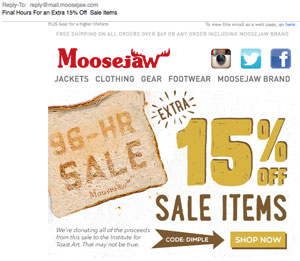
Moosejaw is all sorts of silly and fun. I giggle every time I see a newsletter from them in my Inbox and it makes me smile to spend my money with someone who understands the importance of humor.

Moosejaw email newsletter

Same basic products, different flavor.

Content strategy isn’t not about making sure you’re posting the same, keep-up-with-the-joneses content everyone else is. It’s about sharing that message with your own voice so that the people you want to attract find it valuable and recognizable.

Call it perspective, call it secret sauce, call it seasoning … how do you prepare and serve up your content to stand apart?

Author’s Bio: Lisa D. Jenkins is a Public Relations professional specializing in Social and Digital Communications for businesses. She has over a decade of experience and work most often with destination organizations or businesses in the travel and tourism industry in the Pacific Northwest. Connect with her on Google+

Filed Under: Content, Successful Blog Tagged With: bc, Content, email, newsletter

How To Find Your Blogging Voice

March 14, 2014 by Rosemary

There has been a lot of ink spilled on the subject of where to find blog ideas, how to generate headlines, and the bloggers’ tools of the trade. One area that hasn’t gotten enough attention is the idea of “voice.” When I think of “voice,” I think of Jayme Soulati, who brings a consistent style and tone to her work, regardless of medium. Is your own voice coming through loud and clear in your writing? ~Rosemary

By Jayme Soulati

tongue.jpgJust how does one find blogging voice?

The answer is…elusive! Not sure there is a solid answer, but at the bottom of this article we ought to have a much better understanding of what the hoopla is about a vlogger’s voice.

Omgosh.

When I typed “blogger” in the last sentence, it came up “vlogger,” and I am so grateful that happened whilst sitting in the middle seat in a full airplane cabin pecking letters one by one because the batteries died in my iPad keyboard.

So, instead of using merely a blogger to understand voice, let’s first explore the world of vlogging as it relates to that. Video blogging is so much more visual which makes it easier to illustrate the concept of voice.

What is Voice? Examining Voice and Vlogging

What is your impression watching peeps on camera?

It’s pretty painful sometimes, right? When a vlogger has to look at the camera without furtive eyes or naturally down-turned mouth (without a smile), it is difficult to make great video.

Now think of the words delivered during a video blog.

  • Are you following along and listening?
  • Is that blogger making a connection with you?
  • Are they droning on and on without coming quickly to a point?
  • Did they tick off an agenda or a bulleted list of items they’d cover in their piece?

    How about tone? When someone speaks, it’s normal to listen for inflection and excitement and authority. Is the tone of that vlogger credible? Do they take command of their subject matter and do you believe what you hear?

Exercise 1: How to Identify Others’ Voice on Video

Run and get a video blog you recently watched; I’ll wait. Spend two minutes only re-watching the vlog and pay careful attention; no multi-tasking!

In your head, jot down your impression of clarity, confidence, body language, tone, personality, credibility. Don’t worry, you’ll notice these automagically now that you’re looking and listening more closely.

In a recent vlog I saw, unfortunately, I couldn’t make it to the end and here’s why:

• The person was forced and lacked personality.

• S/he was cracking jokes that were not funny, and the content was subpar.

• It was a sorry attempt at connecting with community using a medium that appeared uncomfortable for him/her.

Let’s revisit some of the factors that make a video blog successful:

• Tone

• Facial expression

• Personality

• Connection with audience

• Command of authority

• Believability

When you add all of the above together with high marks, what you get is a masterful vlogger. Yet, it takes time and practice!

No one can master being on camera unless they are trained broadcasters (who daily practice news delivery prior to going on camera).

Think of Anderson Cooper next to David Letterman. That provides an awesome dichotomy, doesn’t it? The two can’t be farther apart in personality and tone yet they command respect, authority and attention.

Understanding Your Blogging Voice

Are you starting to get the picture of how we’re going to segue into blogging voice?

Many bloggers experience months and months of blogging only to feel a lack of connection with HOW they write. When you read a blogger using English as a second language, the content is often stilted and word choice is sometimes stark.

There isn’t naturalness to the flow of the article, and it takes the reader more time to connect with the writer.

This is not a criticism in the least, it’s merely an observation about how those words jump from the screen and in what tone and fashion. It’s how the reader connects with the writer that makes voice come alive.

Blogging voice is extremely different than journalistic voice or that of an author of romance novels. When bloggers write, there is more usage of the first person. Some new bloggers feel compelled to thread the word “I” throughout writings thinking perhaps that writing in the first person is more personable. In one opinion, it’s more egocentric and boorish.

Bloggers who have “found their voice” seem to fit right into an easy presence and comfort in their blogging skin without too much toil.

Here’s how you get to find your voice:

Establish Goals

When you start blogging, you need to set goals for yourself and the blog.

  • Do you want to build community and subscribers?
  • Do you wish to be an influencer or thought leader?
  • How about being the leading blogger in a genre or category like a parent blogger?

The goals you set drive how you write and thus your voice. If your goal is to sell diapers to moms, then you will need to command authority and then add a sales bent to that voice. Right?

Example of a Mommy Blogger Selling Diapers

Yesterday, I tried the new brand of diaper, called Baby Undies, on my infant daughter and learned the hard way that pretty packaging doesn’t mean better-quality diapers! (I think I’m going to stick to my favorite brand, Diaper G, instead!)

Tone: Personable and friendly

Credible: She experienced a negative event and is warning other moms not to buy that brand

Soft sell: She’s sharing a factual event and encouraging her community to follow her advice

Be Consistent. It takes 12 months of posting about three times a week to find comfort with your online presence. If blogging is your profession, in that 12- month timeframe you most likely have accomplished a few goals and have already switched it up a few times. If blogging is your hobby, then 12 months may be when you see a few milestones happen, and you grow from there.

Know Your Audience

Who is reading your blog? Better yet, who do you want to read your blog? If you are an online educator for home-school kids in fifth grade, your voice will be friendly, informal, conversational, yet authoritative and credible. Your audience is also the home-school parents who duel as teachers.

If you’re the pastor of a community church, blogging voice is going to be oriented to inspiring families to volunteer, tithe and attend church. That pastor blogger will walk a fine line between creating community, encouragement and being a leader.

Understanding your audience who is or may be reading your blog is critical to finding your voice. You will write more powerfully instead of in a meandering way.

You will connect with them to attain your goals each time you write. You’ll think of what they want to hear and write with that purpose.

Think About Buyer Persona.

Have you ever heard of a buyer persona? At first, I thought it silly, but after really thinking hard about who buys my services, I could picture that person reading my blog.

My blog articles began to take on a more professional tone to address some common marketing issues in companies.

My voice amplified confidence in my subject matter, and I felt a connection to the person I’d like to have visiting my blog.

This has contributed to a good feeling about my writing, defined my blogging purpose, which ultimately contributes to my voice.

Exercise 2: Start to Identify Your Own Voice

How and where you find blogging inspiration for writing fodder is a topic for another day. For the purpose of this exercise, select a topic you’d like to write about.

Perhaps you’re a master gardener with a blogging goal to enroll people in your master gardening classes so they can earn their certificate and join your ranks. (Can you recognize the blogging goals in that last sentence?)

How will you write? With purpose!

Your words need to be visual and help the reader connect with your passion about gardening. Do you sense the personalization that has to come across in blogging?

Your passion must be apparent; if you write with dryness you will not connect with your audience. Passion for our topic begets connection with your audience.

Ever read the children’s books Fancy Nancy? Certainly, the illustrator made those books but she had to have the words as inspiration. It was a team effort, for sure.

Your words need to inspire anyone with the hint of a green thumb that they can become a master gardener just like you.

Your plot of land becomes your canvas to create a breezy, flowy, rainbow garden that brings a gasp of visual pleasure with butterfly wings a flutter.

How did that sentence grab you? I hope it created a bit of a visual…don’t butterflies always do that? Notice the word choices that are lighter and more creative with visual appeal. Try to put more of these types of words in your writings and loosen up. Quit being so stilted. A blogger with voice is comfortable with self first and that confidence helps portray authority.

Author’s Bio: Jayme Soulati is an award-winning professional blogger writing at Soulati-‘TUDE! making its home at http://soulati.com. She is president of Soulati Media, Inc., at which she offers business-to-business hybrid public relations blending digital marketing, content marketing and social media marketing with public relations. Since 1984, Jayme has worked in public relations launching in Chicago’s agencies. She is a seasoned practitioner and brings strategy, ideation, writing, media relations, and more to every client engagement.

A version of this post originally appeared on the Shareaholic blog Feb. 28-29, 2013.

Filed Under: Writing Tagged With: bc, voice, Writing

5 Pitches You Must Have Up Your Sleeve

March 13, 2014 by Rosemary

Scheherazade had 1001 stories, but you only need five key stories in order to pitch your business effectively in most situations.

arabian nights

If you have these stories at-the-ready, you’ll be more prepared than 90% of your competitors.

1. Grocery Line

This pitch is your standard response to a stranger’s question, “what do you do?” The nuance here is that it should be understandable by anyone. No jargon, no need to use a silly title like “Chief Cat Wrangler.” This pitch must be super-brief, and ideally will end with you asking a question about the other person.

“I’m a media coach. What do you do?”

2. Business Reception

This is the scenario where you’re standing up, cradling a mini quiche in one hand and a glass of white wine in the other. It’s a business function, and you’re chatting up the person who was behind you in the buffet line. Since it’s a business environment, you can be a bit more detailed. You may have the chance to extend the conversation for a few minutes, so you don’t have to cram everything into one sentence. Find an opportunity to ask the other person a question immediately. And when they speak, listen intently.

“I’m a small business media coach. I take the fear out of dealing with reporters. What brings you to this event?”

3. Sit Down Business Meeting

In this situation, you’re spending a significant amount of time sitting with other professionals (for example, at a workshop). They’re going around the table and everyone is supposed to say “what they do” to the rest of the group. Your goal here is to say something memorable and engaging.

“I help small business owners make a polished impression during media interviews. My specialty is analyzing body language…so everyone uncross your arms right now.”

4. Prospect Call

You did it. You got the prospect on the phone to hear about your services. Of course, you started by asking them to describe their key requirements, and then they said, “can you give us a high level overview of your business?”

“My firm, Dazzling Media Coaching, has been helping small businesses like XYZ Realty polish their media skills for more than 10 years. My background is as a television journalist, which gives me a unique perspective on media training. I use body language, mock interview techniques, and speech pattern analysis to help my clients knock it out of the park. Do you have an upcoming media appearance you’d like help with?”

5. Client Shareable

This one is tricky. Basically it’s a very pithy, memorable phrase you can implant in your clients’ minds so that when someone uses the trigger words, they will refer you.

We all like to categorize each other into “buckets” in our brains, so that we can easily recall appropriate contacts when we need them. This pitch is more like a tagline. What category do you want to be remembered for?

“The go-to media coach for small business.”

I strongly recommend taking some time to craft responses for these 5 common situations. Tell your story with passion, wit, and creativity, and like Scheherazade, your business will live to see another day!

Author’s Bio: Rosemary O’Neill is an insightful spirit who works for social strata — a top ten company to work for on the Internet . Check out the Social Strata blog. You can find Rosemary on Google+ and on Twitter as @rhogroupee

Filed Under: Marketing /Sales / Social Media Tagged With: bc, marketing, pitch, tagline

  • « Previous Page
  • 1
  • …
  • 36
  • 37
  • 38
  • 39
  • 40
  • …
  • 84
  • Next Page »

Recently Updated Posts

Is Your Brand Fan Friendly?

How to Improve Your Freelancing Productivity

How to Leverage Live Streaming for Content Marketing

10 Key Customer Experience Design Factors to Consider

How to Use a Lead Generation Item on Facebook

How to Become a Better Storyteller


From Liz Strauss & GeniusShared Press

  • What IS an SOB?!
  • SOB A-Z Directory
  • Letting Liz Be

© 2025 ME Strauss & GeniusShared