Successful Blog

  • Home
  • Community
  • About
  • Author Guidelines
  • Liz’s Book
  • Stay Tuned

How to take your Pinterest account to the next level

October 18, 2013 by Rosemary

By Charles Mburugu

Pinterest can be a great option for business owners who would like to promote their products and services. One of the most popular social media networks, it is not just for leisure time anymore.

Pinterest allows users to collect photos and videos and share them with others. These images are pinned on boards, which are categorized according to hobbies, interests and events. Here are some tips that will help you take your pinning to the next level.

1. Include hashtags, @reply and keywords

Pinterest users can use hashtags and keywords to look for specific items. In addition, they are informed whenever anyone replies to a pin. Therefore, make sure your pin descriptions have the relevant hashtags as well as keywords. This will increase the chances of your pin appearing in related searches. However, avoid having excess hashtags in your description since this could make it difficult to read. Replies enable your visitors to share their thoughts in the comments section of the pin.

2. Add a ‘Pin it’ bookmark to your browser

If you don’t have a ‘pin it’ bookmark, pinning anything from any site can be a long and frustrating process. The good news is that installing this bookmark on your browser is very simple. All you need to do is visit http://about.pinterest.com/goodies/ where you can download the ‘pin it’ button and then install it. Whenever you pin a web page, you will be able to see all the photos on it. You can then select the specific image you want to pin.

3. Be social

The main purpose of social networks is to enable users to share, comment and connect with others. Therefore, when using Pinterest, you need to engage with others by liking, commenting on or repinning what they have posted. By being social and helpful, you will attract the attention of other users and they are likely to return the favor.

4. Request that followers pin photos of themselves with your product

This can be a very effective strategy for connecting with your fans and finding out what they think about your products. Running a contest would be a great way of implementing this strategy. For instance, the person who pins the most creative photo could get a discount on their next purchase. Alternatively, you could choose the winner based on the number of likes or re-pins their photo gets. This will encourage participants to involve their friends in the contest, thus resulting in more exposure for your products. Always be sure to read the Pinterest business guidelines before starting a contest.

5. Pin directly on your blog

If you have a blog, Pinterest allows you to pin photos directly on it. Whenever you find anything interesting, you can add it to one of your future blog posts. Alternatively, you could write a whole blog post based on that photo. Adding photos to blog posts is very easy. All you need to do is click the ‘Embed’ button on the photo and copy the code which appears. You can choose to adjust the size of the photo before pinning it on your blog.

6. Pin videos

Besides photos, Pinterest also allows you to pin your favorite videos. This is a great feature for people who are selling all kinds of products. You can pin ‘How to’ lessons and ‘DIY’ tutorials that show how the product actually works. Ask some of your fans to pin videos of themselves using your product and taking about its benefits. You could also choose to pin videos which show how the product is actually created. Funny videos of all kinds can also be very effective in capturing the attention of your audience.

7. Test various captions

One of the best things about Pinterest is the captions feature. You can use this feature to add hashtags as well as keywords. As you use these captions, it will be important to monitor them on a regular basis. Find out which captions attract the highest number of likes, repins and comments. This will give you an idea of what kind of captions to use for your future pins.

8. Include a dollar sign for products

If you’re pinning an image of something you have for sale online, you can include the dollar sign in the description, and Pinterest will automatically put a price ribbon across the corner, and index your pin as an item for sale.

Author’s Bio: Charles Mburugu is a HubSpot-certified content writer/marketer for B2B, B2C and SaaS companies. He has worked with brands such as GetResponse, Neil Patel, Shopify, 99 Designs, Oberlo, Salesforce and Condor. Check out his portfolio and connect on LinkedIn.

Filed Under: Marketing /Sales / Social Media Tagged With: bc, images, pinterest, social-media

Q&A with Ian Greenleigh, author of The Social Media Side Door

October 17, 2013 by Rosemary

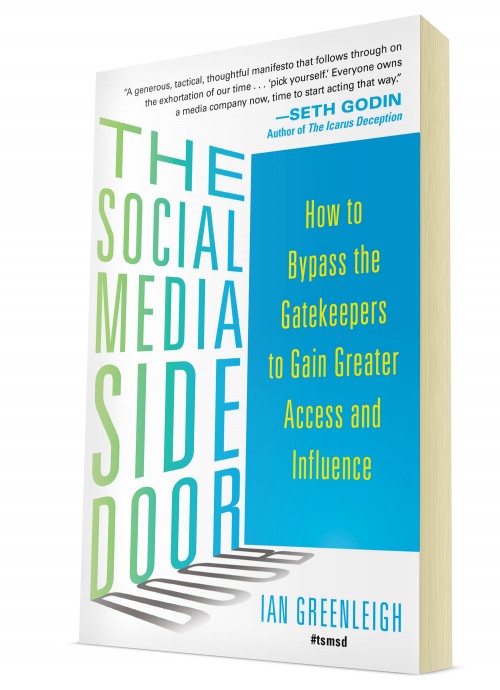
As a small business owner, I’m always hustling to make the most of limited resources. The techniques presented in Ian Greenleigh’s new book, The Social Media Side Door (McGraw Hill, October 2013), are designed to help us take advantage of the seismic shifts that have happened in recent years regarding access and influence.

Ian Greenleigh: The Social Media Side Door

Enjoy this Q&A with Ian, as he offers some great insights from the book.

1. What is the social media side door?

We’re living through an extraordinary time. Social media is decimating the human and technological gatekeepers that have historically prevented non-elites from accessing and influencing powerful people and institutions. The barriers are crumbling all around us, and so many people haven’t even noticed, or they’re simply not yet equipped to take advantage of these massive opportunities, what I call “social media side doors.”

2. How did you discover it?

I really struggled to get a decent job during the recession. I had just graduated with a degree in political science, even though it was a field I didn’t want to pursue. I was in sales, and I wasn’t very good at it. It was pretty bleak. None of the things our society teaches about getting great jobs were working. I thought I was bright, hardworking and creative, but I couldn’t find a way to convey that to the professional gatekeepers in recruiting.

I needed to try something radically different, so I scraped the bottom of my dwindling savings account to attempt something I had seen on a blog. I took out a Facebook ad, pointed it at a special “hire me” page on my blog, pointed the ad at decision-makers at the top companies in Austin, and saw the clicks roll in. Within a few weeks, I had a nice array of options for my next career step.

It wasn’t an anomaly. Once I started looking for them, I realized that social media side doors existed almost everywhere barriers seem to exist. I also realized that no one had written a guidebook to help people spot and take advantage of these new opportunities, so I decided to write it myself.

3. How can people find and open their own side doors in social media?

Realize that side doors often open gradually. For example, every time you leave a comment on a CEO’s blog, or tweet a piece of intelligent feedback to an influencer, you’re opening that side door up an inch or two more.

Think about the goals of the person whom you’re trying to reach, and reflect on how you can help them get there faster. You can do things like introduce them to other influential people via Twitter, interview them on your blog about a project they’re promoting, or help them find information they’re after.

Relationships are still the basis for almost all of the value created in social media. Social media makes it really easy to answer the question, “what has this person done for me lately?” As such, you’ll hear “yes” far more often when you’ve provided value before an ask, or in conjunction with it.

4. Why should we try to open these side doors sooner rather than later?

Imagine it’s the dawn of the 20th century, and you’re a salesperson, marketer or jobseeker. Telephones are expensive and rare, but somehow you’ve acquired one for free. There are no gatekeepers to screen the calls of the rich and powerful, and you can reach any of these fellow telephone owners simply by asking a switchboard operator to put you in touch. If you wait too long to take advantage of this situation, your competition will beat you to the punch, your approach will no longer be unique, and access now seems like more of a liability than an opportunity to those being accessed.

We’re not quite there yet with social media. We see rising adoption among powerful people, but the human and technological gatekeepers haven’t caught up yet. And innovation happens so rapidly, that the arrival of each new social network brings with it a new set of access and influence opportunities.

Author’s Bio: Ian Greenleigh is a social media and content strategist, and author of The Social Media Side Door: How to Bypass the Gatekeepers to Gain Greater Access and Influence. He helps companies turn data, ideas, and relationships into true thought leadership. His words and ideas have been featured in Harvard Business Review, Ad Age, Adweek, Digiday, Ragan, Seth Godin’s The Domino Project, and elsewhere. He writes and speaks on a wide range of topics, including changing consumer-brand relationships, the convergence of personal identities, and the radically shifting landscapes of access and influence. You can connect with Ian on Twitter: @be3d

Filed Under: Marketing /Sales / Social Media, Outside the Box, Successful Blog Tagged With: access, bc, influence, social-media

Manage Your Milennial New Hires With Loose Reins

October 15, 2013 by Rosemary

By Barry Welford

A large proportion of the people you will be recruiting will come from those born since 1980. These are often called Generation Y and the younger of them are known as Generation Z or Millennials. Likely they will be technologically savvy and will be well informed on the job market place and what it has to offer. What are they looking for in working in your company, and what do you need to have them achieve for success?

There is much online help for this significant recruiting challenge and there are even webinars that can set out effective strategies for recruiting Gen-Y.

The recruitment process can only be regarded as a success if both the candidates selected and the company achieve their goals through the contributions of these new hires.

Establishing A Loose Reins Culture

A company culture that is likely to resonate well with these new hires is what the Harvard Business Review calls the “Loose Reins” approach to management. Sometimes, the best management is little or no management at all. Sometimes, effective order and engaging experiences can be achieved with the most simple rules.

The article gives examples of how these principles are applied and gives the following summary of what it is all about:

The power of this kind of self-organization suggests that creativity and innovation might best be achieved not through rigid hierarchy and central controls, but from one or two simple but vital agreements. These agreements are often implicit, ones that everyone understands and is accountable for, yet that are left open to individual interpretation and variation. When we provide the right social context and then let things be, employees self-organize and produce better environment and better results than managers imposing control.

That sounds very appealing but clearly is somewhat revolutionary. Perhaps not everyone will be comfortable in this kind of environment. The recruiting and selection process clearly is critical in making candidate choices that will be successful for both parties.

Selecting Generation Y Candidates Who Can Accept Loose Reins

Before discussing the factors that will distinguish the most successful candidates for this Loose Reins culture, it is easier to define the characteristics of those who will not fit:

Individuals who

  • are black and white thinkers and do not see the shades of gray
  • insist on clearly defined detailed rules
  • are not self-starters
  • have difficulty in making decisions

The better candidates will be at the other end of the spectrum on these dimensions. In particular, they:

  • have an attitude of getting things done
  • can cope with ambiguity and devise practical rules that work
  • are innovative in finding novel solutions
  • will involve and work with other team members

Needless to say candidates will only be interviewed if they have the necessary job and technical skills to handle the position.

What These Candidates Will Demand

What may sometimes be overlooked is that it is even more critical for the candidate that the outcome should be successful. The company can move on fairly rapidly if a wrong decision has been made, but the individual will be faced with much more significant problems if the job is not working out. You can therefore expect that the best candidates will have their own requirements that must be met. In addition to the standard terms such as salary, vacation, hours of work and working conditions these might well include the following:

  • A realistic job description
  • A list of available resources and budgets
  • A clear statement on results to be achieved
  • Possible career opportunities based on success

The bottom line on all this is that the successful candidate and the company must have a shared vision on what is to be achieved and the plan to make it happen. Without this, there is a good chance that one or other or both will be severely disappointed.

Are you a “loose reins” manager?

Author’s Bio: Barry Welford writes for Next Day Flyers. He is a frequent blogger on business performance and Internet Marketing. You can follow him on Twitter at @bwelford.

Filed Under: Business Life, management, Successful Blog Tagged With: bc, Hiring, HR, management

Stop trying to be like everyone else – grow your business faster

October 11, 2013 by Rosemary

By Brian Morris

A few years ago, two friends started a small business in my hometown. Like so many local entrepreneurs that came before and after, they failed. Within a year of opening their doors, their business was dead. They listened to business advice from the wrong people, people whose own businesses were struggling, people who kept telling them to be patient, and they were forced to shut their doors.

If you’ve ever researched starting your own business, you know that one of the most discouraging bits of information consistently recycled by small business gurus is that it will take two to three years for your business to be profitable. That’s a kick in the teeth to otherwise-motivated entrepreneurs who don’t have three years of income built up – or, most of the living universe.

And it’s hogwash. Look, this is the digital age. You can turn a profit today.

Now, I don’t want to oversimplify the process of building a profitable business, and I’m well aware that start-up costs and overhead for, say, a refrigerated trucking company are vast in comparison to, say, a graphic design firm. But the reason I think it takes so many entrepreneurs so long to turn a profit is that they’re trying to be like everyone else.

It all comes down to marketing. You see what the successful businesses are doing, and you try to do it, too. There are three ways people market in my hometown, which boasts a population of around 8,000 people: television, radio and newspaper.

To that I say: expensive, ineffective and wasted effort, respectively. It’s literally been years since I’ve received a direct-mail postcard from a local company, despite the fact that I get postcards every day from national brands. And door hangers? Please…

No one hosts publicity stunts. No one markets effectively on the web. No one posts massive vinyl banners at the busiest intersections, which witness traffic figures easily 10 times the population every single day.

And guess what? Most of our start-ups fail. They blame their failure on so many things: the economy, lack of support for local businesses, the “death” of our downtown, Amazon.com. Few ever blame the real culprits: themselves.

Instead of marketing where everyone else does, try something new. Distribute door hangers door-to-door. Print vinyl banners and place them in high-traffic areas. Brainstorm a fun and engaging publicity stunt, and get awesome PR for it. These are all cheap. These are all highly effective.

What happened to my two friends? Well, one decided to start another business. He opened an office and began to toil, plying his service using the same failed strategies. His mindset, I think, was that the business wasn’t profitable because two people were one too many to get by on their profits.

The other likewise started another business, but adopted a different, more bold marketing strategy. He walked the city with door hangers, began submitting press releases to the local paper, joined networking groups, volunteered in the community, and always has a nice big banner prominently displayed.

Five years later, the friend who opted to keep going down the path of slow and steady lives in an apartment on the wrong side of town. He works out of his rental unit, the downtown studio long gone. The other has bought a new home in a good neighborhood (and I think he’s got at least $30,000 wrapped up in a new addition) and is well-known, respected, and liked throughout the community. His business, it seems, is thriving.

To the best of my knowledge, both of my friends are capable of producing high-quality work, but only one is willing to do what his competitors will not. You hear NFL players talk about playing with a sense of urgency. My friend worked with a sense of urgency – a do-or-die, now-or-never approach – and grew his business rapidly.

Go guerrilla. Market aggressively and on the cheap. Be a grassroots business. Push for business growth without wasteful marketing efforts.

Be bold, and do what your competitors will not do. Don’t do what failed businesses have tried.

Stop trying to be like everyone else. Don’t fail by taking the well-worn path. Be new, different, better. Grow your business faster.

Author’s Bio: Author’s Bio: Brian Morris writes for the PsPrint Design & Printing Blog. PsPrint is an online commercial printing company. Follow PsPrint on Twitter @PsPrint.

Filed Under: Inside-Out Thinking, Marketing /Sales / Social Media, Successful Blog Tagged With: bc, entrepreneur, marketing, startup

Give your site a pulse with live chat help

October 10, 2013 by Rosemary

“A shopkeeper should always have a ready smile”

One of the most impactful changes my company has made in the last couple of years is our addition of live help on the website. It has made a big difference in sales, and I’m convinced that it’s our version of the “ready smile” mentioned in the Chinese proverb.

The cheery greeting “bonjour!” rang out every single time I entered a shop on our trip to France years ago. It didn’t matter if the shopkeeper was in the back, sweeping out front, or behind the counter. It made us feel welcome–and more likely to linger and strike up a conversation.

live chat is a smiling shopkeeper

To power our “ready smile,” we’re using a service called SnapEngage, but there are a lot of other options out there, including LiveEngage, Moxie’s Chat Spaces, and Velaro.

According to a Velaro white paper, “although statistics show that over 66% of all ecommerce shopping carts are abandoned, online customer service (live chat) improves the chance of a purchase by 40%-60%.”

But it’s not really about the technology. It’s about having a person with a ready smile on the other end of the chat. We often get people question the popup box, “are you a robot? or are you a real person?” Our staff is likely to reply with a friendly joke. What better way to make a connection with a visitor than making them smile?

Here’s how to maximize the benefits of live chat on your website:

  • Be selective about where you use the proactive popup. Consider disabling it on pages that show video, or other media that might be interrupted by the popup.
  • Wait a few seconds before it pops up. Let the visitor come all the way in and take a peek before you prompt the chat window.
  • Make sure someone is staffing it. It does take a commitment to staff the live chat; make sure you have internal staff ready to respond if you have the chat window enabled.
  • Train employees to react appropriately to different questions. Incoming questions from visitors can be unpredictable…it can be sales oriented, a customer question, a technical question, or something completely off the wall. Be sure your chat staff is prepared. Does the sales team want an email address collected from prospects? Ensure that message is communicated to those staffing the live chat.
  • Analyze the data (what types of questions, where are they coming from, what browsers are they using, what pages are they lingering on). You’ve got a treasure trove now. Use it to inform your content strategy, your marketing materials, your sales messaging, and perhaps even your product documentation.
  • Define the purpose of the popup (is it customer support, or sales, or both?). Make sure it’s clear to your visitors, and your chat staff is informed.
  • What’s your business personality? Share with your chat staff the tone you want to communicate. Are they free to use smilies? Can they make jokes? We go for a tone of friendly professionalism; often it’s a good idea to follow the lead of the visitor.

A live chat service on your website can be a direct conduit to your visitors’ thoughts.

But perhaps more importantly, it’s a technological version of your “ready smile.”

How do you greet your website visitors?

Author’s Bio: Rosemary O’Neill is an insightful spirit who works for social strata — a top ten company to work for on the Internet . Check out the Social Strata blog. You can find Rosemary on Google+ and on Twitter as @rhogroupee

Filed Under: Tools Tagged With: bc, customer-service, live chat, sales

Why Facebook Contests Really Do Work!

October 8, 2013 by Rosemary

By John Boudreau

Everyone likes to win prizes and contests, especially through social media. These days, you are most likely communicating with your customer online more than you do in person. Has your business taken advantage of this? Not only are contests a great way to community build, but they also help your business show it cares about your audience. According to industry statistics, over 1 billion people are on Facebook. Knowing this, now more than ever is the time to get on board with Facebook contests. However, understanding what it takes to grow your fan base from zero to 700 takes time and patience, as well as a great marketing strategy.

Proven Results

We have seen contests gain traction on Facebook through creative, innovative ideas, which also involve different partnerships. For proven results, here are some examples you can use for inspiration:

Partee Insurance

This California insurance agency runs a game of Hangman every Wednesday from their Facebook page. How do they do this? Throughout the entire day, the staff promotes the contest, and at the end, the winner receives a stuffed cow named Cee Cee the Cow, who is the mascot of Partee Insurance! By conducting this type of contest, the agency has increased their following to well above 800 likes. However, this didn’t happen overnight or from luck. The team works hard to engage their customers on a weekly basis as well as remain creative with the words they select for the game. The consistency of this contest contributed to its success, in addition to the prize being a brand related item, which helped to further promote awareness throughout the community.

Weimer Group

The Weimer Group created strong local partnerships and incorporated those relationships into a contest. During the holiday season, the team set up a 12-week, 12-gift giveaway program, all involving local prizes. In order to run the contest, the agents used an easy promotion application. The first partner promoted was free and then the rest were $15 per promo. In the first week of the campaign, the Group was able to help one partner gain 70 “likes” in only a few days!

Fans had to enter their name, email, and “like” the page of the “partner of the week” in order to win a prize through a raffle drawing. What took the contest to the next level was how the winner was announced. The Weimer Group made personal videos for each winner, explaining exactly what the prize entailed. The dedication and appreciation the agency shows to their local partners and clients reveals how important consistency, promotion, and engagement are to a quality contest.

Rules and Regulations to Follow

So how did these agencies turn ideas into reality? They first had to follow rules and regulations established by Facebook. Failure to abide by these rules when running a contest could cause it to end before it even begins. Some of the terms and conditions are listed below:

  • If you use Facebook to administer a promotion, you are responsible for the lawful operation of that promotion.
  • If you are not sure if your promotion complies with the laws, seek out help from a professional.
  • Contests must be administered within Apps on Facebook.com, either on a Canvas Page or a Page App.
  • Promotions must include an acknowledgment that the promotion is in no way sponsored by or associated with Facebook and disclosure that the participant is providing information to you and not to Facebook.
  • You must not condition entry upon the user liking a Wall post, commenting, or uploading a photo on a Wall. In addition, do not use the Like button as a voting mechanism.

Helpful Apps to Invest In

With so many rules to follow and not a lot of experience, the stress of organizing an event could be heightened. However, to help you remain calm, you can use approved applications. The following includes apps which vary in price and functionality, but all of them make it easier to run a contest and obey the rules:

  • Easypromos (Free)
  • Wildfire (ranges from $25-$250 and $3-$5 per day)
  • Offerpop (cost of this app goes by the number of fans your page has; less than 100 fans, it is free to use)
  • Static HTML (Free)

Put Yourself Out There

With an understanding of the steps to take to run a viable Facebook contest, now you can work on engagement. Your goal should be to get your audience excited and interested in your contest, as well as your business in the process. Here are some tips to help you promote and execute your contest:

  • Offer a unique, enticing prize.
  • Social media is interactive, so your contest must be fun and entertaining. No one wants to participate in a boring game. Some good ideas to start with are photo or video contests.
  • When it comes to creating the rules, make sure they are clear, concise, and simple to follow.
  • Before, during, and after your contest, always promote it. Use all the resources you have at your disposal, including other social media outlets, your website, and blogs. You can also have your employees and partners spread the word.

Setting specific goals for your contest can help you remain true to your mission and business’ values. No matter what kind of prize you offer your customers, the fact that you were able to keep them engaged and energized is the biggest prize of all! Most importantly, have fun with the whole process, because no idea is too out of the box. Your audience will appreciate your efforts to reach out and understand their needs!

Author’s Bio: John Boudreau, COO and Co-Founder of Astonish, has been in the insurance marketing and technology business for nearly 10 years. He works closely with local insurance agencies across the country to understand what works and what doesn’t in an attempt to increase their share of the digital landscape through online marketing tactics and a robust customer relationship marketing tool. For more information on client results, visit Astonish’s list of business profile reviews. Before Astonish, Boudreau honed his problem-solving abilities while working as an environmental analytical chemist. He also founded Ion Marketing Group, a digital marketing company focused on the real estate industry. An avid musician, John plays the drums, the bass and the guitar.

Filed Under: Marketing /Sales / Social Media Tagged With: bc, contests, marketing, social network

  • « Previous Page
  • 1
  • …
  • 47
  • 48
  • 49
  • 50
  • 51
  • …
  • 84
  • Next Page »

Recently Updated Posts

Is Your Brand Fan Friendly?

How to Improve Your Freelancing Productivity

How to Leverage Live Streaming for Content Marketing

10 Key Customer Experience Design Factors to Consider

How to Use a Lead Generation Item on Facebook

How to Become a Better Storyteller


From Liz Strauss & GeniusShared Press

  • What IS an SOB?!
  • SOB A-Z Directory
  • Letting Liz Be

© 2025 ME Strauss & GeniusShared