Successful Blog

  • Home
  • Community
  • About
  • Author Guidelines
  • Liz’s Book
  • Stay Tuned

Pinterest Feature Hot TIp: Promoted Pins

November 1, 2013 by Rosemary

By James White

Pinterest explores the world of monetization with all new promoted pins.

Next time you log into Pinterest, you will notice promoted pins in your pin stream that are identical to those already in your stream. A “promoted pin” notation on the lower portion of the pin is the only differentiation and many people will have missed the small phrase unless they are analyzing the pin thoroughly.

So what is the point?

Promoted Pins will offer a much different dynamic to Pinterest since it will be the first allowed monetization within the company. Since its release, Pinterest never worried about monetizing and only worried about the content. While they are not investing in the monetization of their now-successful company, they do not want it to become so transparent. Instead, they want discretion yet visibility.

Contradicting, isn’t it?

Pinterest is in the beginning stages of their promoted pins, but overall the following can be said about them:

  • Not Flashy. Promoted pins do not offer a flashy or distasteful appeal to them. They are discrete since they blend in with your newsfeed as a regular pin post.
  • Semi-transparent. While it is not flashy, the promoted pins offer some transparency. Pinterest wants their users to know where there pins are coming from and whether or not they were paid or unpaid.
  • Relevant to Current Content. One of the most successful ideas built into the promoted pins feature is relevance it has to the content on your news feed. When streaming, ads will be tailored to fit your specific needs and interests, making it more user-friendly.

All of the above seems to be in the interest of its users.

Pinterest Finally Becoming a Sustainable Business

Promoted Pins seem to be one of many new ideas that Pinterest has in store for its users. Pinterest seems to be developing a solid business model and intends to fully monetize its newfound popularity. Whether or not promoted pins lead to success, its discretion may appeal to potential investors.

Many users on social networks have become adept at ignoring ads unless they directly relate to them. Even so, people are prone to placing “ad blockers” on their computer, which will not hinder Pinterest in the slightest. Since their advertisement is built into their system and not through a third-party app, Pinterest Promoted Pins will continue to stay in line with your newsfeed.

Nondisclosure of Advertisers, but Open to Suggestions

Pinterest prides itself on being a community, so they have shadowed who their current advertisers are for their “promoted pins” ads. Not to mention, only certain community members will have access to the promoted pins ads while others have been closed out. How the selection was made is unknown, but they have used an algorithm to select which users will and will not see promoted pins during its trial period.

However, not all is lost to those who are enduring the “promoted pins” session. Users who see the promoted pins are asked to input their own suggestions on the system and submit ideas for other promotions. While it might seem tedious, it looks as though Pinterest might finally be giving itself a well-needed adjustment to become “one of the big dogs” in social media.

Author’s Bio: James works for Inbound Marketing, Inc. and is the founder of InfoBros. In his free time, he enjoys hiking, cooking, and blogging about health, tech and communication. Connect with him on Twitter at @JGtheSavage.

Filed Under: Marketing /Sales / Social Media Tagged With: bc, images, pinterest, social-media

How to Use the Mirroring Technique in Online Conversations

October 31, 2013 by Rosemary

In psychological circles, mirroring is a subconscious reaction between two people who are very close.

Basically, mirroring is when two people who are in conversation mimic one another’s body language, facial expressions, or conversational style. Have you ever looked up in a meeting and seen everyone on your side of the table with their hands folded in the exact same manner?

mirroring technique

Closeness and rapport is what we all want from our online efforts.

Mirroring happens naturally when rapport exists, but it can also be helped along by proactive mirroring. Ham-handed sales dudes have been using the “mirroring technique” for years, but we don’t have to resort to cheesy parroting of whole sentences.

Judicious use of the mirroring technique can enhance your online conversations

  • If you’re writing a blog post, reflect the topics that your readers express the most interest in.
  • If you’re a sales person, include the same language in your response that your prospects use in their inquiries.
  • If you’re in customer service, repeat the issue back to the customer so they know you understand their problem.
  • If you’re an entrepreneur seeking partners or investors, sync your tone with the individual with whom you’re speaking.
  • If you’re a marketing communications professional, use language that reflects the terms and phrases familiar to your audience or industry.

The key is to be natural, and not force it. Have you ever tried using mirroring to strengthen rapport with your customers, readers, or partners?

Author’s Bio: Rosemary O’Neill is an insightful spirit who works for social strata — a top ten company to work for on the Internet . Check out the Social Strata blog. You can find Rosemary on Google+ and on Twitter as @rhogroupee

Filed Under: Content, Marketing /Sales / Social Media, Successful Blog Tagged With: bc, communication, mirroring, psychology

5 Reasons Why Social Media Managers Shouldn’t Live Without Analytics

October 25, 2013 by Rosemary

By Marcela De Vivo

An adept social media manager knows that no social platform or social signal is truly insignificant, which is why we often create multiple accounts on every platform that exists, or has the potential to become the “next big thing.” Currently sites like Facebook, Twitter, LinkedIn, and Google+ dominate the market, but collating data from these four sites alone can be a full-time job.

Every campaign has its own methods of tracking and analyzing data, but ultimately every social media manager longs for a tool that will not only allow you to aggregate various metrics in a convenient way, but also gives you the data you need to discern what is your most engaging content, how it applies to your target audience, and how it calls them to act.

Long no more–that tool does exist, in the form of social media analytics dashboards. Analytics dashboards are designed to organize information in an easy-to-access and comprehensible presentation. You can gain all the valuable statistics from every social media network, all in one place, along with the data that can help you measure the quality and effectiveness of your campaign, thereby increasing your overall productivity on social media.

With a number of widgets and add-ons, dashboards allow you to gain specific information without having to visit an endless amount of sites to access them. Managing your social media output requires a lot of legwork but dashboards will decrease the amount of time finding the data and giving you the time to work with it.

If you are a social media manager and you do not have a social media dashboard, this will revolutionize the way you do your work for five valuable and empowering reasons:

1. Time Management

It’s vital for a business or website to keep their finger on the pulse of social media, but this often requires having multiple campaigns running on multiple networks, which can be incredibly time consuming. Though the small actions of logging in, tracking activity, switching back and forth to compare metrics, and engaging with customers might only take a few minutes or even seconds each, those actions quickly rack up.

A social media dashboard like Google Analytics or Cyfe can greatly reduce the amount of time you spend because you have access to each network, and each network’s data. This gives you quick and simple answers to questions such as “what’s working” and “when were we the most effective?”

Besides having access to a variety of networks such as Facebook and Pinterest, you can also create multiple dashboards to control each campaign or client separately, if need be. And when it’s time to present reports to clients or to your manager, outputting the data is as simple as a quick export.

2. Visual Comparisons

With a dashboard, the easy aggregation allows you to see all of the statistics regarding a campaign, which can be displayed in a variety of graphs and charts (another great feature for reporting).

sm1

Image Courtesy of koozai.com

Along with the stunning amount of graphs, dashboards like Cyfe gives you the ability to track what works with customers such as the number of conversions, likes, re-tweets, etc. Another time saving tool for social media managers is that most of the brand management data on social media dashboards can not only be exported but also be transferred to a hard copy at the end of a time period

Dashboards simply give you the opportunity to monitor your reputation around the clock worldwide. Kristi Hines’ piece on Cyfe, Get your Business Analytics Fix in One Dashboard, goes in depth about the usefulness of dashboards and widgets in regards to your business (definitely worth checking out).

3. Collaboration

An essential feature of social media dashboards is the ease of sharing; this hands you the ability to collaborate with others in your company. Most dashboards empower you with a feature to share the information no matter what the distance is.

This not only makes it easy to work together with someone on a campaign but increases the effectiveness by giving them the opportunity to see all of the valuable aggregated data. Instead of spending time over the phone or e-mailing, your co-worker can simply just access the dashboard and have all of the data right in front of them.

4. Tracking Your Competitors

A very important quality to social media dashboards is the ability to track your competitors’ data. It’s time consuming enough tracking your own data, so why spend your valuable time tracking theirs? With a dashboard, however, you can monitor widgets that can show you their statistics on social media platforms just the same as yours, and that are just as easy to view and compare.

You can also install widgets to view their SEO data like their MozStats and view their Alexa rating. This gives you the information you need to compare where they stand in regard to your campaign without setting you back in terms of time and resources.

5. Not just for Social Sites

Managing social media doesn’t just stop at Twitter and Facebook. It is important to have access to all of the benefits that the internet has for business.

sm2

Image Courtesy of iacquire.com

Widgets that track your Google Adwords data along with AB testing give you the opportunity to see how customers engage with your business and allow you to track what is most appealing for them. Finance information from Paypal and Salesforce are all available, so you have access to invoices and balances from a variety of sources.

Stop wishing about a quick and easy social analytics dashboard and set yours up this week. Searching will help you find a myriad of tools to get you started.

How are you tracking your company’s data?

Marcela De Vivo is the CEO of Gryffin Media, an online marketing agency specializing in helping companies integrate their social media, paid, and content marketing efforts. She loves to research different ways of growing online, and sharing her knowledge. In her spare time, she’s a yoga and meditation junkie. Follow her on Facebook.

Filed Under: Marketing /Sales / Social Media Tagged With: Analytics, bc, data management

How to take your Pinterest account to the next level

October 18, 2013 by Rosemary

By Charles Mburugu

Pinterest can be a great option for business owners who would like to promote their products and services. One of the most popular social media networks, it is not just for leisure time anymore.

Pinterest allows users to collect photos and videos and share them with others. These images are pinned on boards, which are categorized according to hobbies, interests and events. Here are some tips that will help you take your pinning to the next level.

1. Include hashtags, @reply and keywords

Pinterest users can use hashtags and keywords to look for specific items. In addition, they are informed whenever anyone replies to a pin. Therefore, make sure your pin descriptions have the relevant hashtags as well as keywords. This will increase the chances of your pin appearing in related searches. However, avoid having excess hashtags in your description since this could make it difficult to read. Replies enable your visitors to share their thoughts in the comments section of the pin.

2. Add a ‘Pin it’ bookmark to your browser

If you don’t have a ‘pin it’ bookmark, pinning anything from any site can be a long and frustrating process. The good news is that installing this bookmark on your browser is very simple. All you need to do is visit http://about.pinterest.com/goodies/ where you can download the ‘pin it’ button and then install it. Whenever you pin a web page, you will be able to see all the photos on it. You can then select the specific image you want to pin.

3. Be social

The main purpose of social networks is to enable users to share, comment and connect with others. Therefore, when using Pinterest, you need to engage with others by liking, commenting on or repinning what they have posted. By being social and helpful, you will attract the attention of other users and they are likely to return the favor.

4. Request that followers pin photos of themselves with your product

This can be a very effective strategy for connecting with your fans and finding out what they think about your products. Running a contest would be a great way of implementing this strategy. For instance, the person who pins the most creative photo could get a discount on their next purchase. Alternatively, you could choose the winner based on the number of likes or re-pins their photo gets. This will encourage participants to involve their friends in the contest, thus resulting in more exposure for your products. Always be sure to read the Pinterest business guidelines before starting a contest.

5. Pin directly on your blog

If you have a blog, Pinterest allows you to pin photos directly on it. Whenever you find anything interesting, you can add it to one of your future blog posts. Alternatively, you could write a whole blog post based on that photo. Adding photos to blog posts is very easy. All you need to do is click the ‘Embed’ button on the photo and copy the code which appears. You can choose to adjust the size of the photo before pinning it on your blog.

6. Pin videos

Besides photos, Pinterest also allows you to pin your favorite videos. This is a great feature for people who are selling all kinds of products. You can pin ‘How to’ lessons and ‘DIY’ tutorials that show how the product actually works. Ask some of your fans to pin videos of themselves using your product and taking about its benefits. You could also choose to pin videos which show how the product is actually created. Funny videos of all kinds can also be very effective in capturing the attention of your audience.

7. Test various captions

One of the best things about Pinterest is the captions feature. You can use this feature to add hashtags as well as keywords. As you use these captions, it will be important to monitor them on a regular basis. Find out which captions attract the highest number of likes, repins and comments. This will give you an idea of what kind of captions to use for your future pins.

8. Include a dollar sign for products

If you’re pinning an image of something you have for sale online, you can include the dollar sign in the description, and Pinterest will automatically put a price ribbon across the corner, and index your pin as an item for sale.

Author’s Bio: Charles Mburugu is a HubSpot-certified content writer/marketer for B2B, B2C and SaaS companies. He has worked with brands such as GetResponse, Neil Patel, Shopify, 99 Designs, Oberlo, Salesforce and Condor. Check out his portfolio and connect on LinkedIn.

Filed Under: Marketing /Sales / Social Media Tagged With: bc, images, pinterest, social-media

Q&A with Ian Greenleigh, author of The Social Media Side Door

October 17, 2013 by Rosemary

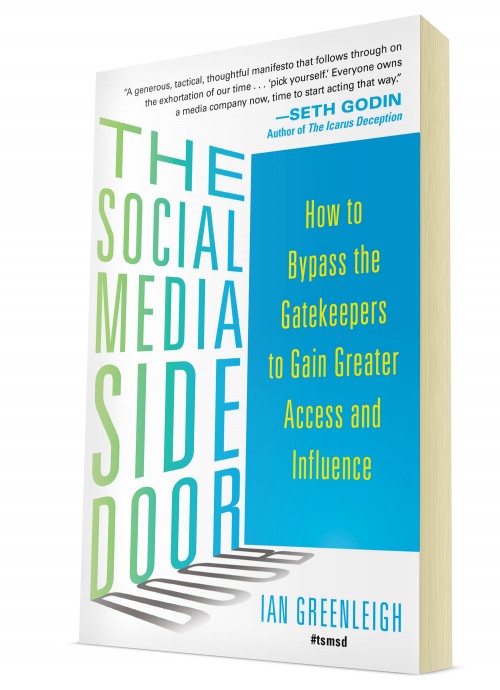
As a small business owner, I’m always hustling to make the most of limited resources. The techniques presented in Ian Greenleigh’s new book, The Social Media Side Door (McGraw Hill, October 2013), are designed to help us take advantage of the seismic shifts that have happened in recent years regarding access and influence.

Ian Greenleigh: The Social Media Side Door

Enjoy this Q&A with Ian, as he offers some great insights from the book.

1. What is the social media side door?

We’re living through an extraordinary time. Social media is decimating the human and technological gatekeepers that have historically prevented non-elites from accessing and influencing powerful people and institutions. The barriers are crumbling all around us, and so many people haven’t even noticed, or they’re simply not yet equipped to take advantage of these massive opportunities, what I call “social media side doors.”

2. How did you discover it?

I really struggled to get a decent job during the recession. I had just graduated with a degree in political science, even though it was a field I didn’t want to pursue. I was in sales, and I wasn’t very good at it. It was pretty bleak. None of the things our society teaches about getting great jobs were working. I thought I was bright, hardworking and creative, but I couldn’t find a way to convey that to the professional gatekeepers in recruiting.

I needed to try something radically different, so I scraped the bottom of my dwindling savings account to attempt something I had seen on a blog. I took out a Facebook ad, pointed it at a special “hire me” page on my blog, pointed the ad at decision-makers at the top companies in Austin, and saw the clicks roll in. Within a few weeks, I had a nice array of options for my next career step.

It wasn’t an anomaly. Once I started looking for them, I realized that social media side doors existed almost everywhere barriers seem to exist. I also realized that no one had written a guidebook to help people spot and take advantage of these new opportunities, so I decided to write it myself.

3. How can people find and open their own side doors in social media?

Realize that side doors often open gradually. For example, every time you leave a comment on a CEO’s blog, or tweet a piece of intelligent feedback to an influencer, you’re opening that side door up an inch or two more.

Think about the goals of the person whom you’re trying to reach, and reflect on how you can help them get there faster. You can do things like introduce them to other influential people via Twitter, interview them on your blog about a project they’re promoting, or help them find information they’re after.

Relationships are still the basis for almost all of the value created in social media. Social media makes it really easy to answer the question, “what has this person done for me lately?” As such, you’ll hear “yes” far more often when you’ve provided value before an ask, or in conjunction with it.

4. Why should we try to open these side doors sooner rather than later?

Imagine it’s the dawn of the 20th century, and you’re a salesperson, marketer or jobseeker. Telephones are expensive and rare, but somehow you’ve acquired one for free. There are no gatekeepers to screen the calls of the rich and powerful, and you can reach any of these fellow telephone owners simply by asking a switchboard operator to put you in touch. If you wait too long to take advantage of this situation, your competition will beat you to the punch, your approach will no longer be unique, and access now seems like more of a liability than an opportunity to those being accessed.

We’re not quite there yet with social media. We see rising adoption among powerful people, but the human and technological gatekeepers haven’t caught up yet. And innovation happens so rapidly, that the arrival of each new social network brings with it a new set of access and influence opportunities.

Author’s Bio: Ian Greenleigh is a social media and content strategist, and author of The Social Media Side Door: How to Bypass the Gatekeepers to Gain Greater Access and Influence. He helps companies turn data, ideas, and relationships into true thought leadership. His words and ideas have been featured in Harvard Business Review, Ad Age, Adweek, Digiday, Ragan, Seth Godin’s The Domino Project, and elsewhere. He writes and speaks on a wide range of topics, including changing consumer-brand relationships, the convergence of personal identities, and the radically shifting landscapes of access and influence. You can connect with Ian on Twitter: @be3d

Filed Under: Marketing /Sales / Social Media, Outside the Box, Successful Blog Tagged With: access, bc, influence, social-media

Stop trying to be like everyone else – grow your business faster

October 11, 2013 by Rosemary

By Brian Morris

A few years ago, two friends started a small business in my hometown. Like so many local entrepreneurs that came before and after, they failed. Within a year of opening their doors, their business was dead. They listened to business advice from the wrong people, people whose own businesses were struggling, people who kept telling them to be patient, and they were forced to shut their doors.

If you’ve ever researched starting your own business, you know that one of the most discouraging bits of information consistently recycled by small business gurus is that it will take two to three years for your business to be profitable. That’s a kick in the teeth to otherwise-motivated entrepreneurs who don’t have three years of income built up – or, most of the living universe.

And it’s hogwash. Look, this is the digital age. You can turn a profit today.

Now, I don’t want to oversimplify the process of building a profitable business, and I’m well aware that start-up costs and overhead for, say, a refrigerated trucking company are vast in comparison to, say, a graphic design firm. But the reason I think it takes so many entrepreneurs so long to turn a profit is that they’re trying to be like everyone else.

It all comes down to marketing. You see what the successful businesses are doing, and you try to do it, too. There are three ways people market in my hometown, which boasts a population of around 8,000 people: television, radio and newspaper.

To that I say: expensive, ineffective and wasted effort, respectively. It’s literally been years since I’ve received a direct-mail postcard from a local company, despite the fact that I get postcards every day from national brands. And door hangers? Please…

No one hosts publicity stunts. No one markets effectively on the web. No one posts massive vinyl banners at the busiest intersections, which witness traffic figures easily 10 times the population every single day.

And guess what? Most of our start-ups fail. They blame their failure on so many things: the economy, lack of support for local businesses, the “death” of our downtown, Amazon.com. Few ever blame the real culprits: themselves.

Instead of marketing where everyone else does, try something new. Distribute door hangers door-to-door. Print vinyl banners and place them in high-traffic areas. Brainstorm a fun and engaging publicity stunt, and get awesome PR for it. These are all cheap. These are all highly effective.

What happened to my two friends? Well, one decided to start another business. He opened an office and began to toil, plying his service using the same failed strategies. His mindset, I think, was that the business wasn’t profitable because two people were one too many to get by on their profits.

The other likewise started another business, but adopted a different, more bold marketing strategy. He walked the city with door hangers, began submitting press releases to the local paper, joined networking groups, volunteered in the community, and always has a nice big banner prominently displayed.

Five years later, the friend who opted to keep going down the path of slow and steady lives in an apartment on the wrong side of town. He works out of his rental unit, the downtown studio long gone. The other has bought a new home in a good neighborhood (and I think he’s got at least $30,000 wrapped up in a new addition) and is well-known, respected, and liked throughout the community. His business, it seems, is thriving.

To the best of my knowledge, both of my friends are capable of producing high-quality work, but only one is willing to do what his competitors will not. You hear NFL players talk about playing with a sense of urgency. My friend worked with a sense of urgency – a do-or-die, now-or-never approach – and grew his business rapidly.

Go guerrilla. Market aggressively and on the cheap. Be a grassroots business. Push for business growth without wasteful marketing efforts.

Be bold, and do what your competitors will not do. Don’t do what failed businesses have tried.

Stop trying to be like everyone else. Don’t fail by taking the well-worn path. Be new, different, better. Grow your business faster.

Author’s Bio: Author’s Bio: Brian Morris writes for the PsPrint Design & Printing Blog. PsPrint is an online commercial printing company. Follow PsPrint on Twitter @PsPrint.

Filed Under: Inside-Out Thinking, Marketing /Sales / Social Media, Successful Blog Tagged With: bc, entrepreneur, marketing, startup

  • « Previous Page
  • 1
  • …
  • 12
  • 13
  • 14
  • 15
  • 16
  • …
  • 174
  • Next Page »

Recently Updated Posts

The Creator’s Edge: How Bloggers and Influencers Can Master Dropshipping

Is Your Brand Fan Friendly?

How to Improve Your Freelancing Productivity

How to Leverage Live Streaming for Content Marketing

10 Key Customer Experience Design Factors to Consider

How to Use a Lead Generation Item on Facebook


From Liz Strauss & GeniusShared Press

  • What IS an SOB?!
  • SOB A-Z Directory
  • Letting Liz Be

© 2025 ME Strauss & GeniusShared