Successful Blog

  • Home
  • Community
  • About
  • Author Guidelines
  • Liz’s Book
  • Stay Tuned

Change As Influence: Get the Attention of Deniers, Followers, Dreamers, and Leaders

January 18, 2011 by Liz

(Updated in 2020)

10-Point Plan: Influential Leadership to Grow Business

Change Is Influence

Every now and then, something happens that pulls the rug out from under us …
The printing press is invented.

400px-handtiegelpresse_von_1811
Printing press from 1811. Photographed in Deutsches Museum Munich, Germany


A golden spike in a railroad track connects what had never been connected.

449px-golden_spike_neil916
A second “golden spike,” identical to the original used in the celebration of the transcontinental railroad in Promontory, Utah, is on display at the California State Railroad Museum in Sacramento, California.

A stock market crash blows entire economies to smithereens!

unemployedmarch
(The Depression) The Single Men’s Unemployed Association parading to Bathurst Street United Church. Toronto, Canada

Those same sorts of changes didn’t just happen then, they’re happening now.
Change is constant. If anything, the state of change is accelerating with our ability to connect and communicate with increasing reach and speed.

Change is the ultimate influence. When change happens, people respond.

Hiders, Followers, Dreamers, and Leaders

The quickest way to change someone’s is to behavior is to change their environment. Change the lighting, change seating, change the way you interact with them. Change causes us to reconsider what we took for granted. It can cause us to stop and evaluate the new circumstances. Our behavior is influence simply by encountering something unexpected.

How we’re influenced depends on our maturity, our world view, our expertise, our experience, and our belief in what we’re building. Our response to change reveals the traits of a hider, follower, dreamer, or leader. Here’s who we are and how to get our attention.

  • Deniers, Hiders and Whiners. When change interrupts and disrupts some folks try to pretend that nothing’s different. Some deny it. Some hide from it. Some whine but don’t do anything about it. They hunker down and do more of what they always did. They run their wagon trains across the country while their customers move to the safer, more comfortable rail cars that get to their destination much faster. They keep making huge books and printed inventory, while ignoring the faster, easier information available on the internet. While they’re hiding their profits drain out while their furniture and assets move to museums. It’s hard to find new ideas or growth inside a closed system that won’t pay attention.To get the attention of a denier, whiner, or hider, the first challenge is to show him or her the safe and predictable benefits of moving into a new world view.
  • Followers. Followers sometimes think they’re leaders, but their leadership is stuck on a set path. When they’re hit by an influential change — even a positive change — they choose to do more of what they’ve already been successful doing. Give the best person a promotion. Does she keep doing the job she left instead of the new one? Move a music teacher to a farm. Does he try to teach the pigs to sing?To get the attention of a follower, the first challenge is to show him or her the advantage of looking for new paths and partnering with people who’ve got more experience at testing and trying new things.
  • Dreamers. Dreamers often have ideas about change. Dreamers love ideas and no lack of imagination. They see opportunity in every occasion. Change inspires them. Some dreamers are lost in their dreams. Some fall in love with an idea just because they had it. Others are moved to action with out considering whether their idea has any traction. What they have in common is that they mistake the idea for a plan. As the Little Prince said, “A goal without a plan is just a wish.”To get the attention of a dreamer, the first challenge is to show him or her the way the dream will benefit by learning from, planning with and including people who have built similar things. .
  • Leaders. Leaders carve their own path, but a true leader isn’t a loner. Leaders are learners. They reach out and reach up to build something they can’t build alone. Change is information and opportunity. Leaders understand deniers, hiders, whiners, fighters, followers, and dreamers because they recognize when they have had similar thoughts and feelings. They respect and honor the people who feel differently and choose words and actions that make change easier for them.To get the attention of a leader, the first challenge is him or her see the benefits of participating in what you’re building. Share your values and your vision. Then invite the leader to join in.

Change is influence. It’s our response that makes it an obstacle or an opportunity.

Change has always been a constant. If we make it part of our toolkit we can manage change to create influence in the positive direction. All it takes is valuing the values of the people we want to influence.

How do you get the attention of people who might not want to do what you need them to do?

Be Irresistible.

–ME “Liz” Strauss

Filed Under: management, Marketing /Sales / Social Media, Successful Blog Tagged With: 10-point plan, change, influence, LinkedIn, loyalty

The Single Biggest Secret to Getting People to Invest and Participate

January 17, 2011 by Liz

Every Great Offer Has a Part of You Inside It

cooltext443794242_influence

Last week in Arizona, I had the pleasure of a “long-thoght” conversation with that great mind that is @MikeCassidyAZ on Twitter. We discussed how we both got where we are – the ups, the downs, the people we work with and the people who buy what we offer.

I had the joy and pleasure of being able to share with him the project that @starbucker and I are launching in the first quarter of 2011. The endeavor is what we’re calling the “New Leadership and Loyalty Business,” and one part in particularly reflects and expands all that we’ve learned in the five years we’ve been working with the leaders who share their time with us at SOBCon.

As I talked Mike through the genesis of the training program that we’ve developed. I explained the nuance and the thinking behind each question and each task set before the group in action. And as he walked with me through the vision, it was obvious he could see the impact and influence of what we’re offering. In fact, his reaction was similar to the one that keeps happening.

I’m starting to feel like Billy Mays saying “But wait! You haven’t hear the best part yet!”

What was so compelling about the offer that makes folks immediately want to bring it into their building? And I’m so aware of the risk of talking so much that I “buy back” the interest I’ve generated. Yet that never seems to happen.

So after our conversation. I spent some time thinking about what makes the new offer, the new idea that we’re bringing, so attractive and compelling that to a person folks are paying attention and asking to hear more and more about it.

And here’s the best of my thinking on what drives their attraction.

  • The concept has been years in the thinking, Thousands of hours have been spent doing it, writing about it, discovering the holes in the process and fixing them.
  • It’s based on the skills and successes that @starbucker and I have had with SOBCon and in our business careers.
  • We’ve been looking at the problems of the people we love serving and tweaking what we’re doing to suit their situations in ways that make it easier, faster, and more meaningful for them to be heroes at what they do.

In other words, it’s darn good and hard business thinking, but that’s not what makes it so compelling.

The critical part is that we’ve put ourselves into the risk not just the benefit.

We’ve built in accountability that holds us equally responsible with every member of the team for the success of what we bring. No skimping. We’re in — willing to lay our time, resources, and trust on the line to deliver a successful outcome.

Leaders want to build something they can’t build alone.

How do you get people to invest and participate in your business, your brand, or your projects by sharing the risk as well as the benefits?

–ME “Liz” Strauss
Work with Liz on your business!!

Buy the Insider’s Guide to Online Conversation.

I’m a proud affiliate of

third-tribe-marketing

Filed Under: Marketing /Sales / Social Media, Successful Blog Tagged With: bc, influence, irresistible offer, LinkedIn, Marketing /Sales / Social Media

Open Letter to Entrepreneurs: You Don’t Hold a Monopoly on the Right Answers

January 14, 2011 by Guest Author

A Guest Post by Scott P. Dailey

peacock1

You want a new Web site. You’re the boss and the company needs a new site. The existing one is home to static and dated talking points and lately you’ve begun to suspect that it is shouting at visitors and is thus, not developed with an evolving 2.0 culture in mind. There’s nothing, you conclude, social about. Your wife, mother-in-law and golf buddies all agree. You’re the boss and this is your mandate.

You want the thing redone and you want it redone now. Details are someone else’s problem. That’s what you pay the worker bees to do. You make the demand, they make it happen. You don’t care how; you just want the darn thing done and done well. You assign a small gaggle of your most qualified people to the task and they immediately spring into action. At the outset however, you make it clear that you want every phase of the project to pass through you before moving through each milestone. You’re Teddy Roosevelt. That’s just the way it is.

The talented group you’ve assembled begin doing all the heavy lifting as you expect it to be done. They do the research. They poll the best resources. They draft the Gantt charts and project time lines that denote, in graphically rich detail, the mile markers that will comprise the job’s lifespan. They have drawn up the wire frames, and the site map too. Nothing is left to guesswork. Your people got it right the first time. And you insist on being involved in every discussion.

The presentation

You call a meeting to review the team’s progress. The team sits down with you and proposes the solution as outlined in the project management materials and research data they’ve spent the previous week developing. The team is pumped. They know they nailed this thing and confidently cannot wait to see your reaction. Your project lead places the plan in front of you and you dig in, allowing her no opportunity to present. You give the proposal a flagrantly cursory look and are quickly ready to respond.

Here’s your appraisal:

The wire frames are bland and unsexy and the sitemap is nothing more than a confusing bunch of boxes with if statements peppered throughout.

Hmmm. The timeline calls for a 12-week project lifespan. 12 weeks, you exclaim, seems an excessive period of time to launch a new Web site. You have no prior experience launching Web sites, but that doesn’t stop you from being thoroughly convinced that you’re right to expect and demand it be done faster.

You don’t known what the terms, CMS, 301, 401 or Gantt all mean and that frustrates you. Instead of learning however, you use your entrepreneurial brawn to deliver a brief and condescending lecture to the lead on why spelling things out in plain English was not achieved and time, consequently, has been wasted. Your untrusted lead cautions you that these materials are internal project guides, intended for the technical eyes of the team and not necessarily a high level presentation meant for non-technical leadership. As the lead, you assure the boss that you’re trying to explain things in digestible terms, but the boss filibusters time and again and silences you’re every effort to simplify the conversation.

Intimidated further by your lead’s sensible rebuttals, you’re the big cheese you recall. So you dig your increasingly fragile heels in and quickly, loudly move on, even more confused now than you were before your initial objection to the amount of nerdy mumbo jumbo in the plan.

Suddenly it dawns on you.

Where’s the layout concept? “What’s this thing going to look like?”, you ask the team. The lead explains that this is a planning meeting and in the timeline spreadsheet, all of these milestones are addressed in their logical order. This frustrates you even more and you again explain to the team that you think 12 weeks is excessive and you now begin to suspect why. All this planning. All these spreadsheets (one in total, mind you). All these wire frames are giving you a headache. There’s no fun in any of this! You insist on seeing ‘something’ (a layout) within the week.

The team lead tries again to explain that designing the creative at this stage puts the sensible order of milestones grossly out of sequence and thus, hinders the team’s ability to get things right. You scoff and launch into a less-than succinct rant about how you built the company and how you met deadlines and adapted to ungodly pressures in far less time than this project asks for. The team tunes you out and, one by one, slowly begin to accept that you don’t give a darn about their expertise in designing and developing great Web sites. You don’t notice, of course, that your team has abandoned you, because you are too busy being certain that this situation is not unlike any other professional crisis you’ve experienced and in each of those, you were 100% in the right. You merely want to control every facet of the job and consequently grant no one beneath you the authority to succeed on terms unfamiliar to you.

10 Months Later…

The site was designed according to your project management sensibilities. It possesses all of the social channels you demanded it possess. It even went live ahead of that senseless 12 week calendar your former team lead recommended. Oh yeah, she quit like six months ago. If you had listened to her, you ponder, you might still be waiting for a site to go live. Your wife and golf buddies think it rocks and while you now have Twitter, Facebook and YouTube profiles, you have no qualified traffic hitting your pages and you’ve ultimately learned nothing from the exercise.

Two Years Later…

You’re broke and out of business. You’re getting older and you haven’t the fundamental computer savvy to impress interviewers. You have enormous debts and the culture that rewarded your business ideologies so many years earlier has now made you virtually unhirable. Humility sets in if you’re lucky and it is then, if you’re luckier, that it dawns on you that you don’t possess a monopoly on the right answers.

That’s when you learn to listen again.
Listening leads to life-long learning.
It’s your chance to start over.

—–

Scott P. Dailey is a Web designer, copywriter and network administrator. Recently Scott launched ( http://scottpdailey.com ), his social media blog that makes connections between social networking etiquette and the prevailing human social habits that drive on and offline business engagement patterns. You can connect with Scott via Twitter at @scottpdailey.

Creative Commons License photo credit: bkang83

Thanks, Scott!

–ME “Liz” Strauss
Work with Liz on your business!!

Buy the Insider’s Guide to Online Conversation.

Successful-Blog is a proud affiliate of

third-tribe-marketing

Filed Under: Marketing /Sales / Social Media, Successful Blog Tagged With: bc, entrepreneurs, LinkedIn, listening, Scott P. Dailey

9 Types of Listeners’ Responses – on Twitter and Everywhere Else

January 10, 2011 by Liz

cooltext443794242_influence

I’m a curious observer. I look, listen, connect things and identify patterns. Then I ask questions to test what it is that I think I’m finding. That’s one way that I keep learning new things about how the world works and how the people in it decide to do things.

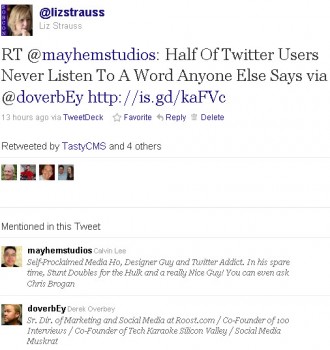
Recently on Twitter, Calvin Lee @mayhemstudios posted an link to an article on Business Insider revealing data about Twitter users who don’t listen. Derek Overbey @doverbEy read it and retweeted it. As did I.

twitter_users_never_listen

As you can see by the image, four people passed it on again.

What to Do About People Not Listening – on Twitter or Anywhere

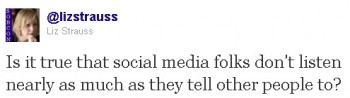
Reading the data about people not listening on Twitter got me curious and turned me into an observer. As I looked, listened, connected things, and identified patterns, I asked a question to test the ideas that we’re coming together.

my-listening-question

Asking questions gives me a chance to listen for myself. Question influence people to respond and in their response are hints and clues to how they think. The response I received fell into a pattern I’ve found predictable when I put an open ended question to the group. I’ve named the types of responses to reflect the group they represent.

  1. The observers retweet the question without sharing their response. Obviously, they’re listening. It would seem that they find the question interesting to pass it on. But they’re not sharing their own opinion on the thought. Maybe their objective is to spread the conversation and listen in to what other folks think. Or maybe they just want to raise their retweet count.
  2. The responding retweeters add a word or two to state whether they agree while retweeting the question to include the reference. They add value with their answer, offer it quickly and share with their friends it in a way that invites others to participate.
  3. The conversationalists add a new thought on the question.They extend the thought with an experience or an additional idea. They’ve considered the question and bring their own thinking to it to share with the group.
  4. The clarity checkers ask for further information about the question. They want further explanation to be sure they understand the question before they join with an opinion.
  5. The controversy seekers find what’s wrong in the premise of the question. Their response is not to seek further understanding or explanation, but to call out the the question itself as wrong.
  6. The contrarians find an answer that’s outside the scope of the question. If you ask whether they prefer fruits or vegetables, they’ll answer steak.
  7. The opportunist teachers see the question as their chance to show how smart they are. They start by answering with what they know on the subject, whether it answers the question or not. Then they continue for several tweets asking questions for which they already know the answers.
  8. and of course,

  9. The spammers find a keyword in the question or an answer to drop a highly promotional link in as if they’re commenting on the conversation. They are people who don’t follow anyone in the tweet stream. They use keyword search tools to interupt for their own spammy purposes.
  10. and the

  11. The lurkers who heard you but choose not to respond They hard to differentiate from the ignorers and the folks who just didn’t show up, but don’t make the mistake of assuming they’re the same.

It’s been said that we can’t talk without talking about ourselves. The words we choose, the metaphors we use, the choices we make of what to respond to and what to leave there all reveal things about our own view of the world and ourselves.

Paying attention to the listens on Twitter is a great way to learn how people think and respond uncovers valuable information that strict data reports cannot – valuable information to any product or marketing person, no matter the conversation or the question at hand.

What might be more important to keep in mind is that we find every one of these types of listeners in every walk of life online and off. If we listen to identify them, we soon some to realize that every kind of listener is looking for a different sort of response and a new question arises …

Some listeners seem to signal by their response that they’re better left to have the final word. What do you think on that?

–ME “Liz” Strauss
Work with Liz on your business!!

Buy the Insider’s Guide to Online Conversation.

I’m a proud affiliate of

third-tribe-marketing

Filed Under: Marketing /Sales / Social Media, Successful Blog Tagged With: bc, LinledIn, listening, relationships, Twitter

Influence is the Most Critical Signal When a FAIL Noise Is Sounding

January 3, 2011 by Liz

(Updated in 2020)

10-Point Plan: Show Influential Leadership in Times of Trouble

Influence Is a Clear Signal Above the Negative Noise

I submit that every person or business with any shred of visibility has had this experience.

You make an offer or offer an opinion that’s meant to establish trust or build a bridge of good intentions. Someone takes it out of context and soon you’re branded as something that is the opposite of who you are, what you stand for, and what you do.

Really what could have prompted us to do something as thoughtless as to put the wheelchair sign next to the stone stairway and think that meant accessibility?

1066245_wheelchair_fail

People start repeating the wrong thing — not what you said or what you did, but some interpretation that sounds more interesting and negative. The tribe is speaking and they’re speaking negative about you. What do you do? Remember that you still have influence.

  • Realize that you’re still you. Capture your values in three words that are smart, heartfelt, and about other people.
  • Immediately move to remedy damage with leadership. Leadership is not a false apology. Leadership can be saying “thank you,” to a detractor. Leadership is what restores balance that moved.
  • Stand on your reputation and start talking too. Tell your story and your history in terms of those values with clarity and conviction.
  • Focus on the truth and compassion for those who misstate or misunderstand it.
  • Keep repeating your commitment to values and leadership.

What person or business has escaped the experience of being misunderstood? The person would have to be a hermit and the business, well, it couldn’t be doing much business.

Sometimes it’s hard to remember that it’s not about pleasing folks who don’t like us, but about truly thrilling and serving the folks who love every bit of us. They are the ones who bet on us when the going gets rough.

Before the Internet we called the people who watched out for us our support system, now we call them our personal or professional network. Whatever we call that group that surrounds us with the benefit of understanding, the reciprocity of keeping them nourished with our attention and fed with our gratitude can be as simple as remembering them.

The best thing we can do for our brand and our businesses is to protect and care for the people who protect and care for us … even when we’re not seeing them do it.

The most critical signal is the respect and gratitude we constantly and consistently celebrate for the people who share our values. It resonate still whenever any negative noise sounds.

What do you consider most critical when a negative noise is sounding around you?

Be Irresistible.

–ME “Liz” Strauss
READ the Whole 10-Point Plan Series: On the Successful Series Page.

Filed Under: Liz, Marketing /Sales / Social Media, Successful Blog Tagged With: 10-point plan, LinkedIn, negative response, signal v noise

Thanks to Week 271 SOBs

January 1, 2011 by Liz

muddy teal strip A

Successful and Outstanding Bloggers

Let me introduce the bloggers
who have earned this official badge of achievement,

Purple SOB Button Original SOB Button Red SOB Button Purple and Blue SOB Button
and the right to call themselves
Successful Blog SOBs.

I invite them to take a badge home to display on their blogs.

muddy teal strip A

cash-and-joy
design-mom
kinetics
makeuseof
socmed-sean

They take the conversation to their readers,
contribute great ideas, challenge us, make us better, and make our businesses stronger.

I thank all of our SOBs for thinking what we say is worth passing on.
Good conversation shared can only improve the blogging community.

Should anyone question this SOB button’s validity, send him or her to me. Thie award carries a “Liz said so” guarantee, is endorsed by Kings of the Hemispheres, Martin and Michael, and is backed by my brothers, Angelo and Pasquale.

deep purple strip

Want to become an SOB?

If you’re an SO-Wanna-B, you can see the whole list of SOBs and learn how to be one by visiting the SOB Hall of Fame– A-Z Directory . Click the link or visit the What IS an SOB?! page in the sidebar.

–ME “Liz” Strauss

Filed Under: Marketing /Sales / Social Media, Motivation, SOB Business, Successful Blog Tagged With: bc, blog-promotion, SOB-Directory, SOB-Hall-of-Fame, Successful and Outstanding Blogs

  • « Previous Page
  • 1
  • …
  • 54
  • 55
  • 56
  • 57
  • 58
  • …
  • 174
  • Next Page »

Recently Updated Posts

The Creator’s Edge: How Bloggers and Influencers Can Master Dropshipping

Is Your Brand Fan Friendly?

How to Improve Your Freelancing Productivity

How to Leverage Live Streaming for Content Marketing

10 Key Customer Experience Design Factors to Consider

How to Use a Lead Generation Item on Facebook


From Liz Strauss & GeniusShared Press

  • What IS an SOB?!
  • SOB A-Z Directory
  • Letting Liz Be

© 2025 ME Strauss & GeniusShared