Successful Blog

  • Home
  • Community
  • About
  • Author Guidelines
  • Liz’s Book
  • Stay Tuned

Are You Using History Strategically … to Claim Your Business and Life Future?

January 16, 2012 by Liz

History Invents Itself

cooltext443809602_strategy

The town I grew up in had a population of 20,000 people. The school I went to kept the same kids in the same classes all through 8 grades … then many of us went to the same high school.By third grade the first week of school held few surprises. I suppose that way good in some ways.

But in one way that situation made for a terribly skewed view of how the world worked.

We grew up in a universe where the people rarely changed. That was true in too many ways.
We rarely changed in that

      we were the same individuals with the same names.


      we were the same in our relationships to each other.


    we were the same in that we couldn’t change or outgrow the stories we knew about each other.

The “kid who wet his pants in first grade” was still that “kid who wet his pants in first grade” on the day he graduated high school. And I can still tell you his name today.

Anyone who’s ever attended a family or school reunion knows what this means. We live up to the stories that define us and sometimes when we get back to the people who were there when those stories first came to be, we revert to being who we were when the story happened.

We believe that our history defines our present.
Don’t believe that. Claim the right to define your business and your life.

The Place of History in Business and in Life

We’ve all heard that history repeats itself. That those who don’t pay attention to it’s lessons are bound to end up learning them again. But not all of histories lessons remain important and relevant. And staying tied to them when situation, skills, and experience change isn’t always a good thing.

That boy who had a bathroom accident at age 6 is now quite successful business man. The people he meets today never see him as that “kid who wet his pants in first grade.” Part of the man’s success is that he knows that story from the past might be true, but it’s irrelevant. He doesn’t let it define the person he is today.

The gorgeous cheerleader named “Cookie” who had straight As, personality, and the coolest crowd going for her in high school is now working as bartender in that small town of 20,000. She still tries to live the old stories, but they’ve faded.

History can be dangerous in it’s ability to keep us stuck in the past. Like a fifteen-year-old hairstyle, if you’re still telling a story from the past to define why your life or your business isn’t good — the story isn’t working for you.

Wisdom comes when we learn from history and use it to write a new and more successful story now. That’s true of business as well as life.

Using History Strategically to Claim the Future

Once SEARS was the World’s Largest Store and named a radio station WLS to celebrate that. The catalog won that title is gone. ABC bought WLS in 1960 and the SEARS Tower was sold in 1994.

Sears story of past success is irrelevant, unless they look at how a future SEARS might apply what they did in the context of a 21-century Internet environment. Even with the same vision and mission, Sears is in a new position with new conditions. They’ll need to make new decisions, build new networks, and new systems to find the unique opportunities to build success — much as they did in the late 19th and early 20th Centuries.

Numbers are important and useful, but they are not as deep as the questions we ask. All numbers we have — sales numbers, revenue numbers, even responses to commercials, ads and blog posts — report history, the success or failure of we did in the past. We can set new goals and build new plans with numbers to measure them, but once we execute to where the measurement occurs that action is past. Those mile markers on the road, at best, show us how far we’ve come.

History can’t drive the present into the future. The right questions will lead to our best true story now. A typical view of history and numbers will inform that, but the right questions will ask:

  • what were missed opportunities.
  • what behaviors always led to your successes.
  • what you’ve learned from wrong turns.
  • and what you want to learn to make your future stronger, faster, easier, more meaningful.

In other words, use history to benchmark how you’ve grown and to guide your path. But make your one true story about who you are and where you’re going and why your history doesn’t draw the picture only adds nuance to the colors.

Research and mine your history to know what was and might have been true once. Then interpret and reapply that lesson to the new situation, skills, and experience to use history to invent a new future — combining what you wish you knew then, what you know now, and the two offer unique future opportunities for you to go.

Are you using history to claim your business and life opportunities?

–ME “Liz” Strauss

Filed Under: Strategy/Analysis, Successful Blog Tagged With: bc, history, LinkedIn, opportunity

Choosing and Deciding: How Do You Sort a Path to Opportunity?

December 13, 2011 by Liz

Knowing the Right Path

insideout logo

It’s the end of what’s been not the best year. The economy is still uncertain. History tells us that it’s times like these that great leaders and great business are born. Inside and outside of traditional business, people are finding their path to opportunity, showing up with their skills, and claiming their reward.

Survey the landscape and three groups stand out.

  • People who are following a path to opportunity set out by someone else.
  • People who are forging their own path to opportunity.
  • People who can’t seem to find a path to be on.

Which group describes what you’re doing?
What are the first two groups doing that the third group is not?

Choosing and Deciding: The Key to Sorting a Path to Opportunity

Every change, every cycle, every downturn and upturn in the economy offers opportunity. The question is how do you find the best opportunity for you, your business, and your team? No matter the economy, we see old and new companies succeeding — How did SAS in Cary, NC get to be #1 on CNN’s 100 Best Companies list? How does Zappos keep growing their happiness business? … and individuals who are doing the same thing. — How did Susan Gregg turn her closet into a $50 Million business? How did Michael Mothner turn a tough interview question into a $12-13 Million business?

How did those folks find success how did they figure out where they’re going and stay true to that?

Obviously every business and individual who’s enjoying success has sorted and found their unique path to opportunity.
Key to that success — leveraging opportunity — is understanding the difference between choosing and a deciding and know when do each. What kind of choosing and deciding sorts the world of possibilities so that we can get on to that same sort of success?

When the Possibilities Are Endless You Need to Choose

Naturally the first step is defining and describing our unique version of success. If the possibilities seem endless, then you need to start with choosing.

Choosing allows us to try alternatives. The origins of the word choose are in French and German words that literally mean to taste or to test. A choice is what happens when we survey a box of chocolates knowing that whichever we take now, we’ll return later to take another one. The choice is a selection that resembles a bungie cord – make a choice, enjoy it, and bounce back to make another version of that choice again. We can choose more than one, even if we’re choosing one at a time.

If you’re choosing, do this.

  • Start broad.
  • Look to your past successes. What common threads do you find in all of them?
  • Identify 5 -7 categories, skills, problems you’ve been solving, or topics to focus your quest.
  • Take time to experiment. Mix and match a few ideas that have worked for you in the past.
  • Try out the possibilities to see what fits.
  • Talk to people who know you about the results.
  • Use each test to narrow your options.

As you keep trying on the options, you’ll begin to see what fits your values and your skills (or that of your team/business). Use the choosing to focus in on a clear vision of where you want to go or what you want to do. Brainstorming, ideation, conceiving new products and new initiatives all start with choosing from the wealth of possibilities available to you.

When It’s Time to Move Forward, Decide

Open options work great when we’re testing and trying, but when it comes time to be building and buying too many options paralyze. Moving forward requires commitment to one option, one direction or it will be too easy to get pulled aside.

Deciding allows us to determine a path. Decide literally means to kill off all other options. Deciding is what happens when we face the junction of many roads, knowing that whichever we take we’re moving on a path that means undoing to go back to that juncture again. We can commit to only one decision, but that commitment determines our direction, sets our destination, and fuels our ability to stay on course.

If you’re deciding, do this. Ask and answer 3 questions.

  1. Can you see the destination? Every time you succeeded you could see the finish when you started — the college degree, the thriving business, the trip across country. Define and describe where you are going or you will never get there.
  2. Is your head in it? Have you the skills, the DNA, and the ability to learn what you need to know to do this? The perfect opportunity is at the crossroads of your skills and the challenges that you enjoy most. Boredom comes when things are too easy. Anxiety sets in when things are too hard. Failure is certain when we choose challenges we weren’t built to meet. I’m 6 ft tall, so despite my grace and my 14 years of dance training, I’m never going to be a ballerina. But in my own way, I’ve become an information choreographer.
  3. Is your heart in it? Will you love the going there enough to keep it fun even when it’s not? Your heart has to be the keeper of the vision, the holder of the commitment that you make to yourself and the decision. We call that integrity. Can you trust your heart to be bigger than the fear that is sure to show up?

Knowing when to choose and when to decide is critical to sorting a clear path to your true north. Choose to sort out your best options then decide on which path will be your own.

Do you use choosing and deciding to your best advantage?

Knowing where you’re going is irresistibly attractive.
Who would follow you if you don’t?

Be irresistible.

–ME “Liz” Strauss
Work with Liz on your business!!

Filed Under: Strategy/Analysis, Successful Blog Tagged With: bc, decision-making., LinkedIn, opportunity, Strategy/Analysis

Ideas & Infographs: The Effects Your Small Business Can Have By Hiring Just One Person

December 8, 2011 by Guest Author

Guest Post
by Adria Saracino

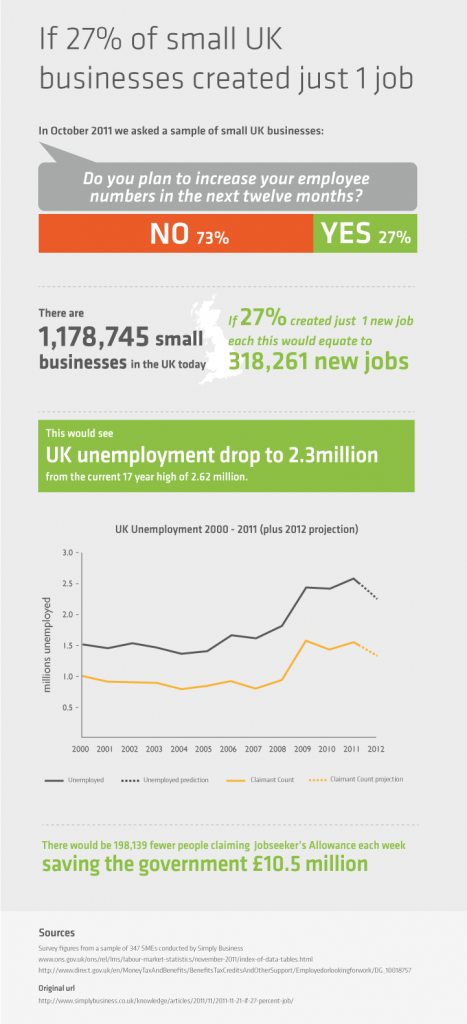
It is hard to imagine a small business hiring one person having any lasting effect on unemployment in the UK. After all, the rates are now at a 17-year high. However, new data suggests this is the case; that small businesses can in fact reduce unemployment.

Simply Business. a company that provides insurance for small businesses, conducted some marketing research after new unemployment data was released by the British government. Of the small businesses surveyed, 27% said they plan to hire at least one employee in the next twelve months. And all of the sudden, that “one person” quickly turns into over 300,00 new jobs across the market.

Simply Business created the following UK unemployment infographic to display the effect small business owners have on the economy.

Click this link to see the full-size infographic.

Jason Stockwood, CEO of Simply Business, said:

“The optimistic picture these small businesses paint is heartening in these tough times. When you consider that SMEs account for 99.9 per cent of the total enterprises in the UK and provide over 59 per cent of the jobs in the private sector their continued success and growth is key to our economic recovery.”

With such a large number of new employment, there would be an estimated decrease in over 190,000 people claiming Jobseeker’s Allowance, resulting in the government saving over £10,000,000 each week.

Are you the owner of a small business? And if so, do you plan on hiring anyone in the next twelve months? If so, you just might end up being part of a large decrease in unemployment rates.

————————————

Adria Saracino is the Head of Outreach at Distilled, a creative Internet marketing agency. When not connecting with interesting people on the web you can find her talking about style at her personal fashion blog. Follow her on twitter @adriasaracino to stay in touch.

Thanks, Adria!

–ME “Liz” Strauss
Work with Liz on your business!!

Buy the Insider’s Guide to Online Conversation.

Filed Under: Strategy/Analysis, Successful Blog Tagged With: bc, Hiring, LinkedIn, small business strategy

Is Not Giving Two Weeks’ Notice Cool When Quitting a Job?

November 9, 2011 by Thomas

The days of individuals staying at one employer their entire lifetime are few and far between any longer.

Given factors like a struggling economy, people going back to school to further or change their careers, and employers downsizing many businesses, it is not uncommon for a professional to end up with four or five jobs by the time they slip into retirement.

For those individuals who decided that it is time for a career or job change within their present line of work, what is the proper protocol for leaving their current employer?

Some individuals believe it is of utmost importance to give two weeks’ notice so that no bridges are burned should they want a relationship with their present employer down the road.

Others, meantime, feel like two weeks is not necessary, given the fact that most employers will let go via layoff or fire someone on the spot, hence, not providing the employee with advanced notice.

When looking at this matter from the employee point of view, keep these factors in mind:

  • Would your employer do the same? – The answer to that question nine times out of 10 is no. Unless it is a matter of not renewing a contract and the employee is told so when it comes up for renewal, employers are not going to walk over to your cubicle or call you into their office and tell you they are firing you in two weeks. In many cases, you will have literally minutes to clean out your desk, gather your belongings and most likely not say goodbye to fellow workers;
  • Will you need this employer as a reference? – Even though many employees switching jobs already have their new job lined up before exiting their present one, they may want their soon to be ex-employer’s reference down the road. They may want to even do some part-time freelance work for the one they are leaving. By not giving two weeks’ notice, those chances pretty much go out the window;
  • Do you want to maintain office friendships – In some instances; you have gotten to be good friends with one or more co-workers in your present office. If you just up and leave for greener pastures, your co-worker or co-workers may view it as bailing on them and specifically that friendship you built if you don’t tell them ahead of time. Determine ahead of time how important your soon-to-be ex co-workers are to you when considering appropriate notice;
  • It really is a small world – Many employees would be surprised to learn how truly a small world it really is. The last thing you want is word getting around that you just up and left a job without proper notice. It may not hurt you now that you landed a new job, but it could down the road when you may be let go by this new company and find yourself job hunting again.

Speaking from experience, I’ve been on both sides of the coin here as far as how much notice I gave.

In my first full-time job out of college, one I was at for just under six years, I gave my employer a good six weeks’ notice because I wanted to have a smooth transition and I knew I was relocating on the other side of the country months ahead of time.

So, how did my employer repay me for doing a nice thing like that? After the first week or so, they had my replacement training under me, telling me several times if I didn’t like my new workload, work conditions etc. I was more than welcome to leave my job early since they had someone in place to replace me.

Needless to say, I never have nor ever would give an employer that much notice going forward.

In one part-time job, I had been told by my employer that certain things would happen following my training process. Needless to say, they never followed through on any of those promises.

Knowing things were not going to change, and knowing I would continue getting the run-around, I worked two weeks ahead of time so that my assignments both present and over the next two weeks were done, walked in one morning and cleaned out my desk, and left before anyone showed up.

I’m not saying it was the wrong or right way to do things, but at the time it felt like the decision I needed to make.

The bottom line is each employee has to weigh the matter at hand, determine how giving or not giving two weeks’ notice will impact them down the road, and go from there.

Yes, it seems like the right thing to always do, but in some cases, right doesn’t always win out.

Photo credit: jezebel.com

Dave Thomas, who has authored a number of articles regarding small business credit cards and commercial vehicle insurance writes extensively for Business.com, an online resource destination for businesses of all sizes to research, find, and compare the products and services they need to run their businesses.

Filed Under: Business Life, Strategy/Analysis Tagged With: bc, businesses, employees, employer

If You’re Still Asking What Business You’re In, You’re Ahead of Them

November 7, 2011 by Liz

Questioning Success

cooltext443809602_strategy

Possibly the smartest businessman I ever met is a guy named Ed. He is the key partner in a prestigious equity firm on Park Avenue in New York City. I met him in a meeting to discuss a company he owned. He ended up hiring me to conceive and drive the strategy to turn that company around.

It’s no wonder I think he’s smart. But truly other folks think so too.

After I’d worked at the company for almost 6 months, I realized something about how Ed was seeing this company that he owned. Because all of his other companies were publishing magazines and newspapers, he figured our book publishing company would work the same and grow the same as those he already owned.

But book companies are significantly different from magazine and newspaper companies in the fact that the Inventory investment — books — lasts so much longer. A newspaper dies within a day. A magazine is done a month later. A book can live for years. What that means is that a mistake in a book is far more costly because it represents inventory that can’t be fixed until that huge investment on the shelves in the warehouse has been sold or burned.

Ed didn’t realize that simple difference until I said it.

I didn’t realize until that moment that Ed didn’t know what business we were in.

From that moment decades ago until this moment now, I’ve made it a mission to start with the idea that everyone I work with needs to know what business we’re in. What I’ve experienced is that from entrepreneur to CEO of huge corporations, those who truly know what business they’re in are fewer than I’d imagined.

  • Some had lost sight of their actual customers.
  • Some saw their value proposition differently than their customers did.
  • Some were trying to reconfigure their customers to fit their idea of what business they were in.
  • Some thought they were smarter than their customers.
  • Some were trying to be the business they had always been.

Some never had asked the questions, “What is our business? Who do we serve and why do they care?”
Some had asked those questions and answered them. Then the business changes, the economy changes, the customers change, and they forget to ask again.

And as a result here’s what I saw happen over and over and over again. The little company who still asked the question would get the customers. They’d have the 10-foot booth at the big trade show (think CES) one year. A few years later, they’d have a 60-ft booth at the trade show. Not much later, they’d have a 90-foot booth at the trade show and be looking to their corporate partners and possible acquisitions to grow <-- losing track of what business they were in.... and while they were looking at other businesses, another little company who still asked the question was talking to their customers from the 10-foot booth right next to them. The biggest mistake a successful business makes is to quit asking the questions that got them there.
Whether you’re an entrepreneur, a small business, or a corporation, if you’re still asking what business you’re in, you’re ahead of them.

What business are you in?

Be irresistible.
–ME “Liz” Strauss
Work with Liz on your business!!

Buy the Insider’s Guide to Online Conversation.

Filed Under: Strategy/Analysis, Successful Blog Tagged With: bc, LinkedIn, success

5 Inspiring Lessons Entrepreneurs Can Learn from Steve Jobs

November 4, 2011 by Guest Author

A Guest Post by
Rahil Muzafar

cooltext443809602_strategy

What Lessons Will You Keep?

By the time this post goes live, millions of words would have already been said, written and discussed about Steve Jobs – the man behind 21st century’s technological revolution. I don’t think any words coming from me would justify the greats of this man. Therefore, I prefer to talk about his inspiring words rather than of the man himself. No words can fill the void he left behind, and because he is a legacy that lives on in his work, I find it a necessity to discuss about his professional feats and their impact on us.

Until earlier, I admit, I was naive enough to think of him as just the CEO of Apple Inc. Never did it cross me that this man was a genius; that he did not only give the world some pretty usable devices, he also made sure his customers became die hard loyalists to Apple. How did he do it? What did he believe in? These are answers that can be found right in his words. Being an entrepreneur there were some amazing words that I found to be not only inspirational but also very practical for people who are looking to make it big. Here’s what I am talking about.

“But Apple really beats to a different drummer. I used to say that Apple should be the Sony of this business, but in reality, I think Apple should be the Apple of this business”

Lesson: Create Your Own Identity

Inspiration should not be mixed with derivation. You should be inspired by the greats – yes; but you should never want to “imitate them”. This is exactly how Apple created its unique identity through the looks, the functionality, and even the internal features of its products. You will not find an Apple product that tries to impersonate another product. There’s always something very distinctive in all of their products. Note that the focus here is not just on unique design or looks, rather on a unique imagination and approach to your business. You don’t become a “great” by mimicking some “great”.

“For you to sleep well at night, the aesthetic, the quality, has to be carried all the way through.”

Lesson: Never Compromise on Product Quality

If quality isn’t your priority, forget about getting customer loyalty. This quote is applicable to all professions coming from all walks of life. Be it engineering or designing, every product must satisfy the eyes of the customer. When a customer’s aesthetic sense gets lured, there will be a natural curiosity to know more about the product. If your service/product satisfies both the customer’s eyes and the purposes, you can put your feet up and relax because you are on solid grounds.

“I didn’t see it then, but it turned out that getting fired from Apple was the best thing that could have ever happened to me. The heaviness of being successful was replaced by the lightness of being a beginner again, less sure about everything. It freed me to enter one of the most creative periods of my life.”

Lesson: Do Not Let Failures get in the way

Let’s face it. Being an entrepreneur and a visionary is not easy. And who knows this better than Steve Jobs! Being fired from your own company is a devastating experience, even more than experiencing some financial loss. But this is what makes the “man” so special, he didn’t give up (Started another company, and just kept going) He was back within a year and ever since he became the epitome of company’s success. Lesson for us, never lose confidence in your abilities even when others are writing you off. There are times when you’ll fail in a grand manner, but that’s what entrepreneurship.

“And it comes from saying no to 1,000 things to make sure we don’t get on the wrong track or try to do too much. We’re always thinking about new markets we could enter, but it’s only by saying no that you can concentrate on the things that are really important.”

Lesson: Focus on Your Niche

The problem with following a success story is that it leaves no room for originality. The moment a business gets successful, euphoric optimism settles in. You start thinking of endless possibilities and try to put your foot in everywhere. This is where focus decentralizes and the business goes awry. Apple was a global leader in manufacturing systems; smart computing systems. The company did not try to be what it was not; it did not try to jump from market to market. All it did was to focus on improvising its core products and making sure people get systems that have never been manufactured by companies before. When you learn to devote time, energy and efforts into developing, enhancing and updating every part of your niche business, you are bound to be successful. Being haphazard in your approach can never get your business the strength, the success or even the attention it deserves.

“Being the richest man in the cemetery doesn’t matter to me. Going to bed at night saying we’ve done something wonderful, that’s what matters to me.”

Lesson: Money should not always be the Sole Purpose

Many wouldn’t agree with me, but money should not be the “only” motivation for you to do anything. It’s true that money is naturally every man’s goal, but you should also realize that the world’s best feelings don’t have anything to do with the richest man; rather it comes from being able to do something which is close to your heart. Entrepreneurs need to look beyond the objective of being profitable. And don’t get disappointed when the cash flow is not as good as expected, because the disappointment might result in bad decisions in a desperate attempt to be financially successful. If you keep money as the sole objective, you will miss many occasions to celebrate.

Rahil Muzafar

—-
Author’s Bio:

Rahil is an SEO expert, and writes on topics related to Internet Marketing. He’s working for smartpress.com that offers quality sell sheet printing service

Thanks! Rahil!

–ME “Liz” Strauss
Work with Liz on your business!!

Buy the Insider’s Guide to Online Conversation.

Filed Under: Marketing /Sales / Social Media, Strategy/Analysis, Successful Blog Tagged With: bc, LinkedIn, Rahil Muzafar, small business, Strategy/Analysis

  • « Previous Page
  • 1
  • …
  • 7
  • 8
  • 9
  • 10
  • 11
  • …
  • 48
  • Next Page »

Recently Updated Posts

Is Your Brand Fan Friendly?

How to Improve Your Freelancing Productivity

How to Leverage Live Streaming for Content Marketing

10 Key Customer Experience Design Factors to Consider

How to Use a Lead Generation Item on Facebook

How to Become a Better Storyteller


From Liz Strauss & GeniusShared Press

  • What IS an SOB?!
  • SOB A-Z Directory
  • Letting Liz Be

© 2025 ME Strauss & GeniusShared