Successful Blog

  • Home
  • Community
  • About
  • Author Guidelines
  • Liz’s Book
  • Stay Tuned

Writer’s Block. The Pain and Panic are Real.

November 4, 2014 by Rosemary

By Lisa D. Jenkins

There’s nothing quite like that feeling of knowing you owe the readers of your blog several hundred words and realizing you’ve got no idea what to write about. The realization that you can write on just about anything only makes it worse. It mires your brain in some sort of one track spiral that does nothing but turn around and around on itself.

Sorry, there are no blogs coming out of the station today.

So you take a walk. You open up the Google machine and surf around. You browse your book collection. You check your blog roll. Hoping for some sort of inspiration to drop an idea into your head.

Been there?

We’ve all seen the lists of X Ways to Beat Writer’s Block and there are often some great bits of advice in them. The problem is sometimes when you’re so stuck you can’t string a cohesive content thought together to save yourself, light prompts usually don’t cut it. You need serious, focused help.

Enter the blog topic generators of the world!

They aren’t perfect, they won’t write for you and they can’t be held responsible for everything, but topic generators have saved me more times than I can count. Here’s a look at 4 blog topic generators you can use to get writing, right now.

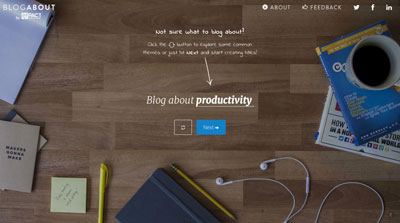
BlogAbout by Impact Branding & Design

“BlogAbout was an idea born out of frustration.”

Blogabout

Start by clicking the refresh button in the center of the screen until you find a prompt that strikes a spark.

Clicking it 5 times has given me:

  • preparation
  • the customer experience
  • customer service
  • a challenge
  • saving money

I’ll use preparation.

Now, click the Next button that generates a fill-in-the-blank phrase you can use with your own keywords. Hit the refresh button to get a new phrase or hit the heart to save a phrase to your notebook.

Here’s what I got:

  • When It Pays to
  • Why __ Timing is Everything
  • 7 Things that Really Great X Do
  • 7 X Tools No X Should be Without
  • 4 Ways to Make Your X More Successful

And that’s how I ended up here with a post on blog topic generators no blogger should be without. How great is that?

Here are a few more generators for you to check out.

ContentIdeator

Enter in a single keyword and click Get Ideas. Pages of existing headlines come up and all you have to do it choose whether you want to see 10, 20 or 30 ideas at a time. Use what you see as inspiration for you own post.

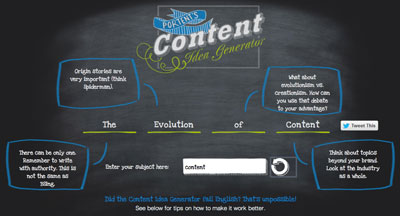
Portent’s Content Idea Generator

Enter your keyword and click the arrow to get started. I’ll use content. Next, you’ll get a title with helpful descriptors. Don’t like it? Hit refresh for another, and another. Here’s the second title I was given:
That’s workable, right?

Portent

Blog Topic Generator from Hubspot

You’ll need three nouns for this. When you’re ready, hit the Give Me Blog Topics button. I used content, productivity and business and was given these 5 blog topics.
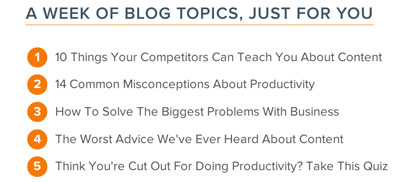
Hubspot content generator

So. I’m not saying these generators will fix everything but they’ll get you focused on a single thread that’s more likely to turn into a blog post or article than, say, aligning your writing utensils from left to right in order of frequency of use will.

And now I give a round of applause to Impact Branding & Design, Portent, Content Forest and Hubspot for helping us all to find our way out of the desolation that is writer’s block.

Author’s Bio: Lisa D. Jenkins is a Public Relations professional specializing in Social and Digital Communications for businesses. She has over a decade of experience and work most often with destination organizations or businesses in the travel and tourism industry in the Pacific Northwest. Connect with her on Google+

Filed Under: Writing Tagged With: bc, ideas, writers-block

5 Social Customer Service Tools You Should Know About

October 31, 2014 by Rosemary

By Diana Gomez

Gone are the days of customer service phones ringing off the hook.

While some people may still want to use traditional means to connect with companies, modern consumers rarely want to pick up the phone if they experience a customer-service issue.

Instead, they’re turning to social media to voice concerns and ask questions, knowing that a simple tweet is often the best way to address an issue quickly and easily.

Social customer service tools

Did you know that 42 percent of consumers who complain on social media expect a response no more than 60 minutes later?

This may seem unreasonable, but compare that with the time it should take for a resolution via phone. And these days, the advent of social media has not only opened up more communication channels, but it has lowered patience. A recent study showed that people who complain on social media on nights and weekends expect the same service and response time as they would during normal Monday through Friday business hours. How can companies keep up with that? What a beast.

Smart companies are catching on that social media is their strongest customer service tool. KLM, for example, the leading airline in customer service, realized the importance of social media in 2010 when Icelandic ash left tens of thousands of customers stranded in airports everywhere. It was the biggest interruption to European air traffic since World War II.

Those customers turned to social media for solutions to their travel woes, and KLM responded. Soon after, the airline made social media the focus of its customer service efforts. Resolution time was cut to one day, and one social media post is responded to within one hour — and it all happens via social media.

There are several tools out there ready to help companies get their customer service needs under control as efficiently as possible using social media. Here are a few I’ve found to be worthwhile.

Salesforce

Salesforce is the tool that drives the customer-service machine of KLM. How does it work? Its system extracts customer-service requests from over 150 million social media networks, blogs, forums and more using customized keyword identifiers. The tool’s technology works its magic by searching comments and phrases combining, for example, #KLM, @KLM, and any KLM mentions with customer-service trigger words like “help” or “my flight is late.”

The cool part is that the software can then prioritize the results automatically using the purchase history of the customer and their activity level on social media. So if you have a big Twitter following and you’re a frequent flier, you’ll probably be placed at the front of the customer-service queue. Pretty nifty.

LiveOps Social

Another social customer service tool, LiveOps Social, is a cloud-based contact center/virtual call center software. But instead of tickets submitted through voice, online contact forms, or email, it searches requests on Twitter and Facebook and then submits a ticket that way. The concern is then placed in a service queue alongside all the other requests, but it is prioritized according to the customer’s social and service history.

Social Dynamx

This social customer service tool lets companies manage one-on-one, real-time social conversation. The system automatically routes customers to an agent based on his or her expertise, work group, current caseload, average time to respond and service satisfaction rate. Work groups represent different issues, so say a product has a very specific issue — a work group is created to address that particular concern, and they’ll receive all the tweets relating to that issue. If a customer prefers a different agent, or expert, that change can be easily made.

SparkCentral

Companies that handle a high volume of customer service requests are turning to social media helpdesk platform SparkCentral. Formerly known as TwitSpark, the key to its success lies in the response time. This tool provides super fast and efficient follow-up customer service over Facebook and Twitter. From seemingly petty problems to crisis management, it’s all automatically prioritized and attended to promptly.

ConverSocial

Used by big companies like Google, Barclaycard, and Hertz, ConverSocial is a cloud-based social service solution for large-scale monitoring. Using sophisticated technology, the service decides for itself whether or not a social media complaint warrants a response.

Any Tweeter out there can understand that not every tweet deserves an agent to spend his or her time responding to it. ConverSocial totally gets that. Like other tools, it prioritizes a response according to social and customer history. More serious issues of course would go to the front of the queue. If a response is delayed, the system automatically reroutes the issue to a new agent.

Has your company used social media to resolve customer service issues? Please share your experiences in the comments!

Author’s Bio: Diana Gomez is the Marketing Coordinator at Lyoness America, where she integrates social customer service and business marketing strategies for USA and Canada. Lyoness is an international shopping community and loyalty rewards program, where businesses and consumers benefit with free membership and money back with every purchase.

Filed Under: Tech/Stats Tagged With: bc, customer-service, technology, tools

Book Review: The Mobile Commerce Revolution

October 30, 2014 by Rosemary

The timing of this book couldn’t have been better.

Yes, we’ve been talking about “mobile” for a few years now, but recently Apple jumped into the fray for real, offering Apple Pay to its millions of iPhone users.

This is one of the first salvos in what will become a war for your credit card. (WalMart, CVS, and others have already fired back with their own system.) And let’s not ignore Taco Bell’s “all-in” approach, launching its own unique payment app.

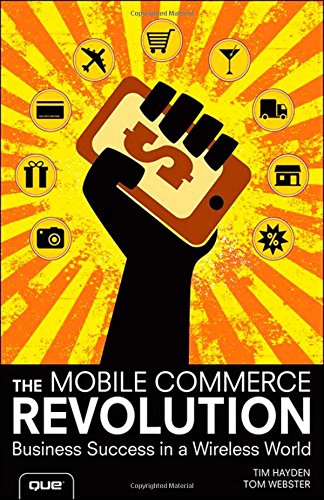
The Mobile Commerce Revolution: Business Success in a Wireless World, by Tim Hayden and Tom Webster, is a deep-dive into the changing landscape of mobile business.

Mobile Commerce Revolution book cover

If you’re ready to pull together a coherent mobile strategy for your business, this book needs to be on your nightstand.

If you are scrunching your eyes together and just hoping this whole mobile thing will just go away, you need to stop reading this blog post and go one-click this book on Amazon.

The mobile revolution is well underway, and it’s not just academic. It’s affecting lives around the world:

“According to a documentary produced by Dr. Steven Shepard on some of Cisco’s efforts to bring mobile Internet to previously off-the-grid areas in Costa Rica, the results are dramatic indeed. According to Shepard, a recent study for the World Economic Forum indicated that an increase in a country’s mobile telephony penetration by 10% leads directly to a 2% increase in Gross Domestic Product (GDP), an increase in life expectancy of 15 months, and education for 600,000 children in that country.”

Be forewarned—this is no quick-read overview. You’ll want to highlight sections, dog-ear some pages, and come back to re-read certain chapters.

One of the most important observations of the book is that “mobile is a behavior, not a technology.”

Think about it. Businesses that want to reach you on your mobile device are really walking with you through your daily life. They’re coming to the restaurant, out on the soccer field sidelines, and (in some cases) into the bathroom with you. Therefore, when you design your own business mobile strategy, you absolutely must consider where, when, and how people are accessing your messages.

Mobilize Your Business: A Summary

  • Look at your online presence. Ensure that your website and your content truly address the needs of the mobile visitor. This goes beyond cramming your same site down into a tiny format.
  • Look at your payment systems. Remove any barriers or friction that make it more difficult for customers to give you their money, regardless of where they are.
  • Look at your message channels. Review your options for outbound messages. Will SMS work? What do your emails look like?
  • Look at your offline presence. Billboards, direct mail pieces, signage, and live events are all part of the mix. Inject some creativity into those traditional outlets.
  • Look at every department in your company. Your mobile strategy can’t begin and end in the marketing department. Reach out across the entire organization and bring in customer service, sales, and everyone else during the planning process.

The authors do an excellent job of describing the current state of affairs, where mobile is heading, and how to address it, including an excellent chapter called “Ten Steps to Mobilize Your Business.”

Bottom line: you’d better get on this now.

Disclosure – I had the great pleasure of attending the book launch party, and received a free copy of the book. However this review was not solicited, and my recommendation is straight from the heart. The link above is not an affiliate link.
Author’s Bio: Rosemary O’Neill is an insightful spirit who works for social strata — a top ten company to work for on the Internet . Check out the Social Strata blog. You can find Rosemary on Google+ and on Twitter as @rhogroupee

Filed Under: Business Book Tagged With: bc, book review, mobile payments

Have a Good Business Idea?

October 29, 2014 by Thomas

abizideaThe business world changes every day and if you want your business idea to succeed tomorrow, then you should pay attention to what’s trending today.

That’s right, by keeping an eye on the current market and successful business ideas; you can make an informed decision based on changing consumer needs.

When it comes to learning from current business trends, here are just a few types of businesses that are expected to grow for years to come:

Accounting

Whether it’s for small businesses or individuals, everyone needs help running numbers. If you have a knack for the financial side of life, then starting an accounting business is definitely a promising career. Accounting is a growing business landscape that offers plenty of job opportunities. The field of accounting isn’t something you can just jump into. To become a certified accountant, licensing and training is required. However, if you do have experience, turning your accounting business idea into a reality is a relatively easy and affordable process. From handling company balance sheets to general tax accounting, there’s no end to the growth possibilities of accounting.

Computer and Smartphone Repair

The popularity of computers and smartphones is going to continue to increase exponentially as time goes on. With a little training and basic licensing, you can turn your computer and smartphone repair business idea into a full-fledged career. There are a growing number of repair businesses that specialize in on-site computer hardware and software repairs as well as smartphone screen repairs. In addition, there are also a number of mobile repair businesses that can take care of repairs quickly and on the spot. No matter which direction you take, the computer and smartphone repair industry is really taking off.

Business Planning

If your business idea involves helping others develop their own business plans, then you’re on the right track. As the following article shows, starting a business plan service is 1 of 3 business careers that are actually fun and rewarding for both parties involved. The startup costs for a business planning service are minimal, but the career opportunities are huge. From preparing and formatting business plan layouts to creating financial outlooks, helping others plan their business will provide you with steady work for the foreseeable future. You can even offer add-on services like ongoing business consulting, which will provide you with a steady workflow as opposed to a freelance-style business approach.

Editing

Editorial services take a number of different shapes and forms nowadays. Whether it’s copyediting for online publications or proofreading company documents, businesses and individuals are always in need of quality editors. The best part is, being an editor means you’ll have a flexible career that you can take on in a full-time, part-time, or freelance capacity. Copyediting and proofreading are probably the two main editorial services that come to mind, but you can expand on your business idea to include other services too. Developmental editing, indexing, copywriting, blog writing and editing, ghost writing, and book doctoring are all much-needed services that fall under the editorial services umbrella.

If you want to know your business idea is a worthwhile venture for the future, then take a tip from the top trending businesses above.

Photo credit: Image courtesy of ddpavumba at FreeDigitalPhotos.net

About the Author: Adam Groff is a freelance writer and creator of content. He writes on a variety of topics including business planning and career outlooks.

Filed Under: Idea Bank Tagged With: bc, business, ideas, innovation

3 Natural Behaviors You Exhibit When You Believe What You Sell

October 28, 2014 by Rosemary

By Scott Dailey

Dale Carnegie said, “If you believe in what you are doing, then let nothing hold you up in your work.” If we truly believe in how we are meant to matter to people, we can begin to be useful to them. We can begin to persuade them. Simply knowing something, or worse, knowing what you want, will never be important enough to others to act as an instrument of persuasiveness.
Keep Calm and Believe
Because our value to others is decided by others, our ability to persuade can never be led by self-important and well-rehearsed scripts. It may seem simple enough a notion to grasp, but in my travels, it’s among the most overlooked precepts of sales: if you’re serving only yourself, then you’re mathematically incapable of serving others. We become valuable to others only when we actually believe what we are doing adds value. Belief, itself, in what we do, is therefore the only conduit through which persuasiveness actually journeys.

Throughout my career, I have found only one immutable principle that binds all successful acts of persuasion and it is in believing what I say and do. So if it’s Dale Carnegie’s persuasive brawn you wish most to emulate, then you need to exhibit a fundamental belief in what you want me to believe with equal veracity.

Below I have outlined three completely organic behavioral changes you are guaranteed to undergo when you believe what you sell. Apply them to your sales practices and like I experienced, you’ll win more frequently and in the process, earn more coveted referrals than ever before.

You Calm Down.

When you believe in something you naturally relax. Mark Twain said, “If you tell the truth, you don’t have to remember anything.” Think about something – anything — you believe. The fundamental process of believing it contains organic calming properties. When you simply know a thing, you don’t kick, scream and wail seeing to it that your belief has its day in court. But in sales, the stress of the pitch often originates from a singular eagerness to advance the wrong agenda. “Sell, sell, sell! I need to sell this stuff,” we declare! When you’re preoccupied with getting your points across, you’re actually losing sight of how few opportunities you’ve left yourself to say something you actually believe. What’s left, because of your urgency to sell, are nothing but uninspiring talking points, programmed into you through print collateral, demanding superiors and perhaps even nagging bill collectors.

When you believe however, you relax and permit your buyer the opportunity to reveal him or herself. The new, cooler you has a chance to be valuable by letting those revealing details act as opportunities to discuss what’s important to the buyer. Now you’re calm. Now you’re useful. Now you’re selling! 

You Quiet Down.

When you believe in something, you stop loudly lobbying, petitioning and proselytizing too. Armed with a new-found tranquility, you actually want to speak less, purely as a means to listen more. Piping down gives your buyer a chance to feel listened to, to feel important to you. And as another benefit of being a more collected version of yourself, you’ll slow down and exhibit the sureness afforded only to those composed enough to let the buyer dictate the pace and tenor of your meetings.

No longer are those periods of silence, excruciating exercises in impatiently waiting to resume your dazzling presentation. Rather, when you believe in your value, you make the conversation meaningful to your buyers, on their terms, in their language and their cadence. And yep, your softer temperament is a natural response to believing in your message. You quite simply need to believe and the demonstration of your beliefs manifest in ways most satisfying to the person you wanted to persuade. Remember, when you believe, you don’t fight for the microphone. You quietly wait until it is passed to you by someone eager to have your words solve their problems. 

You Identify.

We’ve all been told that hearing is not the same as listening. You can hear someone and never really ever listen to a word they’ve uttered.

In the same way, listening is not identifying. If you comprehended what I have said, you have listened to me. Well done! But while listening is critical and certainly better than hearing, it’s not the same as identifying. When you believe what you are telling me, you can relate your products and services to my specific situation. When you do this, you make me feel important because you’ve identified with my circumstances, not merely my business problems. When you identify with me, you go even further than that though. Because you have aligned your products and services soundly with my unique challenges, you have expressed concern for me, not your boilerplate idea of a business such as mine. This selfless brand of sales lucidity only comes from believing that what you are selling to me fits my circumstances, not solely your Goldilocks Client criteria.

Identifying with your buyer leaves them with a memorable sense of self-importance that is — and this is the best part — authored entirely by you. I wish your buyer luck forgetting all about you now. When you identify with your buyer, you cogently declare your concerns for the buyer, not the buyer’s fit.

At first, your calm, quiet character permitted you the desire to listen. Bruce Lee said, “Knowledge will give you power, but character, respect.” When you exhibit the character required to identify, you calmly, quietly tell buyers that their sensibilities are important to you. That’s persuasive — make no mistake. But again, believing is the only way to identify with buyers.

If you want to persuade me, you need to include me in the persuasive process by identifying and citing my significance aloud. You need to let me know that, not only did you hear what I said, but that likewise, you believed that my ideas, values and requirements contained merit and substance. When you identify with me, you allow me to influence our transaction and that makes me feel valued.

When you believe what you are selling, you are operating at your full potential as a sales professional. Said another way, if you lack an authentic belief that your solutions can be useful, how will you persuade anyone to think that they are? Equipped with these three easy ways to practice belief-based selling, you’ll be well on your way to persuading, and yes winning, more often than you ever have before.

Remember that when you don’t believe, you are too busy forcing your rehearsed thinking on me to notice that you’ve lost me. Believing in your ideas makes you a reserved, patient and passionate advocate for those you mean to persuade. And best of all, when you believe, even a “No” is received with a calm, measured response that can now give way to a vast new body of techniques that turn a “No” into a “Yes.”

So start believing and you’ll start persuading – and winning.

Author’s Bio: Scott Dailey is the Director of Strategic Development for the digital marketing company Single Throw, in Wall, New Jersey. Scott leads the marketing and sales department for Single Throw and is an ardent lover of all things digital marketing and lead generation. You can follow Scott on Twitter at @scottpdailey.

Filed Under: Marketing /Sales / Social Media Tagged With: authenticity, bc, sales

Building Your Brand By Building Guest Post Relationships

October 24, 2014 by Rosemary

By Diana Gomez

The internet is a great place to build a community. Take an aspiring musician, for example. If she performs for only 15 people at Open Mic Night at The Lazy Dog Café, that doesn’t mean she’s not being heard. Music fans get the latest news and tips on “what’s hot” by reading popular digital magazine sites and blogs. If she sends her latest mp3 to a few popular sites, and one posts a favorable review, her fan base increases. They “like” her Facebook page, and are now subscribers. It’s that simple.

laptop handshake

When it comes to building an audience for your brand, you’ve got to be proactive. While posting regularly on your own company’s blog and social media accounts is great for your established client base, how can you reach the broader audience of folks who are interested in what you have to say, but are not hearing you say it?

Guest blogging — simply put, posting on other sites’ blogs — is a great way to increase your brand’s visibility, readership, and client base. If you can establish yourself as a high quality guest poster, your relationships with blogs will flourish and you will see the results in your readership. Here’s how:

1. Create a pitch cache.

It’s always better to go to the grocery store on a full stomach. Otherwise, you might feel (and look) desperate. Before you start soliciting blogs, have a stock of several guest post pitches of a wide (but relevant) variety. Don’t feel constrained by the specificity of your brand; your reach is broader than you might think. If you are a florist, for example, you can generate pitches on a variety of subjects:

• How to keep your floral arrangement fresher, longer

• 5 underrated occasions to surprise her

• How to have a smooth hospital visit

• How to make a greeting card feel personal

2. Find blogs that fit like a glove.

If you build it, they won’t necessarily come. When it comes to guest blogging, actively seeking out an existing audience — say, vegan moms — is much better than convincing some general group of people to buy your organic baby toys.

To find relevant blogs, search for “[your specialty] blog” or, better yet, “[your specialty] guest post.” The latter will lead you to sites that have accepted guest posts in the past, which bodes well for your pitch.

If you use your imagination, the possibilities for blog searches may be endless. Beyond searching “organic baby toy guest post,” think about expanding to “eco-friendly guest post,” “day care guest post,” “aunt blog,” and on and on!

3. Choose blogs that have a posse.

Use a discerning eye when perusing blogs you are thinking about approaching. The big two to look closely at are:

a) Number of subscribers b) Number of commenters

If a blog has a low number of both, you may not get a lot of attention. If it has a high number of subscribers but few commenters, it’s hard to tell whether people are truly reading the posts or just have nothing to add to the conversation. If the blog has a high number of comments but few subscribers, this is an intimate but engaged audience.

Depending on what you’re going for, either of these scenarios could benefit you. Of course, a high number of both is ideal.

4. Approach with personality.

When you’ve found a blog that seems like a good fit, choose and specialize a few pitches to send over. Be sure that you’ve researched the site enough to know that they haven’t already written a post on your proposed topics.

When e-mailing or approaching the blogger through social media, writing in the tone of the blog is a great way to show your synchronicity. It is key that you make the approach feel personal and not a boilerplate that you are sending out en masse — guest blogging has been spam-tastic in the past, and bloggers are over it.

And remember, flattery will get you everywhere.

5. Post with quality and dignity.

So you’ve been invited to guest post! As you write the full (600 word+) article, continuously whisper this word out loud: quality. Never plagiarize yourself for multiple blogs. Remember, you are representing your company to a brand new audience: do it with style.

Don’t be tempted to hop on the Hyperlink Highway. Including links to your own site in the body of your post is too tacky for any blogs with credibility to consider. That being said, including a short bio at the end of your post is totally acceptable, and an ideal spotlight to reference your company, website, and expertise. This is how you increase your own traffic, so don’t forget it!

6. Foster your new relationship.

After you’ve had a guest post published on a blog, keep in close touch with the site.

Swapping guest posts, becoming a regular and reliable contributor, and collaborating with sites that aren’t in direct competition to your business will expand your visibility and credibility. Integrate your brand into a community of like-minded people, and growth is inevitable.

Author’s Bio: Diana Gomez is the Marketing Coordinator at Lyoness America, where she is instrumental in the implementation of internet marketing and social media strategies for USA and Canada. Lyoness is an international shopping community and loyalty rewards program, where businesses and consumers benefit with free membership and money back with every purchase.

Filed Under: Writing Tagged With: bc, branding, guest blogging

  • « Previous Page
  • 1
  • …
  • 16
  • 17
  • 18
  • 19
  • 20
  • …
  • 959
  • Next Page »

Recently Updated Posts

Is Your Brand Fan Friendly?

How to Improve Your Freelancing Productivity

How to Leverage Live Streaming for Content Marketing

10 Key Customer Experience Design Factors to Consider

How to Use a Lead Generation Item on Facebook

How to Become a Better Storyteller


From Liz Strauss & GeniusShared Press

  • What IS an SOB?!
  • SOB A-Z Directory
  • Letting Liz Be

© 2025 ME Strauss & GeniusShared