By Suzie Cheel & Des Walsh
Each day we have a choice to keep moving forward by putting one foot in front of the other until we reach our desired destination.
Not always easy!
What do you do to keep moving forward?

Each day we have a choice to keep moving forward by putting one foot in front of the other until we reach our desired destination.
Not always easy!
What do you do to keep moving forward?
Marketing has always been a core necessity of the successful business. But as the Internet has become the primary form of shopping for most people, the need to market in a web-specific fashion has increased. While the old and new way are similar, there are differences that have to be accounted for. Not to mention principles that are completely separate that have to be learned and utilized.
Quora is one of the best professional networks on the web. It is full of experts who really know their way around the online marketing field. Since Quora is, by nature, a Q&A site, it is a great idea to follow some of these experts. But who are the best?
That point could be argued, and everyone has their own opinion on who the true experts are. This is my personal list of must-follow Quora profiles in the world of online marketing.

You might not have heard his name, but you have probably come across his companies (of which he has had several) more than once. His first venture, University Wire, was a network of more than 700 university newspapers that were bought out by CBS. GOLF was bought out by Time Inc., and he has worked for big names like Saving Star. He doesn’t always update, but his answers are always worth reading.

Specializing in online advertising/marketing, Peter Hershberg is a powerhouse who funded many startups in his day. He is currently a successful angel investor, business owner, company adviser and a handful of other impressive titles that all trnaslate to him knowing his stuff. His answers are always incredibly informative and in depth.

Perhaps best known for his time at Microsoft, he is now the startup liason officer at Rackspace. He is also a video blogger, text blogger and technology genius. His Quora profile is well used, and he answers questions all the time. This includes online marketing, of which he is well versed on both a professional and personal brand level. This is one of the must-follow people for anyone interested in either marketing, or technology as a whole. There is a reason this guy is a celebrity in the tech geek world.

Less an expert in online marketing on a business level, Gayle is more of a personal branding and self-marketing guru. She teaching people how to deal with branding themselves on a busy and crowded market, including selling yourself in an interview. She also answers questions unrelated to the field, and is just a personable and interesting person. Well worth following for both her advice and her personal stories about her life, she balances information and experience well.
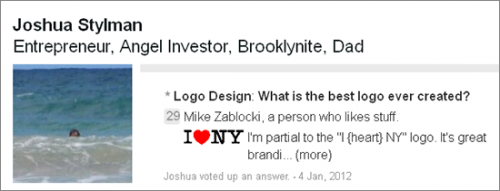
A business owner and angel investor, Joshua Stylman doesn’t answer very often. But his communications are always worth following, and he is just a good guy to have on your network. Experienced, successful and an overall down-to-earth guy, he has a simple way of thinking that still holds enough personal experience and opinion to take you outside the box in your own thinking. He is also a habitual upvoter on other people’s answers, and a proud New Yorker. What’s not to like?

President of Twist Image, a company dedicated to digital marketing, Mitch Joel is one of Canada’s most influential social media users. He knows all about leveraging the web for marketing, and he is more than happy to share that expertise. He is one who is worth following of various social media sites, as he is more active on places like Twitter than he is on Quora. But keeping an eye on his answers is also a good idea. If you want a good read, check out his Six Pixels of Separation. It is part of what has made him such a beloved marketing guru, and launched him into industry stardom.
Do you know of anyone who belongs on this list? Who do you follow on Quora for online marketing advice? There are plenty to choose from. Let us know in the comments.
Have you ever found yourself staring at the screen, mindlessly sipping coffee, hoping that the caffeine will jump start a creative idea? Perhaps you’ve fallen victim to “the creativity crisis.” Or perhaps you just need a little slap upside the head.
Consider this your friendly nudge (my mom told me slapping isn’t nice).
Chris BroganÂs Blog Topics
If youÂd like a dash of community with your writing prompts, Chris BroganÂs blog topics is your place. For $97.00, youÂll get 45 weeks of email newsletter updates with 10 or more blog topic ideas, writing advice, and more.
Mindmapping (Biggerplate or MindMeister)
Sometimes what you really need is to write things down and organize your thoughts. IÂve found that a creative block can happen like a logjam, where you have too many different ideas. Using a mindmap tool can break the logjam by getting some of the ideas out of your brain and into a repository. Both of these tools also offer access to community mindmaps…maybe someone elseÂs mindmap will spark an idea for you!
Unstuck App
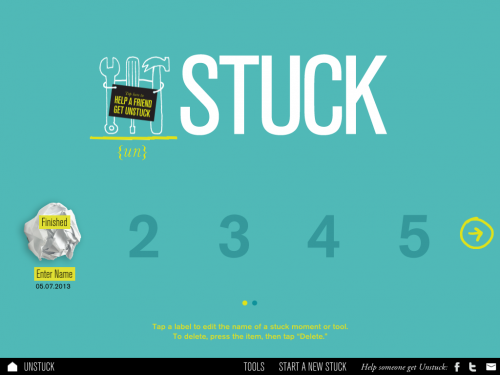
If your primary issue is being Âblocked in general, the free Unstuck App comes to the rescue with a step by step action plan for moving forward. It doesnÂt matter if your block is creative, emotional, work-related, or otherwise, this beautifully designed app will nudge you out of inertia.
Tour the Louvre Online
Step outside of your routine online, and visit a place that contains the creative juices of generations. Schedule 30 minutes with yourself, and wander around virtually, exploring the museum with no crowds moving you along. Sometimes getting away from your same-old industry blogs will get you thinking in a new direction.
Prompts
This is a very simple creative writing app that does one thing effectively–it offers hundreds of prompts and opening lines to jog your creative brain. Extra goodies are kept very minimal; there is a sharing tool, writing reminders, and habit tracking feature to discover your best days and times to write. If you have trouble staring at a blank page, this one might give you that little nudge you need. ItÂs $3.99 in the iTunes store.
What are your secret weapons for getting out of a creative block?

A negative news story or bad review — in print or online — is almost inevitably a cause for alarm in a business ownerÂs life. Bad PR, whether justified or not, can cut into a companyÂs sales volume and ultimately tip the balance from profit to loss.
Although itÂs hard not to panic when confronted with bad press, business owners should guard against that reaction at all costs.
Panic will do nothing to address the matter and could keep the company from taking timely steps to reverse or undo the damage from the negative publicity.
So, what are the steps to undertake when this situation occurs? Among them:
Evaluate Report
The first step must be a careful evaluation of the news story or online posting that is the cause for concern.
Is the report accurate? Does it make valid points about a productÂs failings? A restaurantÂs service?
Or is it a malicious — and unfounded — attack on the business? No matter what the reportÂs origins, steps can be taken to undo the damage. It may take time, however.
Although lashing out in anger may very well be the business ownerÂs knee-jerk reaction to bad press, this is almost certain to appear defensive and may only exacerbate the public relations nightmare that bad press can cause.
Although itÂs essential to cool down before responding to bad press, a timely response is essential. ItÂs unwise to let too much time elapse before making a reasoned response, preferably in the same medium in which the negative report first appeared.
Own Up to It
Hopefully, a careful analysis of the negative report has determined whether it is justified or not.
If the criticism implicit in the report is valid, then the business owner must take responsibility for the productÂs flaw and pledge to correct the problem before the product returns to the market. Owning up to a companyÂs failings and pledging to make things right tends to humanize the business and create a more favorable impression on the public.
In the event, however, the report is inaccurate, the businessÂs response should contain a calm and rational defense of the product or service in question.
If a news story is the source of the bad press, an attack on the reporter is senseless and, once again, comes off as uncomfortably defensive.
Reporters are human too and sometimes make mistakes, including failing to solicit comments from the subject of a negative story before the article is printed.
Gray Areas Exist
Not every instance of bad press can be subjected to a definitive analysis of right or wrong.
A restaurant review that suggests bad service or under-cooked food on the night the restaurant critic visited is virtually impossible to refute.
In a case such as that, the restaurant owner is probably best served by acknowledging that lapses in service and quality occasionally occur and by promising to do everything possible to avoid them in the future. Getting into a war of words with a restaurant critic only tends to call greater attention to the original negative review.
To help bolster a businessÂs ability to withstand negative publicity, business owners should work tirelessly to strengthen the power of their brands.
If the brand of a product or service strikes a strong positive vibe in the minds of consumers, it is better able to survive an instance — or prolonged assault — of bad press.
Solid Brands Weather Storms
Toyota, Ford, Tylenol, and countless others have been subjected to long-running struggles with negative publicity, some of it justified and some not, but so powerful were those brands that they emerged pretty much intact, if a bit battered.
It is, of course, unrealistic to expect small business owners that operate locally or regionally to attain a brand recognition comparable to these multinational giants. But consistent product and service excellence can establish a strong brand, if only in a somewhat smaller marketplace.
And a strong brand helps a company to survive negative publicity with little, if any, lasting damage.
Photo credit: zdnet.com
About the Author: Jay Fremont is a freelance author who has written extensively about personal finance, corporate strategy, and Amerisave.
If you follow the branding convention adopted by most large companies, youÂd note a uniform application of key branding elements, such as logo, slogan and trademarks across all their corporate websites. Big business also optimizes all forms of online interaction, be they blog, social media profiles or corporate portals. To optimize your website, you also can implement tactics that larger players use, provided you adopt a few essential tips and perform multivariate testing thoroughly.
In multivariate testing, you select specific attributes of your website and test them simultaneously. This technique is also called Âmulti-variable testing or Âmulti-variable assessment, and the variables here refer to the websiteÂs attributes. These include user-friendliness, design, layout, compatibility with smart phones, and browsing requirementsÂsay, browser type and security level, depending on the page a user is reading. Unlike multivariate testing, A/B testing only focuses on two operational scenarios and assesses a single attribute.
Also known as portal enhancement, website optimization covers the mishmash of thingsÂsay, esthetic, programming and securityÂthat a company does to elevate the stature of its website in search engine rankings, increase conversion rates and generate cash in the long term. To perform website optimization, adopt a tactic that fits your budget and operational model. You either do it yourself or use online tools to help you convert traffic to online sales. You also can hire an SEO specialist to analyze your content and search ranks, track conversion rates, and rummage in the websiteÂs data to understand whatÂs going on from an optimization standpoint.
To run an effective multivariate test, you should understand not only the fundamentals of the test but also things like usage requirements and testing steps.
You typically would need multivariate testing if you operate a highly trafficked, complex website with stringent coding requirements and security layers. This type of testing is also suitable if you want to improve the Âlook and feel of the portal, an element that becomes as important as ever for a site that experiences heaving readership on a daily basis. For a modest-traffic portal, such as blog or personal website, I recommend A/B testing instead.
Follow these steps to run an effective and efficient multivariate test, but remember again that you can use online tools or hire an expert if you run a complex operation or simply need to have a specialist coordinate the assessment.
Believe it or not, your website says a lot about your company, how seriously you take online commerce, and the operational importance you ascribe to the comfort of readers, shoppers and your existing customers. So adopt effective measures to optimize your corporate portal. In a digital era in which the first impression invariably counts, it is in your companyÂs economic interests to design and deploy an attractive yet informative website. Multivariate testing can help in this process, but make sure you do your homework in advance, apply specific steps, and glean relevant information from specialized portals.
Some creative process went into the making of this.